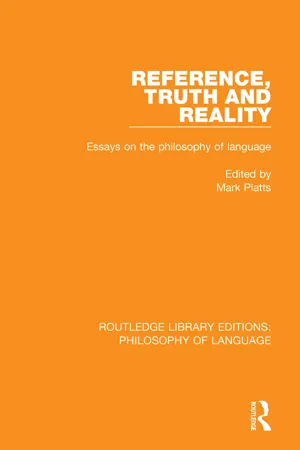
The papers in this collection discuss the central questions about the connections between language, reality and human understanding. The complex relations between accounts of meaning and facts about ordinary speakers' understanding of their language are examined so as to illuminate the philosophical character of the connections between language and reality. The collection as a whole is a thematically unified treatment of some of the most central questions within contemporary philosophy of language.
- 354 pages
- English
- ePUB (mobile friendly)
- Available on iOS & Android
eBook - ePub
About this book
Information
1 Introduction
That the meaning of a sentence can be given by stating its truth-conditions is not a novel doctrine; as an explicitly held doctrine, it is at least as old as the work of Frege. Of late, however, it has been an object of renewed interest among philosophers of language and logic. An evident stimulus to this interest has been the work of Donald Davidson. Davidson’s main contributions to date have been, schematically, of three kinds: to have emphasized the import for the understanding of the truth-conditions doctrine of Tarski’s seminal work upon the concept of truth in formalized languages; to have initiated exploration of the ways in which Tarski’s approach might be adapted to figure in the empirical construction of theories of meaning for natural languages; and to have put forward specific truth-theoretic proposals for handling various natural language constructions of logical, or more general philosophical, importance.
There has also been another, more recently influential, source of interest in the truth-theoretic conception of meaning, stemming primarily from the work of Michael Dummett. This focuses upon the metaphysical content which apparently is built into Davidson’s account (as well as others’ accounts) of the truth-conditions theory of meaning, a content reasonably labelled realistic. Specifically, Dummett has raised a worry as to whether the picture of the relation between language and the world apparently involved in the truth-theoretic account of meaning can mesh adequately with speakers’ understanding, manifestable understanding, of their language.
This volume is a collection of papers, most published here for the first time, directed to issues raised by (though not only statable in terms of) the realistic truth-theoretic conception of meaning. They might be called working papers, since few, if any, of the contributors would think of themselves as having settled the issues they discuss; the hope, rather, is to have advanced understanding of the forms of the issues and of their possible solutions, to have settled a little of the blinding dust that has come to surround them. This introduction is no more than a sketch of one framework in which the contributions might be seen – although not necessarily the framework in which the contributors themselves would wish their efforts to be seen.
The point and form of a theory of meaning
What is the aim of a theory of meaning? And what form, if any, does that aim either impose upon or invite for such a theory?
A theory of meaning for a language should be able to tell us the meanings of the words and sentences which comprise that language. The appearance of anodyne progress here is perhaps misleading since the notion of the meaning of a word or sentence is in part given content by the idea that it is the subject matter of a theory of meaning, and the proper conception of this is what we are trying to crystallize.
Still, resisting immediate immersion in this circle, we might begin by taking over from Frege the thought that it is the sentence, not the word, that is the primary unit of linguistic meaning; for it is the sentence, not the word, that can be used to perform complete linguistic actions, and it is the linguistic actions of speakers of a given language which constitute our starting-point in the construction of a theory of meaning for that language. The meaning of a word is then seen simply as its systematic contribution to the meanings of sentences in which it can figure.
That rationale for treating the sentence as primary, however, serves to remind that talk of the meanings of linguistic expressions is a theoretical abstraction from the data of linguistic usage. The character of a theory of meaning for a language, and so the specific account to be given of the notion of the meaning of some expression in that language, is constrained by the role of that theory in understanding the linguistic behaviour of speakers of that language. (This point about the inevitably theoretical character of any worthwhile analysis of the notion of meaning is distinct from that made two paragraphs back about the theoretical character of that notion itself.) So we are naturally led to ask: what is involved in understanding linguistic behaviour?
Suppose a native speaker of some alien tongue emits a string of noises; and suppose further – the point at which relevant theory first enters – that we take that native to be performing some intentional linguistic action. What we have to do is to make sense of that action as part of making sense of that speaker; and what that involves is redescribing that action, if possible, in such a way as to make that action, that performance, intelligible to ourselves in view of all we know and believe about the speaker.
Such a redescription will issue from an overall theory of linguistic behaviour, one component of which – the theory of force for the linguistic community under study – will have at least the following structure. There will be a speech-act component which (tentatively) identifies the mode of utterance – asserting, commanding, questioning, etc. There will be a syntactic component which serves to identify (tentatively) the sentences uttered and their grammatical moods – indicative, imperative, interrogative, etc. And there will be what we might call a monistic transformational component, which pairs the sentence uttered, whatever its mood, with some sentence of the language under study of some one mood, that mood being antecedently fixed for all sentences that could be uttered. If the sentence uttered by the native is of this antecedently fixed mood, this transformational component will presumably operate as an identity function.
The idea behind this third, monistic transformational, component of the theory of force is this. Within the theory of meaning (which has yet to enter the scene but which will soon do so) there must be, in Dummett’s terminology, some one key concept which has application in the derivation of the meaning of each and every sentence in the language – the doctrine of semantic monism. For only in this way will uniform word-definitions be possible. Any word can occur in any grammatical type of sentence – indicative, imperative, etc.; the meaning of a word is its systematic contribution to the meanings of sentences in which it can figure; but if one semantic concept figured in the derivations of the meanings of, say, indicative sentences while another, distinct, concept figured in the derivations of the meanings of, say, imperative sentences, then every word would require at least two dictionary entries – one to account for its contribution to the meanings of those indicative sentences in which it can figure, another to account for its, ex hypothesi, different (because different kind of) contribution to the meanings of those imperative sentences in which it can figure. But uniform word meanings can be given, so there must be one key concept which figures in the derivation of the meaning of any sentence, whatever its mood, the thesis of semantic monism. The rationale behind the third component of the theory of force, the monistic transformational component, is that it clears the ground for the application of the key concept within the theory of meaning. (Which is not yet to argue that this is the only way in which the need for semantic monism can be accommodated.)
Nearly all theories of meaning have concentrated upon the indicative mood (and the assertoric mode), suggesting that that should be the antecedently fixed mood of the output of the monistic transformational component. A minimal rationale for this is found by considering, first, the syntactic and semantic completeness of the indicative as compared with the imperative (e.g. the lack of tense in the imperative mood) and, second, the communicative completeness of the indicative as compared with the interrogative (e.g. the oddity of a language with resources primarily suited only to the asking of questions with none primarily suited to answering them1). Many philosophers have entertained stronger theses about the primacy of either the indicative mood or the assertoric mode. No case for such a thesis has yet been made good with clear sense attached to the notion of primacy in view of the seemingly obvious possibility that the only linguistic actions performed within a given linguistic community might be, say, commands or might be performed using only imperative sentences. (A quite distinct, and far more plausible, primacy thesis is that of belief over, say, desires and uncertainties.) Still, perhaps tradition and the minimal rationale together give us sufficient reason for expecting the indicative mood to be the output of the monistic transformational component of the theory of force.
The theory of meaning or sense now enters the picture.2 (I do not mean to suggest that we could have all the pre-theory-of-meaning elements fixed before we go on to construct a theory of meaning; the ordered separation of the components of the theory of linguistic behaviour in this exposition does not reflect any clear epistemological ordering.) The native speaker’s emission of noise, tentatively identified as an intentional linguistic action, has also now been tentatively identified by the speech-act component of the theory of force as an utterance in a specific mode; the mood (or moods) of the sentence (or sentences) uttered has (or have) been tentatively identified by the syntactic component of the theory of force; and the monistic transformational component of that theory has, tentatively, been made to yield for each sentence of the native language uttered a paired sentence of that same language in the indicative mood. This yield is the input to the theory of meaning, a theory whose output is for each input sentence a sentence of our own language which interprets, purports to give the meaning of, that input sentence.
The end result of applying such an overall theory of linguistic behaviour, the combined theories of force and meaning, is a redescription of the original performance by the native speaker; we can move from a description of the form ‘He uttered the noises …’ to one like, say, ‘He asserted that it was raining’, ‘He ordered us to make it true that the door is shut’, and so on.
Thus the role of the theory of meaning within a theory of linguistic behaviour is given. But nothing has yet been said about when that overall theory is a good theory; so nothing has yet been said about when the component theory of meaning is acceptable. To fill this lacuna we now have to introduce the connection – or, better, the diverse and complex connections – between the redescriptions of linguistic actions delivered by the theory of linguistic behaviour and the propositional attitudes ascribed to speakers. Centrally, on the basis of someone’s asserting that p we can generally take it that he believes that p and that he intended to say that p; on the basis of someone’s commanding that q we can generally take it that he desires that q and that he intended to order that q; and so on. (This is, of course, far too simple a picture of the connections: irony, sarcasm, deceit, insincerity, metaphor and conversational implicatures all complicate the picture, as do the ways in which propositional attitude ascriptions themselves connect – for example, the ways in which belief-ascriptions are tacit in most, if not all, desire-ascriptions. This is one area desperately in need of detailed, non-simplistic exploration.)
Such propositional attitude-ascriptions, together with the view that the native has then and there expressed such and such an attitude, can be plausible or implausible in countless ways in the light of all else we believe about the speaker. But the general point is simply stated: it can be no part of understanding a speaker’s linguistic actions, and so no part of understanding the speaker himself, to attribute to that speaker propositional attitudes which it is unintelligible that he should have, or to attribute to him expressions of propositional attitudes which it is unintelligible that he should have issued – unintelligible, that is, in the light of all we believe about the speaker’s circumstances.
The aim thus becomes that of finding a theory of linguistic behaviour which, in the light of all we believe about the speaker, issues, for each of his linguistic actions, in plausible propositional attitude-ascriptions to him, and which makes his having expressed those attitudes in his actions in the contexts in which those actions were in fact performed intelligible. To this end, any part of the theory of linguistic behaviour can be modified, even, if need be, back to the point of denying (or asserting) that some emission of noise by him was an intentional linguistic action. A theory of meaning for a language is thus seen to be an acceptable theory of meaning only if, in interaction with the other components of the theory of linguistic behaviour, it issues in plausible redescriptions of all of the linguistic actions performed by speakers of that language – plausible in view of the propositional attitudes consequently ascribed and of the propositional attitude expressions consequently attributed.3
The aim and role of the theory of meaning is thus described; but as regards the form of such a theory little progress has apparently been made. The output of the theory of meaning will be a potential interpretation in our language of each indicative sentence of the language under study. Two further lines of thought suggest a more detailed picture. One is this: the indicative sentences of any natural language being potentially infinite in number, but the sentence components (words and ‘unstructured’ phrases) being finite in number, our theory of meaning should yield an interpretation for each indicative sentence in the language under study via assignment of appropriate semantic properties to the finite stock of sentential components and modes of structural combination. A second, independent thought with much the same formal conclusion is this: the capacity of finite native speakers to understand a potential infinity of novel utterances – utterances of sentences that they ha...
Table of contents
- Cover
- Half Title
- Title Page
- Copyright Page
- Original Title Page
- Original Copyright Page
- Table of Contents
- 1 Introduction
- 2 Truth and use
- 3 Causal modalities and realism
- 4 Moral reality and the end of desire
- 5 Tarski’s theory of truth
- 6 Physicalism and primitive denotation: Field on Tarski
- 7 Reality without reference
- 8 On the sense and reference of a proper name
- 9 Truth and singular terms
- 10 Truth-theory for indexical languages
- 11 Operators, predicates and truth-theory
- 12 Quotation and saying that
- 13 What metaphors mean
- 14 Pronouns, quantifiers and relative clauses (I)
- 15 ‘Most’ and ‘all’: some comments on a familiar programme, and on the logical form of quantified sentences
- Index
Trusted by 375,005 students
Access to over 1.5 million titles for a fair monthly price.
Study more efficiently using our study tools.
Frequently asked questions
Yes, you can cancel anytime from the Subscription tab in your account settings on the Perlego website. Your subscription will stay active until the end of your current billing period. Learn how to cancel your subscription
No, books cannot be downloaded as external files, such as PDFs, for use outside of Perlego. However, you can download books within the Perlego app for offline reading on mobile or tablet. Learn how to download books offline
Perlego offers two plans: Essential and Complete
- Essential is ideal for learners and professionals who enjoy exploring a wide range of subjects. Access the Essential Library with 800,000+ trusted titles and best-sellers across business, personal growth, and the humanities. Includes unlimited reading time and Standard Read Aloud voice.
- Complete: Perfect for advanced learners and researchers needing full, unrestricted access. Unlock 1.5M+ books across hundreds of subjects, including academic and specialized titles. The Complete Plan also includes advanced features like Premium Read Aloud and Research Assistant.
We are an online textbook subscription service, where you can get access to an entire online library for less than the price of a single book per month. With over 1.5 million books across 990+ topics, we’ve got you covered! Learn about our mission
Look out for the read-aloud symbol on your next book to see if you can listen to it. The read-aloud tool reads text aloud for you, highlighting the text as it is being read. You can pause it, speed it up and slow it down. Learn more about Read Aloud
Yes! You can use the Perlego app on both iOS and Android devices to read anytime, anywhere — even offline. Perfect for commutes or when you’re on the go.
Please note we cannot support devices running on iOS 13 and Android 7 or earlier. Learn more about using the app
Please note we cannot support devices running on iOS 13 and Android 7 or earlier. Learn more about using the app
Yes, you can access Reference, Truth and Reality by Mark Platts in PDF and/or ePUB format, as well as other popular books in Philosophy & Language in Philosophy. We have over 1.5 million books available in our catalogue for you to explore.