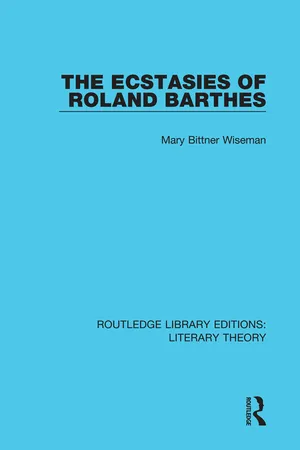
In this book, first published in 1989, Mary Bittner Wiseman interprets Roland Barthes's experiments as efforts to reposition the human subject with respect to language and to time in order to let the subject escape from the language of a particular culture and the present time. With her insistent pushing against the boundaries of our standard academic assumptions, Mary Bittner Wiseman succeeds in interpreting Barthes's effort to join the traditional and the new. This title will be of interest to students of literature and philosophy.
- 204 pages
- English
- ePUB (mobile friendly)
- Available on iOS & Android
eBook - ePub
The Ecstasies of Roland Barthes
About this book
Information
1
I Refuse to Inherit
1977
The old values are no longer transmitted, no longer circulate, no longer impress; literature is desacralized, institutions are impotent to defend and impose it as the implicit model of the human. It is not, if you like, that literature is destroyed; rather it is no longer protected, so that this is the moment to deal with it. Literary semiology is, as it were, that journey which lands us in a country free by default; angels and dragons are no longer there to defend it. Our gaze can fall, not without perversity, upon certain old and lovely things, whose signified is abstract, out of date. It is a moment at once decadent and prophetic, a moment of gentle apocalypse, a historical moment of the greatest possible pleasure. [Emphases added]1
Barthes’s Inaugural Lecture is a quiet manifesto of postmodernism in literature. What goes by the name of postmodern is an attitude toward the past, an attitude that turns on the suspicion that the distinction between past and present is dissolving even as the idea of human beings as centres of consciousness constitutive of their worlds loses its hold on our imagination. The postmodern is a certain conjunction of the classic and the modern, a conjunction between classical works and a modern conception of literature. The classical conception is what is no longer handed down from one generation to the next, and is out of date by virtue of not being part of a common inheritance. No longer in circulation, it rests in an archive, and should our glance fall upon it there we are not sliding back into the past along the line of continuous development beloved by the nineteenth century, where even what was out of date was thought to contain in germ what was present and to be therefore itself present in what was born from it, as the child is present in the man he has become. The line has broken off. Nor are we bridging a gap, drawing a dotted line to cover the gap from then to now; for this suggests that the line is virtually continuous and a collective forgetting has driven segments of it into shadow or underground. This is to deny that the line has broken off. It may seem not to matter much whether we say that some past works are deep buried but at bottom connected to the present or that they stand to present time in the same relation of strangeness as Martian or Mayan time stands to our time. But it is not perverse to slide along a line or to move within the space co-ordinate with a time, and the moment of sliding is no moment of apocalypse. What threatens doom and what goes against nature is letting our gaze fall upon those old and lovely things whose signified is abstracted from the line on which we travel back and forth between present and past, the line that connects past conceptual schemes with the present ones. The sign of (the classical conception of) literature under which the lovely things were signed as literature is out of play, the things are out of date. Between the subject and the objects of the gaze there is a rupture, a chasm.
Neither our arts nor our sciences have characters fixed or continuous through time and social and physical space. It is perhaps worth remembering that nature has ruptures in the theories that give it shape, discontinuities in its smooth working: Newtonian physics does not hold when the objects to which it is applied are moving at a speed approaching the speed of light, and deterministic laws of physics do not hold true of quanta.
Postmodernism appeared when the past lost its guardians, otherworldly angels and monstrous dragons, fabulous creatures both. Once the fables that created them lose their privilege and tumble into literature itself, what is left to protect literature? Nothing. The unprotected past is set adrift from the present, and the past’s works set adrift from the world and the time that gave them birth. The past is conjoined with the present when a viewer’s gaze falls upon the works whose signified is out of date; the conjunction is essentially unstable because the time, the language, and the world presupposed by the act of gazing are discontinuous with those presupposed by the object of the gaze and because the past object is not viewed against the backdrop of the intervening years. The object is a literature whose signified is abstracted from the values assigned it by the world from which it came. We stand to this literature empty of its original or native meaning as we do to Mayan relief sculpture, to the signs of Japan, to avant-garde literature in its first appearance. Making sense of them is not incorporating them into our present set of cultural meanings or displacing present meanings onto them. Nor is it recovering the meanings they bore during the time or in the place of their circulation. The sense we make, the meanings we assign, the effect they have on us is rather the result of the conjunction of discontinuous elements that are also incompatible: the incompatibility is cultural in the case of Maya and Japan, historical in the case of the avant-garde and the classical. In no case is the meaning immediate, given, ready-made.
Literature desacralized is literature modern in its idea of what it is, not works called modern because written after a certain date or in a certain way. The modern conception is that no literature is sacred, even though in its classical mode it had mimed or mimicked the sacred. Like the law of Moses and the life of Jesus, it took itself to serve as the implicit model of the human. How? The law was written by God in stone and the life was lived by God become man, and the more nearly one follows the law or imitates the life, the more nearly one approaches the model. Where is literature here? It gives us neither law nor model to follow in order to become perfect but does presume to give us ourselves, to represent a human nature, a nature sacred in being timeless and changeless and in being able to originate, to make something new. When in the course of the history of the ways in which literature has marked itself as literature, it marks itself as a kind of activity instead of a representation, it has become modern. Literature then models the human by exemplifying certain human activities: writing and reading. Barthes’s texts will argue that writing and a reading that is like writing, not thinking as Descartes had supposed, are the quintessential human activities and that they occur in their pure form in the writing and reading of literature.2
The postmodern conception of literature expressed by Barthes in the Inaugural Lecture conjoins classical and modern conceptions. Its invitation to think together the supposedly incompatible promises to mark out a new place, perhaps a utopia, where the postmodern is deaf to history’s cry of ‘out of date’, as the primitive is deaf to culture’s cry of ‘out of place’. The postmodern and the primitive stand in a formal relation; the former includes both classic and modern and, in so far as these are moments of the same tradition, the latter excludes both.3 This relation can be explored only after Barthes’s articulations of the opposition between classic and modern that figures centrally in Writing Degree Zero (1953), S/Z (1970), and The Pleasure of the Text (1973) have been laid out. Barthes’s first book, Writing Degree Zero, dates the birth of the modern and names its fathers in what is the tale of an ancient battle between necessity and impossibility and a hymn to the blindness of Orpheus.
1953
Writing degree zero is writing at its vanishing point: therefore, there is no such thing. The writing that vanishes at zero degree came into existence in the nineteenth century when literature became an object, and its appearance marked the birth of modern literature. The dream of a literature that captures the social, historical, material real and expresses both the truth of the world and the truth of the human beings for whom it is a world, made tragic the modern writer’s awareness that this is impossible, impossible because the forms of literature now have to be chosen. Were literature’s content timeless essences, they would dictate its form, variations in form occurring in the service of rhetoric and the intention to persuade the reader of the truth there expressed. Modernity appeared with the realisation that there were none such, however, and that henceforth the content of literature would be figured by its forms.
as soon as the writer ceased to be a witness to the universal, to become the incarnation of a tragic awareness (around 1850), his first gesture was to choose the commitment of his form, either by adopting or rejecting the writing of his past. Classical writing therefore disintegrated… This was precisely the time when Literature… was finally established as an object. Classical art could have no sense of being a language, for it was language, in other words it was transparent … It is a well-known fact that towards the end of the eighteenth century this transparency becomes clouded; literary form… acquires a weight. Literature is no longer felt as a socially privileged mode of transaction, but as a language having body and hidden depths.4
Not only do the forms have to be chosen, but so do what would count as reasons for choosing, which in turn is tied up with decisions about what literature is, what it is for, what it has to do with the society in which it appears. To choose a form is to choose a world, but in the light of the recognition that there are no essences, the writer cannot proffer his form of the world as the world’s truth. At most, he can be thought to convene a world, where literary conventions are pacts between the writer and society that announce authors’ and audiences’ shared attitudes toward arbitrarily convened worlds. But talk of shared attitudes supposes that writer and reader have clarified what the relation between literature and society is. Yet one troubling effect of the recognition that time changes all and that belief in the existence of ahistorical natures reflects no more than a wish for permanence, is precisely that this relation has become clouded. For literature, no longer transparent, can no longer be regarded simply as one way of telling a timeless truth.
Having become an object, literature becomes the object of creative action; and the marks and traces as well as the product of the writer’s effort become the object of our gaze:
The whole nineteenth century witnessed the progress of this dramatic phenomenon of concretion… Flaubert… finally established Literature as an object, through promoting literary labour to the status of a value; form became the end-product of craftsmanship, like a piece of pottery or a jewel (one must understand that craftsmanship was here made manifest, that is, it was for the first time imposed on the reader as a spectacle).5
The form is crafted and this signals a certain kind of freedom, but the requisite choice of form, that is, writing, is hardly free. It is, Barthes says, free in gesture but not in duration. It is not free in duration because even if the choice is creative, ringing a change on the direction of development implied by what went before, and the object chosen is new, as soon as the object appears it is put under a concept that is, perforce, related to the scheme of concepts inherited from tradition. The chosen object, the chosen form, recuperated by tradition, is new no longer. Moreover, it could not have been understood or seen or heard until it was recuperated. This argument against the possibility of an effectively free choice of form is based on the tenet of high historicism that even though the intelligibility of things cannot be read in their relation to reality, it can, and must, be read in their relation to history. For history’s course is ordered: the order can be apprehended, and apparently freely chosen forms are to be explained by being folded within it. Radical changes rung by a writer on what she has inherited, then, are a disruption of history’s order, a falling outside of history. But this, historicism holds, is impossible. If a work begins to fall outside, either it does fall and is lost or, claimed by history, it is saved but as part of the tradition the writer had tried not to inherit.
Barthes in 1953 accepts historicism. His announcement of a break between classic and modern, between tradition and an avante-garde, does not contradict the assertion of continuity in the course of history if a continuous line can be traced along the various individual threads the interweaving of which produces the fabric of a time. If the development along one line is not functionally related to development along another, as it is, for example, on the Hegelian hypothesis of a world spirit, then several lines may develop in such a way that closely connected at time t, they are far apart at time t+n. When strands or threads close at t are far apart at t+n, and when some strands woven in at t are out at t+n and others out at t are in at t+n, then it is a matter of conceptual decision as to whether or not we say that there is a discontinuity between the material, political, social, cultural, and intellectual fabric at t and at t+n. In 1953 Barthes argues a change so radical as to amount to a break in the history of the conception of language and literature, but he is committed to the view that if there is change there must be an underlying something that is changing: this is, of course, Aristotle’s solution to the problem of how things can change and yet stay the same that sent Parmenides and Heraclitus off in their opposite directions. The fact that both ancients and moderns are talking in utterly different ways about the same thing, literature, produces a tension that early Barthes calls tragic and later Barthes will call blissful. Barthes says of Racinean tragedy that it consists in the hero’s refusal to inherit. There is a theoretical twist to the refusal to inherit that paves the way to postmodernism: it is the rejection of one of the defining characteristics of modernism, namely, historicism, which insists on the necessity of inheriting.
In accepting historicism, Writing Degree Zero accepts its corollary, that there is no freedom in the legal order of time. There is, therefore, at best freedom in gesture, but even this is narrowly circumscribed. If there are in place at the time of the writing some literary forms or other, and there always are because the writer does not invent literature, then the writer must take some attitude toward their status, rather as the geometer has to take some attitude toward the status of Euclidean geometry since the appearance of the self-consistent and equally powerful geometries of Lobachevsky and Reimann, each of which contradicts one of Euclid’s axioms. The geometer can no longer suppose out of hand that Euclid decribes the space of our world without concluding that the other two systems are false, and there is no good reason, independent of the desire to hold Euclid true, to do this. Similarly, independent of the desire to hold that literature speaks a single and a timeless truth, there is no adequate reason to suppose that literature is what in the past it had claimed to be. The modern writer in choosing how to write must position herself with respect to the literary forms in place, and her choice necessarily occurs against the background of the received beliefs about what literature is and about the validity of its claims to truth. The only alternatives are to accept or to reject tradition’s forms, where acceptance is not the decision ahistorically to repeat the most recent tradition but rather the willingness to assist in the delivery of whatever time is birthing, and rejection is either exile from literature altogether or the decision to change it: to change its form, that is, the idea of it, as well as its forms.
For a century now, every mode of writing has thus been an exercise in reconciliation with, or aversion from, that objectified Form inevitably met by the writer on his way, and which he must scrutinize, challenge and accept with a...
Table of contents
- Cover
- Half Title
- Title
- Copyright
- Original Title
- Original Copyright
- Dedication
- Contents
- Preface
- Introduction
- Part One
- Part Two
- Part Three
- Coda
- Bibliography
- Index
Trusted by 375,005 students
Access to over 1.5 million titles for a fair monthly price.
Study more efficiently using our study tools.
Frequently asked questions
Yes, you can cancel anytime from the Subscription tab in your account settings on the Perlego website. Your subscription will stay active until the end of your current billing period. Learn how to cancel your subscription
No, books cannot be downloaded as external files, such as PDFs, for use outside of Perlego. However, you can download books within the Perlego app for offline reading on mobile or tablet. Learn how to download books offline
Perlego offers two plans: Essential and Complete
- Essential is ideal for learners and professionals who enjoy exploring a wide range of subjects. Access the Essential Library with 800,000+ trusted titles and best-sellers across business, personal growth, and the humanities. Includes unlimited reading time and Standard Read Aloud voice.
- Complete: Perfect for advanced learners and researchers needing full, unrestricted access. Unlock 1.5M+ books across hundreds of subjects, including academic and specialized titles. The Complete Plan also includes advanced features like Premium Read Aloud and Research Assistant.
We are an online textbook subscription service, where you can get access to an entire online library for less than the price of a single book per month. With over 1.5 million books across 990+ topics, we’ve got you covered! Learn about our mission
Look out for the read-aloud symbol on your next book to see if you can listen to it. The read-aloud tool reads text aloud for you, highlighting the text as it is being read. You can pause it, speed it up and slow it down. Learn more about Read Aloud
Yes! You can use the Perlego app on both iOS and Android devices to read anytime, anywhere — even offline. Perfect for commutes or when you’re on the go.
Please note we cannot support devices running on iOS 13 and Android 7 or earlier. Learn more about using the app
Please note we cannot support devices running on iOS 13 and Android 7 or earlier. Learn more about using the app
Yes, you can access The Ecstasies of Roland Barthes by Mary Bittner Wiseman in PDF and/or ePUB format, as well as other popular books in Literature & Literary Criticism. We have over 1.5 million books available in our catalogue for you to explore.