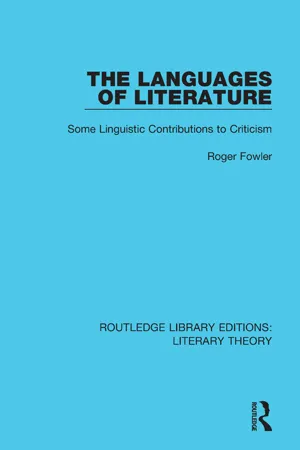
In The Language of Literature, first published in 1971, Roger Fowler argues that the vitality and centrality of the verbal dimension of literature, and, read as a whole, the papers in this collection imply a consistent point of view on language in literature. The author focuses on the continuity of language in literature with language outside literature, on its cultural appropriateness and adjustment, and on its power to create aesthetic patterns and to organise concepts, to make fictions. This title will be of interest to students of literary theory.
- 256 pages
- English
- ePUB (mobile friendly)
- Available on iOS & Android
eBook - ePub
About this book
Information
Ten
What is metrical analysis?
The verse situation is extremely complex; moreover, it is not one, but several situations: for example, reading a poem aloud; listening to a poem being read aloud; reading a poem silently.1 If we ask questions about it (such as the one which gives this article its title) we must realize that there are several very different questions which can be asked. A criticism of existing metrical theory is that most writers on the subject have thought that one question and one answer (various to each) are all they need consider. Most solutions to ‘the problem of metrics’ are unsatisfactory because of this limitation and simplification. This is not the whole reason why metrics has such a low value in literary studies, but it is a good part of it.
The first motive of the new linguistic metrics,2 the desire to approach verse with the aid of a knowledge of the workings of living language (where ‘stress’ is astonishingly more subtle than the ‘stress- or-not-stress’ of traditional metrics), was a reaction against the linguistic unreality of the Saintsbury school. It was good to be reminded that verse is language as well as stylized pattern. But the orthodoxy demanded by the Trager-Smith metrists, the formalization of the line always in terms of the complete suprasegmental array, took away the simple pattern, or at least our means for understanding this pattern, this ‘abstract metre’. By isolating one function of metrical analysis, other functions were ignored. Not unnaturally, Trager-Smith metrics has lost its excitement.3 It is difficult today to understand what the 1956 Kenyon Review pioneers intended: what question they were asking, and what their answer was, in the total set of answers that are proper to questions in metrics.
Some of the questions which must be distinguished in a theory of metre are these: When we refer a poem to a verse tradition, what kind of generalization are we invoking and what, in the poem, is the nature of the evidence which allows the attribution? When a practiced reader of poetry reads a poem silently or listens to an oral reading, what is the nature of his experience? What features of the language of a line tell us how to scan it? What is there in the arrangements of different words which causes one line to differ texturally from another, although they are ‘metrically’ the same? How do we describe consistent textural difference of one poet/poem from another within the same verse design? In what depth of detail does the language of a line dictate its oral reading? How does a poem establish for oral interpreters a permissible range of styles of delivery?
This article suggests a range of related answers to the questions posed in its title, setting up levels for analysis with reference to both a scheme for understanding verse situations and a consideration of practical purposes in describing verse. The specific motive is dissatisfaction with two positions. The phonemic analysis of oral performances must be disqualified because it does not proceed from best evidence, the language as more or less neutrally represented in a written text: this approach, in its simplest and most straightforwardly descriptive form, is only a little closer to metrical reality than pure phonetic methods such as those of E. W. Scripture.4 The dangers of ignoring primitive ictic pattern, of being misled by irrelevant or at least disputable performance features, and of not taking into account the perceptual factor, are obvious. On the other hand, Chatman’s current reduction of metrical analysis to a statement of ictic patterning, though a deliberate restriction and understandable within his own terms of reference, give less information about metre than is often necessary. We need to specify line-structure in detail in order to distinguish poems and poets within the same metrical scheme. Individual poets achieve distinctive ‘textures’ through their manipulation of language within a chosen metre, and such texture is not captured by an analysis which reveals only which syllables are metrically stressed. A poem full of multisyllabic words (for example) is quite different from one which largely utilizes monosyllables and disyllables, different in ways which go beyond the selection of diction. There is, I would claim, a metrical difference, because there is an inevitable phonological difference; moreover, this part of metrics (if established) is of particular critical interest since here metrical form is more closely intimate with other ‘poetic’ details of the language than are the framing patterns of ictus and non-ictus.
The most useful exposition of metrical levels comes from Roman Jakobson:5
Far from being an abstract, theoretical scheme, meter—or in more explicit terms, verse design—underlies the structure of any single line—or, in logical terminology, any single verse instance. Design and instance are correlative concepts. The verse design determines the invariant features of the verse instances and sets up the limits of variations …
The verse design is embodied in verse instances. Usually the free variation of these instances is denoted by the somewhat equivocal label ‘rhythm’. A variation of verse instances within a given poem must be strictly distinguished from the variable delivery instances. The intention ‘to describe the verse line as it is actually performed’ is of lesser use for the synchronic and historical analysis of poetry than it is for the study of its recitation in the present and the past …
How the given verse-instance is implemented in the given delivery instance depends on the delivery design of the reciter; he may cling to a scanning style or tend toward prose-like prosody or freely oscillate between these two poles. We must be on guard against simplistic binarism which reduces two couples into one single opposition either by suppressing the cardinal distinction between verse design and verse instance (as well as between delivery design and delivery instance) or by an erroneous identification of delivery instance and delivery design with the verse instance and verse design.
These are distinct and necessary components of metre from its inception by a poet to its realization by a reader. Briefly, the verse design of a poem is its place in the formally defined set of kinds which make up a poetic literature; verse instance is a particular segment of a poem seen as different from comparable segments within the same verse design; delivery design is a chosen style of recitation; delivery instance is a recitation. To these we add verse type, in which a poem is identified by reference to the phonological features used in its metre (e.g. stress as opposed to length); metrical set, the psychological reflex of verse design, the disposition of a reader, variable according to his experience and to the metrical regularity of the poem in question, to impose a certain reading on it.
These levels of manifestation of metre are chiefly (but not wholly) derived from a level which must be presumed to exist independently of them: ‘the language of the poem’. Verse is language with additional formal constraints; it is nevertheless language and embodies not only the formal restrictions of metre, but also characteristics which are necessary to the syntax and vocabulary of the occurring sentences whether or not the sentences are contrived to make a poem. Moreover, these are features which do not always co-operate with the metre-fixing qualities. One could regard the language as doing more than is strictly necessary to realize the verse design, manifesting verse design more or less complexly, neutrally, or efficiently. It is relevant to enquire what part of the linguistic structure of the text is ‘active’ in this way: a vague concept such as ‘the language of the line’ is inadequate. The language of a text, as it figures in a linguistic description, has three components: syntactic, semantic, and phonological.6 The syntactic component enumerates sentences each of which has a deep structure and a surface structure.7 The deep structure does not concern us, since it is not directly related to the overt form of a text—it is the point at which the lexical formatives (with their semantic features) and categorial relations are introduced, and many transformational and phonological operations intervene before a deep structure ‘becomes’ a well-formed sentence. Surface structure in the syntactic component contains the following information:
(a) identification of lexical formatives according to their phonological composition;
(b) specification of junctures, i.e. directions on how the formatives are to be concatenated;
(c) segmentation into grammatical phrases (e.g. grammatical phrases but not on how the);
(d) functional characterization of the types of phrases involved – noun, verb, etc.
(Chomsky: ‘the surface structure of a sentence is a properly labelled bracketing of a classificatory matrix of formatives and junctures’.)8 Given this information, the phonological component assigns a phonetic contour to a surface structure: if we have this information we know what the sentence sounds like.9 We need no information about deep structure: for example, although we need to know the nature of the juxtaposition grammatical phrases in surface structure, we do not need to know that this construction presupposes a deep structure which would be represented as the phrases are grammatical; nor do we need to know anything about the ‘meaning’ of grammatical or phrase or -s.
A verse design may be fulfilled by a certain phonetic contour, a configuration of stresses, pitch tunes, sound qualities, linearly patterned and dependent on surface structure. If the surface structure of a poem can be determined, the metre can be stated, without reference to an ‘oral rendition’ or a ‘written text’ but relying on the linguistic form which underlies both of these representations of a poem.
Verse type10
The first division necessary to metrics is that between verse and non-verse. Verse is measured language. It has defining regularities of patterning additional to those demanded by linguistic structure as a matter of course. In theory, any feature of a langua...
Table of contents
- Cover
- Half Title
- Title Page
- Copyright Page
- Original Title Page
- Original Copyright Page
- Table of Contents
- Preface
- Sources and acknowledgments
- Note on the next
- One Introduction
- Two Linguistics, stylistics; criticism?
- Three Literature and linguistics
- Four Literature and linguistics: reply by F. W. Bateson
- Five Language and literature
- Six Language and literature: reply by F. W. Bateson
- Seven The structure of criticism and the languages of poetry
- Eight Criticism and the language of literature: some traditions and trends in Great Britain
- Nine Structural metrics
- Ten What is metrical analysis?
- Eleven The Rhythm of Beowulf—a review
- Twelve Three blank verse textures
- Thirteen Some stylistic features of the Sermo Lupi
- Fourteen Linguistics and the analysis of poetry
- Fifteen On the interpretation of ‘nonsense strings’
- Further reading
- Index of names
Trusted by 375,005 students
Access to over 1.5 million titles for a fair monthly price.
Study more efficiently using our study tools.
Frequently asked questions
Yes, you can cancel anytime from the Subscription tab in your account settings on the Perlego website. Your subscription will stay active until the end of your current billing period. Learn how to cancel your subscription
No, books cannot be downloaded as external files, such as PDFs, for use outside of Perlego. However, you can download books within the Perlego app for offline reading on mobile or tablet. Learn how to download books offline
Perlego offers two plans: Essential and Complete
- Essential is ideal for learners and professionals who enjoy exploring a wide range of subjects. Access the Essential Library with 800,000+ trusted titles and best-sellers across business, personal growth, and the humanities. Includes unlimited reading time and Standard Read Aloud voice.
- Complete: Perfect for advanced learners and researchers needing full, unrestricted access. Unlock 1.5M+ books across hundreds of subjects, including academic and specialized titles. The Complete Plan also includes advanced features like Premium Read Aloud and Research Assistant.
We are an online textbook subscription service, where you can get access to an entire online library for less than the price of a single book per month. With over 1.5 million books across 990+ topics, we’ve got you covered! Learn about our mission
Look out for the read-aloud symbol on your next book to see if you can listen to it. The read-aloud tool reads text aloud for you, highlighting the text as it is being read. You can pause it, speed it up and slow it down. Learn more about Read Aloud
Yes! You can use the Perlego app on both iOS and Android devices to read anytime, anywhere — even offline. Perfect for commutes or when you’re on the go.
Please note we cannot support devices running on iOS 13 and Android 7 or earlier. Learn more about using the app
Please note we cannot support devices running on iOS 13 and Android 7 or earlier. Learn more about using the app
Yes, you can access The Languages of Literature by Roger Fowler in PDF and/or ePUB format, as well as other popular books in Languages & Linguistics & Linguistics. We have over 1.5 million books available in our catalogue for you to explore.