- 90 pages
- English
- ePUB (mobile friendly)
- Available on iOS & Android
eBook - ePub
About this book
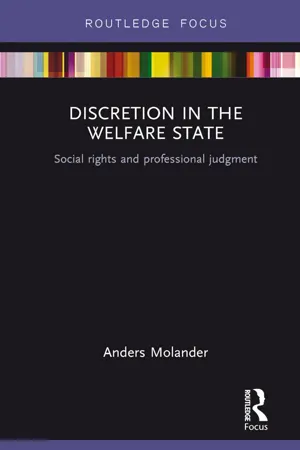
Welfare state professionals decide or establish premises as to whom will receive what, in what manner, when and how much, and when enough is enough. They control who passes through the gates of the welfare state. This book provides an in-depth understanding of the phenomenon of discretion. It shows why the delegation of discretionary powers to professionals in the front-line of the welfare state is both unavoidable and problematic. Extensive use of discretion can threaten the principles of the rule of law and relinquish democratic control over the implementation of laws and policies. The book introduces an understanding of discretion that adds an epistemic dimension (discretion as a mode of reasoning) to the common structural understanding of discretion (an area of judgment and decision). Accordingly, it distinguishes between structural and epistemic measures of accountability. The aim of the former is to constrain discretionary spaces or the behavior within them while the aim of the latter is to improve the quality of discretionary reasoning. This text will be of key interest to scholars and students in the fields of applied philosophy, public policy and public administration, welfare state research, and the sociology of professions.
Information
1 Discretion and its critics
The origin of the English word discretion is the Latin word discretus, a form of the verb discernere, which means to separate, discern, or distinguish. In Leviathan (1651), Thomas Hobbes made an inventory of different intellectual virtues, with discretion being one of them. Discretion, he stated, involves “Distinguishing and Discerning, and Judging between Thing and Thing,” especially in cases where “such Discerning is not easie.”1 To distinguish between “Thing and Thing” is to judge according to some standard: one claims that some object has or does not have a certain property or set of properties. In this sense, one can make judgments, for instance, about objects like utterances, actions, states, or products. A judgment can involve a claim that an utterance is “true” or “authentic,” that an action is “efficacious” or “right,” that a state is “normal,” “desirable,” or “just,” or that a product is “good” (like a good knife) or “beautiful.” Judgments distinguish true from false and authentic from inauthentic utterances; right from wrong and efficacious from nonefficacious actions; normal from abnormal, desirable from undesirable, and just from unjust states; and good from bad and beautiful from ugly products. However, as Hobbes noted, making such distinctions is not always easy. Here is a short list of reasons (ours, not those of Hobbes) of why it may be difficult:
- 1 Identity of the “objects” (or “things”). It is often not clear what the “object” of assessment is. The object can both be very complex and have fuzzy boundaries. For instance, when assessing an action’s efficaciousness, one has to assess its consequences in relation to the intended aim or the agent’s goal. However, an action’s consequences can conflict and may have to be balanced against each other. All actions also have unintended and/or unrecognized side effects. Moreover, some effects are short term, and others are long term; some are proximal, and others are distal. Therefore, one must sort out the relevant consequences. However, sorting out these consequences is not always easy and may arouse controversy. All this may make it difficult to judge whether an action has been efficacious for the simple reason that it is not clear where the boundaries of the object are. In a situation like this, it is not obvious what one actually wants to assess, how the “object” should be focused, and how it should be distinguished from other objects.
- 2 Identity of the properties. There often exists a lack of clear identification criteria for the properties that one is to ascribe (or to abstain from ascribing) to objects. For example, medical diagnostics lack unambiguous descriptions of many diseases (however, there are also, of course, clear descriptions of many diseases). Different diagnostic manuals contain different lists of symptoms, which often match only partially and incompletely – or not at all. Hence, observed symptoms can be difficult to subsume under existing diagnostic labels for the simple reason that it is not evident what existing diagnostic labels include and exclude. This difficulty is rampant in psychiatry. It may also be a problem in criminal justice. The way in which some crimes are described does not always make it clear what can and what cannot be subsumed under the various labels.
- 3 Identity of the standards. Standards used in assessments must be interpreted so as to obtain a hold on reality. For instance, what does it mean that something is normal? Is it something that is healthy in contrast to something that is pathological? Is it a statistical mean value, for example, the mean height or weight in a population? Does it mean something that no one notices because it is so entrenched in the trivialities of everyday life? Often several senses of normal can be relevant simultaneously. The same goes for standards such as justice and, of course, beauty. Standards must be interpreted so as to obtain a hold on reality, but interpretations often differ.
- 4 Relevance. It can be, and often is, unclear which standards are relevant in a particular case. Relevance itself is a very fuzzy concept, and the question of relevance is always connected to some goal or target of action. For instance, if one patient demands more nursing and care than other patients, which standard is relevant to assess this patient’s claims? Should equal treatment with other patients be the right standard? If this is the relevant standard, one cannot give undue weight to one single patient’s particular needs or claims. This patient’s needs and claims must then always be balanced against the needs and claims of others. Or is the individualization of care and nursing the relevant standard here? Should this particular patient’s needs and claims be satisfied without comparing them to the needs and claims of others? Is there a sense in which one should be given one’s due, without regard for the needs and claims of others at all? How should one select the relevant standard in such a situation?
These four issues illustrate why discretion is an “intellectual virtue,” as Hobbes described it: discretion is required when “discerning is not easy.” In addition to listing discretion as an intellectual virtue, Hobbes linked discretion to civil liberty, stating that “[i]n cases where the sovereign hath prescribed no rule, then the subject hath the liberty to do, or forbear, according to his own discretion.”2 In this sense, discretion involves possessing a negative liberty.3 A negative liberty provides the actor with an area for choice and action consisting of those options that are neither forbidden nor prescribed.4 The actor can freely choose between such alternatives without interference from others. An individual’s negative liberty corresponds to the duty of others not to interfere with this individual’s exercise of it. To have discretion in this sense is then to possess a restricted and protected space, where a certain kind of liberty to judge, decide, and act is granted.
This latter sense of discretion corresponds well with common contemporary definitions. In Discretionary Powers, legal scholar D. J. Galligan states, “To have discretion is, then, in its broadest sense, to have a sphere of autonomy within which one’s decisions are in some degree a matter of personal judgment and assessment.”5 In a narrower sense, discretion does not designate the autonomy of legal subjects per se, but rather a power
delegated within a system of authority to officials or a set of officials, where they have some significant scope for settling the reasons and standards according to which that power is to be exercised, and for applying them in the making of specific decisions.6
According to Aharon Barak, discretion is the power “given to a person with authority to choose between two or more alternatives, when each of the alternatives is lawful.”7 Jeffrey Jowell defines it as “the room for decisional manoeuvre possessed by a decision-maker.”8 In his influential book Discretionary Justice, Kenneth C. Davis states, “A public officer has discretion whenever the effective limits on this power leave him free to make a choice among possible courses of action or inaction.”9 In a discussion on discretion in the welfare state, Robert Goodin defines it as “an area of conduct which is generally governed by rules but where the dictates of the rules are indeterminate. In short, discretion refers, negatively, to a lacuna in a system of rules.”10 In the same vein, Keith Hawkins says that discretion “might be regarded as the space, as it were, between legal rules in which legal actors may exercise choice.”11 Several other definitions, all pointing in the same direction, could be quoted here. A common element of these definitions is the “embedded character of discretion.”12 This is well expressed in Ronald Dworkin’s famous doughnut metaphor. Discretion, he says, is like “the hole in a doughnut, it does not exist except as an area left open by a surrounding belt of restriction.”13 To have discretion is to have an authority to decide in cases where rules and standards do not prescribe determinate results.
With Hobbes as our point of departure, we have identified two main ways of understanding discretion. In Robert Alexy’s terms, we have distinguished between discretion in an epistemic sense and a structural sense.14 Epistemically, discretion is a form of reasoning that results in judgments about the properties of various kinds of objects under conditions of indeterminacy or, according to Hobbes, where discerning is not easy. Indeterminacy means that the available reasons do not warrant one and only one outcome; hence, one must make use of one’s own judgment to draw conclusions rather than relying on an algorithm.15 This does not mean that any conclusion is possible. For example, the notion of a “hard case” in law denotes a case where the judge has to choose from among legally acceptable conclusions. Thus, indeterminacy has to be considered a gradual phenomenon, where full determinacy (i.e., there is only one possible outcome) and full indeterminacy (i.e., all possible outcomes are equally acceptable) mark the hypothetical end points of a continuum. When the subset of acceptable outcomes is not identical with all possible outcomes, one may describe this as a case of underdeterminacy.16 Structurally, discretion is a space for decision-making and action-taking on the basis of discretionary judgments. To have discretion means to have a certain liberty or autonomy. To obtain a proper grasp of discretion and its challenges, one needs both the epistemic notion of discretionary reasoning and the structural notion of a discretionary space. We shall return to the analysis of discretion in the next chapter, but will first have a look at the standard arguments in favor of discretion as well as the concerns it has raised.17
Justifying discretion
At least four different arguments for discretion can be distinguished. Some of these arguments are related to one another, but they are, nevertheless, distinct. In many accounts of discretion, several of these arguments are mixed, in one form or another. However, giving each of them a separate treatment can provide greater clarification. We do not intend to provide a historical account of how discretion has been justified. Our survey of the four ways of justifying discretion serves analytical, not historical, purposes.18
One way of justifying discretion dates back to Aristotle’s discussion of legal justice in The Nicomachean Ethics. Aristotle’s argument is based on a logical point about the relations between general statements and particular cases. According to Aristotle, “all law is universal, and there are some things about which it is not possible to pronounce rightly in general terms.” When a law errs owing to its generality (i.e., it does not cover a case), Aristotle states that
it is right … to correct the omissi...
Table of contents
- Cover
- Title
- Copyright
- Dedication
- Contents
- Preface
- Introduction
- 1 Discretion and its critics
- 2 The anatomy of discretion
- 3 Professional discretion in the welfare state: two normative tensions
- 4 Mechanisms of accountability
- 5 Summing up
- Bibliography
- Index
Trusted by 375,005 students
Access to over 1.5 million titles for a fair monthly price.
Study more efficiently using our study tools.
Frequently asked questions
Yes, you can cancel anytime from the Subscription tab in your account settings on the Perlego website. Your subscription will stay active until the end of your current billing period. Learn how to cancel your subscription
No, books cannot be downloaded as external files, such as PDFs, for use outside of Perlego. However, you can download books within the Perlego app for offline reading on mobile or tablet. Learn how to download books offline
Perlego offers two plans: Essential and Complete
- Essential is ideal for learners and professionals who enjoy exploring a wide range of subjects. Access the Essential Library with 800,000+ trusted titles and best-sellers across business, personal growth, and the humanities. Includes unlimited reading time and Standard Read Aloud voice.
- Complete: Perfect for advanced learners and researchers needing full, unrestricted access. Unlock 1.5M+ books across hundreds of subjects, including academic and specialized titles. The Complete Plan also includes advanced features like Premium Read Aloud and Research Assistant.
We are an online textbook subscription service, where you can get access to an entire online library for less than the price of a single book per month. With over 1.5 million books across 990+ topics, we’ve got you covered! Learn about our mission
Look out for the read-aloud symbol on your next book to see if you can listen to it. The read-aloud tool reads text aloud for you, highlighting the text as it is being read. You can pause it, speed it up and slow it down. Learn more about Read Aloud
Yes! You can use the Perlego app on both iOS and Android devices to read anytime, anywhere — even offline. Perfect for commutes or when you’re on the go.
Please note we cannot support devices running on iOS 13 and Android 7 or earlier. Learn more about using the app
Please note we cannot support devices running on iOS 13 and Android 7 or earlier. Learn more about using the app
Yes, you can access Discretion in the Welfare State by Anders Molander in PDF and/or ePUB format, as well as other popular books in Politics & International Relations & Political Philosophy. We have over 1.5 million books available in our catalogue for you to explore.