This text, first published in 1988, examines the underlying rationale of educational aims as applied to individual pupils, social policies and supposedly intrinsic values. This book explores traditional educational aims such as developing the potential and autonomy of individuals or the promotion of rationality as well as more contemporary and often controversial ones. The author provides a clear and balanced justification of educational aims which teachers need in order to combat the rhetoric of changing fashion or the pressures of political and managerial opportunism. This book is essential reading both for students and teachers.
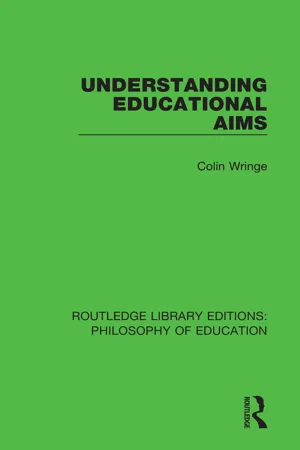
- 159 pages
- English
- ePUB (mobile friendly)
- Available on iOS & Android
eBook - ePub
Understanding Educational Aims
About this book
Information
Part I
Introduction
Chapter One
Aims: Who Needs Them?
Why Should Teachers Concern Themselves with Aims?
If we ask what is presently the most serious shortcoming of the teaching profession, we shall almost certainly be told by many of Her Majesty's Inspectors, Local Authorities and politicians that it is that many of its members lack the necessary skills to do the job that is required of them. New teachers, and those older ones who have remained on the lower rungs of the promotion ladder, are supposed to lack certain 'classroom skills' while those whose ambitions have taken them further in their careers are held to lack the 'managerial skills' appropriate to the running of complex organizations.
This all sounds very modern and businesslike. The malaise is diagnosed in terms of the shortcomings of individuals. These will, of course, require much effort to put right, but do not demand any embarrassing reflections either on the general way we run our schools or upon what we are attempting to achieve by their means. Teachers must simply spend more time learning the supposed skills of the classroom and, incidentally, less time thinking about the nature, significance and social and political role of the lifetime's work on which they are about to embark.
No doubt there is much sense in all this. A teacher who cannot plan a sensible lesson at the right level for a particular group of pupils or devise a variety of tasks and activities that can be accomplished in the time-tabled forty minutes, or whatever, has something to learn. So has he if he cannot write quickly and legibly on the blackboard, or deal effectively with lively third-formers who insist on playing the fool. These are elementary parts of the teacher's stock-in-trade which all members of the profession must possess. It is doubtful, however, if all so-called 'ineffective teachers' and positively miseducative schools will be transformed by these means alone.
Where the educational experience being offered to pupils is unsatisfactory the problem may lie, not simply in clumsy or unskilled performances, but in the lack of any sense of what the point is in teaching a particular lesson, a particular subject or, indeed, in the educational enterprise as a whole.
No doubt it is naive to suppose that if only we get our aims straight, the rest will follow. But even this contains an element of truth. Skills are more readily acquired and more aptly applied when they are seen to be linked to some desirable end. Teachers undeniably need their armoury of knacks, dodges and elements of personal style acquired in the course of training and experience. But with equal urgency they also need a collectively acceptable rationale for the many activities and diverse aspirations in the pursuit of which they are engaged.
There is, of course, no single overriding goal which all of us engaged in the activity of education should be striving to achieve. On the contrary, there are many legitimate and proper aims which may be pursued under the aegis of education, and things often go most wrong when this fact is forgotten. It is therefore proposed to examine various candidates for the status of educational aims that are commonly advocated, or tacitly assumed.
The teaching profession, it will be suggested, needs to be in possession of a body of understanding of the educational enterprise and its various objects which, as far as possible, commands a measure of general consent among rational and responsible practitioners, in order to meet the requirements of principled co-ordination on the one hand, and an appropriate degree of self-direction on the other.
Life in the Classroom: Other-Direction and Self-Direction
Reference to self-direction may come as a surprise to many readers of this book. Those who have yet to undergo their first teaching experience in school may expect to receive fairly explicit instructions about what they are to do, even on a day-to-day basis, over the first few years. Their anxieties will be less about deciding what to do than about whether they will be capable of performing what is required of them by others.
Now it is certainly true that the teacher may be given a textbook whose content he is expected to transmit, and even told the rate at which it is to be transmitted. More likely than in the past, the individual teacher or even the whole department may be expected to follow a syllabus worked out by someone else – or by a committee of which the teacher may or may not have been a member.
In recent years both national and local inspectorates have taken to issuing curricular frameworks and subject guidelines. This has encouraged the impression of the education service as a hierarchical bureaucracy in which aims are expressed at the 'top', these being transmitted downwards as demands which are to be met by acts of compliance below. And, of course, the student on teaching practice will find his friendly neighbourhood head of department or class teacher ready to help him with the detailed planning of his first few lessons.
He will, however, probably be surprised to find how reluctant his older colleagues are to tell him what to do with any precision. Professional tutors are unlikely to articulate educational policies of general application. Their valuable and often very welcome advice is more likely to concern the amounts of time and energy to spend on preparation and marking, how to deal with awkward situations with particular pupils or other members of staff, what the local rules and practices are in relation to dress, movement and sanctions, and so on.
It is to be hoped that those drawing up curricular guidelines pay some heed to overall educational aims, but such guidelines offer little help in deciding which of many possible aims one ought to be giving emphasis to at a given time. Here and now, the teacher may need to decide whether a certain pupil should be treated rather sharply because his behaviour and perception of himself and others is no longer socially acceptable, given his head to develop his sense of personal autonomy, made to get down to some serious work for the sake of his vocational future, or encouraged to stop stuffing his head with facts in order to reflect upon his work in a more detached way. From a logical point of view, the notion that talking about aims is not very practical cannot be sustained. One cannot even begin to be practical or make sensible decisions about what one should be doing or how one should be doing it without some idea of what one is hoping to achieve. Practical activity, even of a simple kind, cannot be conceived of without the notion of an end in view.
This does not mean that teachers constantly have to spend a great deal of time discussing their aims with each other. Often these will be obvious enough. Also, part of the point of considering the question in depth in a detached way during periods of initial and in-service training is to ensure a measure of clarity and mutual understanding between members of the profession, so that fundamentals do not have to be constantly thrashed out de novo in the heat of a busy term.
The Scope of Educational Aims
Even people with such apparently clearly defined missions in life as policemen, doctors, prison warders and businessmen might gain more real benefit for themselves and others if more time were spent considering the ultimate purpose of their activities, rather than in achieving crude efficiency in the performance of their more immediate tasks. This is even more true for educators because of the far greater range of possibilities open to them. Doctors may choose between preserving life and preventing pain, businessmen between short- and long-term profit, and policemen between strictly enforcing the law and creating good community relations. But their options are relatively limited.
What teachers can achieve is restricted by what children are able or willing to learn, but the range of goals they may set themselves, and indeed have set themselves at various times, is almost limitless. There is scarcely any aspiration for good or evil which they cannot in principle seek to forward in the course of their work. Before considering a number of the more widely supported educational aims, however, it will be helpful to distinguish between the notion of an aim and two concepts with which it may easily be confused, namely that of an ideal and that of an objective. This is done not from sheer pedantry but because it is convenient to use these terms to refer to rather different things which, if not kept apart, tend to foul up discussion and obstruct the business of tackling the issues which really concern us. Our interest is in aims rather than in either ideals or objectives and the drawing of clear distinctions between them will enable us to exclude these latter from our discussion at this early stage.
Aims Are Not Ideals
No doubt many, if not most, people have ideals of some sort, be these the ideal home for one's retirement, the ideal marriage partner or the ideal society in which all are equal, free and well cared for. This, in itself, is obviously no bad thing. If the alternative is self-satisfaction and complacency, let us have ideals by all means. The problem is that the terms 'ideal' and more especially 'idealist' have managed to get themselves a bad name, for a number of reasons.
For some, an idealist has become synonymous with an impractical dreamer who thinks the ideal world he yearns for is already with us, or is just around the corner, and consequently fails to protect the practical interests of himself and those who depend on him. A teacher whose ideal was an educational system without examinations and, as a result, failed to help his pupils gain the qualifications they needed for the jobs they eventually wanted to do, or the advanced courses they hoped to follow, would be an 'idealist' of this sort.
Sometimes the term 'idealist' may be used to refer to reformers, politicians and other dedicated individuals who pursue their ideals of religious dedication, artistic achievement, truthfulness or social justice regardless of the cost in suffering to those around them.
So much for those who are sincere in their idealism. The other side of the coin is that many people may, in some sense, possess or hold ideals without this actually having much effect on what they do. This, no doubt, is a harmless, much satirized and largely inoffensive foible. More trouble is caused by the variant of this species who not only has ideals but will not shut up about them, and who gives himself airs on the strength of them, as if uttering virtuous ideals entitled one to the same degree of respect as a life actually devoted to virtuous conduct. The 'idealistic' ex-teacher who despises his former colleagues for 'compromising' over mixed ability teaching when he himself has escaped from the classroom would be an example of this.
Aims and ideals have often been confused by those who write about education, and this has led to much misunderstanding. It has been largely responsible for the unpopularity and even embarrassment that tends to surround the discussion of aims, and this in turn has led to a number of important questions remaining unexamined.
The significant feature of ideals is not that they cannot be reached. Indeed, it will be argued that our most important aims are such that they may not be susceptible to complete fulfilment. It is rather that, being the embodiment of perfection in an imperfect world, their espousal readily lays one open to the charge of being a fool, a fanatic or a hypocrite.
This is not the case with aims, at least in the sense in which I propose to use the term. Aims may be either good or bad. To corner the market in an essential drug in order to increase one's firm's profits is as much an aim as is the promotion of, say, adult literacy. Aims may be modest, or they may be ambitious. A teacher may aim to bring about a small improvement in the oral communication skills of a notoriously sullen group of fourth-formers, The aim – and I mean the aim, not the ideal – of a particular organization may be to promote the cause of equal educational opportunities. To be guided by aims implies neither impracticality nor insensitivity to the aims, interests or wishes of others. Aims are not dreamy visions of a distant state which we may or may not be doing something to bring about. Typically, they may be pointed to as explanations of actual conduct, providing the rationale for a particular action or activity. The conduct or activity is made sense of as a positive and deliberate step in achieving the aim in question, and clarification of a group's or an individual's aims, far from being impractical, may well be the first step in improving efficiency.
Aims may be pursued ruthlessly, but they may also be pursued prudently and in a spirit of compromise and consideration for the interests and legitimate aspirations of others. To compromise over an aim does not imply the same moral falling short as compromising over an ideal, nor do aims run the risk, as do ideals, of excusing conduct which we should otherwise recognize as unacceptable.
One may, of course, be as hypocritical about one's aims as about one's ideals. If an eminent politician visits South Africa his aim may be to crusade against apartheid, or it may be to capture his country's liberal vote in the next round of elections. But to state one's aims truthfully and to urge others to join one in promoting them is less offensive than parading one's ideals and implying some moral inferiority in those who do not share them.
If this evident distinction between aims and ideals has been blurred in the field of education, it is partly because certain writers, who were not invariably classroom teachers (Russell, 1926; Whitehead, 1929; Dewey, 1916, ch. 8), presented what were, on our understanding of the term, educational ideals under the slogan of 'The Aims of Education'. This was sometimes done in a rather insensitive way. Consequently, certain perfectly valid criticisms of existing practice and existing conceptions of the teacher's task – as lacking imagination and breadth of vision – were perceived by many practising teachers as personal criticism by people who were in an authoritative position but had little actual experience of what they were talking about.
Along with this must be considered the contribution of a certain ideology of the teaching profession prevailing in institutions of teacher education, many of which had originally been religious foundations. According to this ideology, teaching was less a profession than a 'vocation' demanding unbounded dedication, patience and love for one's unwashed and ragged pupils, equalling the love of the saint for his own personal colony of lepers.
Lectures on aims' often tended to be little more than harangues, a dose of 'uplift' to inoculate aspiring teachers against the discouragement of the real world of the classroom. In many institutions this was the prevailing perception of 'philosophy's' contribution to teacher preparation and educational thought. Rightly this was seen as, at best, an indication that the tutors involved were out of touch with the real world and, at worst, a form of moral bullying, an attempt to present the real problems of the classroom as personal shortcomings of the individual teacher, and to extract from the teacher a degree of dedication that was unreasonable.
Aims Are Not Objectives
A second important distinction to be made is that between aims and objectives, in everyday speech these terms may be more or less synonymous, except perhaps that the term 'objective', which has been made popular in the jargon of military strategy and management science, may be used when one wishes to give the impression of being particularly scientific or precise about what one expects to achieve. In educational discussion 'objectives' usually refers to specific pieces of learning which we intend to see achieved at the end of a piece of classroom activity, a particular lesson or number of lessons, or even at the end of a longer unit of work.
According to one widely held view of educational planning, both at the level of planning an individual lesson and in designing a whole curriculum, it is essential to begin one's deliberations by 'specifying one's objectives' (see, for example, Davies, 1976). That is, we must begin by saying precisely what we want our pupils to know, understand or be able to do or say at the end of the lesson, at the end of the term or whatever. Some writers (Popham, 1970; Mager, 1962) go further and claim that to spell out our objectives in terms of what our pupils know or understand is not sufficiently precise. What people 'know' or 'understand', they suggest, is rather vague and cannot be absolutely ascertained. Such writers claim that we should spell out our objectives not in terms of such vague and 'unscientific' notions as knowledge, understanding, sensitivity and so on, but in observable 'behavioural' terms. What do we want our pupils to be doing? How do we want their behaviour to be changed as a result of attending our lesson or following our syllabus?
It is not proposed to enter deeply into the debate over how far educators' objectives need to be operationalized in a behavioural, observable way. A more moderate view is that many of the teacher's most important objectives are to be spelled out in terms which are internal to the pupil – his knowledge, understanding, emotive responses, sympathies and so on.
In many respects, recent emphasis given to the need for teachers and others involved in education to be specific about their objectives has been extremely beneficial. When this approach is accepted and applied it gives the business of lesson preparation and other levels of educational planning a quality of rationality and professionalism it may not always have had in the past. Once objectives have been identified, lesson planning becomes a matter of selecting the best and, in terms of time, effort and other resources, the most economical means of achieving them. Such an approach is valuable in stressing that teachers are not only supposed to perform in front of their classes for a certain length of time, keeping them amused or occupied, but are actually supposed to deliver the goods in terms of certain specific learnings which can, in principle and in fact, be checked up on.
This at least has the merit of transforming the teacher from a rather low-level comedian and child-minder into someone with a potentially useful job to do. His performance is to be judged not in terms of such intangibles as his appearance, manner, 'classroom presence', 'authority' or what have you but – due allowance being made for the nature of his particular class – on the basis of his actual achievements. Needless to say, these are not limited to anything so crude as examination passes but include everything that he succeeds in getting his pupils to learn. There is no reason to doubt that, class for class, some teachers succeed in getting their pupils to learn a great deal more than others. If the teacher's task is viewed in this light it would not be surprising if greater effectiveness is achieved by seeing one's lesson plan not in terms of 'finishing off Chapter 3' or 'doing The Ancient Mariner', but in terms of the specific learnings to which the reading of Chapter 3 or the study of th...
Table of contents
- Cover
- Half Title
- Title
- Copyright
- Original Title
- Original Copyright
- Contents
- Dedication
- Preface
- Part I Introduction
- Part II Aims and the Individual
- Part III Aims and Society
- Part IV Intrinsic Values
- Suggestions for Further Reading
- Bibliography
- Index
Trusted by 375,005 students
Access to over 1.5 million titles for a fair monthly price.
Study more efficiently using our study tools.
Frequently asked questions
Yes, you can cancel anytime from the Subscription tab in your account settings on the Perlego website. Your subscription will stay active until the end of your current billing period. Learn how to cancel your subscription
No, books cannot be downloaded as external files, such as PDFs, for use outside of Perlego. However, you can download books within the Perlego app for offline reading on mobile or tablet. Learn how to download books offline
Perlego offers two plans: Essential and Complete
- Essential is ideal for learners and professionals who enjoy exploring a wide range of subjects. Access the Essential Library with 800,000+ trusted titles and best-sellers across business, personal growth, and the humanities. Includes unlimited reading time and Standard Read Aloud voice.
- Complete: Perfect for advanced learners and researchers needing full, unrestricted access. Unlock 1.5M+ books across hundreds of subjects, including academic and specialized titles. The Complete Plan also includes advanced features like Premium Read Aloud and Research Assistant.
We are an online textbook subscription service, where you can get access to an entire online library for less than the price of a single book per month. With over 1.5 million books across 990+ topics, we’ve got you covered! Learn about our mission
Look out for the read-aloud symbol on your next book to see if you can listen to it. The read-aloud tool reads text aloud for you, highlighting the text as it is being read. You can pause it, speed it up and slow it down. Learn more about Read Aloud
Yes! You can use the Perlego app on both iOS and Android devices to read anytime, anywhere — even offline. Perfect for commutes or when you’re on the go.
Please note we cannot support devices running on iOS 13 and Android 7 or earlier. Learn more about using the app
Please note we cannot support devices running on iOS 13 and Android 7 or earlier. Learn more about using the app
Yes, you can access Understanding Educational Aims by Colin Wringe in PDF and/or ePUB format, as well as other popular books in Education & Education General. We have over 1.5 million books available in our catalogue for you to explore.