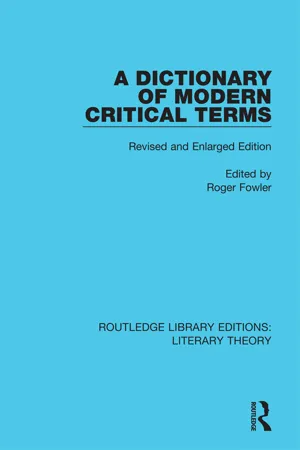
This book, first published in 1987, differs from many other 'dictionaries of criticism' in concentrating less on time-honoured rhetorical terms and more on conceptually flexible, powerful terms. Each entry consists of not simply a dictionary definition but an essay exploring the history and full significance of the term, and its possibilities in critical discourse. This title is an ideal basic reference text for literature students of all levels.
- 262 pages
- English
- ePUB (mobile friendly)
- Available on iOS & Android
eBook - ePub
About this book
Information
S
satire
is a genre defined primarily, but not exclusively, in terms of its inner form (see GENRE). In it the author attacks some object, using as his means wit or humour that is either fantastic or absurd. Denunciation itself is not satire nor, of course, is grotesque humour, but the genre allows for a considerable preponderance of either one or the other. What distinguishes satire from comedy is its lack of tolerance for folly or human imperfection. Its attempt to juxtapose the actual with the ideal lifts it above mere invective.
From this need to project a double vision of the world satire derives most of its formal characteristics, IRONY, which exploits the relationship between appearance and reality, is its chief device, but as Northrop Frye points out in his essay on satire and irony (Anatomy of Criticism, pp. 223–39) it is irony of a militant kind. ‘Irony is consistent both with complete realism of content and with the suppression of attitude on the part of the author. Satire demands at least a token fantasy, a content which the reader recognizes as grotesque, and at least an implicit moral standard’.
The moral standard referred to here is often only discernible in the satirist’s tone of indignation, and in forms which effectively deny the author any tone of voice, satire is achieved differently. For example, much critical discussion of Restoration Comedy has fruitlessly pursued the question of the dramatists’ attitudes towards their subjects. Where an author is forced to efface himself from his creation, or chooses to mask his own attitude, as Swift does in A Modest Proposal (1729), he must rely on the reader to make the necessary comparison between the grotesque fantasy he creates and the moral norms or ideals by which it is to be judged. The best clue to the intentions and the achievements of the Restoration dramatists lies in the techniques of distortion they employ—or fail to employ—in the creation of a fantasy world.
In some satires distortion takes the simple form of displacement: the substitution of an animal world for the human in Swift’s Gulliver’s Travels (1726) or Orwell’s Animal Farm (1945). In others, inverted values serve to distort reality. This technique makes possible the sub-genre of mock-epic. Yet again, writers may use a variety of devices—caricature, exaggerations, parallelism, or parody—to achieve similar ends.
See R. C. Elliott, The Power of Satire; Magic, Ritual, Art (1960); John Heath-Stubbs, The Verse Satire (1969); Ronald Paulson, Satire and the Novel in Eighteenth Century England (1967); James Sutherland, English Satire (1958); David Worcester, The Art of Satire (1940).
BCL
scansion
see METRE
scheme
Redefined by classical rhetoricians and grammarians until its meaning became indeterminate, ‘scheme’ in the sixteenth and seventeenth centuries was enormously popular in the vocabulary of literary and rhetorical theorists who, exploiting their new methods, managed to repeat the process. Any reasonably accurate reading of the versatile definitions and usages of the term in such works as Richard Sherry’s Treatise of Schemes and Tropes (1550), Henry Peacham’s Garden of Eloquence (1577), or John Prideaux’s Sacred Eloquence (1659) will arm the modern critic with sufficient authority to explain and defend as ‘schemes’ all known figures and tropes in English and Mandarin Chinese, the ‘conceits’ of seventeenth-century poetry, the rhetorical strategies of Robespierre, the designs, foils, plots, and prosody of Vladimir Nabokov, and Owen Barfield’s theory of metaphor. Or, conversely— and this has been the actual trend among the twentieth-century scholars from Morris Croll to J. W. H. Atkins to Lee Sonnino in her recent Handbook to Sixteenth Century Rhetoric (1968)— ‘scheme’ has been dealt with as a special kind of FIGURE: an ‘easy’ one, a ‘figure of sound’, or, more simply, as a hazy synonym for ‘trope’. To support such interpretations of Renaissance thought and practice requires the suppression of a considerable amount of evidence, not only because of the extreme scope of the viewpoint in the original texts, but also because ‘figure’, in Renaissance terms, is habitually referred to as a subordinate component of ‘scheme’. Fortunately for those who prefer their history to be cyclical, the readers of ‘scheme’ as the more narrow critical term have thus far cleverly disagreed with each other in specifying it, allowing the conception much of the broad domain it originally entailed. Cf. FIGURE
TGW
scriptible
see PLEASURE
semiotics
deals with the study of signs: their production and communication, their systematic grouping in languages or codes, their social function. It is doubly relevant to the study of literature, for literature uses language, the primary sign system in human culture, and is further organized through various subsidiary codes, such as generic conventions. If, then, the sign-function is basic to both language and literature—and, beyond them, to culture in general—semiotics should repay attention.
Only recently, however, has this attention been directly sustained. Semiotics has an odd history. Various Western thinkers—the Stoics and Saint Augustine, Locke and Husserl—have treated signs and sign-functions, without quite constituting a separate study. Other disciplines can be seen, retrospectively, as crypto-semiotic; thus Tzvetan Todorov has discussed rhetoric from a semiotic point of view (Theories of the Symbol, 1977, trans. 1982). It is probable that any study as ambitiously inclusive as semiotics will always be plagued by problems of cohesion and demarcation. These problems are reflected in the double founding of modern semiotics from within different disciplines, by the American philosopher Charles Sanders Peirce (1839— 1914) and by the Swiss linguist Ferdinand de Saussure (1857–1915).
Saussure’s reorientation of linguistics from a diachronic to a synchronic approach, from the study of historical change to the systemization of a given state of language, conditions his treatment of the sign. ‘Language is a system of signs that express ideas’, and the interrelationship of signs thus determines meaning. The expressive function of the sign is achieved through its components of signifier (as image or form) and signified (as concept or idea); their linkage, with minor exceptions, is seen as arbitrary and unmotivated. Similarly, the system of signs that comprises a language expresses no given or predetermined meanings; these arise from the interrelations of the system: ‘in language there are only differences without positive terms’. And since language is only one among sign systems (Saussure mentions writing, military signals, polite formulas) it is possible to envisage a future ‘science that studies the life of signs within society’, which Saussure calls ‘semiology’—a term still common in French discussions, but elsewhere yielding to ‘semiotics’.
While Saussure envisages an extension to the science of signs, Peirce begins with a generalized system, which he sees as a branch of logic. And while Saussure works with binaristic, dyadic relations, Peirce puts everything in threes, even coining the term ‘triadomany’ for his obsession. The triads make for a certain dynamism in Peirce’s account; he is interested in semiosis, the act of signifying, and the triadic description of this act presents it as a mediation between two terms by a third. ‘A sign is anything which is related to a Second thing, its Object … in such a way as to bring a Third thing, its Interpretant, into relation to the same Object’; the interpretant is itself a sign, so the process recurs. Peirce offers an exhaustive and exhausting taxonomy of all aspects of semiosis, but most of his terms are now neglected except those describing the relation between the sign and its object; Peirce differs from Saussure in allowing a greater role for motivated linkage. Besides the arbitrary ‘symbol’, he describes the ‘icon’ (linked through resemblance) and the ‘index’ (with an existential or causal linkage). These terms are now often applied to the signifier/signified pair.
Although Peirce may offer more scope as a critical tool, Saussure has exercised the greater influence until very recently. While Peirce’s logic was neglected, Saussure’s linguistics flourished, and drew his semiotics along with it. A crucial factor was the rise of STRUCTURALISM, in which the role of linguistics as a systematic model—either directly, or through its adaptation in anthropology—was paramount. Structuralism and semiotics, as they impinged on literary studies, were often indistinguishable, especially when semiotics concentrated on the production of meaning rather than its communication. And they raised similar problems for lettrists. Could the individual text be analysed as a sign-system? If not, of what system was it an instance? Was it justified to accord any essential privilege or particularity to literary language as an aesthetic code? These problems are still current, and it is always worth noting how they are handled by individual critics.
Semiotics should arguably be self-critical, and the fashionable structuralist semiotics of the 1960s did sometimes reflect on its procedures; thus Roland Barthes’s Elements of Semiology (1964, trans. 1967) extends the Saussurean base, gives a greater role to motivation, and expresses doubts about binarism. But any expressed doubt in this period was counterbalanced by a surge of scientistic optimism about the development of what was seen as a rigorously objective and comprehensive study—especially when contrasted with impressionistic literary criticism. And there were undeniable advances; for example, in describing the signifying systems of NARRATIVE. But the last decade and a half has seen extensive ‘post-structuralist’ criticism of this semiotic enterprise. The positivist ideal of a closed and total structuration is itself subject to the metaphysical critique of DECONSTRUCTION. More particularly, the idealization of systems can lead to neglect of the dynamics of signification and a reductive account of the agents involved. To combat this reductionism, Julia Kristeva uses psychoanalysis to enlarge the notion of the speaking subject in semiotics; and the later work of Roland Barthes persistently strives to extend and to de-formalize the role of the reader. Umberto Eco’s Theory of Semiotics (1976) actualizes the potential dynamism of Peirce and the social hints of Saussure. It emphasizes process through what Eco calls ‘the mobility of semantic space’. Codes are subject to change in use: through undercoding, the simplification of alien systems, and through overcod-ing, the addition of extra signifying rules that are crucial in stylistic or ideological elaboration. And the ‘unlimited semiosis’ promised by Peirce’s interpretant that is itself a sign means that for Eco any determinate meaning is replaced by something transitory, the provisional semantic stability of a given culture or subculture.
This is not to suggest that all semiotics has abjured determinate signification. A contrary example is Michael Riffaterre’s Semiotics of Poetry (1978), which describes the reading of poems in terms of a ‘semiotic transfer’ between two systems. The first system is mimetic: for Riffaterre, prior readings are unpoetically referential. They suggest difficulties or ‘ungrammaticalities’ (predictably, as Riffaterre’s examples are Symbolist and Surrealist), which are resolved by code-switching from mimesis to poetic semiosis proper. In the latter system all relationships are finally motivated. It is produced by transforming the ‘matrix’, a unifying node of significance which is variously encoded in text or intertext. The essentialist and organicist bias of Riffaterre’s theory has been sharply questioned, but the brilliance of his readings is not in doubt.
The study of culture itself as a semiotic phenomenon was initiated by the work of Jan Mukařovský and the Prague school, which began in the 1930s. And the most ambitious approach to a semiotics of culture has also come from Eastern Europe, in the work of Jurij Lotman and the Moscow-Tartu school of semiotics. In 1971, Lotman produced one of the most thorough accounts of structuralist semiotics as applied to literature: The Structure of the Artistic Text (trans. 1977). This, predictably, uses a synchronic approach; but Lotman’s cultural studies also encompass diachrony. In the first place, he makes typological distinctions between the semiotic practices of historical cultures: thus medievalism is marked by ‘high semioticity’, which ‘proceeds from the assumption that everything is significant’ (there is an overlap here with the work of Michel Foucault); whereas enlightenment culture sees the world of natural objects as real, so that ‘signs become the symbols of falsehood’. Secondly, Lotman studies diachronic change by describing the interplay between culture as patterned information and an unpat-terned ‘non-culture’, or by describing cultural ‘translation’ in which communicative needs encourage a creative recoding.
The semiotics of culture is still embryonic, but its promise is of special interest to lettrists in their attempts to advance interdisciplinary studies. Interdisciplinary in practice often founders on the fact that two disciplines are merely juxtaposed; work at their interface, which should be most exciting, can become embarrassingly vague. The explanatory scope of cultural semiotics might help to provide a third term which, in proper Peircean fashion, could mediate between the other two.
See John Fiske, Introduction to Communication Studies (1982) ch. 3; R. W. Bailey, L. Matejka and P. Steiner (eds), The Sign: Semiotics Around the World (1978); M. E. Blanchard, Description: Sign, Self, Desire; Critical Theory in the Wake of Semiotics (1980). Current developments can be followed in the journal Semiotica. Robert E. Innis (ed.), Semiotics: An Introductory Reader (1986); a good selection, with particularly useful editorial comments.
EC
sensibility
The prestige of mathematical reasoning in seventeenth-century Europe was immense, and the end of the century might in England be called the Age of Reason. To some thinkers, it looked as if having accomplished so much in interpreting the natural world, reason could go on to solve problems hitherto left to less clear and distinct methods of investigation—matters of values and morals. But poets and critics in England never accepted the total primacy of reason, and they were very willing to take over a moral and aesthetic doctrine which was in reaction against a too great demand on reason. Such a doctrine existed: the elaboration of a notion of a personal, inner faculty, an emotional consciousne...
Table of contents
- Cover
- Half Title
- Title Page
- Copyright Page
- Original Title Page
- Original Copyright Page
- Preface
- Preface to the second edition
- A
- B
- C
- D
- E
- F
- G
- H
- I
- K & L
- M
- N
- O
- P
- R
- S
- T
- V
- W
Trusted by 375,005 students
Access to over 1.5 million titles for a fair monthly price.
Study more efficiently using our study tools.
Frequently asked questions
Yes, you can cancel anytime from the Subscription tab in your account settings on the Perlego website. Your subscription will stay active until the end of your current billing period. Learn how to cancel your subscription
No, books cannot be downloaded as external files, such as PDFs, for use outside of Perlego. However, you can download books within the Perlego app for offline reading on mobile or tablet. Learn how to download books offline
Perlego offers two plans: Essential and Complete
- Essential is ideal for learners and professionals who enjoy exploring a wide range of subjects. Access the Essential Library with 800,000+ trusted titles and best-sellers across business, personal growth, and the humanities. Includes unlimited reading time and Standard Read Aloud voice.
- Complete: Perfect for advanced learners and researchers needing full, unrestricted access. Unlock 1.5M+ books across hundreds of subjects, including academic and specialized titles. The Complete Plan also includes advanced features like Premium Read Aloud and Research Assistant.
We are an online textbook subscription service, where you can get access to an entire online library for less than the price of a single book per month. With over 1.5 million books across 990+ topics, we’ve got you covered! Learn about our mission
Look out for the read-aloud symbol on your next book to see if you can listen to it. The read-aloud tool reads text aloud for you, highlighting the text as it is being read. You can pause it, speed it up and slow it down. Learn more about Read Aloud
Yes! You can use the Perlego app on both iOS and Android devices to read anytime, anywhere — even offline. Perfect for commutes or when you’re on the go.
Please note we cannot support devices running on iOS 13 and Android 7 or earlier. Learn more about using the app
Please note we cannot support devices running on iOS 13 and Android 7 or earlier. Learn more about using the app
Yes, you can access A Dictionary of Modern Critical Terms by Roger Fowler in PDF and/or ePUB format, as well as other popular books in Literature & Literary Criticism. We have over 1.5 million books available in our catalogue for you to explore.