First published in 1985, this book presents the first detailed account of the relationship between the farmworkers, trades unionism, and political and social radicalism. Rural radicalism, one of the most important new features of late-nineteenth and early-twentieth century politics, was particularly strong in Norfolk and as such provides the focus for this study. The author shows the how relationship between 'master and man' and 'man' and 'work' was changing in the period from the 1870s to the 1920s — ending with the great strike of 1923. The main themes are the shifts from religion to politics, from Liberalism to Labour, and in more general terms from local to national consciousness. The book shows men at work and the ways in which politics meshed — or failed to mesh — together. Based on detailed local research and on many hours of recorded interviews, it enables the voice of the labourer to be heard, and a real sense of hope, fear and aspiration to come through.
eBook - ePub
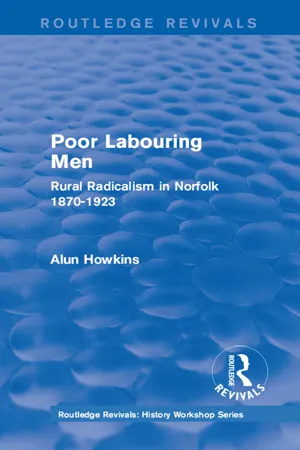
Routledge Revivals: Poor Labouring Men (1985)
Rural Radicalism in Norfolk 1870-1923
- 225 pages
- English
- ePUB (mobile friendly)
- Available on iOS & Android
eBook - ePub
1 The land and the people
Norfolk is celebrated for the diversity and the high cultivation of its soil; for the abundance and excellence of its agricultural productions … and for its numerous antiquities and historical associations.… It is divided from Suffolk by the Waveney and the Little Ouse; from Cambridgeshire chiefly by the Great Ouse, Welney and Nene, and from Lincolnshire by the Wash. Thus surrounded by marine and river boundaries, Norfolk is in fact an island.
White’s History, Gazetteer and Directory of Norfolk, 1890
If we are to explain and understand the rural radicalism and trades unionism which was such a marked feature of Norfolk in the period 1870–1923 we must begin with some consideration, no matter how brief, of the social and economic structure of Norfolk rural society and of the systems of farming which predominated in the country.
In this discussion the onset of the agricultural depression in 1874–5 is of the utmost importance and an event which dominated, to a greater or lesser extent, all the thinking of contemporaries. As Perry has written,1
It is … indisputable that the last quarter of the nineteenth century was a period of agricultural crisis … more numerous bankruptcies, lower rents and untenanted farms. These were the facts which left contemporary farmers, landowners and agricultural pundits in no doubt as to the reality of their problems – problems which were to continue with only one brief respite until the 1940s.
The agricultural depression and after: Farming
The depression, as historians since Ernle have argued, hit the eastern counties particularly badly,2 but Norfolk was not one of the worst affected. According to P.J. Perry, Norfolk ‘escaped comparatively lightly’,3 and this is born out by Druce’s comment on the number of unlet farms in the 1881 Royal Commission.4 Although less affected than other areas, Norfolk did suffer. In common with most southern and eastern counties Norfolk had unlet farms, rent reductions, a decline in farming standards and the putting of arable land down to permanent grass. Within the county there were regional variations. C.S. Read wrote in 1883 that those on ‘very light and very heavy soils have fared worst’, that is those in the Breckland and the south-east; but there were obviously problems elsewhere.5 For all involved, history compounded real economic problems. Norfolk farming had been prosperous for two generations which made many feel that the depression was temporary and discouraged innovation until the late 1890s, and then on a limited scale.
The depression affected the different classes of the agricultural community differently. At the top of the rural hierarchy the landlords suffered from reduced rents, especially in the areas of poor soil. The Earl of Leicester, whose estates contained a good deal of light sandy land, estimated that between 1878 and 1894 he reduced his rents by about 45 per cent. Other decreases mentioned by the Royal Commission range between 26 and 60 per cent. Even this was not enough in some cases. On Leicester’s estate (which had a justifiably good reputation for treating its tenants well) eight farms coming up for renewal in 1895–6 were stated as ‘not going to be renewed’ despite rent reductions of between 40 and 60 per cent.6
Unlet farms and rent reductions meant a reduced income for landowners. On the largest estates this probably had little effect: as Rew noted, ‘it does not involve the positive distress which may be brought upon the owner of a small estate and his family’.7 At worst it involved the cutting of expenditure or the selling of land. F.M.L. Thompson shows how the Earl of Verulam cut his annual expenditure by about £4,000 a year between the early 1870s and 1889.8 Cutting expenditure was relatively simple, selling land was less so. As agricultural prices fell investment in land became less attractive, even a great house and estate in the relatively prosperous corn lands of west Norfolk, Houghton Hall could not find a buyer.9 As Thompson notes,10
the evidence of the figures and the annual reports points unmistakably to a great drop in the amount of land sold; land was a drug on the market, unsaleable, the market was flat and dull and little business was done.
The effect of these kinds of financial problems on village society varied enormously. At the simplest level they meant the loss of jobs and perks for household staff and hangers on.11 More complex were the adjustments necessary as a result of letting the hall to ‘strangers’. Little Hockham for instance acquired a new ‘squire’ in this manner. As Michael Home writes of his boyhood,12
the early Victorian house known to us as Little Hockham Hall, was given the courtesy title only because Squire Finch was living in it … it was only when the estate was running at a dangerous loss that our Squire Finch left the handsome Early Georgian Hall and [went] to live [in] Little Hockham.
In Hockham, as elsewhere in Norfolk, the Hall proper was let to a stranger, a wealthy banker called Green who was begrudgingly given the title ‘squire’ along with Finch.13
Yet we should beware of putting too much emphasis on such changes. Nouveaux riches did not necessarily mean that the social relations and roles within the community altered. John Lowerson has argued for Sussex that the influx of new money and names was dealt with, by and large, very smoothly:14
The transition overall seemed smooth enough, if the older families resented being swamped they allowed few of their feelings public expression, whilst developing more sophisticated mechanisms, not so much for expressing social ostracism as for filtering aspirants.
Also, ‘Squire Green’ kept the Hall in style. This provided a good deal of employment for the village, especially village women, which Finch could never have done even if he was a real gentleman rather than an upstart; ‘the village prospered under Green’s tenancy of the Hall and shooting rights’.15
Elsewhere, where the Hall stood empty and unlet, not only did work opportunities decline but charities and doles, the great unknown of village incomes, would probably vanish. Colonel Pedder, one of the most vitriolic critics the English landed class has ever had, wrote of16
the withdrawal of many of the smaller country gentry who left their duties behind them to be looked after by anyone who chose, much as the ordinary London householder leaves his cats when he goes down for a month to the seaside.
Between the large estate owners and the tenant farmers were intermediate strata of owner occupiers. The effect of the depression on this group varied greatly depending on the size of holding. There were 10,096 landowners in Norfolk in 1873 holding a million and a quarter acres of land.17 Of this heterogeneous group those who suffered worst were probably the large owners who had mortgaged land, as it is likely a fair number had by the early 1890s. Perry’s work on farming bankruptcies is interesting here but inconclusive as far as Norfolk goes.18 What does seem to emerge is a pattern of bankruptcy concentrated in the central and southern areas of the country, with relatively few failures in the western areas and only a few more in the eastern.19 This latter group may be accounted for by the fact that farms were smaller in the east; therefore the ‘dot map’ used by Perry may overestimate the effect in the eastern part of the country.20
Where land was mortgaged but bankruptcy did not result there was a definite decline in farming standards. On occasion the land was ‘sucked’. Some did this deliberately; more were driven to it:21
the land will be run with its labour bill brought down to an irreducible minimum; the hay and straw will be sold off it instead of going back to the soil as manure, weeds will be left to seed, drains to choke and ‘holls’ left uncleared.
The larger owner occupiers farmed on much the same four-course shift as the larger tenant farmers and so the effect of the depression on farming practice can be left to the discussion below. The very small owner occupiers were, however, different. Relying largely on family labour, their own hard work and sometimes wage labour as well, they often weathered the depression better than the larger owners, unless their income was so reduced as to lead to eviction.22
As far as it is possible to generalise, the most remarkable thing about the farmers’ reaction to the depression, despite a fairly general drop in standards, was the lack of effect it had on farming practice, at least in the medium term. That farmers as a class were hard hit by the depression there can be little doubt, even if the experience was differential. The system of ‘farming up to wheat’ was particularly vulnerable to the sharp drop in wheat prices after 1874, especially on marginal lands. However, what should be borne in mind is that Norfolk is good wheat country, with the possible exception of the Brecklands and parts of the south-east. Yield per acre was significantly higher in Norfolk on all cereal crops from the mid-1880s to the mid-1890s, wheat for instance averaging 31.4 bushels per acre as against a national figure of 28.94 bushels. Given the large farms of west Norfolk this represents a considerable margin.
Even so the fall in prices was serious. It often meant, despite remission of rent, living on capital. One Norfolk farmer told the Royal Commission, ‘Men who have capital are wasting it; those who have none are being ruined.’23
The first onset of the depression brought little reaction, Perry has noted:24
It is scarcely a matter for surprise that those most directly caught up in the events and changes of the depression, tenant farmers in particular, were ready to adopt explanations of their misfortune which were imperfect, subjective, individual, and almost invariably neglectful of their own shortcomings.
The first factor blamed was the weather, especially in the evidence given to the 1881 Commission. This belief that it was the ‘bad season’ was made worse in Norfolk by the long period of prosperity before the depression, and the blind faith this created in the four-course shift and farming up to wheat. As we noted above, this meant that change took place largely within the bounds of the four-course shift. First there was the possibility of inserting an extra ‘catch crop’, sown in the autumn for spring feed, although this could make little difference.25 More serious was in some sense abandoning the shift more or less completely. For instance, in reply to Rew’s questions about alterations to the shift since 1881, the Swaffam Board replied ‘Four course shift broken, oats and barley taking the place of wheat’. Similarly the Freebridge Lynn Guardians noted that barley was being substituted for wheat and that ‘artificial grasses are occasionally kept for two years instead of being ploughed up after the first year.’26
As well as breaking or modifying the shift there was the simple, and common, remedy of simply lowering farming standards. The standards demanded by the Norfolk system had always been high, perhaps artificially high, with its emphasis on weeding, stone-picking, and ‘clean’ crops in general. All this seems to have been subs...
Table of contents
- Cover
- Half Title
- Title Page
- Copyright Page
- Original Copyright Page
- Dedication
- Table of Contents
- Introduction
- 1 The land and the people
- 2 Structural conflict and the farmworker
- 3 Radicalism, the first phase: The chapel
- 4 Radicalism, the first phase: The local unions 1872–96
- 5 Radicalism, the second phase: The second union
- 6 Radicalism, the second phase: Rural labour and the wages board 1910–21
- 7 The great betrayal
- 8 The great strike
- 9 The long term
- Notes
- Bibliography
- Index
Trusted by 375,005 students
Access to over 1.5 million titles for a fair monthly price.
Study more efficiently using our study tools.
Frequently asked questions
Yes, you can cancel anytime from the Subscription tab in your account settings on the Perlego website. Your subscription will stay active until the end of your current billing period. Learn how to cancel your subscription
No, books cannot be downloaded as external files, such as PDFs, for use outside of Perlego. However, you can download books within the Perlego app for offline reading on mobile or tablet. Learn how to download books offline
Perlego offers two plans: Essential and Complete
- Essential is ideal for learners and professionals who enjoy exploring a wide range of subjects. Access the Essential Library with 800,000+ trusted titles and best-sellers across business, personal growth, and the humanities. Includes unlimited reading time and Standard Read Aloud voice.
- Complete: Perfect for advanced learners and researchers needing full, unrestricted access. Unlock 1.5M+ books across hundreds of subjects, including academic and specialized titles. The Complete Plan also includes advanced features like Premium Read Aloud and Research Assistant.
We are an online textbook subscription service, where you can get access to an entire online library for less than the price of a single book per month. With over 1.5 million books across 990+ topics, we’ve got you covered! Learn about our mission
Look out for the read-aloud symbol on your next book to see if you can listen to it. The read-aloud tool reads text aloud for you, highlighting the text as it is being read. You can pause it, speed it up and slow it down. Learn more about Read Aloud
Yes! You can use the Perlego app on both iOS and Android devices to read anytime, anywhere — even offline. Perfect for commutes or when you’re on the go.
Please note we cannot support devices running on iOS 13 and Android 7 or earlier. Learn more about using the app
Please note we cannot support devices running on iOS 13 and Android 7 or earlier. Learn more about using the app
Yes, you can access Routledge Revivals: Poor Labouring Men (1985) by Alun Howkins in PDF and/or ePUB format, as well as other popular books in History & 19th Century History. We have over 1.5 million books available in our catalogue for you to explore.