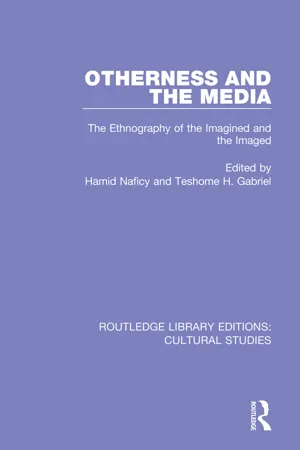
This anthology on otherness and the media, first published in 1993, was prompted by the proliferation of writings centring on issues of 'difference', 'diversity', 'multiculturalism', 'representation' and 'postcolonial' discourses. Such issues and discourses question existing canons of criticism, theory and cultural practice but also because they suggest a new sense of direction in theorisation of difference and representation.
eBook - ePub
Otherness and the Media
The Ethnography of the Imagined and the Imaged
- 292 pages
- English
- ePUB (mobile friendly)
- Available on iOS & Android
eBook - ePub
Otherness and the Media
The Ethnography of the Imagined and the Imaged
About this book
Trusted by 375,005 students
Access to over 1.5 million titles for a fair monthly price.
Study more efficiently using our study tools.
Information
Subtopic
Performing ArtsDisplacing Limits of Difference: Gender, Race, and Colonialism in Edward Said and Homi Bhabha’s Theoretical Models and Marguerite Duras’s Experimental Films
Increasingly, radical literary and film critics, anthropologists, sociologists, political scientists, philosophers, historians, and others are exploring, exposing, and exploding the ways colonial and post-colonial discourses represent racial and sexual others as monolithically and inalterably different from a subject defined as Western, white, and male. Working with a wide range of intellectual traditions, often testing them against personal experiences, Third World critics like Edward Said and Homi Bhabha critique dominant representations of racial and/or ethnic difference. In Orientalism, for example, Said deconstructs racist stereotypes as the products of Orientalist dogmas. Part of a much larger project involving what may be termed the creation of a practical political theory, Said’s focus here is on how Western colonial discourses, including modern mass media, promulgate rigid dichotomies of racial/ethnic difference. In a smaller body of work, Bhabha insists on the psychic ambivalence that underpins and necessitates the compulsive repetition of colonial racist stereotypes. Drawing on Lacanian psychoanalytic theory and post-Althusserian Marxism, he looks at how stereotypes function for both the colonizer and the colonized and, unlike Said, engages to some extent sexual as well as racial difference.
From other angles, but often using similar techniques and strategies, a number of Western feminist critics insist on the need to view sexual difference as a complex and shifting dialectic of projections, idealizations, and rejections. Like Said, and, in other ways, Bhabha, they view difference as constituted intersubjectively in discourse, and draw on shared experiences to subvert patriarchal and imperialist conceptions of identity and authority.
Problems nonetheless remain. Said on the whole ignores the female racial other in his analyses of Orientalism, and thus, despite his support for feminist projects elsewhere, perpetuates in Orientalism the patriarchal definitions of women as “lamentably alien” which he seeks to critique.1 Bhabha, though more sensitive to “the complexity of the question of gender difference,”2 nevertheless chooses to treat racial difference as equivalent to sexual difference when he posits the racial stereotype and the sexual fetish as analogous psychic operations. As a result, he, too, has difficulty articulating sexual difference with racial difference when he discusses colonial stereotypes.3
Those Western feminist critics who focus exclusively or primarily on sexual difference and/or assume that women constitute a coherent category for analysis fall into a reverse trap. Third World feminists like Gayatri Spivak, Chahandra Mohanty, and Marnia Lazreg criticize them for appealing to a timeless, universal, and idealized “sisterhood” of women. In effect, because these Western feminists fail to account for differences of class, race, and ethnicity while they nonetheless still consider Third World women as an ill-defined and separate bloc, they become tacitly complicit with Orientalist strategies. At times they even, in Lazreg’s words, engage in “a search … for the sensational and the uncouth … which reinforces the notion of difference as objectified otherness.”4
In what follows I want to displace the limits of these various theoretical and critical models and thereby open a space for the simultaneous articulation of sexual and racial/ethnic difference. In the first two sections of this paper I will return to the general theoretical paradigms Said and Bhabha propose. Using the insights of Third World and Western feminist critics and others, I will argue that feminism and women cannot be taken for granted or subsumed within general and generically male models of difference. I will not, however, go so far as to propose jettisoning Said and Bhabha’s inclusive models; on the contrary, my goal is to indicate how they may be strengthened when interrupted and challenged by feminist voices.
Throughout this article, I will also ask how and where Said and Bhabha’s theoretical models may be used to analyze cinematic representations of otherness. Both Said and Bhabha concern themselves primarily with realist texts: Said examines nineteenth century novels, traditional ethnographic narratives, travelogues, and the like,5 while in “The Other Question …” and “Difference, Discrimination and the Discourse of Colonialism,” Bhabha addresses cinema directly, discussing Stephen Heath’s reading of Orson Welles’ Touch of Evil.6
What happens, however, to these theories when they are applied to non-realist movies or when they are interrogated by feminist voices? As touchstone for my evaluation of the paradigms Said and Bhabha profer I will, in a third part of this essay, measure their models against three of Marguerite Duras’s experimental films marked by her childhood experiences in French colonial Indochina: India Song (1975), Son Nom de Venise dans Calcutta désert (1976) and Les Mains négatives (1979).7 Duras’s films, I will argue, offer a unique and virtually untapped opportunity to discuss how colonial and post-colonial discourses represent racial and sexual difference, for two main reasons. First, in these films, and elsewhere,8 Duras speaks from a perspective lacking in most discussions of colonialism: that of the white female colonizer sympathetic to yet separate from male and female racial others. “This is what not lying is,” she says.9 Hers is a voice not usually heard from in discussions of colonialism. As anthropologist Paul Rabinow notes: “strangely enough, the group in the colonies who have received the least attention in historical and sociological studies are the colonists themselves.”10 All too frequently the binary opposition colonizer/colonized inhibits examination of what Gayatri Spivak calls “the heterogeneity of ‘Colonial Power,’” at the same time that it masks the roles women play, whether as colonizers or as colonized.11 In Duras’s films, however, both the shared experiences Said and Lazreg call for as alternatives to Orientalism and the deep ambivalence Bhabha unmasks structure the interactions among Third World and female characters and narrators.
Second, because Duras’s films are made in conscious opposition to Hollywood cinema,12 separating voices from images in multiple and unexpected ways, they facilitate critiques of the ideological operations of mainstream films. Usually non-white or female others are positioned as visibly and unalterably different and as silenced, excluded from language. Unheard, these others are seen as weaker and more primitive, yet as threatening and powerful as well. In those cases where the racial, colonial, or national other is actually heard in mainstream films, her or his speech is usually an incomprehensible babel, part of the background, a block of sound.13 Because we cannot understand her or him, we are sure that s/he is relatively unimportant. Only to the degree that s/he adopts the language of the dominant culture is s/he granted “the status of speech as an individual property right.”14
In mainstream film in general, then, visible difference not only justifies discrimination against and oppression of the Other, it makes such discrimination and oppression seem necessary. In Duras’s films, in contrast, women and non-whites speak, but often without being seen. As a result, the importance of fantasy and language, not just, or simply, sight, in the construction and perception of difference is highlighted. The emphases both Said and Bhabha place on vision and the visible are called into question, and must be adjusted accordingly.
My intention is not, however, to revere avant-garde film practice as radical while dismissing Hollywood film as reactionary. Duras’s reduction of the image track in favor of the sound track is by no means solely a progressive strategy to be universally or automatically adopted. Clearly her decision to make avant-garde films severely limits who can and will see her cinema, but in itself this does not preclude her film practice from constituting a form of political cinema. A more serious objection is the fact that, far more than Duras’s earlier, more descriptive novels, the same exotic and essentialist clichés Lazreg objects to in Western feminist theory are still to be found in these films, because they fail to situate sexual and racial/ethnic differences within larger historical contexts.
In conclusion, therefore, I will argue that critical and feminist theory have as much to learn from the problems of Duras’s films and the blind spots in Said’s and Bhabha’s general models as from the solutions all three, though differently, suggest. As each is used to interrogate the others, however, the limits to how we think about ourselves and others can be displaced, and, hopefully, reworked, making it easier to discuss and evaluate the ways sexual and racial/ethnic difference are interwoven, in cinema and society.
I
Of all the recent studies dealing with the construction and functioning of racial/ethnic stereotypes in colonial and imperialist discourse, Edward Said’s Orientalism, a critique and analysis of two centuries of Western writings about the Orient, has no doubt had the most wide-ranging impact. Scholars in fields ranging from anthropology to art history to philosophy find Said’s concern with representation and reality, knowledge and power, challenging and troubling, often at one and the same time.15 Though Said identifies three interdependent Orientalisms—an academic discipline comprised of specialists who write or teach about the Orient; a style of thought “based upon an ontological and epistemological distinction between ‘the Orient’ and ‘the Occident’” and premised on a conception of difference as exteriority; and “a corporate institution for dealing with the Orient”16—the second has provoked the most debate. For Said, dichotomous thought seems a priori to underpin cross-cultural representation, though he insists that “this … does not mean that the division betwe...
Table of contents
- Cover
- Half Title
- Title Page
- Copyright Page
- Original Title Page
- Original Copyright Page
- Table of Contents
- Introduction to the Series
- Introduction — Consuming the Other
- 1. Displacing Limits of Difference: Gender, Race and Colonialism In Edward Said and Homi Bhabha’s Theoretical Models and Marguerite Duras’s Experimental Films
- 2. The Bedouin, the Beatniks, and the Redemptive Fool
- 3. Gender and Culture of Empire: Toward a Feminist Ethnography of the Cinema
- 4. Exile Discourse and Televisual Fetishization
- 5. Recodings: Possibilities and Limitations in Commercial Television Representations of African-American Culture
- 6. Catalan Cinema: Historical Experience and Cinematic Practice
- 7. Making a Nation in Sembene’s Ceddo
- 8. Doubleness and Idiosyncrasy in Cross-Cultural Analysis
- 9. All-Owning Spectatorship
- 10. Travelling Sounds: Whose Center, Whose Periphery?
- 11. Ruin and the Other: Towards a Language of Memory
- 12. “What’s in a Name?”: Film Culture and the Self/Other Question
- 13. Eurocentrism, Afrocentrism, Polycentrism: Theories of Third Cinema
- 14. Setting Up the Stage: A Decade of Latin American Film Scholarship
- Index
Frequently asked questions
Yes, you can cancel anytime from the Subscription tab in your account settings on the Perlego website. Your subscription will stay active until the end of your current billing period. Learn how to cancel your subscription
No, books cannot be downloaded as external files, such as PDFs, for use outside of Perlego. However, you can download books within the Perlego app for offline reading on mobile or tablet. Learn how to download books offline
Perlego offers two plans: Essential and Complete
- Essential is ideal for learners and professionals who enjoy exploring a wide range of subjects. Access the Essential Library with 800,000+ trusted titles and best-sellers across business, personal growth, and the humanities. Includes unlimited reading time and Standard Read Aloud voice.
- Complete: Perfect for advanced learners and researchers needing full, unrestricted access. Unlock 1.5M+ books across hundreds of subjects, including academic and specialized titles. The Complete Plan also includes advanced features like Premium Read Aloud and Research Assistant.
We are an online textbook subscription service, where you can get access to an entire online library for less than the price of a single book per month. With over 1.5 million books across 990+ topics, we’ve got you covered! Learn about our mission
Look out for the read-aloud symbol on your next book to see if you can listen to it. The read-aloud tool reads text aloud for you, highlighting the text as it is being read. You can pause it, speed it up and slow it down. Learn more about Read Aloud
Yes! You can use the Perlego app on both iOS and Android devices to read anytime, anywhere — even offline. Perfect for commutes or when you’re on the go.
Please note we cannot support devices running on iOS 13 and Android 7 or earlier. Learn more about using the app
Please note we cannot support devices running on iOS 13 and Android 7 or earlier. Learn more about using the app
Yes, you can access Otherness and the Media by Hamid Naficy, Teshome H. Gabriel, Hamid Naficy,Teshome H. Gabriel in PDF and/or ePUB format, as well as other popular books in Media & Performing Arts & Performing Arts. We have over 1.5 million books available in our catalogue for you to explore.