Education, like every other important branch of knowledge, has its underlying philosophical problems. It is these problems and the attempts to solve them which together make up the philosophy of education. This book, first published in 1957, provides a simple explanation and illustration of what philosophy can (and cannot) do for educational thinking. This title will be of interest to students of the philosophy of education.
- 154 pages
- English
- ePUB (mobile friendly)
- Available on iOS & Android
eBook - ePub
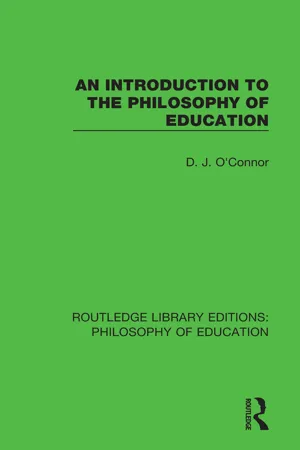
An Introduction to the Philosophy of Education
About this book
Information
1
Philosophy and Education
I
THE phrase 'philosophy of education' occurs commonly in writings about the theory and practice of education. It is however not always obvious what it means. Often, indeed, if we look critically at the uses of phrases like 'the philosophy of education', 'the philosophical basis of education', 'philosophical presuppositions of educational theory' and so on, it becomes clear that they are no more than vague though high-sounding titles for miscellaneous talk about the aims and methods of teaching. Such usages could well be dropped in the interests of clarity. But I certainly do not want to suggest that language of this sort has no proper and useful function. Phrases like 'philosophy of science', 'philosophy of history' or 'philosophy of art' are also used from time to time in a pretentious or muddle-headed way. Yet they can be used to refer to genuine and important fields of enquiry.
Even a non-technical use of the word 'philosophy' in such contexts may be helpful if it is made clear. Sir Godfrey Thomson, in his well-known book A Modern Philosophy of Education, explains that he uses the word 'philosophy' in the title merely 'to indicate that I wish to look at education as a whole, and try to make as consistent and sensible an idea of that whole as I can'.1 Again, the word may occur in such phrases as 'a Christian philosophy of education'. Here it often means no more than guiding values or ideals' as when we talk colloquially of 'a philosophy of life'. Neither of these senses of the word have much connexion with the technical meaning with which we shall be concerned in discussing the philosophy of education. Yet there are ways in which philosophy as a specialized discipline is very relevant to education. And I want to try to work out in this short essay the main ways in which philosophy, in this sense of the word, and educational theory and practice are related. For I believe that philosophical methods and findings can be of service to educational theorists and students of education, just as they can be of service to scientists, literary critics, historians or theologians. But they cannot be of service unless the nature of philosophy and its limitations are first understood.
In this first chapter, I shall try to give an outline account of the respective spheres of philosophy and education. This will enable us to see the possible points of contact between the two subjects. My account of the aims and methods of philosophy will be very sketchy and directed rather to get rid of misconceptions than to give any positive information. I shall have to amplify and justify what I say, at some length, in later chapters.1 In what I say about education, I shall be occupied only in stating some familiar platitudes that may serve to indicate the points with which this chapter is concerned and to clear the ground for future discussion.
II
When a student begins the study of philosophy, he is often surprised to find that much of his time is taken up with getting acquainted with the opinions of the philosophers of the past, in some cases, men who lived well over two thousand years ago. This seems surprising because in subjects like mathematics and chemistry the history of a particular theorem or hypothesis is usually only of incidental interest. Our interest in the theorem of Pythagoras does not arise from the fact that Pythagoras or Euclid first stated and proved it at a certain stage in the history of mathematics. We are interested in it because it follows validly from the foundations of Euclidean geometry and has many useful applications in our everyday world. The ground of our interest in Boyle's law is not that Boyle first formulated it in the seventeenth century but that it describes more or less accurately the way in which gases behave under pressure. If a particular scientific hypothesis such as the caloric theory of heat or the phlogiston theory of combustion is disproved, it is discarded from the body of science and survives, if at all, only as an historical curiosity.
But the student of philosophy learns philosophy to a large extent from the history of his subject. Experience has shown that it is not easy to teach it in any other way, at least to beginners. And here he is further surprised to find that he is not taught the opinions of Plato, Aristotle, Descartes and the rest because they are universally accepted as true. On the contrary, he finds that very few, if any, philosophical doctrines are generally held by philosophers and that he learns what Plato said about knowledge or what Descartes said about the relation between mind and body only, so it seems, to refute them. A large part of undergraduate courses in philosophy consists in destructive criticism of the opinions of the great philosophers from Socrates to Russell. It is not only the student of philosophy who is impressed by the seemingly negative and unprogressive character of philosophical enquiry. Philosophers themselves have tried to find remedies for it from time to time or have tried at least to explain it. And there have been plenty of cynical or sceptical critics who have pointed to the activities of philosophers as evidence that the very hope that philosophy might give knowledge or enlightenment of any kind is a chimerical one. But this sceptical attitude results from misunderstanding the significance of the critical activities of philosophers. Indeed, its significance has been appreciated by philosophers themselves only in quite recent years. The work of Professor G. E. Moore and of Lord Russell in the early years of this century was the first stage of a revolution in philosophy that is still in progress. It is rash to try to summarize the effects of a contemporary movement of this kind but the work of leading philosophers in recent years has made it clear that philosophy is not a body of knowledge of a positive kind like history or botany or law.
In the past, both philosophers and their critics made the mistake of assuming that philosophy was a kind of superior science that could be expected to answer difficult and important questions about human life and man's place and prospects in the universe. In particular, philosophers tried to answer questions of the following kinds: Is there a God and, if so, what, if anything, can we learn by reason about His nature? Do human beings survive their death? Are we free to choose our own courses of action or are human actions events in a causal series over which we can have no control? By what standards are we to judge human actions as right or wrong? How are these standards themselves to be justified?
I said above that it was a mistake to assume that philosophy was a sort of superior and profounder science whose findings would give the answers to questions like these. In saying this, I am putting forward a philosophical theory which, like all such theories, finds no general acceptance. Nevertheless, it can be made very plausible and part of my task in the following chapters will be to explain and defend this view of philosophy and show how it can throw some light on the problems of education. It is a view which is very widely accepted in one form or another at the present day. And even those philosophers who do not accept it have modified their opinions and their methods under its influence. I shall give an elementary account of this view of philosophy in Chapter 2. Elsewhere, I shall try to show some of its uses in practice. For the present it will be sufficient to state that in this view, philosophy is not in the ordinary sense of the phrase a body of knowledge but rather an activity of criticism or clarification. As such, it can be exercised on any subject matter at all, including our present concern, the problems of educational theory.
III
It is a good deal easier to understand the nature, aims and methods of education. In one sense of 'education', we all know very well what it means. The word refers to the sort of training that goes on in schools and universities and so on. But it is not this sense of the word with which we are now concerned. When a student at a university or a training college is said to be studying education, he is not interested only in the very diverse kinds of activities that go on in schools and colleges. The word 'education' has a wider meaning for him, a meaning that can be summarily expressed as follows:
'Education' refers to:
- (a) a set of techniques for imparting knowledge, skills and attitudes;
- (b) a set of theories which purport to explain or justify the use of these techniques;
- (c) a set of values or ideals embodied and expressed in the purposes for which knowledge, skills and attitudes are imparted and so directing the amounts and types of training that is given.
It is the third element (c) that is most clearly relevant to philosophy. This is because (a) and (b), the techniques of teaching and the theories that explain and justify them, are matters that can be determined only by the methods of the positive sciences and in particular, the science of psychology. The question of what techniques are most effective for teaching arithmetic or geography or anything else is a question of fact to be determined by observation, refined by experiment and aided by statistical devices for weighing the evidence obtained. There is no other way of settling such questions. Again, the theories of the educational psychologists about such matters as learning, motivation, the nature and distribution of intelligence, child development and so on are (or ought to be) the theoretical basis on which particular educational techniques or administrative methods are recommended or explained. These theories are part of a science and must be established, if they are to be of any value at all, by the methods appropriate to a science. Philosophy has nothing whatever to do with proving such factual questions. There is however one way in which philosophy may be of service even here. It is not always obvious to students of a science exactly what is the relation of the scientific theories which they study to the facts that support the theories and which the theories are said to explain. Even in the case of the physical sciences, this relation between fact and theory is not always clear to the student, though in these sciences it is usually easiest to understand. And in the case of the biological and social sciences the relations between the facts of experience and the explanatory superstructure of theory is often much more complex and difficult. Now these questions about the nature of theories and their explanatory function are philosophical questions. I shall therefore have something to say in Chapter 5 about the function of educational theories.
Nevertheless, it is the questions of value raised by (c) that are felt most acutely as problems by the student of education and the educational theorist. And on these questions too, philosophy can help, at least to the extent of showing what the problems are and explaining their special character. We can best introduce this matter by considering the question of the aims of education implicit in (c) above. It is obviously the most important question that can be asked on this topic. For upon the detailed answer that is given will depend the whole of the organization and teaching practice of a society. Different ends usually require different means, in education as elsewhere. What then can usefully be said about the aims and objects of education?
There is a sense in which the aim of education must be the same in all societies. Two hundred years from now there will be no one alive in the world who is alive here today. Yet the sum total of human skill and knowledge will probably not be less than it is today. It will almost certainly be greater. And that this is so is due in large part to the educational process by which we pass on to one generation what has been learned and achieved by previous generations. The continuity and growth of society is obviously dependent in this way upon education, both formal and informal. If each generation had to learn for itself what had been learned by its predecessor, no sort of intellectual or social development would be possible and the present state of society would be little different from the society of the old stone age. But this basic aim of education is so general and so fundamental that it is hardly given conscious recognition as an educational purpose. It is rather to be classed as the most important social function of education and is a matter of interest to the sociologist rather than to the educational theorist. Education does this job in any society and the specific way in which it does it will vary from one society to another. When we speak in the ordinary way about the aims of education, we are interested rather in the specific goals set by the nature of the society and the purposes of its members.
The educational system of any society is a more or less elaborate social mechanism designed to bring about in the persons submitted to it certain skills and attitudes that are judged to be useful and desirable in the society. Ultimately, all the questions that can be asked about a given educational system can be reduced to two: (i) What is held to be valuable as an end? (ii) What means will effectively realize these ends? Now if in order to answer this question about the aims of education, it were necessary to survey all the philosophical problems connected with valuation and all the sociological questions about the most effective policies for achieving different ends, it would not be possible to write concisely about the relations between philosophy and education at all. But fortunately, as the question arises in any society, we can take for granted a lot of common ground even between those people who differ most sharply between themselves on education and its aims. For the ordinary day-to-day working of the society itself makes it necessary for its members to have a certain minimum of skills and attitudes in common. And the imparting of this common minimum is one of the ends of education. The question 'What is this minimum?' will be answered differently in different societies. In twentieth-century England, reading, writing and a respect for the law would be a part of the common minimum. In a South Pacific island, swimming, fish-spearing and a respect for one's elders might be more in place.
I propose then to give a tentative list of the aims of education in order to bring out one of the important points of contact between philosophy and education, the issue of the nature and validity of value judgments. I shall purposely make my list neither so specific as to be uselessly controversial nor so vague as to give us no guide to action. To talk of education in Dewey's words as 'a constant reorganizing or reconstructing of experience', or in Thomson's as 'the influence of the environment upon the individual to produce a permanent change in his habits of behaviour, of thought and of attitude', is to be too general. We need not suppose that we are trying to give a 'real' or 'true' definition of the concept we are concerned with. All we need to do here Is to describe in fairly precise and recognizable terms the aims of the social process called 'education' with which we are all, to some degree, familiar from our own experience. When these aims are expressed in general terms, they can form a convenient basis on which educational theorists of the most diverse views can all agree. But as soon as we begin to elaborate some of these aims and specify them more precisely, differences of opinion on their interpretation are bound to arise. With this proviso about the limitations of such a catalogue, I shall list the aims of education as follows:
- to provide men and women with a minimum of the skills necessary for them (a) to take their place in society and (b) to seek further knowledge;
- to provide them with a vocational training that will enable them to be self-supporting;
- to awaken an interest in and a taste for knowledge;
- to make them critical;
- to pat them in touch with and train them to appreciate the cultural and moral achievements of mankind.
Such a list as this may seem merely one more of the edifying platitudes that are so apt to occur in writings on education. My purpose in producing (or reproducing) here a programme of this sort is partly to try to clarify the main points of contact between philosophy and education so that I can show what help the student of education may expect from the activities of the philosopher. For the purposes of my argument, it is immaterial whether it is claimed that these are the 'real' aims or that they ought to be the aims of any system of education. I am saying merely that these aims do as a matter of fact command a wide measure of assent among persons interested in such matters. It will be obvious too that some of these aims can be realized at fairly primitive levels of education while others can be achieved only imperfectly even at very advanced levels. Nevertheless, such are among some of the most important aims of an educational system in any civilized country.
But if we look more closely at the list, it is easy to see that a more precise specification of its contents soon gives occasion for disagreement. The following remarks to explain and amplify the items of the list may therefore be regarded merely as my own recommendations for interpreting a set of rather abstractly stated ends in a more detailed and therefore more practical way. Any such interpretation will make clear the valuations of the interpreter. But as practically any set of value judgments raises much the same philosophical problems, it matters very little which set we take as illustrative. The important thing to notice is that any such list of educational aims must embody, however carefully they may be disguised, the valuations of its proposer. Like superstitions, valuations are dangerous unless they are recognized for what they are.
1 The minimum skills: This is the least controversial of the listed aims. In most civilized societies, constituted as they are at present, men and women must know how to read and write and calculate sufficiently to get through their ordinary daily business. And those of them who have the interest and ability to be technicians or scientists or scholars or artists, will need to develop these elementary skills to a much higher level. They may need, for example, to read and write more than one language and to have a better command of their own or to have at their disposal techniques of calculation far beyond those of simple arithmetic.
2 Vocational training: At its simplest level, this aim will overlap the first. To be able to live as useful members of a society, we must in general be capable of supporting ourselves. Many jobs will always be unskilled and many others can be learned only by doing them. But where the organization of a society is technically complex, a large number of the skilled occupations will always presuppose in the novices who enter on them a considerable body of theoretical knowledge and practical skills. Even to start training to be a doctor or an engineer, a boy must know a good deal of elementary science and mathematics that cannot usually be acquired in less than four or five years of school.
The relation between technological training...
Table of contents
- Cover
- Half Title
- Title
- Copyright
- Original Title
- Original Copyright
- Preface
- Contents
- 1 Philosophy and Education
- 2 The Nature of Philosophy
- 3 The Justification of Value Judgments
- 4 Theories and Explanations
- 5 What is an Educational Theory?
- 6 Some Questions of Morals and Religion
- Bibliographical Notes
- Bibliography
- Index
Trusted by 375,005 students
Access to over 1.5 million titles for a fair monthly price.
Study more efficiently using our study tools.
Frequently asked questions
Yes, you can cancel anytime from the Subscription tab in your account settings on the Perlego website. Your subscription will stay active until the end of your current billing period. Learn how to cancel your subscription
No, books cannot be downloaded as external files, such as PDFs, for use outside of Perlego. However, you can download books within the Perlego app for offline reading on mobile or tablet. Learn how to download books offline
Perlego offers two plans: Essential and Complete
- Essential is ideal for learners and professionals who enjoy exploring a wide range of subjects. Access the Essential Library with 800,000+ trusted titles and best-sellers across business, personal growth, and the humanities. Includes unlimited reading time and Standard Read Aloud voice.
- Complete: Perfect for advanced learners and researchers needing full, unrestricted access. Unlock 1.5M+ books across hundreds of subjects, including academic and specialized titles. The Complete Plan also includes advanced features like Premium Read Aloud and Research Assistant.
We are an online textbook subscription service, where you can get access to an entire online library for less than the price of a single book per month. With over 1.5 million books across 990+ topics, we’ve got you covered! Learn about our mission
Look out for the read-aloud symbol on your next book to see if you can listen to it. The read-aloud tool reads text aloud for you, highlighting the text as it is being read. You can pause it, speed it up and slow it down. Learn more about Read Aloud
Yes! You can use the Perlego app on both iOS and Android devices to read anytime, anywhere — even offline. Perfect for commutes or when you’re on the go.
Please note we cannot support devices running on iOS 13 and Android 7 or earlier. Learn more about using the app
Please note we cannot support devices running on iOS 13 and Android 7 or earlier. Learn more about using the app
Yes, you can access An Introduction to the Philosophy of Education by D. J. O'Connor in PDF and/or ePUB format, as well as other popular books in Education & Education General. We have over 1.5 million books available in our catalogue for you to explore.