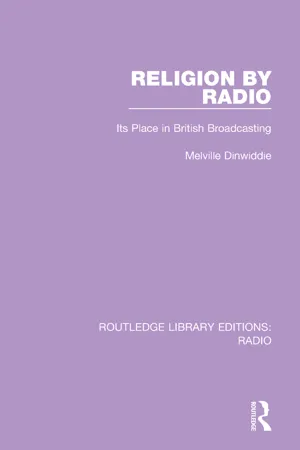
This book, first published in 1968, describes the development of religion by radio, and its influences on people both inside and outside the Church. It tells of experiment and practice, of acceptance and rejection, of inspiration and comfort in peace and war, and assesses the great contribution made by religion to British broadcasting over the decades since the first religious broadcast, on Christmas Eve of 1922.
- 136 pages
- English
- ePUB (mobile friendly)
- Available on iOS & Android
eBook - ePub
About this book
Information
CHAPTER I
THE FRAMEWORK OF RELIGIOUS BROADCASTING
Sowing the Seed
‘Who hath ears to hear, let him hear’
Beginnings are always exciting. The pioneer in radio is a creative artist whose canvas can span the globe and whose target is the hearing ear and the understanding heart. Policy must determine the pattern of planning, and imaginative ideas supply the content and quality of programmes. It was perhaps natural that a broadcasting company whose General Manager was the son of a Scottish Minister should give high priority to religion as a regular ingredient of its output. Mr Reith wrote that he had been more concerned about the religious policy of the BBC in matters great and small than anything else.
Broadcast Stations were opened in London, Birmingham, and Manchester in November 1922, and new horizons began to appear in music, drama, social and political affairs, with news and information, hitherto available only in print or heard at public meetings, brought directly into the homes of the people. In the religious sphere, broadcasting was immediately confronted with the disunity of Christendom, because the churches had reverted to their denominational isolation after much combined war effort. So sadly were they divided that it would have caused little surprise if religion as such had been entirely omitted from the programmes. The commercial purpose of the Broadcasting Company was to attract purchasers of receivers by providing pleasant home entertainment, and religion might have been regarded as an unnecessary extra. For this and other reasons, the programme planners introduced it very gradually – indeed, for the first year of radio in Britain, only some ten minutes on Sunday evenings were allocated for a religious address. On Christmas Eve, little more than a month after regular daily transmissions began, the address was given by J. A. Mayo, Rector of Whitechapel, who thus had the honour of being the first clergyman to broadcast in Britain. He was followed a week later by Dr Archibald Fleming, Minister of St Columba’s (Church of Scotland), who gave a New Year message at midnight on the last night of the old year. So from the very start, barriers of denomination were of less consequence to the BBC than ability to speak at the microphone. The list of preachers who gave the addresses on Sunday evenings during 1923 included a broad mixture – Gipsy Smith, the evangelist, who spoke from the Albert Hall at the first religious outside broadcast; Tubby Clayton, Founder Padre of Toc H; Prebendary Carlile of the Church Army; Father H. Vaughan of the Roman Church; Dr F. W. Norwood of the City Temple; Studdert Kennedy, ‘Woodbine Willie’ of the 1914–18 war; and Dr Pereira, Bishop of Croydon – truly, a varied assortment.
As time went on, requests were received for a full service to be broadcast, but doubts were expressed as to whether it would be suitable for radio. Mr Reith went to Archbishop Randall Davidson for help and advice; he was invited to listen to an address transmitted by radio, and was so much interested that he agreed to call together representatives of the Churches in England to confer about religious broadcasting. This group formed the first Advisory Committee, known as the ‘Sunday Committee’. It met in May 1923 under the chairmanship of Dr Cyril Garbett, then Bishop of Southwark, and discovered a wide area of agreement for the working of this new medium of communication. But many problems had to be solved before a church service could be broadcast. What form of worship; what emphasis on teaching; what aim and purpose in preaching should be pursued? Then a choice had to be made between the varied methods of conducting religious services, the different versions of the Bible, the many hymn books in use and the diversity of church praise before a definite policy could be worked out. In December 1923, Mr Reith, now Managing Director of the Company, wrote in Radio Times, which had begun publication that autumn, ‘It has been decided to try another experiment. We are going to broadcast a complete church service – without prejudice to any denomination. If the result is satisfactory, we shall be guided by our representative Sunday Committee in the matter of further broadcasts of a similar character.’ On January 6, 1924, a service was relayed from St Martin-in-the-Fields. Dick Sheppard was willing to undertake the experiment, but was doubtful whether the music of his church would be suitable for radio transmission. He also anticipated some criticism, and asked that the Sunday Committee should send a formal letter of invitation to his church council so that he might assure them that he was not ‘trying to fix up any sort of stunt with the Broadcasting Company’. He wanted to make it clear that the request for facilities came from a body representing more than one denomination. This service brought so many letters of appreciation that a series of broadcasts was arranged for the second Sunday of each month at 8 o’clock. The preachers were to include men from other denominations in addition to the Church of England, thus beginning a united witness in Britain. Dick Sheppard described these monthly relays as an endeavour to provide ‘a simple service for all’, a proclamation of the Gospel to him that hath ears to hear. This was literally true, because crystal sets and earphones were in general use at that time, and it was said that eighty per cent of the population within crystal range would get an earful of religion by radio.
Local stations, of which there were more than twenty at that time, some with their own advisory bodies, were under no obligation to take the St Martin’s service. As there was only one programme, most of them preferred to relay acts of worship from churches in their own areas, probably a wise practice in view of the wide differences of form and practice. It was not until the Daventry high-power station opened in 1925, when the national network covered the whole of England, that the monthly service from St Martin’s became available as an alternative choice. Scotland and Wales were in due course included, and it is interesting to reflect on the reaction of listeners of very different religious practice to Anglican services heard by radio. Criticism was to some extent avoided by prominent preachers from all over Britain being invited to take part in these broadcasts. Many clergymen were also critical of listening to worship on earphones. Even the highest ecclesiastical authorities were suspicious and had to be convinced that complete acts of worship could be broadcast without blasphemy. The Armistice Day service of 1923 and the relay of the wedding of a member of the Royal Family from Westminster Abbey were refused. The reasons given were that ‘the services would be received by a considerable number of persons in an irreverent manner, and might even be heard by persons in public houses with their hats on’. It was not until some years later that the Dean and Chapter of St Paul’s Cathedral gave permission for broadcasts from that great building though other churches in the metropolis were ready to provide facilities.
Antagonism from atheists and agnostics was to be expected. A letter published in Radio Times in the autumn of 1923 evoked the reply from a freethinker that such items as religious services were futile and unnecessary and should be stopped. In the correspondence which followed, the concensus of opinion was so definitely in favour of their continuance that the advice of the Sunday Committee to extend them became the policy of the BBC. Religious items increased and were to be found in the programmes on weekdays as well as on Sundays. Special broadcasts for children were included, and Evensong was relayed from Westminster Abbey on Thursday afternoons from October 1926. About the same time, the epilogue was introduced as the closing item on Sundays. Mr Reith had asked that the programme that evening should end on a religious note, but it had been difficult to insert such an item at the close of a popular concert. It was decided to have a separate item consisting of a hymn, a few verses of scripture, and a psalm. There was no prayer out of deference for those who were unaccustomed to saying or hearing prayers, though such well-known hymns as ‘Abide With Me’ and ‘Nearer my God to Thee’, were greatly appreciated. The London Station Director, B. E. Nicolls, suggested the title Epilogue, and so this most appropriate way of ending Sunday listening was started and had become one of the permanent features of broadcasting. A listener described it as ‘a perfect benediction’.
In December 1926, Hugh Johnston, Vicar of Cranleigh and a former curate of St Martin’s, was asked to take a daily service as an experiment. Many requests for such an item had been received from listeners, especially invalids and old folk – indeed, a petition had been signed by thousands of people for a half-hour service every day in the afternoon. Although there were as yet no regular morning transmissions, it was decided that a fifteen-minute service at ten-fifteen each weekday morning would be most suitable. The experiment was so well received and appreciated by patients in hospital and the housebound, that the BBC was inundated with some 8,000 letters suggesting subjects for prayer to meet personal needs. Even busy housewives made time to listen, and so began an item which was to continue in peace and war, in times of joy and sorrow, and which still attracts a large and appreciative audience.
It is difficult now to realise the limitations of the programme schedules in these early days. Broadcasting normally began at five o’clock on Sunday afternoons and on week-days, apart from the daily service and a few morning items, transmissions did not start until late afternoon. Technical research, however, quickly extended listening facilities. The high-power station at Daventry, using a wavelength of 1500 metres, gave improved transmission and clearer reception. The increasing use of loudspeakers (the large horn type was then a novelty and sold for the modest sum of around thirty-five shillings in the mid-twenties), made earphones unnecessary, and altered the whole character of home listening. In the religious sphere, it meant that church services and other items would be heard in groups rather than in isolation with the family as the normal unit.
Experiment and research also helped the development of simultaneous broadcasts – known techically as SB – a system which had been used mainly for news and special items. The autonomy of local stations, so much a feature of the early years, resulting from shortage of staff and equipment, was being curtailed by the rapid advance of scientific progress. For religious items, technical changes brought new problems. How far should Sunday services be shared? And how could the needs of local churches be conserved with increased centralisation? If the purpose of this new medium of communication was to make people better Christians, could this be achieved more effectively by local or national broadcasts? Entertainment programmes in the twenties had found their main support in local talent, and it was argued that the same policy should be applied to religion. But there was a vital difference in dealing with the Gospel of Christ, the ultimate unity of which demanded the sharing of resources, and a search for more common ground between denominations, if this unity was to be more than an ideal.
For the first ten years of broadcasting in Britain there was no special staff for the planning and presentation of religious items. In London, J. C. Stobart, an educationist on the programme staff, was asked to look after religion in addition to his own work. He became deeply absorbed in it, and gave much thought to the policy and preparation of services and other items. When he died in 1933, his fine contribution to the development of religious broadcasting received many well-deserved tributes.
At local stations, any member of staff who had time to spare was given the task of supervising religious items. It was little wonder that they suffered from lack of planning and co-ordination until there was a full-time Director of Religion. F. A. Iremonger, Editor of The Guardian, a Church of England weekly, was appointed and took up his duties in July 1933. He brought system and a definite policy into this most important sphere of broadcasting, and welded into a team those in charge of religion in London and the regions. He acted as Secretary to the Central Religious Advisory Committee, known as CRAC, and was able to exert a guiding influence on the deliberations of regional committees. His genial personality and constructive attitude to the wider aspects of radio made him also a consultant and adviser on questions of moral standards, especially in connection with Sunday items, a vitally important function in helping to ensure that only the best was broadcast, and that there was nothing to offend. He became a ‘father-in-God’ to many members of staff, and exercised a unique ministry in its breadth and usefulness. But perhaps the greatest contribution to radio of Freddie Iremonger, as he was familiarly called, was the preparation of the Coronation broadcast of 1937, and his remarkable and deeply reverent commentary of that great event. He retired from the BBC in 1939 and became Dean of Lichfield. His splendid work was recognised by a well-merited doctorate from Glasgow University.
The thirties had begun with the economy of the country at a low ebb and with many unemployed, following the sudden and complete collapse of post-war prosperity in America. Poverty was widespread in Britain; cynics were active against Church and State, and religious faith was far from easy when the essential need of so many people was to secure the bare necessities of life. The churches rose to the challenge of the emergency, and showed a fine spirit of service in bringing the comforts of life and the encouragement of religion to the needy and despairing. Clubs were organised for those without work and kitchens provided soup for the hungry. Broadcasting was used to make known the deep concern of church people for those in need without distinction of class or creed, and showed radio as a useful ally of organised religion.
In spite of the poverty of that period, receiving licences continued to increase. The amount of programme time devoted to religion also increased, and an estimate of the number of religious items broadcast over the whole of Britain in 1932 was ample evidence of steady expansion. From a mere fifteen minutes in 1922, nearly four hours each week were given to religion ten years later, and some ten million licence-holders and their households could hear them. Many choices were also available for those who took the trouble to tune into a particular station, though there was no secular alternative to religious services. The most any listener could do was a bit of sermon-tasting, if he was willing to exercise tolerance and gain understanding by hearing the worship of different denominations. The range of choice was passing to those at the receiving end. Full details of services and other religious items were published in Radio Times and the press, and The Listener, which began publication in 1929, printed excerpts from broadcast sermons. Those who based their religious life on radio were able to become sincere ‘receivers of the Word’. Regular items gradually built up their own audience of those ready to keep tryst with their loudspeakers alone or in family groups. The initial opposition of the churches had not only died down, but had turned into an eagerness to use this medium for the proclamation of the Gospel.
Many developments took place in the years before the Second World War. The Empire Service of the BBC began officially in 1932, and opened up vast possibilities of establishing and maintaining contact with Christians all over the world, and making the Gospel available to those of every race and religion who were able to listen.
Another major contribution was made by two series of addresses, ‘God and the World through Christian Eyes’ and ‘The Way to God’. They dealt with fundamental beliefs, and presented the faith in a comprehensive manner. The speakers were chosen for their intellectual ability rather than their denominational affiliation. It was hoped that listeners would be urged to think more about their personal religion, and that the addresses would result in discussion by groups and argument in the family circle. Pamphlets were issued and correspondence was stimulated. But listeners were reluctant to study the basic truths of religion by radio. The series made little impact outside the membership of the churches.
Considerable audience reaction was voiced, however, in 1936 when the Corporation decided to revise the Sunday programme schedules and permit alternatives to religious items. A service was already broadcast at nine-thirty that morning, and had been accepted by clergy and church authorities with considerable misgivings. It was also decided to begin transmissions of secular items after that service on Sundays instead of the late afternoon. The BBC had to receive much listener criticism and meet deputations from the Lord’s Day Observance Society as well as from others who were trying, often with difficulty, to maintain the sanctity of the Sabbath. Such protests are now of little more than academic interest, but they are useful reminders of the concern of church people at that time to express their fear of a Continental Sunday being introduced into Britain.
War brought drastic reductions in broadcasting. Only one composite programme for the whole country was permitted for reasons of security until February 1940 when a second, known at first as the Forces Programme, was brought into operation. The religion department in London was moved to Bristol and later to Bedford, making its organisation much more difficult. This was in many ways a return to the very early days of the twenties with only a single programme.
The Daily Service and the Sunday Epilogue never ceased to be broadcast, but listeners everywhere had to hear the same Sunday services or none – a demonstration of unity in an emergency dictated by technical restrictions. More religious items were gradually included both on Sundays and week-days and, when the crisis deepened, short acts of intercession were broadcast each night after the nine o’clock news, and often at the close of the evening’s programmes. As was to be expected, war with its national and personal tensions aroused greater interest in religion and gave radio a unique opportunity to meet this need.
In 1940, religious programmes began to assume a certain stability and a recognised shape in the struggle against a ruthless and pagan enemy. Outside broadcasts from churches were resumed, though their locality could not be given, and regional items were allowed on the wavelengths allotted to them. Dr James Welch had succeeded Freddie Iremonger as Director of Religious Broadcasting, and an adequate staff was appointed to serve under him. Eric Fenn, a minister of the English Presbyterian Church; Cyril Taylor, a talented musician; John Williams, and A. C. F. Beales, made an able team in the war years.
One of the first innovations in wartime was an early morning item, a kind of spiritual exercise, coupled with a series of physical jerks, at seven-thirty on weekdays. It began in Scotland in December 1939, with the title ‘Lift up your hearts; a thought for the day’, and it served to remind listeners of the constant need for God’s power and love in the dark days of war. It was heard by a large audience, and survived the war as a regular morning item, though the Daily Dozen stopped soon after the end of hostilities. After twenty-five years in its original form, the title was changed and the content varied to attract a wider audience.
The Forces Programme was provided for members of the Armed Services on land, sea, and in the air, and also became popular with relatives at home, war workers, and those who wanted easy background listening, because it included much light music. Religion found a place in that programme, and this resulted in another innovation – the creation of a radio personality who could speak to and gain the confidence of those on military service. Ronald Selby Wright of the Canongate Kirk in Edinburgh, himself a Chaplain with Army Service both at home and overseas, was chosen for this important work. He became known as the Radio Padre and, in his friendly manner and simple straightforward way of talking at the microphone, broadcast to a remarkable audience of serving personnel, their families, and friends. His influence was wide and far-reaching, and of great value in bringing the essence of the Gospel to those who longed for comfort and encouragement in anxious days, and to others who felt the need of a working faith in such trying times. His talks continued to be heard for some years after the war on both national and regional wavelengths.
Another religious item for easy listening found its way into the Forces Programme. The Sunday Half-hour of Community Hymn Singing was intended for all who could enjoy and perhaps benefit by singing together, whatever their attitude might be to worship and organised religion. Beside...
Table of contents
- Cover
- Half Title
- Title Page
- Copyright Page
- Original Title Page
- Original Copyright Page
- Table of Contents
- Foreword
- Introduction
- 1 The Framework of Religious Broadcasting
- 2 Advice from the Churches
- 3 Worship at Home
- 4 Prayer in Secret
- 5 Broadcast Praise
- 6 Preaching Without Pulpit
- 7 Teaching out of the Air
- 8 Radio Evangelism
- 9 Unity and Universality
- 10 The Wider Impact
- 11 Some Element of Competition
- Epilogue
- Index
Trusted by 375,005 students
Access to over 1.5 million titles for a fair monthly price.
Study more efficiently using our study tools.
Frequently asked questions
Yes, you can cancel anytime from the Subscription tab in your account settings on the Perlego website. Your subscription will stay active until the end of your current billing period. Learn how to cancel your subscription
No, books cannot be downloaded as external files, such as PDFs, for use outside of Perlego. However, you can download books within the Perlego app for offline reading on mobile or tablet. Learn how to download books offline
Perlego offers two plans: Essential and Complete
- Essential is ideal for learners and professionals who enjoy exploring a wide range of subjects. Access the Essential Library with 800,000+ trusted titles and best-sellers across business, personal growth, and the humanities. Includes unlimited reading time and Standard Read Aloud voice.
- Complete: Perfect for advanced learners and researchers needing full, unrestricted access. Unlock 1.5M+ books across hundreds of subjects, including academic and specialized titles. The Complete Plan also includes advanced features like Premium Read Aloud and Research Assistant.
We are an online textbook subscription service, where you can get access to an entire online library for less than the price of a single book per month. With over 1.5 million books across 990+ topics, we’ve got you covered! Learn about our mission
Look out for the read-aloud symbol on your next book to see if you can listen to it. The read-aloud tool reads text aloud for you, highlighting the text as it is being read. You can pause it, speed it up and slow it down. Learn more about Read Aloud
Yes! You can use the Perlego app on both iOS and Android devices to read anytime, anywhere — even offline. Perfect for commutes or when you’re on the go.
Please note we cannot support devices running on iOS 13 and Android 7 or earlier. Learn more about using the app
Please note we cannot support devices running on iOS 13 and Android 7 or earlier. Learn more about using the app
Yes, you can access Religion by Radio by Melville Dinwiddie in PDF and/or ePUB format, as well as other popular books in Social Sciences & Media Studies. We have over 1.5 million books available in our catalogue for you to explore.