First published in 1987, this book is an attempt to re-establish semiotic on the basis of principles consistent with its past history, rather than the 'cultural semiotics' of the European tradition, and especially with the guiding ideas of Peirce and Morris. The book is divided into two parts, with the first two chapters providing the background for the more systematic discussions of signs at different levels taken up in the last three. In the final chapter issues that have become the focus of recent philosophy of language regarding the reference, meaning, and truth of sentences are discussed in light of the analogies to more primitive signs developed in the preceding two chapters.
In contemporary philosophy the focus of study is the use and interpretation of language. To study scientific inquiry is to study the language of science and how it is used; to study legal decision-making is to study the language used in applying laws; to study aesthetic expression is to study the symbolic forms for this expression; and so it is for every human activity. For philosophy seeks to understand the nature of thought, and to think is to use and interpret language, sometimes as it is publicly expressed by ourselves and others, sometimes in the form of what Plato calls in the Phaedo the ‘inner dialogue of the soul with itself where public expression is suppressed or delayed. If we had special introspective powers by which we could directly intuit the nature of our thought processes, then language might play a less central role in philosophical investigations. But we have no such powers, and previous attempts to describe directly these processes andtheir contents through such terms as ‘concept’, idea’, ‘sense data’, etc. can be shown to be in fact importing distinctions derived from language. Hence the shift instituted at the end of the nineteenth century by Frege and Peirce from a conception of philosophy as the study of psychological processes to one concentrating on the description and analysis of linguistic expressions.
On these points almost all can probably agree, and the justification for making the shift is generally accepted. Differences arise mainly over the method to be used in studying language and the objectives to be pursued. It is helpful at this preliminary stage to review briefly the two methods that have dominated recent philosophy in the English-speaking world and to raise some difficulties that confront them. This will help us to determine the special role semiotic can hope to play in relation to contemporary studies of language.
1.1 Logical analysis
Bertrand Russell can be credited with instituting the widely adopted method for applying the symbolism and paraphrase techniques of modern predicate logic to sentences in natural languages in order to clarify their meaning, and thereby correct philosophic conclusions based on a misunderstanding of their logical form. Russell’s paradigm sentence, the one whose analysis can be regarded as starting the logical program, was
(1) The present king of France is bald which he paraphrased by
(2) Exactly one (material) thing is such that it is a king of France and bald
Its representation in symbolic notation becomes finally
(3) ∃x[Kx & ∀y(Ky ⊃ y=x) & Bx]
with ‘K’ for ‘is a king of France’ and ‘B’ for ‘is bald’. In (3) the existential quantifier ‘∃x’ and the first two conjuncts within its scope have the effect of stating that there exists at least one king of France and at most one (any other thing which is a king of France will be identical with the one which has been stated to exist). The third conjunct as quantified states this king is bald. The effect of the paraphrase is to change the subject from the original grammatical subject ‘the present king of France’ in (1) to the general subject ‘thing’ or ‘material thing’ of (2). This latter is the logical subject, and is represented by the variable ‘x’ within the existential quantifier. The ‘true’ meaning of (1) is revealed, Russell claims, only by the paraphrase, and this meaning is represented by the sentence’s logical form as (3).1 The project of analysis begun by Russell was to be carried out by similarly paraphrasing and representing all those other sentences of ordinary language whose grammatical form disguised logical form in a way giving rise to philosophical confusions.
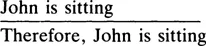
The symbolism of formal logic was originally designed to represent the form of sentences within the context of inferences in order to evaluate these inferences as valid or invalid. In order to make such evaluations the logician must make certain assumptions. The most fundamental are those which insure a connection between the premisses and conclusion of a given inference. Consider an example of the simplest of all inferences,
(4)
in which the conclusion simply repeats the premiss. It is, of course, valid. But in order to establish its validity we must assume that the sentence ‘John is sitting’ as it occurs in the premiss expresses the same content in the conclusion. This common content necessary for validity is labelled the ‘proposition’ expressed by the two occurrences or tokens of the sentence. Sameness of proposition in turn requires first that what logicians call the ‘denotation’ of its subject term ‘John’ remains constant, i.e., that there be a unique individual which both occurrences of the name denote. And second, granted that we have the same proposition, we must assume its truth value remains constant, that if it is true in the premiss it remains true in the conclusion. John could stand up between the time a speaker utters the premiss and then utters the conclusion, and hence the premiss would be true and conclusion false. Logic must assume that this does not occur. The effect of these assumptions is to abstract the sentence ‘John is sitting’ as it occurs in the content of inference (4) from its use or interpretation by a person on a given occasion. All we need to know in evaluating (4) as valid is that if the premiss were true then the conclusion would be true also. For this a person’s assertion of or assent to the sentence at a given time and place is irrelevant.
Outside inferential contexts, of course, sentences function very differently. On different occasions of use the name ‘John’ may be used by a speaker to refer to different individuals. The triadic relation between an utterance of a name within a sentence, a person using or interpreting the sentence, and a referent, is thus different from the dyadic relation between the name and what it uniquely denotes as considered by the logician for his special purposes of evaluating inferences (cf. below Section 5.2). And similarly for change of truth value. ‘John is sitting’ as used on one occasion can be asserted as true, while on another denied as false, contrary to what must be assumed when the sentence is used as a premiss and our task is inference evaluation.
It is small wonder, then, that Russell’s project of employing techniques and symbolism designed for inferences where truth and denotation constancy are assumed, would encounter difficulties when applied to sentences isolated from inferential contexts. As Strawson has shown, it is because the assumptions do not generally hold of these sentences that Russell’s paraphrase and representation of sentence (1) is defective.2 To assert the proposition it expresses as true, or to assent to it, presupposes the existence of its referent on that occasion. Only if we can identify the referent of the singular term ‘the present king of France’ can we judge the proposition true or false. Since this condition does not hold (in fact, there is no such referent), (1) cannot be asserted or assented to. Yet (2) must be asserted as false, since its first conjunct as quantified falsely states there is at least one king of France.3 Hence, (2) cannot be regarded as having the same logical meaning expressed in more perspicuous form as (1).
Implicit in Russell’s project of analysis is the assumption that every sentence with a specific meaning has a unique logical form which paraphrase and logical representation can reveal. The meaning of a sentence is regarded as equivalent to the totality of consequences that it (or the proposition it expresses) logically entails. To specify a sentence’s meaning then becomes the task of representing its form in such a way that the inferences to all these consequences can be shown to be valid. But, in fact, no one logical representation will justify this indefinite number of inferences. Consider, for example, Donald Davidson’s analysis of action sentences such as
(5) John walks in the street
which Davidson proposes to paraphrase by ‘There is an event which is such that John walks in it and it (the event) is in the street.’ This is finally represented by
(6) ∃x(Wjx & Ixs)
This is claimed to represent the form of (5), since it justifies the inference to its consequence ‘John walks’.4 Indeed, this inference is justified, but the cost in intuitive plausibility is a high one, since we are forced into introducing a variable ranging over events, names of individual things such as persons and things, and strange relations between them, e.g. the relation of walking in between John and an event. Moreover, there are other consequences which (6) will not justify, consequences such as ‘John sometimes walks’, ‘John walks somewhere’, and ‘It is possible that John walks’. To represent them we will have to introduce additional variables ranging over other ‘objects’ such as times, places, and actual and possible worlds. Such objects require even more bizarre relations between them.
All of this seems to show that there is not some meaning of (5) which some unique logical form can specify. Instead, there is an indefinite variety of inferential contexts in which (5) can occur, and as these contexts vary we vary our logical representation in order to justify those inferences which on the basis of pre-logical intuitions we accept as valid. Logical representation is not a means of specifying the meaning of an isolated sentence, but instead a device for evaluating a specific inference in which the sentence may occur.
Logical analysis has thus its principal application to a special use of language, that of deductively inferring conclusions from premisses. It can also be extended to assist in the solution of specific philosophical problems, and has proved successful as a means of criticizing mistaken inferences from grammatical form to ontological conclusions. The symbolism of logic is also useful as an abbreviating device for stating general conclusions not restricted to this or that particular example. But as a general theory of language and meaning it has not had and cannot have the success its advocates have hoped for it.
1.2 Ordinary language description
The so-called ‘ordinary language’ school of philosophy instituted by the later Wittgenstein, Austin, Ryle, and Strawson used a very different method. Instead of paraphrasing and representing sentences in the manner required for inference evaluation, they undertook to describe the use of a variety of categories of sentences, including imperatives, expressions of feelings and emotions, and reports of sensations, in addition to the fact-stating indicative sentences that occur in standard deductive inferences. There are rules governing the use of sentences in these various categories, and it becomes the role of philosophy to make them explicit. Of special interest are what Austin terms ‘performatives,’ sentences containing prefixes such as ‘I promise that …’ or ‘I state that …’ which are used by speakers to perform the speech acts described by their main verbs, verbs such as ‘promise’ or ‘state’. But the explication of rules of use is also extended to sentences containing words such as ‘believe’, ‘certain’, ‘voluntary’, ‘ought’, etc., often with the intent of criticizing a traditional philosophic theory which is claimed to be based on a misunderstanding of their use.
Doubts must be raised about the long-term viability of this method. First of all, granted its success as a means of criticizing assumptions made in modern philosophy since Descartes, once the criticisms have been completed there seems little else to accomplish. There is a limited number of errors that can be presumed to have been made in the historical tradition because of a misunderstanding of key words of ordinary language. Having exposed them, at least this reason for studying the rules governing the use of ordinary language will come to an end. Indeed, this prospect is envisaged by Wittgenstein when he predicts the demise of philosophy once the ‘therapy’ of disclosing its violation of rules of ordinary language has been completed.
As for the constructive task of simply describing linguistic rules, this also threatens to come to an end as a distinctively philosophical project. The science of linguistics has gradually incorporated most of philosophy’s main findings as it has extended beyond the study of the syntax of language to the fields of semantics and pragmatics. The rules governing the use of performatives and the presuppositions for this use, for example, have become the subject matter of pragmatics as a branch of linguistics, and the statement of these rules is virtually indistinguishable from that given by the ordinary language philosophers. Just as the a priori introspective psychology of modern philosophy was, in Austin’s words, ‘kicked upstairs’ to become part of empirical psychology, so philosophic conclusions reached about language have supplied the foundations for new areas of linguistics.
An attempt to distinguish the philosophy of language from linguistics can be made by claiming that philosophy attempts to state necessary or essential features of language, features which every natural language must have, while linguistics states contingent features which languages happen to have as the result of the special needs and arbitrary choices of the communities in which they have evolved. Thus, it can be claimed, and with justification as we shall see in Chapter 5, that every sentence must have a subject-predicate structure, while the specific grammatical rules which specify agreement between nouns and verbs will vary from one language to another. These rules will then be the subject matter of linguistics, while the subject-predicate distinction is a philosophical one.5 But linguistics is also concerned with specifying universal features of languages, features which are in fact shared by all the world’s surveyable languages. Included among these are the subject-predicate structure of sentences, as well as universal phonological laws which place constraints on the permissible sequences of speech sounds, for all languages. These universal features are inferred on the basis of an inductive inference from empirical evidence, and are in this sense contingent features. How do we distinguish them from the necessary features sought by philosophy? Within the framework of language itself it is difficult to make this all-important distinction, and vague intuitions seem to become the final court of appeal.6
In fact, few philosophers in the ordinary language tradition (Strawson is a notable exception) have even attempted to confront this problem. Its critics have noted the almost indefinite variety of linguistic forms studied and the haphazard selection from among them that has often been made.7 Often selected for attention, as we have noted, has been a word or phrase which is the source of what is claimed to be a confusion made by the historical tradition. But relevant though they may be for historical corrections, such selections seem to be totally irrelevant to a general theory of language. Again, certain features of language are presumably central for any such philosophic theory, but ordinary lang...
Table of contents
Cover
Half Title
Title Page
Copyright Page
Original Title Page
Original Copyright Page
Dedication
Table of Contents
Preface
1 Introduction
2 History of Semiotic
3 Natural Signs
4 Communication
5 Language
Postcript
Notes
Name Index
Subject Index
Trusted by 375,005 students
Access to over 1.5 million titles for a fair monthly price.
Study more efficiently using our study tools.
Frequently asked questions
Yes, you can cancel anytime from the Subscription tab in your account settings on the Perlego website. Your subscription will stay active until the end of your current billing period. Learn how to cancel your subscription
No, books cannot be downloaded as external files, such as PDFs, for use outside of Perlego. However, you can download books within the Perlego app for offline reading on mobile or tablet. Learn how to download books offline
Perlego offers two plans: Essential and Complete
Essential is ideal for learners and professionals who enjoy exploring a wide range of subjects. Access the Essential Library with 800,000+ trusted titles and best-sellers across business, personal growth, and the humanities. Includes unlimited reading time and Standard Read Aloud voice.
Complete: Perfect for advanced learners and researchers needing full, unrestricted access. Unlock 1.5M+ books across hundreds of subjects, including academic and specialized titles. The Complete Plan also includes advanced features like Premium Read Aloud and Research Assistant.
Both plans are available with monthly, semester, or annual billing cycles.
We are an online textbook subscription service, where you can get access to an entire online library for less than the price of a single book per month. With over 1.5 million books across 990+ topics, we’ve got you covered! Learn about our mission
Look out for the read-aloud symbol on your next book to see if you can listen to it. The read-aloud tool reads text aloud for you, highlighting the text as it is being read. You can pause it, speed it up and slow it down. Learn more about Read Aloud
Yes! You can use the Perlego app on both iOS and Android devices to read anytime, anywhere — even offline. Perfect for commutes or when you’re on the go. Please note we cannot support devices running on iOS 13 and Android 7 or earlier. Learn more about using the app
Yes, you can access Principles of Semiotic by David S. Clarke in PDF and/or ePUB format, as well as other popular books in Langues et linguistique & Linguistique historique et comparative. We have over 1.5 million books available in our catalogue for you to explore.