Observers of Iran have often ascribed the main cause of the revolution to economic problems under the Shah's regime. This book, first published in 1990, on the other hand focuses on the political and social factors which contributed of the Pahlavi dynasty. Mehran Kamrava looks at the revolution in detail as a political phenomenon, making use of extensive interviews with former revolutionary leaders, cabinet ministers and diplomats to show the central role of the political collapse of the regime in bringing about the revolution. He concentrates on the internal and the international developments leading to this collapse, and the social environment in which the revolution's leaders emerged.
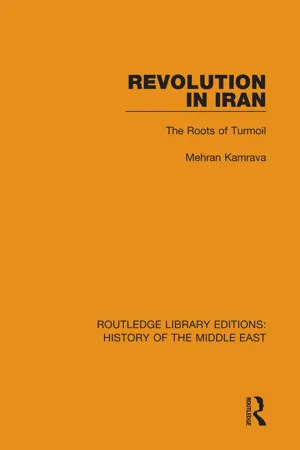
- 186 pages
- English
- ePUB (mobile friendly)
- Available on iOS & Android
eBook - ePub
About this book
Information
Chapter one
Causes of revolution
Social scientists have long been engaged in an ongoing debate over the concept of revolution, its causes, and its consequences. The Iranian revolution has added great stimuli to this debate by challenging some of the main premisses on which most theories of revolution are based. At the same time, it has validated some other premisses of the existing theories, although in all instances this validation has been limited and has not been inclusive of an entire theoretical framework. The Iranian revolution has, in essence, called forward the necessity of re-evaluating existing explanations for why revolutions take place. Such a reevaluation has yet to occur in a systematic and in-depth manner. Nevertheless, the Iranian revolution has prompted at least one expert on the study of revolutions to alter some of her original arguments.1 This chapter will examine the applicability of some of the prominent theories of revolution to the Iranian example. Based primarily on the Iranian model, an effort will also be made to try to identify the main areas where future scholarship on revolutions needs to place greater emphasis.
Theories of revolution
One of the main theoretical frameworks for the study of revolution has come to be known as the value-systems approach. According to this paradigm, revolutions are likely to occur when discrepancies develop between a society’s values and the realities of its social life. This line of argument, elaborated by Chalmers Johnson, identifies the rapid displacement of social values and norms as the underlying cause of mass opposition to a regime. Johnson argues that revolutions need to be studied in the context of the social systems in which they occur. ‘The analysis of revolution’, he writes, ‘intermeshes with the analysis of viable, functioning societies, and any attempt to separate the two concepts impairs the usefulness of both.’2 Johnson argues that social systems are homeostatic, (i.e. self-regulating) and can thus adapt to changes and influences that act on them in their environment.3 When a society loses its capability to adapt to environmental changes, it becomes ‘disequilibrated’, a condition that arises out of ‘dissynchronization’ between a society’s values and its division of labour.4 The disequilibration of a system does not automatically lead to revolution. There still need to be appropriate ‘accelerators’ as well as ‘elite intransigence’ in a disequilibrated system for revolutions to occur.5 Johnson identifies three types of accelerators: military weakness or disarray within the incumbent forces; the confidence of the revolutionaries in overpowering the elite; and the military and strategic actions that the revolutionaries initiate against the elite’s armed forces.6 The regime, losing its legitimacy because of the displacement of values, relies increasingly on its coercive forces in order to stay in power. Once the regime’s values are no longer considered to be legitimate, the success of the revolution depends primarily on the revolutionaries’ military victory over the intransigent elite.7
A second group of scholars examine causes of revolution by relying on an ‘aggregate psychological’ approach. The proponents of this approach argue that the stability or the instability of a political system ‘is ultimately dependent on a state of mind, a mood, in a society’.8 A mass of people frustrated with a regime and in close contact with one another form a ‘critical mass’, one that is capable of mobilizing itself in opposition to a regime.9 Ted Gurr and James Davies have relied on this approach extensively in explaining the reasons that underlie various forms of political unrest. Davies argues that revolutions are likely to erupt when people perceive, rather than actually experience, a reduction in their social and economic opportunities.10 In a statement that has come to symbolize his theory, Davies claims: ‘Revolutions are likely to occur when a prolonged period of objective economic and social development is followed by a short period of sharp reversal.’11 An abrupt termination of economic growth and opportunities for social and economic advancement will lead to the frustration of hopes and expectations, leading in turn to political opposition. Identifying psychological frustration as the main factor in causing revolutions, Davies contends that revolutions will not occur in a society ‘where there is the continued, unimpeded opportunity to satisfy new needs, new hopes, new expectations’.12 Similarly, revolutions will not take place where there is ‘no hope, no period in which expectations have risen’.13
Gurr adopts an approach similar to that of Davies, although his theoretical framework is considerably more comprehensive and stronger than Davies’. Similar to Davies, Gurr sees psychological frustration as the principal cause of revolutions. Frustration arises when the expectations that are commonly perceived to be attainable are not realized. Gurr calls this condition ‘relative deprivation’.14 He outlines three patterns of relative deprivation, namely aspirational, decremental, and progressive deprivation. Decremental deprivation occurs when value expectations remain relatively constant but value capabilities are thought to decline -deprivation is experienced in relation to one’s own past. Traditional societies and transitional societies are most likely to be affected by decremental deprivation.15 A more common form of deprivation occurs when rising expectations are not fulfilled and the desire to gain is frustrated. Gurr calls this aspirational deprivation, which occurs when capabilities remain static but expectations rise.16 There is also progressive deprivation, occurring when expectations increase but at the same time capabilities decrease. This form of deprivation is most prevalent in modernizing societies, where newly emerging social classes frequently find their social and economic opportunities restricted by the limited capabilities of their society.17 Relative deprivation, according to Gurr, prepares the society for the occurrence of revolution. ‘Discontent’, he writes, ‘leads men to political violence when their attitudes and beliefs focus it on political objects, and when institutional frameworks are weak enough, or opposition organizations strong enough, to give the discontented a sense of potency.’18 In order to gain dominance over one another, both the contenders and the incumbents must maintain ‘enduring social support by providing patterns of action that have predictably rewarding consequences for their followers’.19 The success of a regime or that of dissident organizations depends on such characteristics as their scope, cohesiveness, and complexity, and on the dissidents’ ability to provide their supporters with ‘value opportunities, satisfactions and means for expressive protest’.20
Johnson, Davies, and Gurr all agree that revolutions start non-voluntarily and without the cognitive initiatives of would-be agitators. Charles Tilly, on the other hand, holds that revolutions are brought about by the wilful efforts of contending political actors. Tilly explains causes of revolution in basically political terms. Arguing that ‘multiple sovereignty’ is the identifying feature of revolutionary situations,21 Tilly claims that revolutionary movements arise when ‘previously acquiescent members of the population find themselves confronted with strictly incompatible demands from the government and from an alternative body claiming control over the government, and those previously acquiescent people obey the alternative body’.22 The important preconditions for the occurrence of revolutions, according to Tilly, are not social or social-psychological developments but rather ‘interests, mobilization, strategy, repression, and power positions’.23 Three sets of circumstances, he argues, lead to revolutions: the appearance of contenders making exclusive claims to power; commitment to those claims by a significant segment of the population; and the unwillingness or the incapacity of the government to suppress the alternative coalition.24 Revolution, therefore, necessitates that significant segments of the population recognize as legitimate the political authority of a body independent of the government. How such an alternative and revolutionary body is formed, according to Tilly, ‘remains one of the mysteries of our time’.25
Besides Tilly, a number of other scholars have also sought to explain the causes of revolutions by examining the political dynamics of the pre-revolutionary states. Theda Skocpol, Samuel Huntington, and more recently Jerrold Green are some of the more notable representatives of this group of social scientists.26 Huntington and Green focus on the social ramifications of the process of state building undertaken by the pre-revolutionary regime. Skocpol, however, concentrates mainly on the structural collapse of the pre-revolutionary polity.
Huntington sees revolutions as a side-effect of modernization.27 He argues that modernization leads to the emergence of new social classes who, among other things, demand the right to participate in the political process.28 The greatest demands for political participation come from the middle class, which constitutes the ‘true revolutionary class’ in most modernizing societies.29 This revolutionary class emerges in societies that have experienced some social and economic development, especially in places where the process of political development lags behind the process of social and economic change.30 More specifically, revolutions are likely to occur when (1) political institutions are capable of providing new channels for the participation of new social forces into politics, and (2) when the social classes that are currently excluded from politics wish to take active part in the political process.31
Jerrold Green agrees with this general approach, although he divides the process of political participation into the ‘mobilization’ and the ‘countermobilization’ stages. Modernization, Green argues, implicitly politicizes a population. ‘The denial of political participation to such politicized sectors can lead to popular unrest. This in its most extreme form may spell revolution.’32 Demands for political participation lead to political mobilization. If the government is incapable of controlling this mobilization (through political parties, voting systems, or other mechanisms for political input), then ‘countermobilization’ occurs, which, Green claims, is itself a form of revolution. The conditions that lead to ‘countermobilization’ are: a decline in the coercive powers of the state; a simplification of politics; the politicization of traditionally non-political groups; crisis-initiating events; and exacerbating responses by the regime.33 As an ‘antecedent to full-scale countermobilization’, a simplification of politics divides the pre-revolutionary society into two crude groupings: those who oppose the regime and those who support it.34 As the opposition to a regime widens, ‘the oppositional pole exercises an undisceming, almost magnetic pull, passively attracting supporters rather than actively recruiting them’ (original emphasis).35 This passive attraction to opposition groups or at least to their causes and ideals by large segments of society results in the politicization of groups who would otherwise remain aloof of politics. Finally, a series of crises or government initiatives occur and result in the final pre-condition for ‘countermobilization’, namely the transition from reformism to revolution.36 The revolution feeds itself, Green argues, ‘with each triumph leading to greater heights of unity and cohesion’.37
The last theoretical explanation for the occurrence of revolutions considered here is that put forward by Theda Skocpol. Instead of pointing to the appearance of ‘multiple sovereignty’ or a ‘participation crisis’ as the underlying cause of revolutions, Skocpol originally focused on the political collapse of states and on class-based antagonisms. She argued that revolutionary crises develop when the state becomes unable to meet the challenges of evolving international situations. Such challenges often arise out of military conflicts between competing states. Skocpol based her arguments on the examples of the French, Russian, and Chinese revolutions. ‘Caught in the cross-pressure between domestic class structures and international exigencies’, she wrote, ‘the (pre-revolutionary) autocracies and their centralized administrations and armies broke apart, opening the way for social revolutionary transformations spearheaded by revolts from below.’38 Relying on a ‘structural perspective’,39 Skocpol argued that once the old regime states were broken apart, political and class conflicts were set in motion, not to be resolved until the establishment of new administrative and military organizations.40 Her emphasis on structural dynamics led her to conclude that revolutions start non-voluntarily and nonpurposively, emphasizing ‘objective relationships and conflicts among variously situated groups and nations, rather than the interests, outlooks, or ideologies of particular actors in revolutions’.41 Despite the role often ascribed to ‘vanguard’ parties, Skocpol argued that revolutions ‘come about only through inter- and intranational structural contradictions and conjunctural occurrences beyond the deliberate control of avowed revolutionaries’.42
At first glance, it would seem that all of the theories discussed here apply to the example of the Iranian revolution. Johnson’s systems-value theory is validated by its contention that the rapid social and cultural changes that occurred in Iran in the 1960s and the 1970s led to the ‘disequilibrium’ of Iranian society and ultimately resulted in a revolutionary eruption in 1978–79. The ‘accelerators’ that propelled Iran’s disequilibrated society into revolutionary circumstances, according to this frame of reference, included among other things the abrupt reduction of oil prices after 1973 and President Carter’s human rights policies. The theories of Davies and Gurr are also both validated by the sudden reversal of the generally positive economic conditions of the early 1970s after 1975 and a subsequent rise in the level of unemployment among aspiring groups and classes.
Political explanations for the causes of revolution appear to be equally applicable to the case of Iran. The gathering in Paris of a coalition of Iranian revolutionaries and their claim that the government in Tehran was ‘illegal’ corresponds with Tilly’s identification of ‘multiple sovereignty’ as the leading pre-condition for revolutionary episodes. Huntington’s arguments find similar applicability, particularly in presenting an accurate description of the groups who spearheaded the revolution and the reasons why they did so. The Pahlavi state was indeed overthrown by the social classes that were brought about as a r...
Table of contents
- Cover
- Half Title
- Title
- Copyright
- Original Title
- Original Copyright
- Contents
- List of tables
- Preface
- 1 Causes of revolution
- 2 The Pahlavi state
- 3 Opposition to the regime
- 4 Social change
- 5 Revolutionary mass mobilization
- 6 Conclusion
- Appendix
- Notes
- Bibliography
- Index
Trusted by 375,005 students
Access to over 1.5 million titles for a fair monthly price.
Study more efficiently using our study tools.
Frequently asked questions
Yes, you can cancel anytime from the Subscription tab in your account settings on the Perlego website. Your subscription will stay active until the end of your current billing period. Learn how to cancel your subscription
No, books cannot be downloaded as external files, such as PDFs, for use outside of Perlego. However, you can download books within the Perlego app for offline reading on mobile or tablet. Learn how to download books offline
Perlego offers two plans: Essential and Complete
- Essential is ideal for learners and professionals who enjoy exploring a wide range of subjects. Access the Essential Library with 800,000+ trusted titles and best-sellers across business, personal growth, and the humanities. Includes unlimited reading time and Standard Read Aloud voice.
- Complete: Perfect for advanced learners and researchers needing full, unrestricted access. Unlock 1.5M+ books across hundreds of subjects, including academic and specialized titles. The Complete Plan also includes advanced features like Premium Read Aloud and Research Assistant.
We are an online textbook subscription service, where you can get access to an entire online library for less than the price of a single book per month. With over 1.5 million books across 990+ topics, we’ve got you covered! Learn about our mission
Look out for the read-aloud symbol on your next book to see if you can listen to it. The read-aloud tool reads text aloud for you, highlighting the text as it is being read. You can pause it, speed it up and slow it down. Learn more about Read Aloud
Yes! You can use the Perlego app on both iOS and Android devices to read anytime, anywhere — even offline. Perfect for commutes or when you’re on the go.
Please note we cannot support devices running on iOS 13 and Android 7 or earlier. Learn more about using the app
Please note we cannot support devices running on iOS 13 and Android 7 or earlier. Learn more about using the app
Yes, you can access Revolution in Iran by Mehran Kamrava in PDF and/or ePUB format, as well as other popular books in Social Sciences & Regional Studies. We have over 1.5 million books available in our catalogue for you to explore.