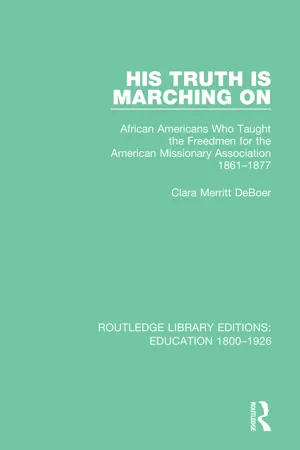
This title, first published in 1995, explores the history of the American Missionary Association (AMA) – an abolitionist group founded in New York in 1846, whose primary focus was to abolish slavery, to promote racial equality and Christian values and to educate African Americans. This title will be of interest to students of history and education.
eBook - ePub
His Truth is Marching On
African Americans Who Taught the Freedmen for the American Missionary Association, 1861-1877
- 420 pages
- English
- ePUB (mobile friendly)
- Available on iOS & Android
eBook - ePub
His Truth is Marching On
African Americans Who Taught the Freedmen for the American Missionary Association, 1861-1877
About this book
Information
I
Overview of Ama Work During the Civil War
The Constitution of the United States recognizes him as a person. In the days of Thomas Jefferson, Virginia and other States designated him as a citizen. The prowess of Small and other colored individuals, and the good conduct and courage of the colored troops, have proved him to be a soldier and a hero. The eloquence of Douglass and of other sable speakers, has shown that he can be an orator. The piety of thousands of colored men evince that he can be a Christian. If, then, he is a person, a citizen, and capable of being a soldier, an orator, and a Christian, none but an idiot or a blockhead would assert that he is not a MAN.
—Lewis Tappan, February, 1865
It is important at the beginning of this study to introduce Lewis Tappan, author of the above words, and to give some perspective to the American Missionary Association (AMA), of which Tappan was a founder and leader.
Lewis Tappan—administrative genius of the abolition movement, business man (who founded the company now known as Dun and Bradstreet), and churchman—was the unpaid Treasurer of the AM A for almost two decades and its most respected spokesman. Unlike the Garrisonians, who believed their mission was accomplished when slavery was abolished in the United States,1 Tappan and the AMA did not rest at emancipation but went on to attack "caste," institutionalized racism that treated African Americans as something less than human beings. In his February, 1865, call for an end to America's discrimination against the black man, Tappan went on to say:
If then, the Negro is a man and a citizen, he is entitled to the treatment of a man and a citizen, and unless he is recognized and treated as such, he cannot be safely elevated in the scale of being. It will be in vain that he is liberated, that arms are put into his hands, that he is educated, that he is religiously instructed. And it will be worse than in vain, because if unacknowledged as a man entitled to all the prerogatives of a man and a citizen he will be a dangerous person in the community—the more dangerous in proportion to his intelligence, native and acquired.
As a missionary Association, having in view the intellectual, moral and religious good of men and especially of the people of color, and particularly the recently emancipated, and those who in the providence of God, and the march of events, are speedily to be emancipated, we claim that our colored brother should be treated in all respects as a man and as a citizen, by the churches, by the Government, and by the people.
At present, he does not receive such treatment either from the churches, the Government, or the people; to their shame be it spoken! Churches refuse him admittance to their pews and communion on equal terms; Government does not award to him the pay and honors due to his valor, nor shield him from the insolence and cruelty of others; and the people ostracize him from the esteem, and confidence, and emoluments of his country.
If the United States aims to be a righteous nation, and a power and example of civil and religious liberty to the nations of the earth; if its churches feel the obligation of christianizing its people, and aiding in the evangelization of the world; if the people expect the blessing of heaven upon their efforts to secure peace, respect, and honor to themselves and their posterity, let them first conquer themselves, and then award equity to those who are with themselves common inheritors of civilization and Christianity, and the joint subjects of retributive justice on earth, and at the bar of God.2
The AMA was founded in 1846 as an abolition organization by churchmen—black and white, mainly Congregational and Presbyterian—as a protest against the practice of denominational and interdenominational mission agencies of accepting money from slaveholders. Having tried unsuccessfully, as supporters of these agencies, to reform them from within, they finally saw no alternative to establishing a new organization that would not be thus tainted. The AMA was closely allied with the American and Foreign Anti-Slavery Society (the Tappanite wing of the abolition movement) and shared offices with it for many years in New York City, Lewis Tappan was a key officer in both organizations.
The AMA still exists today as a mission arm of a Protestant denomination, the United Church of Christ, that is a successor through church union of the Congregational churches of the nineteenth century.
Although it is not—and was not—primarily an educational organization, it did more to educate the freed slaves than any other organization, including the Freedmen's Bureau. The AMA's financial contribution to the education of African Americans through 1893 was twice as much as that of the Freedmen's Bureau during this period and second only to the aggregate of all the funds expended by all the Southern states and cities.3 In 1867 almost one third of all the teachers reported by the Freedmen's Bureau at work in the South were commissioned by the AMA.4
"New England School Marms"?
The prevailing myth has been that "New England school marms" were the teachers sent to the South. In fact, as this study shows, many were from the Middle West, about one-third were men, and many were African Americans from both the North and the South. The AMA is best known for its educational work on behalf of African Americans, establishing some 500 schools and colleges including Fisk, Hampton, Atlanta, and Howard. This reputation is deserved. But this study focuses on what African Americans did in and through the AMA; some 500 African American abolitionists were discovered. In contrast to other abolition organizations, the AMA was established with four African Americans on its policy-making board of twelve men.5 William Lloyd Garrison's American Anti-Slavery Society was criticized by blacks such as Samuel Ringgold Ward and Frederick Douglass for using African Americans only in clerical positions. The Quakers, too, lacked African Americans in policy-making positions, leading Levi Coffin, a white Quaker abolitionist, to join the AMA.6
The AMA through its spokesman Lewis Tappan viewed the Civil War (as Abraham Lincoln also viewed it) as the retributive justice of God, Its cause was slavery—in the upholding of which the North shared guilt with the South. Although the numerically inferior South had dominated American politics for much of the country's history, it was with the connivance of the North that this was so.7
Although as men of peace the officers of the AMA deplored the war, they were nevertheless fearful that a speedy end to the conflict would result in a compromise with slavery and the perpetuation of the evil institution. Immediately after the outbreak of the rebellion, which he saw as begun by the South, Tappan called for "Immediate and Universal Emancipation" by executive decree as proposed by John Quincy Adams in 1842.8
To the cry of what to do with the thousands of African Americans who would be pouring into the North as a result of the war, Tappan answered that they must be treated humanely, in fact, must be loved as brothers. If the freed people were "kindly and justly treated; if paid fair wages for their services;" they would "prove valuable, contented, and happy citizens." To those who argued in favor of expatriation, Tappan declared that "the colored people must remain here." It was "both physically and morally impossible that four or five million of our people" could be transported to "foreign parts." They were "native Americans" with "more natural rights to remain here unmolested and in the pursuit of happiness" than the millions of immigrants who had "a peaceful habitancy" here.9
The AMA followed the Union armies and established schools wherever and as soon as the military situation permitted. Thus the progress of the war dictated that work begin in coastal Virginia, proceed to coastal South and North Carolina, include Washington, D.C., and move to the West as the war sent refugees into cities like St. Louis, Memphis, and Cairo.
In some cases the Association felt the army was slow to allow them access to the freedmen. In April, 1865, for example, AMA Secretary Strieby attempted to persuade Secretary of War Stanton to give teachers passes to Richmond, arguing that at the very least the Association would give clothing to the women and children of enlisted colored men. Black enlistment would be encouraged when the men saw their children being educated and their families cared for. Although Secretary Stanton insisted he wanted schools for black children as much as Strieby did, he said it could only be done "consistently with public interests." Asked if he thought the schools established so soon after the armies entered Savannah and Wilmington were "prejudicial to the public interest," Stanton said that Savannah was as quiet as Oberlin twenty-four hours after Sherman took it, but that Richmond was "entirely different," that "the military necessity demanded a different course there." Although Strieby recognized that there was probably some truth in Stanton's remarks, he nevertheless felt that the real reason was "that Richmond is nearer Stanton's immediate supervision, and that the same technicality, that refused 'ration and shelter' to teachers in the District of Columbia, rules in denying passes to Richmond."10
The coming of the war not only opened up a vast new field of work for the AMA, but it affected those fields already established (like the Mendi Mission in Africa and the mission among African American expatriates in Canada) and fields about to be established, as in Haiti.11 The long-cherished dream of making Mendi a truly African mission by staffing it with African American missionaries and teachers was still in the future. A step was taken, however, in the sending forth of Elymas Payson Rogers (black poet and minister of the Plane Street Presbyterian Church, Newark, New Jersey) to survey the Yoruba territory and report back on the work of Christian missions in Africa, making recommendations for the AMA's future there. His untimely death at Cape Palmas, Liberia, deprived America of one of her educated black sons and ended Roger's dream of becoming a missionary to his fatherland as well.12
Although the AMA is best known for its educational work among the freedmen in the South, it had been a strong abolitionist mission organization for fifteen years before the outbreak of the Civil War. That war was to change the AMA's priorities.
The work in the Mendi Mission went on during and after the Civil War, but the emerging needs of the southern fields threatened to cut off supplies of both funds and personnel for Mendi. Eventually Mendi was transferred to the United Brethren mission board.
The mission to Haiti was abandoned after the death of the Rev. John W. Lewis, an African American minister from New England, shortly after he led a band of about thirty people—mostly fugitives from South Carolina, many of whom also died of fever—to Haiti in 1861. Never an advocate of colonization, the AMA had commissioned Lewis as a missionary. He and his thirty followers were organized as a church in New York prior to embarkation, and they were to form the nucleus of a mission on the island.13
The AMA relinquished its Canadian work, allowing the commission of Lewis C. Chambers to lapse in 1863. The migration of African Americans from Canada to Haiti and back to the United States had already largely depopulated some black communities.14 Mary Shadd Cary, African American missionary teacher and editor supported by the AMA in Canada for several years, gave up teaching in 1863 to recruit black troops for the Union forces, a position she filled with her customary enthusiasm.15
During the war years the ...
Table of contents
- Cover
- Half Title
- Title
- Copyright
- Original Title
- Original Copyright
- Dedication
- Contents
- List of Illustrations
- Preface
- Acknowledgments
- Libraries and Archives Visited
- List of Abbreviations
- Chapter I Overview of AMA Work During the Civil War
- Chapter II Teachers in Virginia
- Chapter III Teachers Elsewhere in the South
- Chapter IV Overview of AMA Work During Reconstruction
- Chapter V The Reaction of the South
- Chapter VI African Americans in the Administration of the AMA
- Chapter VII African Americans and the AMA Colleges
- Chapter VIII African Americans and AMA High and Normal Schools
- Chapter IX African Americans and the AMA Common Schools
- Chapter X The Jubilee Singers and other African Americans
- Chapter XI Catos and Congregationalists
- Chapter XII Religious Education of the Freedmen
- Chapter XIII The AMA and Black Religious Groups
- Chapter XIV Prejudice and Paternalism: White and Black in the AMA
- Bibliography
- Index
Trusted by 375,005 students
Access to over 1.5 million titles for a fair monthly price.
Study more efficiently using our study tools.
Frequently asked questions
Yes, you can cancel anytime from the Subscription tab in your account settings on the Perlego website. Your subscription will stay active until the end of your current billing period. Learn how to cancel your subscription
No, books cannot be downloaded as external files, such as PDFs, for use outside of Perlego. However, you can download books within the Perlego app for offline reading on mobile or tablet. Learn how to download books offline
Perlego offers two plans: Essential and Complete
- Essential is ideal for learners and professionals who enjoy exploring a wide range of subjects. Access the Essential Library with 800,000+ trusted titles and best-sellers across business, personal growth, and the humanities. Includes unlimited reading time and Standard Read Aloud voice.
- Complete: Perfect for advanced learners and researchers needing full, unrestricted access. Unlock 1.5M+ books across hundreds of subjects, including academic and specialized titles. The Complete Plan also includes advanced features like Premium Read Aloud and Research Assistant.
We are an online textbook subscription service, where you can get access to an entire online library for less than the price of a single book per month. With over 1.5 million books across 990+ topics, we’ve got you covered! Learn about our mission
Look out for the read-aloud symbol on your next book to see if you can listen to it. The read-aloud tool reads text aloud for you, highlighting the text as it is being read. You can pause it, speed it up and slow it down. Learn more about Read Aloud
Yes! You can use the Perlego app on both iOS and Android devices to read anytime, anywhere — even offline. Perfect for commutes or when you’re on the go.
Please note we cannot support devices running on iOS 13 and Android 7 or earlier. Learn more about using the app
Please note we cannot support devices running on iOS 13 and Android 7 or earlier. Learn more about using the app
Yes, you can access His Truth is Marching On by Clara Merritt DeBoer in PDF and/or ePUB format, as well as other popular books in Education & Education General. We have over 1.5 million books available in our catalogue for you to explore.