The political community of Islam grew out of the religious community. This book, first published in 1927, is the key work in understanding the early development of Islam and the history of the Arab peoples.
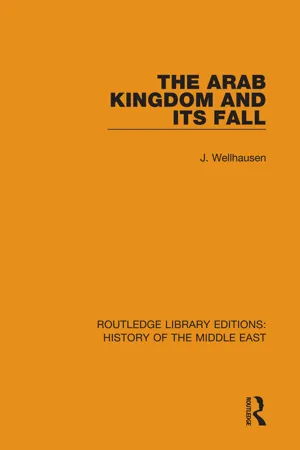
- 612 pages
- English
- ePUB (mobile friendly)
- Available on iOS & Android
eBook - ePub
The Arab Kingdom and its Fall
About this book
Information
ARAB KINGDOM AND ITS FALL
Chapter I
INTRODUCTION
1. The political community of Islam grew out of the religious community. Muhammad’s conversion and his call to be an apostle took place about the same time. He began with himself; he was, to begin with, possessed with the certainty of the all-powerful God and of the last judgment, but the conviction that filled his own heart was so great that it forced its way out. He felt bound to show the light and the way to the brethren who were groping in darkness, and thereby save them from error. Straightway he founded a little congregation at Mecca.
This congregation was held closely together by the belief in the One Invisible God, the Creator of the world and the Judge of the soul, and by the moral law arising thence, to serve Him and no other lord, to gain one’s own soul and not the world, to seek righteousness and mercy and not earthly possessions. In the oldest chapters of the Qoran monotheism is as emphatically moral as it is in Amos and in the Sermon on the Mount. As in the Gospel, the thought of the Creator immediately awakens the thought of personal justification to Him after death. He claims the soul absolutely for Himself,—to do His will, not merely to submit to it. The original Islam is not fataliṣm in the usual sense of the word, and its God is not the Absolute, i.e. a religious figure-head, but with the Supreme Power morality and righteousness are indissolubly bound up. Sometimes the one, sometimes the other is emphasised according to the feeling of the moment, without any attempt to keep the balance, or any consciousness of inconsistency. Muhammad was neither philosopher nor dogmatist.
Externally the community was bound together by the common observances of religious ceremonies; the oldest name which they had among outsiders, the name Sâbians, can have its origin only in these ceremonies. Even in the earliest parts of the Qoran prayers, prostrations and vigils are postulated; they are only not yet so strictly defined and regulated as they are later.
Muhammad began by winning over individuals,—friends, relatives and slaves, but these he regarded only as first-fruits. From the beginning his aim was to draw all Mecca to himself,—his family, the Hâshim and the Muttalib, and his people, the Quraish. He was an Arab, and as an Arab his feelings for the family and the tribe (i.e. the people), were such as we only understand for the narrower household. An order of things aloof from the community and acting independently with sovereign power, was as yet unknown among the Arabs. The state was not an institution and not a territory, but a collective body. There was thus, in reality, not a state, but only a people; not an artificial organisation, but simply a full-grown organism; no state officials, but only heads of clans, families and tribes.1 The same bond,—that of blood, held together the people and the family; the only difference was their size. The commonwealth, free from any external constraining influence, was based upon the idea of a blood-community and its sanctity. Relationship, or the faith in relationship,—both came practically to the same thing,—worked as a religion, and this religion was the spirit which made the race into one living whole. Along with this there was also an outward cultus, but no religion which laid upon them any other claims, ties or obligations except only those of blood. If Muhammad had founded a faith whose professors did not take cover under the bond of tribal relationship he would have broken up the blood-related community there and then, since it was too closely bound and knit together to suffer the intrusion of a foreign agent. But he did not want that, and, besides, he could perhaps scarcely imagine a religious community in any other setting than that of blood-relationship. So his mission was not to gain adherents far and near. He had to begin, of course, with individuals, but his aim was to gain the whole. His nation was to become his congregation; he was not content with an “ecclesiola pressa” in Mecca.
Failing to win over his own people, the Quraish, in Mecca, he tried to strike up a connection with other tribes and towns, for which he found opportunity in the markets and fairs in the neighbourhood of Mecca. At Tâif he approached the elders of the Thaqîf with regard to the admission of the commonwealth as a whole into Islam. Finally he gained a footing in Yathrib, i.e. Medina. His emigration thither, the Hijra, was an event that founded a new era, but the new era really meant no conscious break with the past. Muhammad did not deteriorate by his change from preacher to ruler. His ideal had long been to attract not only individuals but the whole commonwealth. He always considered the prophet as the God-sent leader of His people, and drew no distinction between a political and a religious community. His desire to continue to be in Medina the same as he had been in Mecca, the Prophet and Messenger of God, was not hypocrisy or the acting of a part. Only, in Mecca his efforts were in vain; in Medina he succeeded; there he was in the opposition, here he attained his end. That made a great difference, and not an external one only. It is a regular occurrence for the opposition to change when it comes into power, and theory differs vastly from practice since the latter has got to reckon with possibilities. A historical community cannot altogether break with its existing foundations, and might follows laws of its own in order to maintain and extend its power. It is this which explains why the Prophet as ruler became different from the Prophet as pretender, and why the theocracy in practice differed from the theocracy in theory. The political element became more prominent, the religious element less so, but it must always be remembered that, in principle, politics and religion flowed together, though a distinction was made between divine and secular politics, and alongside of them the piety of the heart still kept its place.
2. In Medina the ground was prepared for Muhammad by Judaism and Christianity. There were many Jews there, and the town stood on the boundary of that part of Arabia which was under the Graeco-Roman and Christian-Armenian influence. The political conditions were even more favourable for him. In Mecca peace and order prevailed. The old principle of a community acted smoothly. The new one that the Prophet threatened to introduce, was felt to be a disturbing element and rejected. But blood did not, by any means, wield this power all over Arabia. Its effect was not uniform in all the degrees of relationship, but was stronger in the narrower circles than in the wider ones; in the former it was spontaneous, in the latter more a matter of duty. Consequently the uniting element might also become the dissolvent if the interests of the family became at variance with the interests of the tribe or people. A family was particularly unwilling to renounce the blood-revenge incumbent upon them, even towards families related to them, of the same tribe. Then there would arise blood-feuds between the clans, since there was no authority in a dispute which could command peace and punish a breach of it. This was the state of things that prevailed in Medina. The community was divided into two hostile camps—the Aus and the Khazraj. Murder and manslaughter were the order of the day; nobody dared venture out of his quarter without danger; there reigned a tumult in which life was impossible. What was wanted was a man to step into the breach and banish anarchy; but he must be neutral and not involved in the domestic rivalry. Then came the Prophet from Mecca, as if God-sent. Blood, as a bond of union, had failed; he put faith in its place. He brought with him a tribe of Believers, the companions of his flight from Mecca, and slowly, advancing steadily step by step, he established the commonwealth of Medina on the basis of religion as an Ummat Allah, a congregation of God. Even if he had wished he could not have founded a church, for as yet there was no state in existence there. What had to be done was the elementary work, the establishment of order, and the restoration of peace and right. Since there was no other authority, a religious authority took the lead, got the power into its hands, and secured its position by performing what was expected of it. Muhammad displayed the gift of ability to deal with affairs in the mass. Where he was in doubt he knew the right man to ask, and he was fortunate in finding reliable supporters in some of the emigrants who had come with him from Mecca, and who formed his nearest circle of friends.
In the circumstances stated the power of religion appeared chiefly as a political force. It created a community, and over it an authority which was obeyed. Allah was the personification of the state supremacy. What with us is done in the king’s name was done in the name of Allah; the army and the public institutions were called after Allah. The idea of ruling authorities, till then absolutely foreign to the Arabs, was introduced through Allah. In this there was also the idea that no outward or human power, but only a power inwardly acknowledged and standing above mankind, had the right to rule. The theocracy is the negative of the Mulk, or earthly kingdom. The privilege of ruling is not a private possession for the enjoyment of the holder of it; the kingdom belongs to God, but His plenipotentiary, who knows and carries out His will, is the Prophet. He is not only the harbinger of truth, but also the only lawful ruler upon earth. Beside him no king has a place, and also no other prophet. This conception of the “monarchic prophet” originates with the later Jews; it is typically portrayed in the contrast between Samuel and Saul, as it appears, for example, in I Samuel: 8 and 11. The Prophet represents the rule of God upon earth; Allah and His Messenger are always bound up in each other, and stand together in the Creed. The theocracy may be defined as the commonwealth, at the head of which stands, not the king and the usurped or inherited power, but the Prophet and the Law of God.
In the idea of God justice, and not holiness, predominated. His rule was the rule of justice, and the theocracy was so far, a “dichaarchy,” but by this we are not to understand a rule of impersonal law. There was no law as yet; Islam was in existence before the Qoran. Nor did the theocracy resemble a republic, notwithstanding the idea that all the subjects of Allah stand in equal relationship to Him. The chief characteristic of the republic, election through the people, was absent altogether. The supreme power rested not with the people but with the Prophet. He alone had a fixed,—even divine—office; all authorities had their origin in his supreme authority. But he did not appoint actual officials, but only gave certain commissions, after the execution of which the commissioners retired of themselves. His advisers, too, were private individuals with whom he was on terms of friendship, and whom he gathered into the circle of his society.
Of a hierarchy there is no trace. The Muslim theocracy was not marked by an organisation of special sanctity; in this respect it had no resemblance to the Jewish theocracy after the Exile.1 There was no order of priests, no difference between clergy and laymen, between religious and secular callings. The power of Allah pervaded every function and organ of the state, and the administration of justice and war were just as sacred offices as divine service. The mosque was at one and the same time the forum and the drill-ground; the congregation was also the army; the leader in prayer (Imâm) was also the commander.
From the idea of the rule of God there arose no actual form of constitution. The new factor which, through Muhammad, was cast into the chaos, certainly effected a concentration of elements hitherto unknown. It might seem as if the old sacred ties of blood would be overwhelmed by the community of the Faith, but as a matter of fact, they continued unchanged, even though the centre of gravity was transferred from them to the whole. The framework of what had been the organisation up till then,—the tribes, families and clans, was taken over into the new commonwealth; faith in Allah did not provide anything else to put in their place. The Muslims’ right to political equality, arising out of the idea of the theocracy, was not established in such a way as to banish party differences. The men of Mecca, the so-called Muhâjira, kept by themselves; side by side with them were the indigenous tribes of Arabs of Medina, the so-called Ansâr, and also the tribes of the Jews of Medina. The settlers remained settlers and the slaves remained slaves, even when they accepted Islam.
From the early period after the Hijra, before the battle of Badr, there is preserved to us a decree of Muhammad in which appear some of the chief points of the law of the state at first current in Medina. It throws light upon how far the old conditions were, or were not, altered by the fact that Medina by this time has become a united Umma. Umma is not the name for the old Arab bond of relationship; it merely signifies “community.” Generally it is the religious community, not only since Islam but even earlier (Nâbigha, 17, 21). Even in our document the Umma has something of a religious flavour;1 it is the community of Allah established for peace and protection. Allah rules over it, and in His name, Muhammad, who, however, is never called “prophet.” The bond of unity is the Faith, the Faithful are its supporters. They have the chief obligations and the chief privileges. Still it is not only the Faithful who belong to the Umma, but also all who ally themselves with them and fight along with them, i. e. all the inhabitants of Medina. The Umma embraces a wide area,—the whole precincts of Medina are to be a district of inviolable peace. There are still heathen among the Ansâr, and they are not excluded, but expressly included. The Jews are also included, though they have not so close a connection with the Umma as the Muhâjira and the Ansâr, and have not exactly the same rights and obligations. The degree of communion is not precisely equal,—there still persists an analogy with the old Arab distinction between natives and settlers. It is significant that the Umma includes both heathen and Jews, and also that it consists in general not of individuals but of alliances. The individual belongs to the Umma only through the medium of the clan and the family. The families are enjoined to remain as they are, and as such to become members of the Umma. There is no notion of the possibility of a new principle arising according to which they might become members of the community. Even the heads of families remain and are not replaced by, e.g., theocratic officials. As regards the relation of the Umma with the families and the defining of the mutual duties and obligations, the families continue, as before, to be liable for expenses which are not of a purely private nature, namely, the payment of blood-money and the ransom of prisoners. As yet there is no state-treasury. Client-ship, too, is a clan and family affair, no one is allowed to take away another man’s client. Even the important privilege of guaranteed protection, the Ijâra, is not restricted; any individual may take a stranger under his protection, and by so doing puts the whole community under the same obligation. It is only for the Quraish of Mecca, the declared foes of Muhammad, that the Ijâra has no protecting power.
To the Umma the family is obliged to yield the right of civil feud, i. e. feud with the other families of Medina, for the first aim of the Umma is to prevent internal fighting. When disputes arise they must be brought to judgment. “If you are in dispute about anything whatsoever, it must be brought before God and Muhammad.” But if the internal peace is broken by violence and mischief, then not only the injured person or his tribe, but the whole community, including the relatives of the criminal himself, are obliged to go in united strength against him, and to deliver him up to the avenger so that he may make the latter just amends. The revenge for bloodshed can then no longer resolve itself into a family feud. It is robbed of the dangerous element that is a menace to the general peace and softened down into the “Talio.” Indeed the Talio existed before Islam, though it was not often exercised, because it was too like the parts and too dependent upon them to have any coercive power whatever over them. It was in Medina that the Talio was first strictly applied, because here God stood above blood, and, in theory at least, possessed a real sovereignty. As yet it does not amount to a proper punishment. Its execution is still in the hands of the injured party, and it rests with him to exact his right of revenge, or renounce it and accept recompense in money. It marks, however, the transition from revenge to punishment. The duty of prosecution being taken from the individual and given to the whole marks a very important step, making revenge a duty of the state, and thus turning it into punishment. It suffices to prevent internal feud. Inside the territory of Medina a public peace, general and absolute, holds sway. There are not so many alliances for protection as there are families over which protection does not extend, or at least is not properly effective. There is only one general peace, that of the Umma.
The other aim of the Umma is to unite the families for defence against external foes. The “Faithful” are mutually bound to help each other against “men”; they are avengers of each other, a mass against all outsiders. The duty of revenge on a foe devolves not on a brother for a brother, but on believer for believer. As a matter of fact, war is by this means deprived of the idea of a blood-feud, with which it before coincided; it becomes a military affair. As war with an outside people is common to the Faithful, so also is peace common. No one can, on his own account, conclude a peace which does not serve for all.
Nevertheless, the right of the tribe or family to carry on feud against outsiders is not altogether abolished. This is open to the same criticism as the corresponding inconsistency that even the Ijâra, which assures for a stranger the right to a home in Medina, is not yet withdrawn from the individual, although it is the duty of the whole, and so it must have been a privilege of the Umma and of its leader, the Imâm.1 This line of demarcation between the whole and its parts is not yet quite defined. The Umma has not yet reached its full growth. But the Faithful were the soul of it, with the Prophet at their head; they were the leaven, the spiritually...
Table of contents
- Cover
- Half Title
- Title
- Copyright
- Original Title
- Original Copyright
- CONTENTS
- Preface
- Chapter I—Introduction
- Chapter II—Alî and the First Civil War
- Chapter III—The Sufyânids and the Second Civil War
- Chapter IV—The First Marwânids
- Chapter V—Umar II and the Mawâlî
- Chapter VI—The Later Marwânids
- Chapter VII—Marwân and the Third Civil War
- Chapter VIII—The Arab Tribes in Khurâsân
- Chapter IX—The Fall of the Arab Kingdom
- Index
Trusted by 375,005 students
Access to over 1.5 million titles for a fair monthly price.
Study more efficiently using our study tools.
Frequently asked questions
Yes, you can cancel anytime from the Subscription tab in your account settings on the Perlego website. Your subscription will stay active until the end of your current billing period. Learn how to cancel your subscription
No, books cannot be downloaded as external files, such as PDFs, for use outside of Perlego. However, you can download books within the Perlego app for offline reading on mobile or tablet. Learn how to download books offline
Perlego offers two plans: Essential and Complete
- Essential is ideal for learners and professionals who enjoy exploring a wide range of subjects. Access the Essential Library with 800,000+ trusted titles and best-sellers across business, personal growth, and the humanities. Includes unlimited reading time and Standard Read Aloud voice.
- Complete: Perfect for advanced learners and researchers needing full, unrestricted access. Unlock 1.5M+ books across hundreds of subjects, including academic and specialized titles. The Complete Plan also includes advanced features like Premium Read Aloud and Research Assistant.
We are an online textbook subscription service, where you can get access to an entire online library for less than the price of a single book per month. With over 1.5 million books across 990+ topics, we’ve got you covered! Learn about our mission
Look out for the read-aloud symbol on your next book to see if you can listen to it. The read-aloud tool reads text aloud for you, highlighting the text as it is being read. You can pause it, speed it up and slow it down. Learn more about Read Aloud
Yes! You can use the Perlego app on both iOS and Android devices to read anytime, anywhere — even offline. Perfect for commutes or when you’re on the go.
Please note we cannot support devices running on iOS 13 and Android 7 or earlier. Learn more about using the app
Please note we cannot support devices running on iOS 13 and Android 7 or earlier. Learn more about using the app
Yes, you can access The Arab Kingdom and its Fall by J. Wellhausen, Margaret Graham Weir in PDF and/or ePUB format, as well as other popular books in Ciencias sociales & Estudios regionales. We have over 1.5 million books available in our catalogue for you to explore.