Transformational syntax is an analytic technique of grammatical description which has exciting psychological and philosophical ramifications inspiring creative research into the conceptual powers and behaviour of man. In this book, first published in 1971, the author suggests that the techniques of the classical period (1964-66) of transformational syntax provide the securest foundation for syntactic analysis, and are indispensable if students are to understand recent changes to the analytical technique. This title will be of interest to students of language and linguistics.
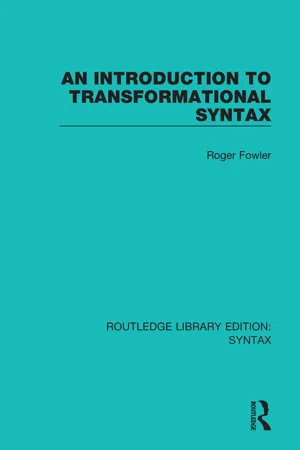
- 188 pages
- English
- ePUB (mobile friendly)
- Available on iOS & Android
eBook - ePub
An Introduction to Transformational Syntax
About this book
Information
eight
Negatives, Passives, Questions and Similar Structures
In the interests of providing a simple example for the sample derivation, I chose in (165) a collection of features of Aux which entailed as little as possible complexity in surface structure and hence an uncomplicated sequence of realization rules. In this chapter I will describe some more complex arrangements for which various configurations of features from Aux are responsible, and in particular some distinctive constructions which have especially interested transformationalists from the earliest days of this modern approach to syntax.
But first, we look at one other characteristic of surface structure which (165) happened not to illustrate: agreement (sometimes called concord). This is a situation in which some syntactic information is given more than once in the surface realization of a sentence. The most familiar examples, for most readers, will probably be drawn from highly inflected languages like French and Latin where adjectives agree with nouns and verbs agree with nouns. A French noun belongs to one or other of two genders: masculine or feminine. (This distinction has almost nothing to do with the sex-distinction, and applies to inanimate as well as animate nouns.) The gender of a noun is reflected in the article which accompanies it (le or la, un or une) and in the ending of any adjective which relates to it:
- (166) un arbre vert
- (167) une maison verte
Similarly, the ending of the adjective reflects Number in the NP:
- (166) un arbre vert
- (168) les arbres verts
Latin enjoyed a similar system, as did Anglo-Saxon, but this inflexional redundancy has disappeared in modern English. Again, French and Latin verbs respond to the Number of the NP and, where the NP is a pronoun, to the Person of the pronoun:
- (169) dominus servos amat [-P1] [III Pers]
- (170) domini servos amant [+P1] [III Pers]
- (171) patriam amo [-P1] [I Pers]
The remnants of an agreement system are evident in the English verb. It affects all verbs when they are [-Past], and the auxiliary be in [+Past] too. [-Past] verbs have the affix -s when the Subject-NP contains [-P1], and Ø when the Subject is [+P1]; be employs quite distinct words for singular and plural:
- (172) Peter opens the window.
- (173) Doormen open doors.
- (174) This apple is sweet.
- (175) These apples are sour.
No variation is found as between [+P1] and [-P1] when the verb is [+Past], except where the auxiliary be is concerned:
- (176) Peter/the children enjoyed the film.
- (177) The apple was sweet.
- (178) The apples were sour.
Finally, there are more complicated patterns when the Subject is a pronoun; verbs are sensitive to the 'person' of pronouns:

But there are simpler patterns with most of the 'modal auxiliaries': will, may, shall, can ([+Past] would, might, should, could) are invariable in relation to number and person.
These facts are well known. What we have to consider is how to represent them in a transformational grammar. One thing is clear: that there is redundancy in surface structure – compare a dog barks, where dogØ signals [-P11] just as much as barks, and dogs bark, where barØ; only duplicates the information P1] given by dogs. Now number is basic to the NP (it is a feature of Det) and not intrinsic to V or Aux. Similarly, in French and Latin gender is inherent in N, and is reflected in Adj merely for convenience or by accident. (Inflecting Latin adjectives for gender and number is functional because it associates an adjective and the noun it modifie...
Table of contents
- Cover
- Half Title
- Title
- Copyright
- Original Title
- Original Copyright
- Contents
- Preface
- one What is a Grammar?
- two Deep and Surface Structure
- three Constituent Structure: Syntactic Fractions
- four Constituent Structure: Categories and Derivations
- five Lexical Interpretation
- six Deixis: Det and Aux
- seven Derivation of a Simple Sentence
- eight Negatives, Passives, Questions and Similar Structures
- nine Pro-forms
- ten Complex Sentences
- eleven Some Nominalizations
- twelve Relative Clauses and Adjectives Revisited
- thirteen Conjoining Transformations
- fourteen Postscript: Linguistic Universals and the Nature of Grammatical Descriptions
- Selected Reading
- Index
Trusted by 375,005 students
Access to over 1.5 million titles for a fair monthly price.
Study more efficiently using our study tools.
Frequently asked questions
Yes, you can cancel anytime from the Subscription tab in your account settings on the Perlego website. Your subscription will stay active until the end of your current billing period. Learn how to cancel your subscription
No, books cannot be downloaded as external files, such as PDFs, for use outside of Perlego. However, you can download books within the Perlego app for offline reading on mobile or tablet. Learn how to download books offline
Perlego offers two plans: Essential and Complete
- Essential is ideal for learners and professionals who enjoy exploring a wide range of subjects. Access the Essential Library with 800,000+ trusted titles and best-sellers across business, personal growth, and the humanities. Includes unlimited reading time and Standard Read Aloud voice.
- Complete: Perfect for advanced learners and researchers needing full, unrestricted access. Unlock 1.5M+ books across hundreds of subjects, including academic and specialized titles. The Complete Plan also includes advanced features like Premium Read Aloud and Research Assistant.
We are an online textbook subscription service, where you can get access to an entire online library for less than the price of a single book per month. With over 1.5 million books across 990+ topics, we’ve got you covered! Learn about our mission
Look out for the read-aloud symbol on your next book to see if you can listen to it. The read-aloud tool reads text aloud for you, highlighting the text as it is being read. You can pause it, speed it up and slow it down. Learn more about Read Aloud
Yes! You can use the Perlego app on both iOS and Android devices to read anytime, anywhere — even offline. Perfect for commutes or when you’re on the go.
Please note we cannot support devices running on iOS 13 and Android 7 or earlier. Learn more about using the app
Please note we cannot support devices running on iOS 13 and Android 7 or earlier. Learn more about using the app
Yes, you can access An Introduction to Transformational Syntax by Roger Fowler in PDF and/or ePUB format, as well as other popular books in Langues et linguistique & Grammaire et ponctuation. We have over 1.5 million books available in our catalogue for you to explore.