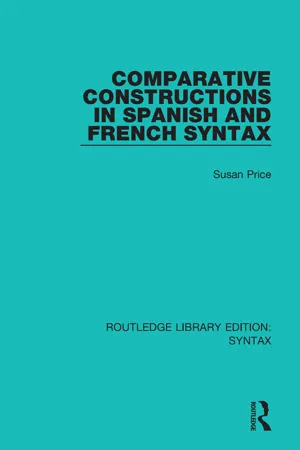
This study, first published in 1990, presents a comprehensive description of the comparative constructions of Spanish and French, and shows that the apparently numerous differences in their syntactic realisations can be accounted for by general constraints on the expression of comparison. There is also a discussion of parallel constructions in other Romance languages, showing that these languages display a range of constructions equally compatible with the suggested pattern of possibilities resulting from the general constraints proposed. This title will be of interest to students of language and linguistics.
- 258 pages
- English
- ePUB (mobile friendly)
- Available on iOS & Android
eBook - ePub
Comparative Constructions in Spanish and French Syntax
About this book
1 The nature of comparative constructions
‘If the realm of language is seen as a cosmos, vast, largely unexplored and sometimes bewildering, then the comparative construction must be a microcosmos, reflecting all the complexity of the whole.’(Hoeksema 1984: 93)
The comparative construction has been the subject of numerous studies, in which both its syntax and semantics have been exhaustively analysed.1 Recent contributions to this field include two major general works, Andersen (1983) and Stassen (1985), in which comparative constructions are treated within the framework of word-order typology, as well as Hellan (1981), a more restrictive study, in which an integrated analysis of the syntax and semantics of the comparative construction is attempted, though this bears almost exclusively on English. The aims of the present study are rather different and more modest in scope; they are, in brief, to present a comprehensive description of the comparative constructions of Spanish and French, and show that the apparently numerous differences in their syntactic realizations can be accounted for by general constraints on the expression of comparison. Reference will also be made to parallel constructions in other Romance languages, in an attempt to show that these languages display a range of constructions not divergent from the suggested pattern of possibilities resulting from the general constraints proposed.
As the intention is to present a descriptive analysis of the constructions concerned, the approach will be neutral in terms of syntactic model, observations being couched rather in terms of traditional grammatical theory. However, it is impossible to avoid the use of certain terms which may appear inextricably linked with particular theoretical approaches. This is particularly the case with regard to the term ‘deletion’. Nevertheless, I intend to use this term as a convenient label for the consistent relationships which exist between sentence types, following Stassen (1985: 21): ‘when I use the term “deletion” it should not be inferred that I claim that a specific procedure of string-derivation by means of deletion rules should be part of a grammar.’ My use of the term ‘deletion’ will correspond broadly to the more traditional term ‘ellipsis’.
1.1 RECENT STUDIES
Andersen (1983: 118), basing his analysis on a representative sample of the world’s languages, establishes five different types of comparative construction:
1 juxtaposition: A is big, B is small/not (big)
2 adpositional: A is bigger FROM B
3 case: A is big(ger) B-FROM
4 particle: A is bigger THAN B
5 verbal: A SURPASSES B
Examples of juxtaposition comparatives are given from Dakota (p. 108), Mosquito (p. 109), Hittite (p. 112) and Classical Sanskrit (p. 113). The Mosquito example follows:
(1) Jan almuk, Sammuel almuk apia
John old Samuel old not
John is older than Samuel
John old Samuel old not
John is older than Samuel
Examples of adpositional comparatives (where the adposition may be either pre- or post-posed), are given from Nuba and Hindi (pp. 109, 113), Modern Greek (pp. 110, 113) and Japanese (p. 125). A Hindi example follows:
(2) Mohan se barā
Mohan from big
bigger than Mohan
Mohan from big
bigger than Mohan
Latin (pp. 111, 113) is given as an example of a case comparative, where the relation between the second compared category and the adjective is expressed through the case ending:
(3) te maior
you-from bigger
bigger than you
you-from bigger
bigger than you
Latin, German, Finnish, Old Indic and French (pp. 111, 117–18) are given as examples of particle comparatives, where a separate lexeme connects the compared category and the adjective; the following is one of the Latin examples:
(4) maior quam tu
bigger than you
bigger than you
Examples of verbal comparatives, where a verb meaning ‘to surpass’ explicitly contains the comparative idea, are given from Homeric Greek (pp. 111, 131), Old Indic, English and German (p. 131). The German example follows:
(5) Er übertrifft ihn an Körperkraft
He surpasses him in strength
He surpasses him in strength
For Andersen, then, Spanish and French will fall into group 4, the particle constructions, ‘particle’ here being a term for the item which links the two clauses of a comparative construction containing the terms of comparison.
However, Andersen distinguishes between an adpositon and a particle on very specific grounds. Both adpositions, which may be either preposition or postposition, and particles serve to connect the compared category to the adjective; these he terms ‘links’. However, he also introduces the concept of ‘marker’, defined as ‘that specific element which distinguishes a comparison of inequality from a comparison of equality. It is, therefore, that element which expresses the specific result of inequality as opposed to the only other result possible, namely, that of equality (p. 116). Adpositions, he claims, serve as both links and markers (as do case endings). Particles, on the other hand, serve only as links, and not as markers, given that, according to his evidence, ‘the particle does not distinguish comparisons of inequality … from comparisons of equality’. For example, que in French acts as the ‘comparative particle’ in both comparatives of inequality and equality. The evidence from Spanish, however, would contradict this assertion, given that the ‘particles’ que and como do serve to distinguish between the two types of comparison. This may suggest that particle comparatives are not an entirely discrete category, a point which will be taken up again in section 1.8.
Stassen (1985: 39–44) also posits the existence of five major types of comparative construction, though there is no one-to-one correspondence with Andersen’s list:
1 the separative comparative
2 the allative comparative
3 thelocative comparative
4 the exceed comparative
5 the conjoined comparative
Separative comparatives are defined as instances of ‘fixed-case adverbial comparative constructions’, with one of the compared NPs ‘encoded as a constituent part of an adverbial phrase with a … separative interpretation’ (p. 39). Examples are given from Japanese, Carib and Mundari, the latter of which (his (11)) follows:
(6) Sadom-ete hati mananga-i
horse-from elephant big -PRES.3SG.
The elephant is bigger than the horse
horse-from elephant big -PRES.3SG.
The elephant is bigger than the horse
Thirty-two languages are listed as exhibiting separative comparatives as their primary structural option and nine, including Old French, as having a secondary separative comparative.
Allative comparatives are also fixed-case adverbial comparatives, defined as ‘the mirror-image of the Separative Comparative’, but with the compared NP ‘encoded as a constituent part of a … goal-phrase’ (p. 40). Examples are given from Breton and Maasai; the latter (his (14)) follows:
(7) Sapuk ol-kondi to 1 -kibulekeny
is-big the-deer to the-waterbuck
The deer is bigger than the waterbuck
is-big the-deer to the-waterbuck
The deer is bigger than the waterbuck
Seven languages are listed as exhibiting allative comparatives as their primary structural option and three as having a secondary allative comparative.
Locative comparatives are also fixed-case adverbial comparatives, but the compared NP is ‘a constituent of an adverbial phrase which is marked by an element that indicates spatial or non-spatial contact’ (p. 41). Formally it is similar to the previous two types of comparative. Examples are given from Chuckchee and Salinan, the second of which (his (17)) follows:
(8) Ragas-mo in luwa ti-hek
surely-you more man on-me
You are more of a man than me
surely-you more man on-me
You are more of a man than me
Seventeen languages are listed as primary in this class and eight as secondary.
Stassen’s separative, allative and locative comparatives appear to correspond to Andersen’s single group of adpositional comparatives.
Exceed comparatives are also fixed-case constructions, with the compared NP ‘constructed as the direct object of a special transitive verb, the meaning of which can be glossed as “to exceed” or “to surpass”‘ (p. 42). Examples are given from Yoruba, Hausa, Swahili and Vietnamese; the Vietnamese example (his (19)) follows:
(9) Vang qui hon bac
gold valuable exceed silver
Gold is worth more than silver
gold valuable exceed silver
Gold is worth more than silver
Twenty languages are listed as having some variant of the exceed comparative as their primary option and six as being secondary in this class. The exceed comparatives are equivalent to Andersen’s verbal comparatives.
Conjoined comparatives are derived-case constructions in which ‘NP-comparison is typically effected by means of the adversative coordination of two cl...
Table of contents
- Cover
- Half Title
- Title Page
- Copyright Page
- Original Title Page
- Original Copyright Page
- Table of Contents
- Acknowledgements
- 1 The nature of comparative constructions
- 2 Comparative constructions in Spanish
- 3 Comparative constructions in French
- 4 Variation between Spanish and French comparative constructions and a consideration of other Romance languages
- References
- Further reading
- Index
Trusted by 375,005 students
Access to over 1.5 million titles for a fair monthly price.
Study more efficiently using our study tools.
Information
Publisher
RoutledgeEdition
1Year
2016Print ISBN
9781138698475
9781138698468
Subtopic
Grammar & PunctuationeBook ISBN
9781315518916
Frequently asked questions
Yes, you can cancel anytime from the Subscription tab in your account settings on the Perlego website. Your subscription will stay active until the end of your current billing period. Learn how to cancel your subscription
No, books cannot be downloaded as external files, such as PDFs, for use outside of Perlego. However, you can download books within the Perlego app for offline reading on mobile or tablet. Learn how to download books offline
Perlego offers two plans: Essential and Complete
- Essential is ideal for learners and professionals who enjoy exploring a wide range of subjects. Access the Essential Library with 800,000+ trusted titles and best-sellers across business, personal growth, and the humanities. Includes unlimited reading time and Standard Read Aloud voice.
- Complete: Perfect for advanced learners and researchers needing full, unrestricted access. Unlock 1.5M+ books across hundreds of subjects, including academic and specialized titles. The Complete Plan also includes advanced features like Premium Read Aloud and Research Assistant.
We are an online textbook subscription service, where you can get access to an entire online library for less than the price of a single book per month. With over 1.5 million books across 990+ topics, we’ve got you covered! Learn about our mission
Look out for the read-aloud symbol on your next book to see if you can listen to it. The read-aloud tool reads text aloud for you, highlighting the text as it is being read. You can pause it, speed it up and slow it down. Learn more about Read Aloud
Yes! You can use the Perlego app on both iOS and Android devices to read anytime, anywhere — even offline. Perfect for commutes or when you’re on the go.
Please note we cannot support devices running on iOS 13 and Android 7 or earlier. Learn more about using the app
Please note we cannot support devices running on iOS 13 and Android 7 or earlier. Learn more about using the app
Yes, you can access Comparative Constructions in Spanish and French Syntax by Susan Price in PDF and/or ePUB format, as well as other popular books in Languages & Linguistics & Grammar & Punctuation. We have over 1.5 million books available in our catalogue for you to explore.