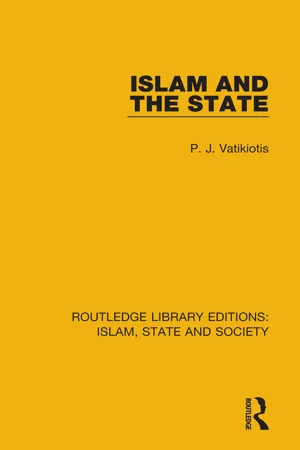
Examining the theoretical problems which arose when the modern European ideology of nationalism was adopted by Muslim societies organized into formally modern states, this book, first published in 1987, also deals with the practical difficulties arising from the doctrinal incompatibility between Islam and the non-Muslim concept of the territorial nation-state. It illustrates this conflict with a consideration of the record of several states in the Islamic world. It suggests that whereas the state, an organization of power, has been a most durable institution in Islamic history, the legitimacy of the nation-state has always been challenged in favour of the wide Islamic Nation, the "umma", which comprises all the faithful without reference to territorial boundaries. To this extent too, the more recent conception of Arab nationalism projects a far larger nation-state than the existing territorial states in the Arab world today. This title will be of interest to students of Middle Eastern studies.
- 140 pages
- English
- ePUB (mobile friendly)
- Available on iOS & Android
eBook - ePub
Islam and the State
About this book
Information
1
Islam and the State: A Historical Survey
It is useful to recapitulate briefly — even to encapsulate — the history of the civilization and lands we are dealing with when considering Islam and the nation-state.
The Arabs under the Umayyads created in less than one hundred years, from AD 660 to 750, the conditions in which a new Islamic civilization could be built in the great urban centres of the ancient Near East. Although the conception of the state was alien to them, since they were a tribal society which knew no citizens — only kinsmen united by blood ties — they nevertheless provided a stable centralized state to control their rapidly expanding empire, with an administration more elaborate than anything the Arabs had known before. It was this which allowed a conquering, politically and socially dominant minority of mainly Christian, pagan and Zoroastrian populations to consolidate Islam and quickly subjugate the Semitic and Iranian worlds.
By the time the Umayyad Caliphate in Damascus gave way to the Abbasid in Baghdad in 750, the Arab conquests had politically unified a large part of the world from Spain to India. The widespread use of a common language, Arabic (a new lingua franca for that area), facilitated the exchange of ideas. The fact that the central lands of the Nile and Tigris-Euphrates valleys that were conquered had had settled urban civilizations for millennia also helped. Then their immunity from external attack for nearly 400 years, from the middle of the seventh to the middle of the eleventh century, enabled the Islamic dominion to promote a vast free-trade area without barriers, permitting the development of commerce which, in turn, created a wealthy middle class of merchants, traders, bankers. craftsmen, artisans and professional men. Some of these, in turn, patronized learning and the arts, the development of which was also assisted by the use of paper, thus creating a rich, sophisticated society, so much admired by the rest of the world.
The Abbasids promoted further a cosmopolitan civilization with Baghdad as its centre and Arabic as its lingua franca. It was not specifically a Muslim one, since only its language, law and theology were that. The rest of its ingredients came from non-Muslim sources, such as Greek philosophy and science (which as we shall see were later rejected with significant consequences), and Persian and Indian influences. Its culture was multiracial, since much of its philosophical literature was written by Christians and Jews; its medical and mathematical treatises were written by Persians and Indians.
And yet two epochal developments — one fairly early, the other later — led to the collapse initially of the Arab and subsequently of the more cosmopolitan Muslim civilization. The first one was the break-up of the Caliphate, the disintegration of the political unity of the Islamic dominion. This was due in part to the restlessness and upheavals of the non-Arab converts, the rise of heresies and other religio-political movements among them, and the transformation of the military system by the introduction of that institution so unique to Islam, slave armies and praetorian garrisons, which rendered the Caliphate an otherwise powerless spiritual office. They inaugurated the Sultanate, a secular institution, based strictly on power. The weakness of the Caliphate allowed the usurpation of power by provincial governors and other satraps who founded short or long-lived dynasties at will. The break-up of the political unity of Islam was a reality by the middle of the eighth century when Abdel Rahman set up an independent state in Spain. By the beginning of the tenth century, a third rival Caliphate, the Fatimid in North Africa and Egypt, added to the disintegration.
Political events were not the only disrupters of the political unity of Islam. Religious, cultural and economic changes contributed to it too. Pre-Islamic religious influences in Iran led to theological dissension and revolutionary messianism. A revival of Persian local or parochial sentiment expressed itself in a proliferation of Manichean and millenarian sects. In the heart of Islam the battle raged for a time between those who were attracted by Greek rational philosophy on one side and, on the other, those insisting upon the pre-eminence of the revealed word of God as the only explanation of human and natural phenomena.
Despite all these challenges and political disruption, the Muslim world enjoyed, until the eleventh century, economic and other prosperity. The possession of a common language outweighed the loss of political unity. After that, however, the Islamic realm was subjected to a new threat, that of external attack from the desert and steppe nomads of Central Asia, culminating in the Mongol devastation 250 years later. City life decayed and, since medieval Islamic civilization was essentially urban and its material basis that of commercial wealth, economic prosperity declined. Islamic cities, however, had never developed self-governing institutions or defence arrangements like those of their contemporary Lombard and Hanseatic Leagues. Consequently, primary loyalty in them was not civic but religious, an important fact for our subject. Their inhabitants had no common civic loyalty; they were not genuine burghers. Muslims, Jews and Christians coexisted, but in separately designated quarters.
In the meantime, the destruction wreaked by external foes and senseless conquerors, and the loss of political unity were paralleled by the loss of linguistic and cultural unity, when the intellectual monopoly of the Arabic language was broken by the revival of Persian and later by Turkish. Thus, Arab philosophy was in effect dead by 1200 and Arab science two hundred years later. Christian Europe acquired through the Renaissance a secular tradition with its background of Greek rationalism and science. The only tradition behind Islam was the proclaimed cultural poverty of the pre-Islamic 'Age of Ignorance'. The spirit of Islam was not rational in the Greek sense of the term, in that God was beyond Reason and His ordering of the Universe was to be accepted not explained. True knowledge is that of God and His Law, which embraces all human activity. This is an important ingredient in Islamic thinking from the start, which later became more explicit in countering heresy and enthroning orthodoxy.1 Truth was to be sought only in divine revelation.
Yet after the Mongol devastation, Islam set out on a new expansion for 400 years (1300-1700) — a second age of conquest and empire from Hungary to Indonesia. Four illustrious states adorned the Muslim world: Mamluk Egypt, Ottoman Turkey, Safavid Persia and Mogul India. But this second imperial age differed from the first in that the Arabs were now subjects not masters (which is why they do not like it; for Arabs today the Golden Age of Islam ended in 1258), and they played little or no part in the new states.
The last 300 years (since 1700) have been dismal for Islam The Mamluks were eliminated in 1798 by European power, the Safavids were extinguished in 1723 and the Moguls around the same time, and the Ottomans in 1918, The greatest devastators of Islam have been the liberal West and autocratic Russia.
Despite the recent political emancipation of these areas there is as yet no sense of Muslim unity or even a genuine Renaissance; only a resurgence and militancy, just as diverse as the political and religious experience of Muslims in an earlier period in their history. Perhaps because since the eleventh century, the only political theory of Islam has been that of passive obedience to any de facto authority, government by consent remains an unknown concept; autocracy has been the real and, in the main, the only experience.2
Lacking the humanist and scientific tradition and recognizing their cultural and material backwardness, Muslims are attracted and repelled by the West at one and the same time. The Muslim traditional, quietist conservative and the more radical, activist militant alike, however, still believe that ultimate truth and wisdom rest in superior Islam, not in the inferior West. With this brief, captious but necessary recapitulation of the Islamic historical experience, we can now turn to a consideration of the rather wide subject of Islam and the nation-state. The brief is too broad and unmanageable if one is to throw some light on the relation between a faith and a civilization on the one hand and an organization of power, an arrangement for a public order on the other. One must therefore confine one's exposition to a highly selective array of concepts, relations, problem areas and illustrations, if one is to convey both the historical evolution of religion and state in Islam as well as its significance today, and the way it manifests itself in the affairs of states whose populations happen to be Muslim in the main but which are not necessarily Islamic states; or of nation-states that are not quite nations in the secular sense of the term. This in turn will force us to consider terms, definitions, perceptions and interpretations.
In looking at the central political notions in the Islamic scripture, the Koran, or the structure of political ideas that one can extrapolate from it, my colleague Michael Cook suggests that one can form a general view of their import. For the believers, these ideas basically suggest that there are those who rule and those who are ruled: the weak, the oppressed. The meek shall not inherit the earth, unless they get up and go, or emigrate (muhajirun), in order to constitute a political community, with a designated authority — the Prophet or Caliph — membership of which is sharply defined in religious terms: believers versus unbelievers (kuffar), with an intermediate category of hypocrites (munafiqun). There is one clear political activity for the members of the community: jihad, or holy war, against unbelievers who are outside it.
The Koranic conception of politics is not irenic. It is confrontationist, or rather Manichean, emphasizing rectitude versus error, and an armed confrontation between them. It is also radically monotheistic, synthesizing a monotheist policy ex nihilo. Moreover, the political idiom of the Koran itself is ideological.3 Thus the unbelievers are enemies of God (see Khomeini), who are pitted against the believers, who are friends of God (and the Ayatollah).4 The actions of believers are couched in sacred terms: jihad, hijra (migration), etc.
What the Koran has to say about pontics is not tied to a specific historical context and is therefore widely applicable Thus, jihad is a most amenable notion to the purposes of state: it can legitimize aggressive policy. But Koranic political ideas provide no clear-cut blueprint for authority in the Islamic community after the Prophet; the Koranic term imam does not refer to a ruler, but a prayer leader. Amir al-muminin (Commander of the Faithful) is not a Koranic term, but shares with the Koran the ideological overtone of militancy. The term khalifa (Vicegerent) appears in the Koran but not as khalifatullah (Vicegerent of God); rather, it denotes broadly the Muslims at large as inheritors of the earth.
The basic structure of political ideas in the Koran, though activist and militant, is somewhat neutral and does not help the rule of the Islamic community after the Prophet. However, these ideas remain equally dangerous and uncomfortable for the Muslim rulers because they are ideological. They can be mobilized equally in the conflict against unbelievers and against Muslim rulers, as indeed they have.
On the whole, the Koran is a meagre source on political authority in Islam. Muhammad derived his political power from a divine office, but the new concept of amir al-muminin afterwards produced a disparity between the way that accession to power occurred historically and the theory of the Caliphate, or leadership of the Islamic community, evolved by jurists — or the way in which ijma', the consensus of the community, justified whatever happened in Islam; or the constant psychological problem of the dichotomy between the real and the ideal, between God's dominion and the observance of the law; or the division of legal authority between a temporal and religious official class, the sultans and the ulema, and the new extra-canonical sources of law, such as custom, convention and the ruler's will (qanun, nizam, iradeh). Political authority in Islam, therefore, is not simply based on Koranic sources. Other traditional, cultural and environmental influences, such as tribalism, Byzantine-type despotism, Iranian-style court practices and later Turkish autocracy also helped to shape it.5
Another colleague, Patricia Crone, has argued recently that Muhammad was a militant preacher, who combined possession of the Word of God with a particularistic ethnos — the Arab tribal communities of Arabia — to produce a dynamic for the conquest of the region, without any prior political tradition.6 The only thing the Peninsula Arabs possessed was ethnic and cultural homogeneity. But the whole movement which became the basis of a new civilization was born in the mind of one man — Muhammad. Having united the feuding Arab tribes into one community based on the Word of God as revealed to one of them, conquest in the name of this God became possible. In short, a particular insular tribal society went out to conquer in the name of a universal truth or faith.
The problem of religion and state was born with this curious 'marriage' between a universal religious truth or message and an otherwise very parochial community which held it and fought for it or in its name. Establishing and legitimizing an Islamic state in settled non-tribal communities proved impossible. In other words, as conquerors, the early Muslim Arabs broke out everywhere with a common identity, but without the structures for a state. Whatever instruments they took over — bureaucracies, courts, mercenary and slave professional armies — all served to keep them in power. Once they lost their own military power to the new groups of mercenary and slave armies recruited by the Caliphs to fight their wars, the very nature of their political order was transformed beyond all recognition, first into a military polity and later into a military-bureaucratic one. Inevitably, the distance between religion and state grew, without however — beyond the well-known juristic rationalizations — reformulating the relationship. Thus, 'power in Islam had to be intrinsically sacred: it was only when power and sanctity no longer could be kept together that the Muslims had to make do with an illusion'.7
In dealing with religion and state we are therefore in a sense dealing not merely with a serious practical problem of government and politics but also with a theoretical fiction.
Power in the community and the state in Islam originally derived from an ethnic faith. To this extent Muslims have been unwilling to share the power given to them by God with others. They exclusively possess religious truth and power, as per, for instance, the Koranic Sura: 'Power belongs to God, His Apostle, and the believers.'8 Nor did they combine at the beginning learning and power; this combination was left to non-Arab converts who greatly influenced the development of the civilization of Islam but hardly changed its general character, particularly as regards the relation between religion and state.
The reshaping of Islamic government on the Persian model, for instance, continued to be rejected or ignored by Arab Muslims. It produced bureaucratic, fiscal and other government functions, all separate from the original intention of the fusion of power and sanctity. The ulema who were most adamant in rejecting the desanctification of power ended up as the guardians of the religious law, but hardly helped either the retention of the old fusion or the move towards 'two worlds', the temporal and the spiritual. Whereas the Christians in Europe were, by the fourteenth to fifteenth centuries, defining temporal power as vain and transient, they none the less accepted it. The Muslims, under the guidance of their ulema, simply rejected temporal power, which was very much with them, as illegitimate. To this extent they perpetuated the illusion or fiction and yet kept the religious law hopelessly tied to secular power. Sacred title to power by Islamic rulers, underpinning the legitimacy of their rule, remained in the face of its having been acquired by force. The jurists and scribes continued to insist, as Ibn Muqaffa' did, that the Caliph was the sole source of religious and political authority, and therefore he must impose religious and political uniformity on community and polity.9
As the central political authority grew and expanded its functions, recourse to the creation of slave institutions to control and govern it completed the separation between caliphal authority and power. The state, in effect, ceased to lay claim to religious authority which ended in the exclusive hands of the ulema. State power however was often shared by local satraps, notables, dynasties and others. The rest of the burgeoning urban society, concerned with commercial and other wealth, became non-political. The separation of central power and society ensued.10 In fact, more and more groups in society, if not society in its entirety, avoided the state, so that a disjunction occurred between the exponents of state authority and those of religion.
Subsequently, new or fresh conquerors of infidel lands in the name of Islam came to be considered defenders of the faith. Even though most of them may have been usurpers, they nevertheless acquired Islamic legitimacy, and their...
Table of contents
- Cover
- Half Title
- Title
- Copyright
- Original Title
- Original Copyright
- Contents
- Introduction
- 1. Islam and the State: A Historical Survey
- 2. Islam and the Nation-State: An Enduring Contradiction
- 3. The Return of Islam to Politics or Radical Islam: Promise and Reality
- 4. Islam and Nationalism: The Problem of Secularism
- 5. The Obstacles to Plural Politics and a Pluralist Polity in Islam: Non-Muslims in a Muslim Society
- 6. Islam and Europe: Conflict or Cooperation?
- Notes
- Index
Trusted by 375,005 students
Access to over 1.5 million titles for a fair monthly price.
Study more efficiently using our study tools.
Frequently asked questions
Yes, you can cancel anytime from the Subscription tab in your account settings on the Perlego website. Your subscription will stay active until the end of your current billing period. Learn how to cancel your subscription
No, books cannot be downloaded as external files, such as PDFs, for use outside of Perlego. However, you can download books within the Perlego app for offline reading on mobile or tablet. Learn how to download books offline
Perlego offers two plans: Essential and Complete
- Essential is ideal for learners and professionals who enjoy exploring a wide range of subjects. Access the Essential Library with 800,000+ trusted titles and best-sellers across business, personal growth, and the humanities. Includes unlimited reading time and Standard Read Aloud voice.
- Complete: Perfect for advanced learners and researchers needing full, unrestricted access. Unlock 1.5M+ books across hundreds of subjects, including academic and specialized titles. The Complete Plan also includes advanced features like Premium Read Aloud and Research Assistant.
We are an online textbook subscription service, where you can get access to an entire online library for less than the price of a single book per month. With over 1.5 million books across 990+ topics, we’ve got you covered! Learn about our mission
Look out for the read-aloud symbol on your next book to see if you can listen to it. The read-aloud tool reads text aloud for you, highlighting the text as it is being read. You can pause it, speed it up and slow it down. Learn more about Read Aloud
Yes! You can use the Perlego app on both iOS and Android devices to read anytime, anywhere — even offline. Perfect for commutes or when you’re on the go.
Please note we cannot support devices running on iOS 13 and Android 7 or earlier. Learn more about using the app
Please note we cannot support devices running on iOS 13 and Android 7 or earlier. Learn more about using the app
Yes, you can access Islam and the State by P. J. Vatikiotis in PDF and/or ePUB format, as well as other popular books in Politics & International Relations & Middle Eastern Politics. We have over 1.5 million books available in our catalogue for you to explore.