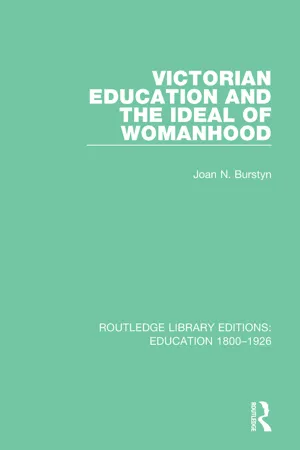
This study, first published in 1980, argues that higher education for women was accepted by the end of the nineteenth-century, and higher education was becoming a desirable preparation for teachers in girls' schools. By accepting the opponents' claim that higher education for women had the potential to revolutionise relations between the sexes, this fascinating book demonstrates how the relevance of the nineteenth-century serves to enhance our understanding of the contemporary women's movement. This title will be of interest to students of history and education.
- 190 pages
- English
- ePUB (mobile friendly)
- Available on iOS & Android
eBook - ePub
Victorian Education and the Ideal of Womanhood
About this book
Information
1 The Politics of Aspiration: Education for the Middle Class
Their institutions challenged by the social and economic forces of industrialism, the Victorians saw education as a means of both social control and individual betterment. The two themes existed side by side; social control was emphasized in the education of the lower classes, individual betterment in that of the middle classes, but in both cases the second theme was discernible. Thus, the lower classes were taught primarily to know their place, and were given only the rudiments of literacy, but it was possible, through self-improvement or, later in the century, through further schooling for bright lower-class students to improve their position in society. Among the middle classes, though schools came increasingly to emphasise scholarship and competitive examinations, moral behaviour and adherence to group norms were enforced, particularly through the prefect system and team sports.
The variation in emphasis according to class between social control and individual betterment applied particularly to men's education. For most of the century social control was the predominant theme of Victorian education for women of all classes. The thrust towards control was expressed through the ideal of womanhood, which cast woman as an entity and left little room for variations among individuals. The ideal was prescriptive, and spread its tentacles through all the institutions designed for women's education. Hence, women of the middle classes, unlike their brothers, were subject to as rigid a programme of control as their lower-class sisters, although it was different in kind.
The movement for higher education for women was an attempt to break through the prescriptions of the ideal, to provide women of the upper and middle classes with the opportunity for individual betterment. The movement cannot be considered alone; it was part of a broad upheaval caused by the development of industrialism, which affected women's economic well-being, and their aspirations for participation in the political and social life of the country.1
This book concentrates on the opposition to higher education for women. It untangles the threads of opponents' arguments in order to show how serious a threat the movement for higher education was to the ideal of womanhood. At first, the number of women who wanted to attend the universities was small. It may seem indulgent, therefore, to concentrate on those few hundreds, when the history of millions of other women is still unwritten. However, the struggle to obtain higher education had broad implications for all women because Victorian society was hierarchical. The norms for behaviour were set by the ruling classes who came to be identified closely with the upper middle classes. It was they who most eagerly adopted the Victorian ideal of womanhood; and it was they who first discovered its flaws as reality. However, English society in the nineteenth and early twentieth century was like a snake, whose body rippled along the ground following the path taken by its head some time before. While the head stretched across open ground, the body remained deep in the undergrowth. Hence, the Victorian ideal of womanhood was not abandoned by English society, despite the challenge to it from some of those who had turned it into reality. It was modified and, in our own century, was adopted by groups who had not been able to afford it during the nineteenth century.
Only after the Second World War did the ideal become reality for large numbers of women. The current women's movement is in part an extension of the discontent expressed by women of the upper middle classes in the late nineteenth century. At that time the challenge of those who had found the ideal vacuous as reality had to be denied; now, the challenge is so widespread it has to be answered. By looking more closely at the struggle to attain higher education for women we can better understand the meaning of the present shift in relations between men and women.
We shall first examine Victorian middle-class society, and its views on the education of men and women.
The Victorian middle classes
Class in Victorian society was defined through a subtle combination of occupation, income, and values; hence the difficulty historians have in defining the limits of any one class. Definitions of class were linked to the occupations and incomes of males. Females were assigned a class according to the status of their fathers so long as they were unmarried, and of their husbands once they were married. Unmarried women, separated or divorced women and widows were a special problem, because they retained the status of their fathers or husbands unless they took jobs on their own account, when they acquired a status of their own.
The middle classes were diverse, but they shared certain attributes. They were usually city dwellers, and although some had incomes similar to skilled craftsmen, the latter worked with their hands and therefore were not usually considered middle class. Annual income for the middle classes ranged from less than £100 to more than £1000. These figures varied upwards in the last decades, but from the perspective of our own time, prices and incomes throughout the nineteenth century remained remarkably stable. Historian Patricia Branca has shown that the range from £100 to £300 covered the annual incomes of over two-thirds of the middle classes in 1803, and about 42 per cent of them in 1867. Branca calculated that between those dates the greatest expansion among the middle classes was of those earning under £100 (where the overlap with the lower classes made the extent of the expansion unclear), and of those earning between £100 and £300.2 However, for our purpose it is important to note also that between 1803 and 1867 the number of families earning over £300 tripled, reaching 150,000 by 1867. If we estimate, conservatively, that families of the upper middle classes averaged at least three children per family, that would make a minimum of 750,000 people in the upper middle classes of 1867. Their influence was significant because their lifestyle became the ideal for all the middle classes.
To these 150,000 families, the expansion of commerce and manufacturing brought unprecedented wealth. Factory owners, merchants, bankers, and shopkeepers expanded their businesses; lawyers, accountants, and doctors added to their practices. Some of these people used their new wealth to buy land outside the cities. Others stayed close to their work but moved to more spacious homes. Most bought additional personal property such as furniture, carpets and draperies, horses and carriages.3
However, the number of goods they could buy was limited because society at that time was less attuned than ours to the consumption of luxury goods. Therefore, many used their wealth to purchase services; they employed servants for their homes, and assistants for their businesses. In the latter half of the nineteenth century, as shops expanded into department stores and merchandising became more complex, more people were employed as shop assistants, clerks, and bookkeepers. At the same time, more families moved into larger houses where they employed three or four servants, instead of one or two. Where there was a housemaid, a cook, and a children's nurse in the home, mothers and children had leisure undreamed of in previous generations.
Branca has pointed out that the majority of the middle classes did not share this affluence. Yet even they, by 1870, were likely to employ one full-time servant who lived in the house. The trend was for wives no longer to keep business accounts, young sons to run errands, young daughters to mend clothes; other people were employed to do such work.
Families found it difficult to adjust to the new circumstances. Wealth rarely enabled men to give up their work; only their families could enjoy the leisure bought by the employment of servants. The change in men's fashions in the first half of the nineteenth century illustrates how completely the masculine work ethic of the middle classes came to dominate British society. At the turn of the century fashionable men had been wearing non-functional attire of bright colours, but by mid-century even men of the aristocracy were wearing black frockcoats and dark cravats, symbols of the sombre work of businessmen. All men had come to be valued for their diligence at work.4
Successful businessmen worked long hours. In cities, their place of business was likely to be some distance from home, where wives and children were left all day to their own occupations. Some families had experienced this pattern for generations, but during the nineteenth century it became a new way of life for thousands of families who, in the past, had worked together—father, mother, and children—each performing separate but rei ated tasks, with little time for any members of the family to read, write, or develop their unique talents. By the beginning of the nineteenth century, a growing number of women and children of the upper middle classes had little work to do and much time on their hands.
Their first response was to organise lite in the same way as before, with the family, except the father, working together. Older daughters, for instance, were expected to occupy themselves in the same room as their mothers, as they had done in previous generations, although their homes now invariably had several rooms, and as 'ladies' they were less likely to be occupied with the necessities of life, making bread or sewing breeches, than with luxuries such as embroidery or making wax flowers. Sons were more difficult to organize. Some parents followed the example of the aristocracy and hired private tutors for them, but formal schooling arranged separately by each family was too expensive for most of the middle classes, good tutors were hard to find, and a ratio of one tutor to three or four pupils threatened to exhaust the supply as more families hired them. Quite early in the century, therefore, it became the custom for sons of the middle classes to be sent to school. They might attend local grammar schools, or, if their parents could afford it, they might be sent to a boys' public school. Until the last half of the century, girls, however, were often educated at home, or attended a private school briefly in order to acquire poise and social graces.
The deference paid to respectability increased among the middle classes from the end of the eighteenth century, and the increase can be linked to the new leisure enjoyed by women of the middle classes. More women began to read books and magazines, which, as a result, began to cater to women's interests and sensibilities. Language and behaviour became less coarse. Exuberant drinking, eating, and swearing among men, popular early in the eighteenth century, was frowned upon by its end. Men and women no longer used the same phrases they had a generation earlier; references to bodily and sexual functions became less direct. A decent married woman was no longer 'with-child', she became pregnant; she was not 'brought-to-bed' but was 'confined'; her husband might 'perspire', but he would never 'sweat'. These euphemisms, extended in number during the nineteenth century, led eventually to a repression of natural instincts that we associate with Victorian prudery, but their introduction reflected a growing concern for individuals and the quality of their lives.5
The increasing refinement of language and behaviour may be linked also with the growth of cities. In the open countryside, people could enjoy a freedom of behaviour intolerable in crowded cities. The closely built houses of the cities and the need to share public transport brought more and more people into close contact with one another; their smell, their noise, their refuse, their excrement, their numbers became public concerns.6 The Victorians became obsessed with the need to provide public bathhouses, sewage systems, and street lighting. They looked also to a refinement of individual manners as a way to make city life more bearable and to bring self-respect to the city worker, because Victorian cities were viable only so long as all classes were prepared to live together without violence. All people, therefore, were set a standard of refinement—temperance, delicacy of language, prudence, and self-denial (usually phrased in Christian terms) -which the ruling classes believed would enable them to better their own and their families' status.7
Increased refinement was illustrated by changes in styles of recreation during the nineteenth century, and by replacement of the militia by an unarmed police force to control the populace. Refinement represented a change in the locus of control for most people; where previous generations had expected to behave with exuberance and spontaneous expression of feeling which might be quelled by outside force, or punished by the law, the nineteenth-century citizen was expected to exert self-control and to internalise the need for restraint. Since respectability could be demonstrated only through behaviour, each person had always to maintain the expected standard.
Education for boys and men
In theory people could become refined and respectable through their own efforts. The lower classes were encouraged to educate themselves, and they founded self-improvement societies for adults.8 At the same time there was a concern for the education of children. Small 'dame schools' flourished where, for a few pennies a week, children gathered to learn the skills of literacy. Many parents preferred this kind of education, despite its cost, to the formal setting of the new church schools, where moral responsibility was emphasised as much as reading, writing, and calculating.9
However, the larger church schools had the advantage of economy of scale, and were supported by middle and upper-class employers who realised that moral responsibility was more easily taught in large schools where parents had little influence, standards were set by professionals, and where the system of instruction enforced conformity. By the time of the 1870 Education Act the larger school had become the norm for educating both boys and girls of the lower classes, and an intricate machinery for preparing teachers, inspecting schools, and administering government aid had been established.10
Schools for the lower classes were separate from those of the middle classes, and most children attending them were expected to remain in the social class to which they had been born. In the long run, the schools did much to change the source of initiative for self-improvement from the person who desired it to the teachers in the schools, because class mobility was channelled so that only those few students designated by the school could move on to further vocational education or prepare themselves for teaching.
It was not only the lower classes who strove to improve themselves; the middle classes, also, looked to education as a means for bettering their positions. For men, self-improvement had two components: acquiring the skills for successful practice of a profession or maintenance of a business; and acquiring the attributes of respectability. Lower-middle-class parents were particularly anxious for their sons to learn marketable skills. Many of them thought of education as technical training only, and were prepared to allow their sons to attend school only so long as they were taught something 'useful'. However, most schools of the early nineteenth century did not reflect their ambitions; the school curriculum did not include 'useful' subjects. As a result, parents whose schoolboy sons learned Latin, Greek, and Euclidian mathematics, subjects irrelevant to the counting house or factory, became discontented and agitated to change the curriculum of the schools and universities. By the end of the nineteenth century they had been at least partially successful.11
However, there was an ambivalence in the attitude of the middle classes towards the traditional curriculum. Familiarity with Latin and Greek was the hallmark of a gentleman. Merchants and factory owners who aspired to have their power legitimated were eager that their sons should have that hallmark bestowed on them. If the curriculum of schools were changed, a distinguishing characteristic of the upper classes would be taken away and the triumph of successful fathers lesse...
Table of contents
- Cover
- Half Title
- Title
- Copyright
- Original Title
- Original Copyright
- Contents
- List of Illustrations
- Preface
- 1. Politics of Aspiration: Education for the Middle Classes
- 2. Eduation and the Ideal of Womanhood
- 3. Women and the Economy
- 4. Woman's Intellectual Capacity
- 5. Education and Sex
- 6. Religion and Woman's Education
- 7. The Ideal of Womanhood Confronts Reality
- 8. The Opposition's Influence on Higher Education for Women
- 9. Conclusion
- Select Bibliography
- Index
Trusted by 375,005 students
Access to over 1.5 million titles for a fair monthly price.
Study more efficiently using our study tools.
Frequently asked questions
Yes, you can cancel anytime from the Subscription tab in your account settings on the Perlego website. Your subscription will stay active until the end of your current billing period. Learn how to cancel your subscription
No, books cannot be downloaded as external files, such as PDFs, for use outside of Perlego. However, you can download books within the Perlego app for offline reading on mobile or tablet. Learn how to download books offline
Perlego offers two plans: Essential and Complete
- Essential is ideal for learners and professionals who enjoy exploring a wide range of subjects. Access the Essential Library with 800,000+ trusted titles and best-sellers across business, personal growth, and the humanities. Includes unlimited reading time and Standard Read Aloud voice.
- Complete: Perfect for advanced learners and researchers needing full, unrestricted access. Unlock 1.5M+ books across hundreds of subjects, including academic and specialized titles. The Complete Plan also includes advanced features like Premium Read Aloud and Research Assistant.
We are an online textbook subscription service, where you can get access to an entire online library for less than the price of a single book per month. With over 1.5 million books across 990+ topics, we’ve got you covered! Learn about our mission
Look out for the read-aloud symbol on your next book to see if you can listen to it. The read-aloud tool reads text aloud for you, highlighting the text as it is being read. You can pause it, speed it up and slow it down. Learn more about Read Aloud
Yes! You can use the Perlego app on both iOS and Android devices to read anytime, anywhere — even offline. Perfect for commutes or when you’re on the go.
Please note we cannot support devices running on iOS 13 and Android 7 or earlier. Learn more about using the app
Please note we cannot support devices running on iOS 13 and Android 7 or earlier. Learn more about using the app
Yes, you can access Victorian Education and the Ideal of Womanhood by Joan N. Burstyn in PDF and/or ePUB format, as well as other popular books in Education & Education General. We have over 1.5 million books available in our catalogue for you to explore.