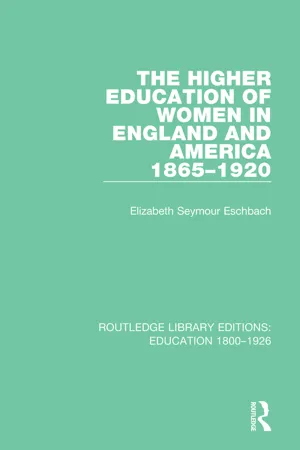
This study, first published in 1993, traces the path of women toward intellectual emancipation from eighteenth-century precedents, through the hard-won access to college education in the nineteenth-century, to the triumphs of the early 1900s. The author compares women's experiences in both the US and England, and will be of interest to students of history, education and gender studies.
eBook - ePub
The Higher Education of Women in England and America, 1865-1920
- 252 pages
- English
- ePUB (mobile friendly)
- Available on iOS & Android
eBook - ePub
The Higher Education of Women in England and America, 1865-1920
About this book
Information
The Higher Education of Women in England and America 1865-1920
Chapter 1
The Eighteenth-Century Legacy
Late, when the house was still, parents and servants having retired, young Mary Somerville (1780-1872) made her solitary way by candlelight through volumes of Euclid, Virgil, and Shakespeare. Quietly, so her secret passion would not be disclosed, Mary night after night absorbed much of the scholarship that would one day enable her to become a renowned English scientist. But familial disapproval and censorship frequently interrupted her studies in this last decade of the eighteenth century, forcing her to momentarily abandon her books. Once, noticing the supply of candles dwindling at a suspiciously rapid pace, the servants were told to remove them from her room when she went to bed. "We must put an end to this," declared her father, "or we shall have Mary in a strait jacket one of these days."1
This did not deter Mary. Nor was she discouraged when she found herself placed in the village school to learn cookery and needlework to prevent her "wasting her time in reading."2
By the age of thirty-three, Mary Somerville had progressed in her process of self-education to the higher levels of mathematics, astronomy, and physics. She then began translating and publishing. Soon she would receive the first of the many stipends, awards, and honors from England and abroad by which her work would be recognized for the rest of her life.3
As an adult, Mary often looked back on this unhappy childhood "and the long course of years in which I had persevered almost without hope." Having embraced a life of scholarship, she realized that "concealment was no longer possible, nor was it attempted. I was considered eccentric and foolish, and my conduct was highly disapproved of by many."4
When she died in 1872 at the age of 92, The London Post proclaimed Mary Soraerville "The Queen of Nineteenth-Century Science." She had become one of the foremost scientific writers of her age.
Mary Somerville's experience was both typical and exceptional. Her parents' hostility to her unrelenting devotion to learning reflected the prevalent attitude of late eighteenth-century English society toward scholarship in women. Mary Somerville, however, was an extraordinary woman. Thoroughly self-educated, she overcame parental and societal strictures to gain a place for herself in science that few women in history had been accorded. As scientist Margaret Alic notes, "It is impossible to know what the brilliant woman might have accomplished with early encouragement and training."5
A few decades earlier, across the Atlantic Ocean, the daughter of a distinguished South Carolina family pursued her studies with much the same enthusiasm as Mary Somerville would. Unlike Mary, however, young Harriott Pinkney (b. 1748) did not have to hide her learning in the darkness of the night. Rather, she was trained and encouraged by one of the best-educated women of the colonies, her mother, Eliza Lucas Pinckney (1722-1793), who taught her daughter Latin and French. Although Harriott had an able teacher in her mother, who had likened her own education to a "valuable fortune,"6 Harriott lacked formal training, particularly the kind her brothers enjoyed in England. While Harriott attended her lessons in languages and plantation management under her mother's tutelage, her brothers matriculated through Westminster and Oxford University.7 Always "fond of learning,"8 Harriott continued to study, borrowing algebra and geometry textbooks from her younger brother.9
Harriott Pinckney, like Mary Somerville, was an exceptional woman. Born into an illustrious, forward-looking family that valued intelligence in their daughter, as well as their sons, Harriott proved to be an avid learner whose mind, said her mother, was "excellent soil" to cultivate.10
Nonetheless, the Pinckney family demonstrated a characteristic eighteenth-century distinction in emphasis. While her brothers were sent abroad to attain the best education, Harriott was kept at home. It was Harriott's father's wish that his elder son "be virtuously, religiously and liberally brought up and Educated in the Study and practice of the Laws of England," in order to "become the head of his family and prove not only of service and advantage to his country, but also an Honour to his Stock and Kindred."11 No such imposing destiny would have been imagined for Harriott. Her life, instead, revolved around her home, her husband, and her children.
The lives of Mary Somerville and Harriott Pinckney, different in so many ways, shared the impact of common assumptions regarding the nature of women, the quality of their intellect, and the ideals of femininity. Both women were subject to the similar patterns and ideologies that shaped female behavior and destiny on both sides of the Atlantic in the eighteenth century, ideologies that precluded the opportunity for most women to gain educational advantage. The rationale behind these ideologies reached deep into the roots of western culture. Woman as wife, child-bearer, and nurturer had no need of formal education. Her energies were to be directed towards die service of husband, home, and family. Traditionally, then, education was a male preserve. The foundations of advanced scholarship in Europe, the early universities, prepared a man for a public life in theology, law, medicine, or university teaching. Woman, whose work was centered in the private realm of the home, had little use, tradition claimed, for advanced knowledge.
Contemporary eighteenth-century voices reinforced age-old practices, articulating and elaborating them. From the works of the celebrated Jean Jacques Rousseau (1712-1778) to the sermons and conduct manuals of relatively obscure preachers and doctors, English and American society bore no shortage of treatises that defined the dimensions and limitations of women's lives.
Translated into English in 1763, Rousseau's Emile, for example, affirmed the traditional notion of the social, political, and intellectual inferiority of women. While positing the kind of educational reform necessary to shape a male citizen for an idealized society, Rousseau provided a model of manhood based on strength, action, and intelligence gained through nature and experience. Rousseau's vision of womanhood, however, shared few of the characteristics of his ideal man. Passive and yielding, a woman, said Rousseau, is by nature weak and must follow the course nature has set for her. To aspire beyond her proper attributes by cultivating the "manly" qualities of strength, action, and intelligence would bring unhappiness. Created to provide pleasure to the opposite sex, the meaning of her life could be perceived only in relation to a man. The education of women, therefore, was in no need of reform. Governed largely by the natural cycles of pregnancy, childbirth, nursing, and child-rearing, women were already prohibited from intellectual exploration. In Rousseau's vision of men and women at home in a natural world, therefore, no educational changes in a girl's childhood were necessary. "To oblige us, to do us service, to gain our love and esteem . . . these are the duties of the sex at all times, and what they ought to learn from their infancy," he claimed.12
Some would shun Rousseau's views altogether; others would find fresh, stirring conceptions of family and gender relations and would follow Rousseau's visions accordingly. Generally among readers and thinkers of the time, Rousseau held a powerful influence. "Rousseau cast a spell over the foremost thinkers of Europe," wrote Dorothy Gardiner, "insisting that the birthright of women was inferiority of intellect and pettiness of soul."13
Less illustrious writers found audiences, as well. Following the pattern of the genre of courtesy books designed for gentlemen of the eighteenth century, advice books outlining general concepts of conduct for women were widely published in the latter half of the century in England. While focusing on aspects of proper decorum, these books inevitably addressed the question of education.
Written in an intimate, epistolary style, these manuals filled the bookshelves of families who aspired to gentility. Widely read and frequently reprinted, these sermons, letters, stories, and anecdotes defined for girls their religious, moral, and domestic duties, their recreations and amusements, and the nature and extent of their learning.14
One work by an English physician and moralist was especially popular in England and America. Dr. John Gregory's (1724-1773) A Father's Legacy to His Daughters remained fashionable until the 1870s, While similar to much of the didactic literature published in England during the last decades of the eighteenth century, this small book was famous for its often-quoted admonition to young women: "If you happen to have any learning, keep it a profound secret, especially from the men, who generally look with a malignant eye on a woman of great parts and cultivated understanding."15
Since wifehood and motherhood constituted a woman's prime vocation, such an exhortation was profoundly persuasive to girls and parents alike who might have otherwise considered the advantages of an education. Found in family libraries throughout England and the colonies and sometimes used as required reading in girls' schools, Dr. Gregory's book, as well as the Reverend John Bennett's Letters to a Young Lady, Dr. James Fordyce's Sermons to Young Women, and a host of similar tracts imposed restrictions not only on expressions of learning, but on any behavior that did not conform to the ideal of feminine delicacy.16
Throughout the eighteenth century, English writers of didactic literature increasingly idealized the sense of delicacy and sentiment in women. "The softness of manners," "the bloom of modesty," "the charms which enchant all hearts" were the qualities young women were to cultivate and the attributes society was to appreciate in the "fair sex." Any "bold action," or "difficulties and exertions," whether physical or mental, would stain a woman's femininity, the essence of her being.17
By implication, then, if not direct prescription, English priests and physicians, as well as a handful of women writers, informed their readers and followers of the inherent dangers of self-assertion in women. An active pursuit of knowledge or the quest for intellectual achievement were thus deprecated and discouraged. Only exceptional women such as Mary Somerville and Harriott Pinckney had the personal or familial resources to overcome the weight of such strictures. Most eighteenth-century women lacked these assets.
This "sentimental haze" that shrouded a woman's existence served, as Katharine Rogers indicates, to glamorize a woman's dependency. Delicacy became a euphemism for weakness, timidity, and subordination. Evolving during the eighteenth century as an ideal, modesty implied self-effacement and provided an effective barrier against tendencies toward self-fulfillment.18 The Reverend John Bennett's Strictures on Female Education, for example, warned direly against the ills of intense study since, "The delicacy of the everlasting pea, which so happily unites elegance with sweetness, would be easily oppressed. The tender plant which is refreshed with gentle gales, would be entirely overwhelmed by a whirlwind."19
While exalting passivity, the haze of sentiment dampened the expressions of women's aspirations, and, as Mary Somerville knew so well, forced most women who sought knowledge to follow Dr. Gregory's advice and "keep it a profound secret." Femininity was the primary trait by which a woman's identity was fashioned in the eighteenth century, and few were willing to compromise this identity. Most women fiercely guarded it, displaying only what Frances Reynolds, sister of Sir Joshua, called "the most perfect feminine mind," which "habitually aims at nothing higher than an exemption from blame."20
In America writers reinforced the advic...
Table of contents
- Cover
- Half Title
- Title
- Copyright
- Original Title
- Original Copyright
- Dedication
- Contents
- Acknowledgments
- Introduction
- 1. The Eighteenth-Century Legacy
- 2. Early Steps To Higher Education
- 3. A College Like a Man's
- 4. Reaction To An Education Like a Man's
- 5. The Promise of Equal Education In America
- 6. The Hope of Equal Recognition In England
- 7. Higher Education In The South
- 8. Expansion And Limitations In The Early Twentieth Century
- 9. Continuing Hope and Struggle
- Epilogue
- Bibliography
- Index
Trusted by 375,005 students
Access to over 1.5 million titles for a fair monthly price.
Study more efficiently using our study tools.
Frequently asked questions
Yes, you can cancel anytime from the Subscription tab in your account settings on the Perlego website. Your subscription will stay active until the end of your current billing period. Learn how to cancel your subscription
No, books cannot be downloaded as external files, such as PDFs, for use outside of Perlego. However, you can download books within the Perlego app for offline reading on mobile or tablet. Learn how to download books offline
Perlego offers two plans: Essential and Complete
- Essential is ideal for learners and professionals who enjoy exploring a wide range of subjects. Access the Essential Library with 800,000+ trusted titles and best-sellers across business, personal growth, and the humanities. Includes unlimited reading time and Standard Read Aloud voice.
- Complete: Perfect for advanced learners and researchers needing full, unrestricted access. Unlock 1.5M+ books across hundreds of subjects, including academic and specialized titles. The Complete Plan also includes advanced features like Premium Read Aloud and Research Assistant.
We are an online textbook subscription service, where you can get access to an entire online library for less than the price of a single book per month. With over 1.5 million books across 990+ topics, we’ve got you covered! Learn about our mission
Look out for the read-aloud symbol on your next book to see if you can listen to it. The read-aloud tool reads text aloud for you, highlighting the text as it is being read. You can pause it, speed it up and slow it down. Learn more about Read Aloud
Yes! You can use the Perlego app on both iOS and Android devices to read anytime, anywhere — even offline. Perfect for commutes or when you’re on the go.
Please note we cannot support devices running on iOS 13 and Android 7 or earlier. Learn more about using the app
Please note we cannot support devices running on iOS 13 and Android 7 or earlier. Learn more about using the app
Yes, you can access The Higher Education of Women in England and America, 1865-1920 by Elizabeth Seymour Eschbach in PDF and/or ePUB format, as well as other popular books in Education & Education General. We have over 1.5 million books available in our catalogue for you to explore.