Handbook of Carbohydrate-Modifying Biocatalysts
eBook - ePub

Handbook of Carbohydrate-Modifying Biocatalysts

  1. 1,056 pages
  2. English
  3. ePUB (mobile friendly)
  4. Available on iOS & Android
eBook - ePub

Handbook of Carbohydrate-Modifying Biocatalysts

About this book

This book provides an actual overview of the structure, function, and application of carbohydrate-modifying biocatalysts. Carbohydrates have been disregarded for a long time by the scientific community, mainly due to their complex structure. Meanwhile, the situation changed with increasing knowledge about the key role carbohydrates play in biological processes such as recognition, signal transduction, immune responses, and others. An outcome of research activities in glycoscience is the development of several new pharmaceuticals against serious diseases such as malaria, cancer, and various storage diseases. Furthermore, the employment of carbohydrate-modifying biocatalysts—enzymes as well as microorganisms—will contribute significantly to the development of environmentally friendly processes boosting a shift of the chemical industry from petroleum- to bio-based production of chemicals from renewable resources.

The updated content of the second edition of this book has been extended by discussing the current state of the art of using recombinantly expressed carbohydrate-modifying biocatalysts and the synthesis of minicellulosomes in connection with consolidated bioprocessing of lignocellulosic material. Furthermore, a synthetic biology approach for using DAHP-dependent aldolases to catalyze asymmetric aldol reactions is presented.

Frequently asked questions

Yes, you can cancel anytime from the Subscription tab in your account settings on the Perlego website. Your subscription will stay active until the end of your current billing period. Learn how to cancel your subscription.
At the moment all of our mobile-responsive ePub books are available to download via the app. Most of our PDFs are also available to download and we're working on making the final remaining ones downloadable now. Learn more here.
Perlego offers two plans: Essential and Complete
  • Essential is ideal for learners and professionals who enjoy exploring a wide range of subjects. Access the Essential Library with 800,000+ trusted titles and best-sellers across business, personal growth, and the humanities. Includes unlimited reading time and Standard Read Aloud voice.
  • Complete: Perfect for advanced learners and researchers needing full, unrestricted access. Unlock 1.4M+ books across hundreds of subjects, including academic and specialized titles. The Complete Plan also includes advanced features like Premium Read Aloud and Research Assistant.
Both plans are available with monthly, semester, or annual billing cycles.
We are an online textbook subscription service, where you can get access to an entire online library for less than the price of a single book per month. With over 1 million books across 1000+ topics, we’ve got you covered! Learn more here.
Look out for the read-aloud symbol on your next book to see if you can listen to it. The read-aloud tool reads text aloud for you, highlighting the text as it is being read. You can pause it, speed it up and slow it down. Learn more here.
Yes! You can use the Perlego app on both iOS or Android devices to read anytime, anywhere — even offline. Perfect for commutes or when you’re on the go.
Please note we cannot support devices running on iOS 13 and Android 7 or earlier. Learn more about using the app.
Yes, you can access Handbook of Carbohydrate-Modifying Biocatalysts by Peter Grunwald in PDF and/or ePUB format, as well as other popular books in Medicina & Bioquímica en medicina. We have over one million books available in our catalogue for you to explore.

Information

Chapter 1

Basics in Carbohydrate Chemistry

Heinrich Hühnerfuss
Department of Organic Chemistry, University of Hamburg,
D-20146 Hamburg, Germany

1.1 Introduction

The terms carbohydrate, saccharide, and sugar are being used as synonyms: carbohydrate refers to the classical assumption that this class of compounds exclusively consists of the elements C, H, and O, where the latter two elements exhibit the same relation as encountered in water, i.e., a relation of 2:1. Accordingly, a general formula of Cn(H2O)n was derived which was actually in line with the formulae of several basic sugars such as glucose (C6H12O6) or ribose (C5H10O5). However, though more detailed structural studies revealed that these compounds did not contain intact water molecules, the term carbohydrates persists. Furthermore, it was shown that many natural carbohydrates contain additional elements, e.g., nitrogen or sulphur. Saccharide stems from the word sugar in several early languages (sarkara in Sanskrit, sakcharon in Greek, and saccharum in Latin).
Carbohydrates are the most abundant class of bioorganic compounds in the biological world, making up more than 50% of the dry weight of the Earth’s biomass (Bruice, 2004). They play a crucial role in various functions in living organisms. For example, several carbohydrates serve as a major source of metabolic energy. Grass, leaves, fruits, seeds, stems, and roots of plants contain carbohydrates that plants use for their own metabolic needs and that also serve the metabolic needs of animals that eat the plants. Other carbohydrates can be found as structural components in cells or they act as recognition sites on cell surfaces. In the latter case, one of the most well-known phenomena is the approach of a sperm recognizing a carbohydrate on the surface of an egg’s wall. More examples highlighting the importance of carbohydrates in the world of bioorganic molecules will be given in Section 1.4.
Handbook of Carbohydrate-Modifying Biocatalysts
Edited by Peter Grunwald
Copyright © 2016 Pan Stanford Publishing Pte. Ltd.
ISBN 978-981-4669-78-8 (Hardcover), 978-981-4669-79-5 (eBook)
www.panstanford.com

1.2 Classification of Carbohydrates

Basically, two different systematic approaches can be used for a classification of carbohydrates: as carbohydrates either contain hydroxy and aldehyde functions (see Fig. 1.1a, glucose) or, alternatively, hydroxy and ketone functions (Fig. 1.1b, fructose), this discrimination may form a basis for a classification. Another approach that is often being used in basic monographs is based on the systematic discrimination between monosaccharides, disaccharides, oligosaccharides and polysaccharides. In the present chapter, both approaches will be combined by including the functional aspects in the sub-chapter mono-saccharides. As the terms suggest, mono- and di-saccharides consist of one and two sugar units, respectively, while oligosaccharides are assumed to contain 3 to 10 subunits linked together (according to the Greek word oligos, for “a few”). Polysaccharides contain more than 10 subunits.

1.2.1 Monosaccharides

The early constitutional as well as stereochemical investigations are closely related to the names Emil Fischer, Kiliani, and Tollens (Lichtenthaler, 1992). It was inferred from these basic results that monosaccharides can be considered to be oxidation products of alcohols that contain several hydroxy groups, resulting in polyhydroxy aldehydes or polyhydroxy ketones. The former group of oxidation products is nominated aldoses, while the latter group is called ketoses.
image
Figure 1.1 (a) Glucose and (b) fructose.
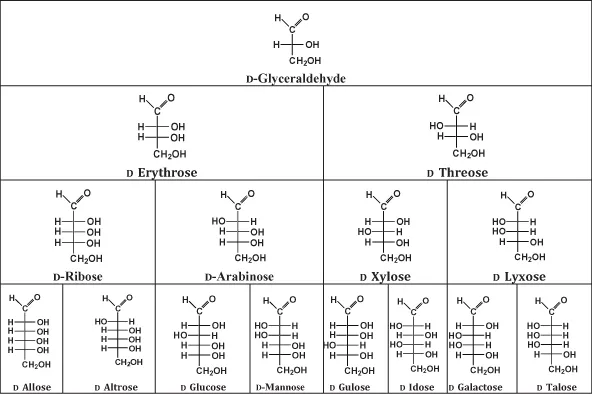
On the basis of the above definitions the so-called sugar tree can be derived, starting with the most simple compound that fulfils these characteristics, the aldotriose 2,3-dihydroxy propanal (“glyceraldehyde”). Insertion of an additional H–C–OH group leads to aldotetroses, further insertion of another H–C–OH group results in aldopentoses, and finally, addition of another H–C–OH group supplies the aldohexoses. This procedure is depicted in Fig. 1.2.
image
Figure 1.2 “Sugar tree” showing the stereoisomers of aldotetroses, aldopentoses, and aldohexoses as systematically derived from D-glyceraldehyde.
1.2.1.1 Configuration and nomenclature
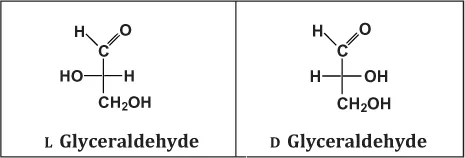
A full understanding of the sugar tree requires information on the absolute structures of these monosaccharides. The basic compound glyceraldehyde contains one stereogenic centre at the C2 atom. Accordingly two enantiomers can be defined. In order to discriminate between these enantiomers, different notations can be used. In Fig. 1.3 the so-called Fischer projection is displayed that follows very strict drawing rules: the stereogenic centre is placed in the centre of two crossing lines. Please note that the atom in this centre must not appear, i.e., in the case of the chiral glyceraldehyde the C2 must not be drawn. Otherwise a constitutional formula without any stereochemical information would be obtained. Furthermore, the carbon with the highest oxidation number, in the case of the monosaccharides an aldehyde or keto function, appears at the top or as close to the top as possible. The carbon chain backbone is being written in the vertical line. If the hydroxy group at the stereogenic centre appears at the right hand side, the D-enantiomer is obtained, and if the hydroxy group is placed at the left hand side, the L-enantiomer is assigned. This means that in the sugar tree shown in Fig. 1.2 exclusively the D-glyceraldehyde is given. Furthermore, it should be noted that IUPAC rules require the D and L prefixes to be written in small caps.
image
Figure 1.3 Fischer projection of the chiral glyceraldehyde.
The unequivocal advantage of the Fischer projection is that the absolute structure can be inferred, according to the following definition: the horizontal lines of the central cross lines are pointing towards the observer, while the two vertical lines are directing into the plane. Addition of an additional H–C–OH group (aldotetroses) gives rise to a second stereogenic centre. As a consequence, 2n = 4 stereoisomers can be expected, i.e., two pairs of enantiomers, where the stereochemical relation between these two pairs is denominated with the term diastereomer. It is worth noting that enantiomers basically exhibit the same physical parameters, while diastereomers may show different ones, provided that no enantioselective interactions with other chiral molecules or polarized light is encountered. In the case of aldopentoses, three stereogenic centres are present, and for aldohexoses four stereogenic centres are found, resulting in 23 = 8 and 24 = 16 stereoisomers, respectively. For example, in the case of the aldohexoses the eight stereoisomers shown in Fig. 1.2 plus the respective mirror images (enantiomers) exist. Basically, at each stereogenic centre a D- or L- notation is conceivable. However, in order to facilitate the nomenclature, a clear definition allows an assignment to the D- and L- notation: the stereogenic centre that is most remote of the carbonyl function (carbon exhibiting the highest oxidation number) determines the assignment to the group of D- and L-stereoisomers. However, it has to be noted that the absolute structure of the molecule cannot be directly inferred from the name; it can only be indirectly obtained on the background of additional knowledge of the glucose structure. Diastereoisomers that exhibit the opposite configuration at only one of two or more tetrahedral stereogenic centres present in the respective molecular entities are called epimers. This holds, for example, for the diastereomeric pair D-glucose and D-mannose (see Fig. 1.2).
Alternatively, the R-/S- notation that is based on the Cahn-Ingold-Prelog (CIP) rules can be applied to carbohydrates with several stereogenic centres. For example, strict assignment of each stereogenic centre in D-glucose to the R-/S- notation results in the exact IUPAC name (2R,3S,4R,5R,6)-pentahydroxyhexanal. In contrast to the D/L notation, this name allows an exact assignment of each stereogenic centre to its absolute structure. However, as this name is very inconvenient in publications, the name D-glucose as well as the respective names of other sugars according to the D/L notation are still dominating.
1.2.1.2 Ring structures of carbohydrates
As early as 1883 Tollens had recognized that simple aldohexoses such as glucose do not show all characteristics of aldehydes. In particular, no addition of sodium hydrogensulfate or ammoniak were observed, and no reaction with Schiff's reagent takes place. Tollens inferred from these observations that simple sugars do not prefer the aldehyde or keto form arrangement. Instead, an intramolecular hemiacetal formation may lead to cyclic structures, as shown in Fig. 1.4. These Tollens formulae suggest that basically five- or six-membered rings can be formed by reaction of the carbonyl function with the hydroxy group at C4 or C5. Furthermore, it is evident that an additional stereogenic centre is formed at the C1 position. If the hydroxy group...
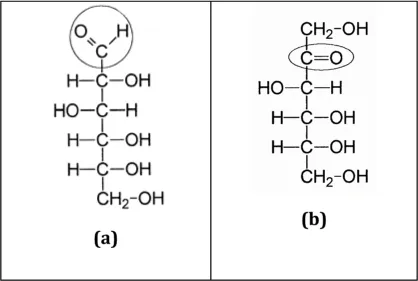
Table of contents

  1. Cover
  2. Half Title
  3. Title Page
  4. Copyright Page
  5. Contents
  6. Preface
  7. 1 Basics in Carbohydrate Chemistry
  8. 2 Glycoconjugates: A Brief Overview
  9. 3 Oligosaccharides and Glycoconjugates in Recognition Processes
  10. 4 Glycoside Hydrolases
  11. 5 Disaccharide Phosphorylases: Mechanistic Diversity and Application in the Glycosciences
  12. 6 Dihydroxyacetone Phosphate-Dependent Aldolases: From Flask Reaction to Cell-Based Synthesis
  13. 7 Enzymatic and Chemoenzymatic Synthesis of Nucleotide Sugars: Novel Enzymes, Novel Substrates, Novel Products, and Novel Routes
  14. 8 Iteratively Acting Glycosyltransferases
  15. 9 Bacterial Glycosyltransferases Involved in Molecular Mimicry of Mammalian Glycans
  16. 10 Sulfotransferases and Sulfatases: Sulfate Modification of Carbohydrates
  17. 11 Glycosylation in Health and Disease
  18. 12 Sialic Acid Derivatives, Analogs, and Mimetics as Biological Probes and Inhibitors of Sialic Acid Recognizing Proteins
  19. 13 Enzymes of the Carbohydrate Metabolism and Catabolism for Chemoenzymatic Syntheses of Complex Oligosaccharides
  20. 14 From Gene to Product: Tailor-Made Oligosaccharides and Polysaccharides by Enzyme and Substrate Engineering
  21. 15 Synthesis and Modification of Carbohydrates via Metabolic Pathway Engineering in Microorganisms
  22. 16 Metabolic Pathway Engineering for Hyaluronic Acid Production
  23. 17 Microbial Rhamnolipids
  24. 18 Chitin-Converting Enzymes
  25. 19 Linear and Cyclic Oligosaccharides
  26. 20 Fungal Degradation of Plant Oligo-and Polysaccharides
  27. 21 Bacterial Strategies for Plant Cell Wall Degradation and Their Genomic Information
  28. 22 Heterologous Expression of Cellulolytic Enzymes
  29. 23 Engineered Minicellulosomes for Consolidated Bioprocessing
  30. 24 Design of Efficient Multienzymatic Reactions for Cellulosic Biomass Processing
  31. Index