- 392 pages
- English
- ePUB (mobile friendly)
- Available on iOS & Android
eBook - ePub
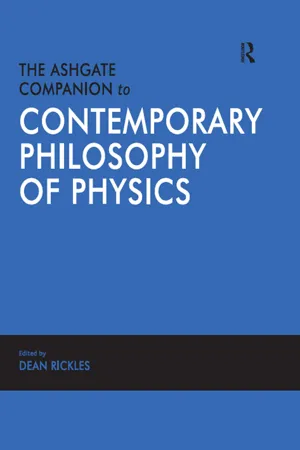
The Ashgate Companion to Contemporary Philosophy of Physics
About this book
Introducing the reader to the very latest developments in the philosophical foundations of physics, this book covers advanced material at a level suitable for beginner and intermediate students. A detailed overview is provided of the central debates in the philosophy of quantum mechanics, statistical mechanics, quantum computation, and quantum gravity. Each chapter consists of a 'state of the art' review written by a specialist in the field and introduces the reader to the relevant formal aspects along with the philosophical implications. These, and the various interpretive options, are developed in a self-contained, clear, and concise manner. Special care is given to situating the reader within the contemporary debates by providing numerous references and readings. This book thus enables both philosophers and physicists to engage with the most pressing problems in contemporary philosophy of physics in a fruitful way.
Information
1
ADVANCING THE PHILOSOPHY OF PHYSICS
There are several (general) philosophy of physics textbooks on the market.1 An obvious question to ask at the outset then is: Why another one? In his “Some Philosophical Aspects of Particle Physics”, Michael Redhead bemoans the common practice of philosophers of science of dealing with examples “which are no longer of current research interest in science” ((1980), p. 279). This practice is still common even among many philosophers of physics, and, for the most part, the available textbooks continue to engage in this practice. Generally, one finds a little spacetime, a little statistical mechanics, and a little quantum theory. Now, these are of course the ‘pillars’ of modern physics, so it is what we should expect to be covered in any textbook on the philosophy of physics worth its salt (and, indeed, they are well represented in this book). However, the issues that are dealt with are usually very old fashioned and very limited in scope: ‘spacetime’ means ‘the twins paradox’ (and possibly conventionalism); ‘statistical mechanics’ means ‘time asymmetry’; and ‘quantum theory’ means ‘the measurement problem’. Redhead is surely right that this leads physicists to “regard philosophy of science as somewhat irrelevant”. Rightly so, too, if this were in fact representative of much of what actually goes on in philosophy of physics. However, the state of play as represented in philosophy of physics and (some) philosophy of science journals shows a very different level of engagement, with philosophers of physics investigating the frontiers of scientific research. This disparity (or the impression of such) is the raison d’être for the book you are now reading. The result is an introductory textbook covering those portions of philosophy of physics research that other textbooks fail to cover, or cover only very briefly or very simplistically. The three pillars of modern physics—relativity, quantum theory and statistical mechanics—are still represented, then, but from a more advanced and contemporary perspective.
1.1 What is Philosophy of Physics?
A pretty good characterization of a philosopher of physics is ‘one who is shunned by philosophers and physicists in near equal measure’! Philosophers often view philosophers of physics as focusing on too restricted a field and as mere lapdogs to physicists. Physicists often view philosophers of physics either as simply incapable of understanding their work or else as tackling issues that are incapable of being resolved or that are not really in need of being resolved (i.e. irrelevant), and hence that are no aid to progress. This is, I hope you will agree, unfair to both physicists and philosophers of physics for a variety of reasons:
• Philosophers of physics don’t just accept what physicists tell them; a large part of their job is to interpret the constructions of physicists (and thus go beyond the ability of such constructions to yield accurate predictions). Another large part of the philosopher of physics’ job is to assess the epistemic status of the claims made by physicists (in the context of their theories or otherwise). This part is often highly critical, involving the denial of physicists’ claims. For example, it may be taken for granted by physicists that their theory comes with a particular unique ontology, a single way that the world would be if the theory were true. This is almost always false.2 If there are multiple pictures then it is assumed that evidence or internal, rational principles can settle the matter in favour of one or the other. Failing this, physicists might simply say they are not in the business of offering ontologies, only with making the right predictions. This might be true for many, but it conflicts with the intuitions of most physicists’ views of what they see themselves as doing, namely uncovering the (objective) secrets of Nature—Steven Weinberg, for example, staunchly defends such a view (see (Weinberg, 1987)). Philosophers of physics probe the assumptions that underlie such intuitions, and often expose erroneous ones.
• Philosophers of physics have also been known to occupy more constructive rôles too, contributing work on, e.g. quantum information theory, that is virtually indistinguishable from ‘normal’ physics—of course, many philosophers of physics began life as professional physicists, and in some cases led very distinguished careers in physics. One can often find philosophers contributing to physicists’ journals, books, conferences, and workshops—indeed, one frequently finds that the philosophers’ contributions are the most technical (possibly as a result of some need to prove themselves amongst the group of physicists).
• Physicists aren’t just concerned with describing the actual world: they often work on circumscribing what is physically possible, and often on what is possible according to various notions of physical necessity (i.e. involving different laws of physics). However, more importantly, physicists often employ (albeit often implicitly) a great many philosophical principles—a belief in the unity of Nature being one example; a belief in the simplicity of Nature being another. Moreover, as an examination of the history of physics quickly shows, philosophical scruples are never far away in revolutionary research: Newton, Bohr, Schrödinger, Heisenberg were all unashamedly ‘philosophical physicists’. Also, though they quite vocally said otherwise, the views of Dirac and Feynman were laced with philosophical presumptions. And let’s not forget Einstein; for him, philosophical thinking freed the mind leading to better physics:
I fully agree with you about the significance and educational value of methodology as well as history and philosophy of science. So many people today—and even professional scientists—seem to me like someone who has seen thousands of trees but has never seen a forest. A knowledge of the historic and philosophical background gives that kind of independence from prejudices of his generation from which most scientists are suffering. This independence created by philosophical insight is—in my opinion—the mark of distinction between a mere artisan or specialist and a real seeker after truth. (Einstein, from a letter to R. A. Thornton—taken from (Howard, 2005), p. 34)
The links between philosophy and physics are, then, tight and old. There have been clear instances in the past where aspects of one have influenced aspects of the other. Results in physics have directly contributed to the demise (or at least severe weakening) of positions in philosophy, especially in metaphysics. Kant’s views on the necessity of certain concepts in experience—Euclidean space and time for example—foundered in the light of developments in physics. The reasons for the tight connections are obvious: both involve a desire to understand the fundamental nature of things. The categories investigated intersect: matter, space, time, causality, etc. If a philosophical theory concerning these categories does not accord with the world as described by physics, then it perishes. In this way physics acts as a judge presiding over cases of metaphysics.
In other words, physics and philosophy of physics are not really so different (at least if we are talking about theoretical physics). This is a curious and, I think, almost unique case in which the ‘philosophy of X’ is very close to X itself.3 A browse through the pages of the International Journal of Theoretical Physics, Foundations of Physics, Studies in the History and Philosophy of Modern Physics, makes it hard to tell what is physics and what is philosophy of physics. Indeed, one can often find collaborations between philosophers and physicists on both ‘philosophical products’ and ‘physics products’. The chapters in this book respect this blurry distinction: the contemporary landscape of physics, treated here, involves considerable philosophical reflection from both camps and, likewise, contemporary philosophy of physics involves considerably more technical sophistication than previously required. The available textbooks on philosophy of physics simply fail to reflect the present situation—note that I do not say that they should; they have different aims from those of this book.4
1.2 The Job of the Philosopher of Physics
There are many ‘philosophy of …’ subjects, as mentioned above. Indeed, most work in philosophy is of such a sort: the application to some specific field of enquiry or subject matter of the concepts, tools and methods of philosophy. Then there are central ways—the ‘pillars of philosophy’—of investigating such things, i.e. ontological (metaphysical), logical, axiological, linguistic, epistemological, and methodological. The philosophy of physics is no different from, say, the philosophy of mind in this respect. One can apply all of the standard resources of philosophy to the subject matter of physics just as one can apply them to the mind.
1.2.1 The Interpretation Game
Arthur Fine once pondered what it is that philosophers of science do that scientists don’t do (1988, p. 4): Why are there philosophers of science at all? His answer, one that I agree with, boiled down to interpretation. This does not mean that scientists are not perfectly capable in such activities; Fine also rightly points out that they do engage in such debate. But they also sometimes engage in discussions of the ethics and politics or science, and venture into many areas that are deemed to lie outside of the proper practice of science. The point is, there are also people whose primary areas of expertise are those subjects just mentioned. Philosophers of physics, to a very large extent, devote themselves to the interpretation of physical theory. Likewise, that does not mean they are not perfectly capable of doing computational work in physics; many of them do too. Fine goes further: he would like to see philosophers of science doing empirical science. However, I don’t agree with Fine that “[w]ith very few exceptions … this divides philosophers from scientists pretty well” (ibid., p. 6). A vast number of physicists don’t ‘get their hands dirty’ at all with empirical science. Fine’s main point, however, is that there isn’t really much of a difference between ‘the scientific understanding of science’ and ‘the philosophical understanding of science’. That matches what was previously argued.
What does it mean to interpret a theory? Bas van Fraassen puts it best; the interpreter will ask: “Under what conditions is this theory true?” and “What does it say the world is like?” (1991, p. 242). The interpreter will then answer by specifying the class of worlds that make the theory true.5 What we end up with, then, is a set of worlds that make the theory true; or, a set of possible worlds according to the theory. Thus, interpretation, according to Gordon Belot, “consists of a set of stipulations which pick out a putative ontology for the possible worlds correctly described by the theory” (1998, p. 533).
Now, there are differing degrees of complexity which interpretation has to deal with. In some cases, interpreting a theory is a simple matter: the formalism seemingly maps one-to-one on to physically possible worlds. Or, there might be multiple types of possible worlds that constitute models of the theory, but that are compatible. The kinds of interpretive problems philosophers of physics are interested in happen when there are multiple incompatible possible worlds. We see this, for example, in the interpretation of quantum mechanics, where we have possible worlds (each satisfying the formal demands of quantum mechanics) with collapse and without collapse, with world-splitting and without world-splitting, and so on. Or quantum field theory with particles and without particles. Electro-magnetism as a theory of fields versus potentials versus loops; as a local theory versus an action-at-a-distance theory. General relativity as a theory with fundamental spacetime points and without fundamental spacetime points. These are empirically equivalent and they satisfy the basic postulates of the theories (van Fraassen’s syntactic part), but they are not equivalent simpliciter: they differ at the level of interpretation. This is, of course, the problem of underdetermination again: the representation relation between formalism (the syntactic structure of a theory) and worlds is one-to-many. We find similar underdetermination problems in all of the main pillars of physics. The basic problem is that there is an apparent ontological difference with no empirically discernible difference: even assuming one of the worlds really did describe the actual world, there is no way we could come to know, empirically, which world that was.6 The negative energy solutions of Dirac’s equation make a fine case in point here. The solutions appeared as part of the formal structure in Dirac’s theory, but they weren’t included in the semantics: no interpretation was given to them, and they were deemed ‘surplus structure’, to borrow a phrase of Michael Redhead’s. However, this is a rather large amount of surplus to be carrying around, and there is no apparent reason for its existence (qua surplus) that would explain it—that is, there is no symmetry responsible for generating it, or any other noticeable mechanism. Dirac reinterpreted the negative energy solutions (or just interpreted them in our sense) so that they left ‘the realm of surplus’ and entered ‘the realm of the physical’: they were taken to have a counterpart in the worlds that are models of the theory (i.e. that satisfy the equation). This new interpretation involved viewing the negative energy states as ‘holes’ that are positive (anti-electrons). These holes are ‘filled’ by electrons.
Of course, interpretation demands there be something to interpret. However, one of the issues faced in the chapters by Frigg (on statistical mechanics) and by Rickles (on quantum gravity) is that there is no unique, agreed upon formal framework. We don’t quite know what the theory is! Quantum mechanics too has numerous formulations, but they are equivalent.7 Not so in the cases of statistical mechanics and quantum gravity, though the reasons are different: in the case of quantum gravity there is simply a problem concerning experimental evidence. The problem for statistical mechanics is more normative: we aren’t entirely sure what it ought to be a theory of. For this, and other reasons, these chapters follow a slightly different route to the others: the class of interpretations is multiplied by the number of formal frameworks. However, the issues involved are the same once we target a specific formalism.
1.2.2 Experimental Philosophy
The interpretation game seeks to work out what a theory is telling us about the world. Related to the interpretation game is the second major job of the philosopher of physics: seeing what impact this has on our conceptual scheme. The results of interpretation are often incompatible with widely-held beliefs about the world, especially where space, time, and matter are concerned.8 When the theory has a firm experimental basis, this can lead to revisions. Even without experiment it suggests contingency in that conceptual scheme, the possibi...
Table of contents
- Cover
- Title Page
- Copyright Page
- Table of Contents
- Preface
- Acknowledgements
- 1 Advancing the Philosophy of Physics
- 2 Philosophy of Quantum Mechanics
- 3 A Field Guide to Recent Work on the Foundations of Statistical Mechanics
- 4 Philosophical Aspects of Quantum Information Theory
- 5 Quantum Gravity: A Primer for Philosophers
- Index
Trusted by 375,005 students
Access to over 1.5 million titles for a fair monthly price.
Study more efficiently using our study tools.
Frequently asked questions
Yes, you can cancel anytime from the Subscription tab in your account settings on the Perlego website. Your subscription will stay active until the end of your current billing period. Learn how to cancel your subscription
No, books cannot be downloaded as external files, such as PDFs, for use outside of Perlego. However, you can download books within the Perlego app for offline reading on mobile or tablet. Learn how to download books offline
Perlego offers two plans: Essential and Complete
- Essential is ideal for learners and professionals who enjoy exploring a wide range of subjects. Access the Essential Library with 800,000+ trusted titles and best-sellers across business, personal growth, and the humanities. Includes unlimited reading time and Standard Read Aloud voice.
- Complete: Perfect for advanced learners and researchers needing full, unrestricted access. Unlock 1.5M+ books across hundreds of subjects, including academic and specialized titles. The Complete Plan also includes advanced features like Premium Read Aloud and Research Assistant.
We are an online textbook subscription service, where you can get access to an entire online library for less than the price of a single book per month. With over 1.5 million books across 990+ topics, we’ve got you covered! Learn about our mission
Look out for the read-aloud symbol on your next book to see if you can listen to it. The read-aloud tool reads text aloud for you, highlighting the text as it is being read. You can pause it, speed it up and slow it down. Learn more about Read Aloud
Yes! You can use the Perlego app on both iOS and Android devices to read anytime, anywhere — even offline. Perfect for commutes or when you’re on the go.
Please note we cannot support devices running on iOS 13 and Android 7 or earlier. Learn more about using the app
Please note we cannot support devices running on iOS 13 and Android 7 or earlier. Learn more about using the app
Yes, you can access The Ashgate Companion to Contemporary Philosophy of Physics by Dean Rickles in PDF and/or ePUB format, as well as other popular books in Philosophy & Philosophy History & Theory. We have over 1.5 million books available in our catalogue for you to explore.