Nature is an attractive source of therapeutic and preventive compounds, and with such chemical diversity found in millions of species of plants, over 60% of currently used anticancer agents are derived from natural sources. Cancer Inhibitors from Chinese Natural Medicines summarizes new advancements in the experimental and clinical research of a selection of promising cancer inhibitors. It focuses on the latest scientific investigations of 238 Chinese herbs and discusses important aspects, including the types of inhibitors in the herbs, level of potency, mechanisms, and the advances in modification and formulation. Formulations from nano-particulates and immunotoxins in cancer inhibitors are also included in this comprehensive resource.
- 731 pages
- English
- ePUB (mobile friendly)
- Available on iOS & Android
eBook - ePub
Cancer Inhibitors from Chinese Natural Medicines
About this book
Information
1
Anticancer Activities of Exogenous Pathogenic Factor-Eliminating Herbs
CONTENTS
1. Arctium lappa 牛蒡子 Niu Bang Zi (Great burdock seed)
2. Bupleurum chinense and B. scorzonerifolium 柴胡 Chai Hu (Chinese thorowax)
3. Centipeda minima 石胡荽 Shi Hu Sui (Spreading
4. Cimicifuga foetida, C. dahurica, and C. heracleifolia 昇麻 Sheng Ma (Black cohosh)
5. Pueraria lobata and P. thomsonii 葛 Ge (Kudzu)
1 Niu Bang Zi 牛蒡子
Great burdock seed
Herb Origination
The herb Niu Bang Zi (great burdock seed) is the dried ripe seeds of a Compositae plant Arctium lappa. This plant is native to the broad temperate regions from Scandinavia to the Mediterranean and from the British Isles through Russia and the Middle East to China and Japan, and it is naturalized almost everywhere in the world now. Besides the seeds, the leaves, the stems, and the roots of the plant were also used as folk medicines in China.
Antitumor Activities and Constituents
The methanolic extract of Niu Bang Zi displayed obvious inhibitory effects against human prostate cancer cells in vitro, and its 70% ethanolic extract exerted potent antiproliferative activity against B cell hybridoma MA60 cells.1,2 The in vitro assay revealed the antiproliferative effect of its dichloromethane extract on various human cancer cell lines, especially K562 leukemia, MCF-7 breast cancer, and 786-0 renal cancer cell lines.3 NI-07, a product derived from A. lappa, could significantly repress the viability of breast cancer cell lines (HCC1419, MCF-7, MDA-MB-231, MDA-MB-468, and SKBR-3) after a 48 h treatment, but it had no cytotoxicity in normal mammary epithelial HME50HT cells and normal mammary fibroblast CCD-1074sk cells.4 In addition, its hydroethanolic extracts exerted marked free radical-scavenging activity.3
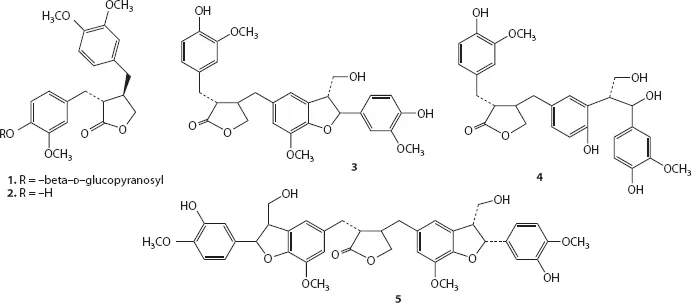
The major antineoplastic components discovered from these extracts were identified as dibenzylbutyrolactone lignans. Arctiin (1) and arctigenin (2) are the most potent inhibitors against the proliferation of cancer cells among these lignans. Both displayed strong cytotoxicity against human HepG2 hepatoma cells but little toxicity toward normal Chang liver cells.5
Arctiin
Arctiin (1) was reported to have the abilities to influence sex hormone metabolism and to inhibit protein synthesis and steroid biosynthesis.6 The antigrowth effect of arctiin (1) was found to partly correlate with the downregulation of cyclin-D1 expression in various types of human neoplastic cell lines, including on PC3 prostate cancer, osteosarcoma, melanoma, and cancers in lung, colorectal, kidney, cervical, and breast.7 In the initiation or the postinitiation period of mammary carcinogenesis caused by 2-amino-1-methyl-6-phenylimidazo[4,5-b]pyridine in female rats, arctiin (1) markedly reduced the incidence of mammary carcinoma, implying that arctiin (1) possesses chemopreventive potential on the carcinogenesis in the breast, particularly in the mammary gland.8 Moreover, during an anaerobic incubation with a human intestinal bacteria, arctiin (1) could be transferred to six bioactive metabolites. Among them, one metabolite termed (2R,3R)-2-(3′-hydroxybenzyl)-3-(3″,4″-dihydroxybenzyl)butyro-lactone at a concentration of 10 μM displayed the most potent suppressive activity against the estradiol-mediated proliferation of human MCF-7 breast cancer cells in vitro.9
Arctigenin
The potent antiproliferative effect of arctigenin (2) was observed in two kinds of human HL-60 and K562 leukemia cells (IC50: 0.1 μg/mL) and mouse MH60 hybridoma cells (IC50: 1.0 μM), which activity closely correlated with the induction of apoptosis evidenced with DNA fragmentation and DNA laddering, downregulation of B cell lymphoma 2 (Bcl-2) expression, upregulation of Bcl-2-associated X (Bax), cleave of poly(adenosine diphosphate [ADP]-ribose) polymerase (PARP), and activation of caspase-3.2,10 Also, arctigenin (2) was the most effective lignan toward M1 myeloid leukemia cells, while sesquilignans and diligenans derived from Niu Bang Zi were less effective. Arctigenin (2) also induced a differentiation of M1 myeloid leukemia cells in mice and activated phagocyte to the leukemia cells at a concentration of 0.5 μM.11 Comparing the three lignan structures with the activities revealed that the esterification of arctigenin (2) augmented the differentiation of leukemic cells, but its aliphatic esters were more dynamic in the induction of the M1 cells to differentiation than its aromatic esters. Especially, the n-docanoate of arctigenin was the most active derivative that induced more than half of the M1 cells into the phagocytic cells at a concentration of 2 μM.12 But the lignoid analogue was inactive toward the HL-60 cells in vitro.11
Moreover, arctigenin (2) at a concentration of 0.01 μg/mL was 100% preferential cytotoxic to nutrient-deprived cancer cells but not active under a nutrient-rich condition.13 Arctigenin (2) showed the cytotoxic effect on A549 (lung), HepG2 (liver), and KATO III (gastric) cancer cell lines accompanied with the promotion of apoptosis. The ED50 values were 4.5 μg/mL in HepG2 cells, 5.4 μg/mL in A549 cells, and 11.0 μg/mL in KATO III cells. Its antiproliferative effect was also shown in A431 epidermoid cancer cells (ED50: 49.8 μg/mL) and VMRC-LCP lung squamous cell cancer cells (ED50: 62 μg/mL).14 The growth inhibition of arctigenin (2) was also observed in several tested pancreatic carcinoma cell lines in vitro and in nude mice implanted with human PANC-1 pancreatic neoplasm.13 3′-O-Demethylarctigenin, an anaerobic microbiological metabolite of arctigenin, demonstrated the cytotoxicity in the PANC-1 cells but is less active than arctigenin (2).15 The mechanism of antipancreatic cancer effect was revealed to be related to the blocking of the nutrient supplement and the activation of Akt by glucose starvation.13 In human OVCAR3 and SKOV3 ovarian cancer cell lines, arctigenin (2) treatment resulted in a dose-dependent inhibition of the proliferation and the induction of caspase-3-dependent apoptosis, associating with the blocking of inducible nitric oxide synthase/nitric oxide/signal transducer and activator of transcription 3 (STAT3)/survivin signaling.16 Through a reactive oxygen species (ROS)/p38 mitogen-activated protein kinases (MAPK) pathway and the epigenetic inhibition of Bcl-2 by the upregulation of histone H3K9 trimethylation, arctigenin (2) stimulated the apoptosis of human MDA-MB-231 breast cancer cells and consequently restrained the cell growth in vitro and in vivo.17 However, it was inactive to human HeLa (cervix), SKBR-3 (breast), PC-14, and RERF-LC-KJ (lung) cancer cell lines, ACC-MESO-4 malignant pleural mesothelioma cells and several normal cell lines.14 Similarly, by selectively blocking the expression of unfolded protein response (UPR) target genes such as phosphorylated-PERK, ATF4, CHOP, and GRP78 and enhancing eIF2α phosphorylation during glucose deprivation, arctigenin (2) preferentially obstructed the viability of human HT-29 colon cancer xenografts in vivo, and the UPR suppression led to apoptosis via a caspase-activated mitochondrial pathway.18 In addition, arctigenin (2) was able to inhibit both constitutively activated and IL-6-induced STAT3 phosphorylation and subsequent nuclear translocation in the cancer cells. Therefore, arctigenin (2) could dramatically promote cisplatin-induced cell death in the cancer cells by enhancing the sensitivity of tumor cells to cisplatin primarily via STAT3 suppression.19
According to the evidence, arctigenin (2) was considered as a potential drug lead for structure modification to develop safer and more potent agents.20 From the arctigenin, α-[3-(β-chloroethyl methylaminomethyl)-4-hydroxy-5-methoxybenzyl-β-(3,4-dimethoxybenzyl)-butyrolactone was synthesized. It acted as a mustard inhibitor to exert the tumoricidal activity against Amytal ascites sarcoma, solid sarcoma 37 cells, and Nemeth–Kellner ascites lymphoma, but it was not effective in Ehrlich ascites cancer and solid sarcoma 180 cell lines. In this molecule, both monofunctional mustard and γ-lactone moieties were largely related to the antitumor activity. But the antitumor mustard showed a curare-like acute toxicity (LD50 of 36 mg/kg by intraperitoneal (i.p.) administration) to markedly reduce the bone marrow cellularity and the peripheral leukocyte concentration.21
Lappaols
Lappaols C (3), A (4), and F (5) separated from the ethanolic extract of Niu Bang Zi displayed a moderate suppressive effect against the proliferation of human LNCaP prostate cancer cells in vitro with IC50 values of 8, 16, and 40 μg/mL, respectively.1 In the in vitro experiments, lappaol F (5) time and dose dependently obstructed the growth of neoplastic cel...
Table of contents
- Cover
- Half Title
- Title Page
- Copyright Page
- Dedication
- Table of Contents
- Preface
- Author
- List of Herbs
- 1. Anticancer Activities of Exogenous Pathogenic Factor-Eliminating Herbs
- 2. Anticancer Potentials of Antipyretic Herbs
- 3. Anticancer Potentials of Antirheumatics Plant Herbs
- 4. Anticancer Potentials of Internal Cold-Dispelling Herbs
- 5. Anticancer Potentials of Vital Energy-Regulating Herbs
- 6. Anticancer Potentials of Blood-Activating and Stasis-Resolving Herbs
- 7. Anticancer Potentials of Hemostatic Herbs
- 8. Anticancer Potentials of Expectorant, Antitussive, and Antiasthmatic Herbs
- 9. Anticancer Potentials of Tonic Herbs
- 10. Anticancer Potentials of Purgative and Diuretic Herbs
- 11. Anticancer Potentials of Hard Lump-Resolving and Swelling-Reducing Herbs
- 12. Anticancer Agents from Antispasmodic Chinese Herbs
- 13. Anticancer Potentials of Anthelmintic Herbs
- 14. Anticancer Potentials of Other Herbs
- Index of Latin Names for Chinese Herbs
- Index of Chinese Names for Chinese Herbs
- Index of English Names for Chinese Herbs
- Index of Acronyms
Trusted by 375,005 students
Access to over 1.5 million titles for a fair monthly price.
Study more efficiently using our study tools.
Frequently asked questions
Yes, you can cancel anytime from the Subscription tab in your account settings on the Perlego website. Your subscription will stay active until the end of your current billing period. Learn how to cancel your subscription
No, books cannot be downloaded as external files, such as PDFs, for use outside of Perlego. However, you can download books within the Perlego app for offline reading on mobile or tablet. Learn how to download books offline
Perlego offers two plans: Essential and Complete
- Essential is ideal for learners and professionals who enjoy exploring a wide range of subjects. Access the Essential Library with 800,000+ trusted titles and best-sellers across business, personal growth, and the humanities. Includes unlimited reading time and Standard Read Aloud voice.
- Complete: Perfect for advanced learners and researchers needing full, unrestricted access. Unlock 1.5M+ books across hundreds of subjects, including academic and specialized titles. The Complete Plan also includes advanced features like Premium Read Aloud and Research Assistant.
We are an online textbook subscription service, where you can get access to an entire online library for less than the price of a single book per month. With over 1.5 million books across 990+ topics, we’ve got you covered! Learn about our mission
Look out for the read-aloud symbol on your next book to see if you can listen to it. The read-aloud tool reads text aloud for you, highlighting the text as it is being read. You can pause it, speed it up and slow it down. Learn more about Read Aloud
Yes! You can use the Perlego app on both iOS and Android devices to read anytime, anywhere — even offline. Perfect for commutes or when you’re on the go.
Please note we cannot support devices running on iOS 13 and Android 7 or earlier. Learn more about using the app
Please note we cannot support devices running on iOS 13 and Android 7 or earlier. Learn more about using the app
Yes, you can access Cancer Inhibitors from Chinese Natural Medicines by Jun-Ping Xu in PDF and/or ePUB format, as well as other popular books in Medicina & Medicina alternativa e complementare. We have over 1.5 million books available in our catalogue for you to explore.