eBook - ePub
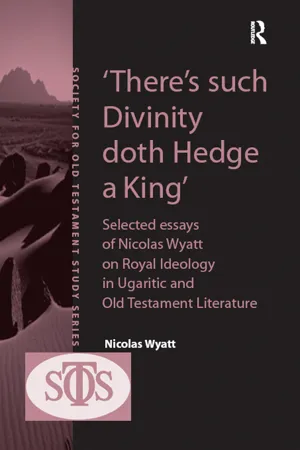
'There's such Divinity doth Hedge a King'
Selected Essays of Nicolas Wyatt on Royal Ideology in Ugaritic and Old Testament Literature
- 312 pages
- English
- ePUB (mobile friendly)
- Available on iOS & Android
eBook - ePub
'There's such Divinity doth Hedge a King'
Selected Essays of Nicolas Wyatt on Royal Ideology in Ugaritic and Old Testament Literature
About this book
The ideology of power is as much a part of modern life as in the ancient world, in which it has its long-lasting roots. Communities have always provided a supernatural sanction for the maintenance of power by the few, often dressing it up in elaborate mythic fictions, rich iconography and complex rituals. This volume presents Nicolas Wyatt's discussions of royal ideology, its mythic and ritual expressions and various literary treatments in ancient Israel, viewed from a comparative perspective. Exploring the possibility that in many of the manifestations of Israelite kingship we can detect the influence of broader cultural patterns, notably as found in Egyptian and West Semitic contexts, he considers the main early cultural influences on Israel and emphasizes the mythic dimension in which the 'divinity' of the king is a real factor.
Information
Chapter 1
‘Araunah the Jebusite’ and the Throne of David
First published in ST 39 (1985) 39–53.
I
An important event in the consolidation of David’s control over the newly-conquered city of Jerusalem was his acquisition of the threshing-floor of ‘Araunah the Jebusite’, which was already a sacred place of some importance, and was to become the site of the temple which so powerfully symbolized the cohesive power of the cult of Yahweh in the empire which David then proceeded to build. The divine choice of the site was indicated by the avenging angel of Yahweh halting his pestilential visitation of the people, following David’s impious census, at the very spot (2 Samuel 24:15–17). In the passage which immediately follows this account (2 Samuel 24:18–25) we have the extraordinary spectacle of the conquering David negotiating the purchase of the threshing-floor from its owner, when we might reasonably expect him to seize it by right of conquest. It seems that behind the seemingly straightforward veneer of the narrative a number of very complex issues lie concealed.
The problem is in no way diminished by the recognition that behind the form ‘Araunah’ there lies the designation of the king of Jerusalem, who in the present narrative formally hands over the sacred place to his successor. Is this formal gesture intended to represent the transfer of the kingship itself, or are we to see evidence of such a transfer elsewhere in the Davidic tradition? We shall try to offer a solution to these problems below.
The reasons for supposing that ‘Araunah’ is not an individual personal name, but the designation of a king, are as follows. The word appears in a number of different forms in 2 Samuel 24. In v. 16 it appears with the article as h’wrnh (K; h’rwnh: Q), in v. 18 as ’rnyh (K; ’rwnh: Q), and in vv. 20-24 (seven times) as ’rwnh. In 1 Chronicles 21:15–25, 2 Chronicles 3:1 it appears nine times as ’rnn (’ornan), and in LXX as ’Oρνα in all cases.1 H.B. Rosen suggested2 that the form ’rwnh was primary, being derived from the Hittite arawanni-, meaning ‘free’, ‘aristocratic’. He drew attention to the article in 2 Samuel 24:16, and interpreted the term h’rwnh (Q) as ‘the free man’. At the same time he explained ’rnyh in v. 18 as a variant form, representing Hittite arawannia-s (sic), and further noted, without comment, B. Maisler’s (Mazar’s) suggestion3 that the source of the biblical word might rather be Hurrian ewar-ne – ‘governor’. G.W. Ahlström noted Rosen’s article,4 and appears to have accepted the form ’rwnh as original, serving as a personal name; he drew attention to the expression in 2 Samuel 24:23 hkl ntn ’rwnh hmlk lmlk, noting that the accentuation of the sentence requires the formula ’rwnh hmlk to be taken as a unity, indicating that Araunah was given the title mlk, and was in fact the last Jebusite king of the city.
The Hurrian rather than the Hittite form of the word appears to be the more likely direct source of the biblical form, for two reasons. Firstly, the order of the first three consonants ’wr (rather than ’rw) appears to be supported both by the obvious problem MT has with the correct form, and by its desire to produce a uniform usage ’rw, which in its departure from the vocalization presupposed by both the Chronicler’s usage and by LXX, is manifestly secondary. Secondly, while the Hittites are frequently mentioned in connection with southern Palestine, this is unlikely to have a strictly historical (or accurately ethnological) application,5 whereas the presence of Hurrians in several Palestinian cities, including Jerusalem, in the latter part of the second millennium is well attested.6 To revert to 2 Samuel 24:23, we may modify Ahlström’s assessment of the curious form of the sentence by restoring an older form as follows, on the analogy of the usage with the article in v. 16: hkl ntn h’wrnh hmlk lmlk, and interpreting it in this way. The term h’wrnh is a title of office, rather than a personal name, clearly meaning ‘king’ in the present context,7 and the following hmlk is simply a gloss translating the foreign term into Hebrew for the reader’s benefit.
II
If we may regard it as fairly certain that the person from whom David acquires the threshing-floor is the ‘Jebusite’8 king of Jerusalem, then the question naturally arises as to whether we have any biblical evidence which allows us to establish his identity. We may mention one identification that has been suggested (though without any connection being made with 2 Samuel 24), and also consider another one.
Zadok
This was first suggested by S. Mowinckel,9 followed up by A. Bentzen,10 and rejected by H.H. Rowley.11 We need not enumerate the arguments here, because not only do we concur with Rowley’s rejection of the hypothesis, but believe that there is altogether more supporting evidence in favour of our second candidate.
There is a further point about Zadok which calls for remark here. G.E. Hauer has drawn attention12 to 1 Chronicles 12:28 (EVV 29), which refers to ‘Zadok, a young man mighty in valour (ncr gbwr ḥyl), and twenty-two commanders from his father’s house’ (RSV). Hauer proposes that this Zadok is none other than the priest, and reconstructs a scenario according to which Zadok, an important figure in Jerusalem society before David’s annexation of the city, plays an important though unspecified role in assisting David to gain control of the city, being subsequently rewarded for his treachery. Now the translation by RSV of ncr as ‘young man’ is patently inadequate. The term denotes a person of very elevated, not to say royal, status,13 and we may not unreasonably conjecture that ‘his father’s house’ was the royal household in Jerusalem. In other words, while Zadok was not himself the king of the city, he was the king’s son. His priestly status, presumably ex officio by virtue of his royal descent, may then be compared with the priestly status of David’s sons, mentioned in 2 Samuel 8:18.14 Perhaps his twenty-two commanders were the officers of a praetorian guard, with whose connivance the capture of the fortified city would have been only too easy. The silence of the tradition on so sensitive a point is perfectly understandable: as Hauer remarks, ‘the more immediate reasons [for Zadok’s surprising good luck at David’s hands] would not be shouted abroad’(!).
Uriah the Hittite
The unfortunate husband of Bathsheba, first cuckolded and then effectively murdered to avoid embarrassment for David, probably seems at first glance a most unlikely candidate for royal status. But there are several pieces of evidence which cumulatively support the suggestion.
a) His name He is consistently called Uriah the Hittite. That is, he is specifically said to be of non-Israelite or Judahite stock. This suggests that the explanation of his name in terms of a typical Hebrew theophoric name is misguided.
We should rather look to a ‘Hittite’ explanation, or one consonant with whatever ethnic identity may lie behind the term ‘Hittite’, given the unlikelihood of it actually having a straightforward meaning.15 In view of our discussion above on the form ’wrnh and variants, it seems very reasonable to detect in the consonantal form ’wryh not the Hebrew ‘Yah is (my) light’, but rather ‘Yah is lord’, as a Hurrian theophoric name of the model of the Ugaritic examples cited.16 As to the precise import of the final yh, two possibilities are available: either it is regarded as the supposedly commonplace hypocoristic ending which has cropped up in large numbers of personal names in Ebla, for example (though I myself regard this as an example of special pleading in over-reaction to some of the more extreme pan-Yahwist claims that have also been made), or it may be regarded as a Hurrian divine title, which was proposed as the source of the divine name Yahweh in a provocative and surprisingly neglected study by J. Lewy.17 There is no need to enlarge here on this problem, however, since it does not affect the likely Hurrian meaning of the name Uriah in the present context.
b) His wife Uriah’s wife Bathsheba, presumably married to him before the capture of the city, must surely have been of non-Israelite or Judahite origin too. She is said in 2 Samuel 11:3 to be the daughter of Eliam (in 1 Chronicles 3:5 she is called Bathshua, and he Ammiel), which suggests a Semitic pedigree, but can be explained perfectly well in terms of the Semitic (Canaanite) population of the city, where the Hurrians probably formed the ruling caste. However while this would allow a Semitic etymology, this does not sound entirely convincing (‘Daughter of the Seven’ – sc. the Pleiades – has no West Semitic parallel; ‘Daughter of oath’18 seems contrived), it is tempting to look for a Hurrian one. There is no obvious transliteration of any recognizable or constructible Hurrian personal name here, but if we allow for a garbled form, we may conjecture that behind the second part lies the divine name Hepa.19 We may also note the interesting observation of Ezekiel (Ezekiel 16:3, 45), addressing Jerusalem, that ‘your father was an Amorite and your mother a Hittite’. The background to this expression is the mythical presentation of a city in terms of a goddess or queen,20 and while the identity of the Amorite father remains obscure, it is quite likely that Ezekiel looks upon Bathsheba as ‘Hittite’ by virtue of her marriage to Uriah, if not in her own right, as the personification of the city, with perhaps more than a hint at her adultery. This possibility will become the clearer in the light of our discussion below.
III
Bathsheba’s Ideological Role
a) The office of Gebirah This office in the ancient West Semitic kingdoms appears to have been of considerable importance.21 It is significant that whenever genealogical and chronological data are listed for successive kings of Israel and Judah, the Deuteronomist gives the name of the king’s mother, not that of the queen. It appears to be by virtue of his sonship to her that he holds his royal title. There are two aspects to this. Firstly, the possibility must be considered that it is through the female line, not the male line, that the rightful occupation of the throne descends, so that a king reigns by virtue of his relationship to the chief queen, who has, as it were, the keys of the kingdom. The analogy with ancient Egyptian practice looks promising: there the chief queen is regarded as an embodiment (‘incarnation’!) of Isis (whose very name, 3st, means ‘throne’, and whose chief iconographic feature is the throne-headdress she wears), or by New Kingdom times of the composite Isis-Mut-Hathor (Mut, ancient consort of Amun, being herself the apotheosis of royal motherhood – mwt: ‘mother’). So vital was the female title to the throne in Egypt that kings made a habit of marrying not only the chief queen, who might be their own mother, but all daughters, sisters, cousins and concubines who might inherit the title upon the demise of its incumbent.
We have no evidence of such extravagance in ancient Judah, of course, but there are instances which look suspiciously like the same principle at work. Maacah, daughter of Absalom, who we know held the office of Gebirah (gebîrâ) because Asa dismissed her ...
Table of contents
- Cover
- Half Title
- Title Page
- Copyright Page
- Table of Contents
- Preface
- Acknowledgements
- Abbreviations
- 1 ‘Araunah the Jebusite’ and the Throne of David
- 2 ‘Jedidiah’ and Cognate Forms as a Title of Royal Legitimization
- 3 Cain’s Wife
- 4 The Hollow Crown: Ambivalent Elements in West Semitic Royal Ideology
- 5 Echoes of the King and his Ka: An Ideological Motif in the Story of Solomon’s Birth
- 6 When Adam Delved: The Meaning of Genesis 3:23
- 7 ‘Supposing Him to be the Gardener’ (John 20:15): A Study of the Paradise Motif in John
- 8 The Meaning of El Roi and the Mythological Dimension of Genesis 16
- 9 The Theogony Motif in Ugarit and the Bible
- 10 The Liturgical Context of Psalm 19 and its Mythical and Ritual Origins
- 11 Ilimilku’s Ideological Programme: Ugaritic Royal Propaganda, and a Biblical Postscript
- 12 Arms and the King: The Earliest Allusions to the Chaoskampf Motif and their Implications for the Interpretation of the Ugaritic and Biblical Traditions
- 13 Degrees of Divinity: Some Mythical and Ritual Aspects of West Semitic Kingship
- 14 Ilimilku the Theologian: The Ideological Roles of Athtar and Baal in KTU 1.1 and 1.6
- 15 Marriage, Mayhem and Murder: An Everyday Story of Royal Folk
- Bibliography
- Index
Trusted by 375,005 students
Access to over 1.5 million titles for a fair monthly price.
Study more efficiently using our study tools.
Frequently asked questions
Yes, you can cancel anytime from the Subscription tab in your account settings on the Perlego website. Your subscription will stay active until the end of your current billing period. Learn how to cancel your subscription
No, books cannot be downloaded as external files, such as PDFs, for use outside of Perlego. However, you can download books within the Perlego app for offline reading on mobile or tablet. Learn how to download books offline
Perlego offers two plans: Essential and Complete
- Essential is ideal for learners and professionals who enjoy exploring a wide range of subjects. Access the Essential Library with 800,000+ trusted titles and best-sellers across business, personal growth, and the humanities. Includes unlimited reading time and Standard Read Aloud voice.
- Complete: Perfect for advanced learners and researchers needing full, unrestricted access. Unlock 1.5M+ books across hundreds of subjects, including academic and specialized titles. The Complete Plan also includes advanced features like Premium Read Aloud and Research Assistant.
We are an online textbook subscription service, where you can get access to an entire online library for less than the price of a single book per month. With over 1.5 million books across 990+ topics, we’ve got you covered! Learn about our mission
Look out for the read-aloud symbol on your next book to see if you can listen to it. The read-aloud tool reads text aloud for you, highlighting the text as it is being read. You can pause it, speed it up and slow it down. Learn more about Read Aloud
Yes! You can use the Perlego app on both iOS and Android devices to read anytime, anywhere — even offline. Perfect for commutes or when you’re on the go.
Please note we cannot support devices running on iOS 13 and Android 7 or earlier. Learn more about using the app
Please note we cannot support devices running on iOS 13 and Android 7 or earlier. Learn more about using the app
Yes, you can access 'There's such Divinity doth Hedge a King' by Nicolas Wyatt in PDF and/or ePUB format, as well as other popular books in Theology & Religion & Biblical Studies. We have over 1.5 million books available in our catalogue for you to explore.