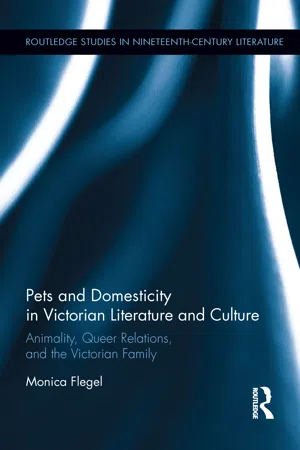
Addressing the significance of the pet in the Victorian period, this book examines the role played by the domestic pet in delineating relations for each member of the "natural" family home. Flegel explores the pet in relation to the couple at the head of the house, to the children who make up the family's dependents, and to the common familial "outcasts" who populate Victorian literature and culture: the orphan, the spinster, the bachelor, and the same-sex couple. Drawing upon both animal studies and queer theory, this study stresses the importance of the domestic pet in elucidating normative sexuality and (re)productivity within the familial home, and reveals how the family pet operates as a means of identifying aberrant, failed, or perverse familial and gender performances. The family pet, that is, was an important signifier in Victorian familial ideology of the individual family unit's ability to support or threaten the health and morality of the nation in the Victorian period. Texts by authors such as Clara Balfour, Juliana Horatia Ewing, E. Burrows, Bessie Rayner Parkes, Anne Brontë, George Eliot, Frederick Marryat, and Charles Dickens speak to the centrality of the domestic pet to negotiations of gender, power, and sexuality within the home that both reify and challenge the imaginary structure known as the natural family in the Victorian period. This book highlights the possibilities for a familial elsewhere outside of normative and restrictive models of heterosexuality, reproduction, and the natural family, and will be of interest to those studying Victorian literature and culture, animal studies, queer studies, and beyond.
eBook - ePub
Pets and Domesticity in Victorian Literature and Culture
Animality, Queer Relations, and the Victorian Family
- 204 pages
- English
- ePUB (mobile friendly)
- Available on iOS & Android
eBook - ePub
Pets and Domesticity in Victorian Literature and Culture
Animality, Queer Relations, and the Victorian Family
About this book
Information
1 Love Me, Love My Dog The Role of the Pet in Rituals of Courtship, Domesticity, and Parenthood
DOI: 10.4324/9781315735733-2
In this first chapter, I take a closer look at literary representations of domestic animals at all stages of “normative” coupling according to Victorian familialism, from identifying a proper mate, to courtship, to marriage, to parenthood. As beings that allowed for physical affection and open declarations of attachment, pets in texts such as Anne Brontë’s Agnes Grey (1847) act as surrogate partners for the young single person, occupying a similar position, I argue, to the romantic friend. Carolyn Oulton describes romantic friendships in the nineteenth century as bonds that were “associated almost automatically with the young, whose passionate energy was directed towards love of friends either in place of, or in preparation for, expected marriage” (30). Given that romance between members of the opposite sex in the middle classes was often strictly supervised, the pet provided an opportunity for passionate attachment that was meant, particularly for women, as practice for conjugal and maternal love. The cherished pet as a “lovemachine” (Kete 55) worked to open the affections of the young, and thus teach them both romantic feeling and proper care of dependents. The depiction in novels such as Agnes Grey and George Eliot’s Middlemarch (1874) of young women embracing their role as care-givers with loveable dogs therefore demonstrates these women are at their most marriageable, just as their less nubile sisters are revealed through their failed interactions with domestic pets or their too-close identification with the wrong kind of pets.
As (mostly) mute arbiters of romantic feeling, pets in the texts studied here are put to use in romantic communications, expressing on behalf of their masters and mistresses the complex emotions involved in intimate relationships that could not easily be expressed within the parameters of polite society. I argue further that the pet occupies a much more complicated position than a simple love machine in courting and romance rituals, instead also lending itself as a means of expressing all the fraught emotions that accompany courting, such as eroticism, jealousy, violence, and possessiveness. While relations with pets can operate as a sign of a young man or woman’s ability to feel affection and nurturance, they can also be, as is the case in novels such as Dickens’s David Copperfield (1850), a sign of a serious flaw. An overinvestment in a pet, for example, might speak to a primary narcissism making one unsuited to marriage and parenthood, while a pet treated with cruelty might serve as a means of demonstrating the violent disruption of romantic bliss. As barometers of affections within the home and between partners, pets are as apt to reveal disharmony as they are to register familial affection. These multi-faceted roles played by the domestic pet in human romantic relationships speaks, in part, to the fraught relationship we have with our pets:
Do we love dogs the way we love erotic partners or spouses? Or do we rather love them the way we love children – or even, as some have implied, as masters ‘love’ their servants or their slaves? … Do we ‘love’ dogs not only because they ‘love’ us, but because the power relation between a human being and an inferior loving subject is intrinsically pleasurable?(Garber 125)
These questions invite us to acknowledge, I suggest, the extent to which these vexed relations also have the power to throw into high relief the presence of similar inter-relations of power and eroticism within human familial relations, revealing those fractures and fault lines that exist underneath the surface of domestic relations.
“It is A Beauty Like that of Kittens”
Identifying Appropriate Romantic Partners through Pet Analogies and Pet Relations
Pets come into play in nineteenth-century texts at the very beginning of romantic attachment, playing a role in distinguishing what are constructed as good and healthy romantic choices from those that spell out future unhappiness and marital disharmony, both through analogies linking humans with animals and through representations of human/pet relationships that are meant to stand in for or presage human attachments. The use of animal analogies in nineteenth-century novels continued a practice that has a long history: “From Aristotle to Darwin down to the present, naturalists have credited bees with monarchies, ants with honesty, and dogs with tender consciences. … In many cultures, the fundamental moral and prudential lessons of human life are taught via myths about animals, such as Aesop’s fables, which have been told and retold for millennia” (Daston and Mitman1). Domestic pets, particularly cats and dogs, were often used in English culture to represent the vices or virtues of their masters but, even more so their mistresses, because women have in many cultures been configured as “playthings and pets” (Tuan 123). As Laura Brown observes of eighteenth-century England, for example, pet-keeping “suggests a special role for gender in the imaginative involvement with animal-kind, since women are constitutive” of the “distinctive, domestic representation of human-animal conjunction” (65). In the texts studied here, what matters most in terms of predicting what kind of wife a woman will be is the kind of pet with which she is associated.
Kittens in particular were often linked to attractive young women, their frolicsome beauty ably capturing all that was beguiling and tempting in a nubile girl. In describing Hetty Sorrel in Adam Bede (1859), George Eliot uses analogies with kittens as a means of capturing Hetty’s particular power: “… there is one order of beauty which seems to turn the heads not only of men, but of all intelligent mammals, even of women. It is a beauty like that of kittens … – a beauty with which you can never be angry, but that you feel ready to crush for inability to comprehend the state of mind to which it throws you, [sic] Hetty Sorrel’s was that kind of beauty” (84). Kittens, with their combination of helplessness and attractiveness, perfectly convey Hetty’s childish and beguiling beauty and the disordered state of mind into which she throws those, like Adam, who are caught in her orbit. Similarly, in Anne Brontë’s The Tenant of Wildfell Hall (1848), young Gilbert Markham finds himself drawn to the local coquette, Eliza Millward: “Her voice was gentle and childish, her tread light and soft as that of a cat; – but her manners more frequently resembled those of a pretty, playful kitten, that is now pert and rogueish, now timid and demure, according to its own sweet will” (23). Descriptors such as “gentle,” “soft,” and “timid” fall well within appropriate femininity here, but there are clear indications that Eliza’s affections are perhaps more sexual than they are strictly feminine, “pert” and “rogueish” as she is. Both Hetty and Eliza are clearly seductive creatures, and a large part of their attraction is their confusing, indefinable nature, which likewise infects those who are drawn to them with a state of emotional turbulence. In Hetty’s case, her beauty is such that it arouses both care and violence, and with Eliza, her kittenish beauty speaks to the fleeting and changeable nature of her own moods. These young women are in a state of sexual nascence, caught between girlhood and womanhood, and their flirtatious attractions speak to a sensuality that is not yet determined or confined within marriage, one that is still playful and polymorphous.
While their kittenish qualities capture all that is attractive about the flirtatious, sensual young women, it is these very attributes that exclude Hetty and Eliza as good choices for a mate. In nineteenth-century English texts, woman as pet sits uneasily within the middle-class expectations of wife as moral center of the home and rearer of children. When a woman is represented as sharing too close an association to the pet, such proximity represents her own selfish, inward-turning admiration rather than her ability to undertake the care and affection of others. Cat analogies in particular, which often operate as coded references to female sexuality, indicate a woman whose desires are perhaps more libidinal than maternal. The link between women and cats has a long history, particularly the “association of the cat with rapacious feminine sexuality” (Kete 119). For example, cats were often linked to female prostitutes, as both were seen as “aggressively sexual animals that constantly groomed themselves” (118), leading one nineteenth-century French commentator, as Katharine M. Rogers relates, to suggest “both animals are essentially ‘antipathetic to marriage,’ are ‘keen on maintaining [their] appearance,’ are silky and shiny, eager for caresses, ardent and responsive, graceful and supple, make night into day, and shock ‘decent people with the noise of [their] orgies’” (119–120). Constructed as vain, deceitful, and manipulative, the cat’s “domesticity was a sham. Kittens, especially, could be appealing, even gentle, but ‘at the same time, they have an innate malice, a falseness of character, a perverse nature, which age augments and education can only mask’” (Kete 118).
The association of cats with rampant female sexuality means that when a woman is compared to cats in a nineteenth-century novel, she probably possesses a sexual independence or, at the very least, a selfishness that makes her unsuited for her role as domestic angel. Eliza Millward’s kittenish behavior, for example, serves as a red flag to back up the warning Gilbert Markham’s mother gives him in regards to choosing Eliza as a romantic partner: “You’ll soon tire,” she says, “of petting and humouring your wife, be she ever so charming. …” (Brontë, Tenant 56). As a source of playful flirtation, woman as pet is just fine, but as a future wife, the defiance that is captured in the description of Eliza’s “own sweet will” (23) speaks to a character trait that will require her husband to serve her needs, rather than the patriarchally approved reverse. Eliza is later proven, in her role as vicious gossip, to be every bit as “catty” as her role as bewitching pet suggests.
This correlation of women with cats as a means of signaling a woman’s unfitness for marriage is present also in George Eliot’s description of Hetty Sorrel, “that distracting kitten-like maiden” (Adam Bede 85) who causes such grief through her narcissistic, bewitching beauty.Though Eliot concedes Hetty’s beauty is enticing, in part because it suggests a fragility and delicacy that is like catnip to the young (and old) males of the text, her seeming meekness is disingenuous; her beauty is instead a “false air of innocence” (85), one that masks a “coquettish tyranny” (99). As well, though her beauty is a source of pleasure to others, it is also problematically a source of joy to herself, and as such represents an inward-turning female vanity, a sexuality that is “aggressive,” rather than receptive, and focused on sexual pleasure rather than the wifely duty of love and reproduction.When Eliot writes, “Hetty did not speak, but Adam’s face was very close to hers, and she put up her round cheek against his, like a kitten. She wanted to be caressed – she wanted to feel as if Arthur were with her again” (359), she uses the connection with the cat, who is often represented as seeing primarily to her own needs and wants, to demonstrate that this young girl’s sexuality exists for her own sake, because she takes affection from one man while fantasizing about another. Tempting but treacherous, kittenish women are “spoiled” women, those who are unsuited for service to others in marital and parental relationships. Furthermore, Hetty might be soft and pretty but, like a kitten, she also has claws and is capable of great callousness: “Hetty would have been glad to hear that she should never see a child again; they were worse than the nasty little lambs that the shepherd was always bringing in to be taken special care of in lambing time; for the lambs were got rid of sooner or later” (154). Hetty’s hatred of young things speaks, of course, to her own unfitness for the role of wife and mother, which will be supported by the later infanticide of her outof-wedlock infant. Bewitching, self-satisfied, and self-satisfying, the kittenish woman and the domestic cat were the anti-wife and the anti-pet, disruptive to domesticity rather than constitutive of it.
Dogs fare better as arbiters of married bliss, though lapdogs in particular have not always enjoyed a good reputation, being often associated with wealthy, carnal women; to this day, “The idea that little dogs both stand for and take the place of humans as objects of a wealthy woman’s affection informs the most common derogatory stereotypes of small dog breeds” (McHugh 85). As a symbol of female desires, and as a non-human partner with whom a woman might reveal her capacity for relationships with another, lapdogs occupied a complex position, with some early commentators suggesting that such pets went beyond arousing the affections to being used to satisfy their mistresses’ more carnal appetites. Susan McHugh refers to Abraham Flemyng’s Of English Dogges (1576), in which “Fleming waxes ministerial, even poetic, as he condemns dogs of ‘dantie dames’ or ‘wanton women’s’ toys as ‘instruments of folly for them to play and dally withal, to trifle away the treasure of time, to withdraw their mindes from more commendable exercises, and to content their corrupted concupiscences with vaine disport’” (86–87). Lest one thinks Fleming alone in his suspicion of lapdogs, Marjorie Garber observes in Dog Love that
Edward Ward’s “Panegyrick upon my Lady Fizzleton’s Lap-Dog” of 1709 notes that the lady “Kindly rewards the little Four-legg’d Beau/ For secret Service he performs below,” and Robert Gould’s 1682 satire on women, Love Given O’re, links lapdogs and dildos as providers of women’s pleasure in their private apartments: “Where flaming Dil----s doe inflame desire,/And gentle Lapd----s feed the am’rous fire: Lap-d----s! to whom they are more kind and free,/Than they themselves to their own Husbands be.” (143)
The lasciviousness of these women and the dogs with whom they are associated speak to the double role played in dog analogies. While often prized for loyalty and affection, dogs are equally associated with unbridled sexuality and, as such, can operate much like the cat in representing a woman’s affection and sexuality that is as onanistic rather than productive. That the woman’s sexuality should instead exist for her male partner is made clear in these texts by the jealousy of the male observer, who feels the lapdog has taken the place that should rightly be occupied by a male, or in Fleming’s more broadly castigating text, by “more commendable exercises.” Certainly the dog in all of these texts has served to bring out the affections of the woman, but has done so in ways unsanctioned by patriarchy – both of the lesser creatures, woman and dog, have found ways to bring pleasure to each other but neither is serving or servicing the master, who looks on in envious disapproval. Rather than showing everything that is “kind and free” to the husband, a woman’s kindness and freedom are spent upon the animal and herself, leaving the man, it would seem, out in the cold.
Laura Brown identifies the “lady and the lapdog” as “a staple trope of the antifemale verse satire of the first half of the eighteenth century,” a trope that relied on “a set of allied images of female sexuality: the woman’s bed, the breast, the nap, the lap, sometimes the gaze, and especially the kiss” (71). Of poems such as Edward Stephen’s “On the Death of Delia’s Lap-Dog” (1747) and Isaac Thompson’s “The Lap-Dog” (1731), Brown suggests “the lapdog seems to be both an inappropriate or perverse sexual partner for the woman, and also a metonym for female sexuality – a dynamic that places the animal simultaneously within and outside the realm of the human, or – from another perspective – places the women both within and outside the realm of the animal” (72). This linkage of women and women’s sexuality with animals and animal bodies continues throughout the nineteenth century and to the present day, supporting what Cora Lansbury identifies as a shared discourse between animal vivisection and pornography1 and what Carol J. Adams has labeled the “sexual politics of meat.” While readings linking women and animals are certainly supported by Victorian texts, the domestic animal in Victorian novels is not necessarily or solely associated with the woman. Tess Cosslett notes that pets in Victorian fiction could also be used to demonstrate “the affinity between animal and child” (74) and between animals and servants (83). I further argue that even as pets stand in both for the woman and for the eventual and seemingly inevitable offspring, pets also act as a signifier for the male, serving as a proxy for the future husband. Rather than displacing the male and providing the woman with sexual and emotional satisfaction outside human coupling, the pet dog in stories of successful coupling instead prepares the woman for and is eventually displaced by the male husband.
The ability of the pet dog in nineteenth-century texts to represent woman, man, and eventual child in the Victorian family has much to do with lapdogs enjoying a better reputation in the nineteenth century than they did in the eighteenth, with their ability to arouse the emotions more clearly and carefully linked to those feelings associated with proper domesticity rather than with sexual satisfaction. By the nineteenth century, “More than other beasts, pets displayed ‘a generosity, gratitude, fidelity, and affection worthy of imitation.’ The pet encapsulated the virtues of the heart, unsullied by sceptical calculating intellect” (Turner 76). No longer furry dildos, pets became instead both small romantic companions and babies-in-training, as seen, for example, in the role played by pet-keeping in the training of children in compassion and care. As Kete observes, “The dog trained the children in ethical life. The dog had ‘the gift of exciting sentiments of good, of humanity, of love among children’” (48). The feelings of love and kindness elicited in childhood also prepared young men and women for the further development of those emotions into romantic attachment later in life. In her analysis of a short story about two lovers brought together by a young man’s dog, appropriately entitled “Marrying for the Dog,” Susan Pearson notes
Just as children might learn proper “heart culture” through their pets and practice ideal family relations with them, so too adult families are both completed and formed through emotional investment in the pet-child. Every family ought to have a dog, wrote another author on the same theme, “for it is like having a perpetual baby in the house.” To have a perpetual baby was, in the context of nineteenth-century bourgeois family ideals, to continually enact the family’s emotional constellation and reason for being. (38)
Dogs in particular, from large working animals to lapdogs, came to be “family-constituting beings” (37) in this period and as such played an important role in the domestic novel in terms of signaling the readiness of male and female characters for a heteronormative future.
Thus when young and lonely Agnes develops an attachment to a small dog in Anne Brontë’s Agnes Grey (1847), we are meant to understand her heart is ready for a romantic relationship, a point supported by the many parallels between her little terrier and her eventual mate, Mr. Weston. Agnes starts out the novel as a “pet,” spoiled by her parents to be “too helpless and dependent, too unfit for buffeting ...
Table of contents
- Cover
- Halftitle Page
- Routledge Studies in Nineteenth-Century Literature
- Title Page
- Copyright Page
- Dedication
- Contents
- List of Figures
- Acknowledgements
- Introduction: Animals in the Family: Pet Relations in Victorian Literature and Culture
- 1 Love Me, Love my Dog: The Role of the Pet in Rituals of Courtship, Domesticity, and Parenthood
- 2 Becoming Crazy Cat Lady: Women and their Pets in the Domestic Circle
- 3 Pets and Patriarchy: Bachelors, Villains, and their Animal Companions
- 4 Household Pets, Waifs and Strays: Children and Animals Inside and Outside the Victorian Home
- Conclusion: Animals and their Families
- Index
Trusted by 375,005 students
Access to over 1.5 million titles for a fair monthly price.
Study more efficiently using our study tools.
Frequently asked questions
Yes, you can cancel anytime from the Subscription tab in your account settings on the Perlego website. Your subscription will stay active until the end of your current billing period. Learn how to cancel your subscription
No, books cannot be downloaded as external files, such as PDFs, for use outside of Perlego. However, you can download books within the Perlego app for offline reading on mobile or tablet. Learn how to download books offline
We are an online textbook subscription service, where you can get access to an entire online library for less than the price of a single book per month. With over 1.5 million books across 990+ topics, we’ve got you covered! Learn about our mission
Look out for the read-aloud symbol on your next book to see if you can listen to it. The read-aloud tool reads text aloud for you, highlighting the text as it is being read. You can pause it, speed it up and slow it down. Learn more about Read Aloud
Yes! You can use the Perlego app on both iOS and Android devices to read anytime, anywhere — even offline. Perfect for commutes or when you’re on the go.
Please note we cannot support devices running on iOS 13 and Android 7 or earlier. Learn more about using the app
Please note we cannot support devices running on iOS 13 and Android 7 or earlier. Learn more about using the app
Yes, you can access Pets and Domesticity in Victorian Literature and Culture by Monica Flegel in PDF and/or ePUB format, as well as other popular books in Social Sciences & English Literary Criticism. We have over 1.5 million books available in our catalogue for you to explore.