This book explores the making of robots in labs at the Massachusetts Institute of Technology (MIT). It examines the cultural ideas that go into the making of robots, and the role of fiction in co-constructing the technological practices of the robotic scientists. The book engages with debates in anthropological theorizing regarding the way that robots are reimagined as intelligent, autonomous and social and weaved into lived social realities. Richardson charts the move away from the "worker" robot of the 1920s to the "social" one of the 2000s, as robots are reimagined as companions, friends and therapeutic agents.
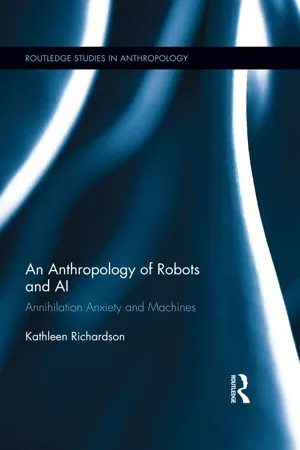
- 136 pages
- English
- ePUB (mobile friendly)
- Available on iOS & Android
eBook - ePub
About this book
1
Revolutionary Robots
Robots are objects of modernity created to reflect on what it means to be human. The robot is a literary creation of KarelČapek and is first seen in the play R.U.R. (Rossum’s Universal Robots) in 1921. In R.U.R., the robot is characterized as a human-like entity built to labor and without any other purpose except “to work”. This play on the meaning “to work” is critical as it reminds us ofČapek’s intention in creating the robot character—to take the worker one step further. The robot character is human-nonhuman, occupying tense spaces in conceptual imaginings (Jiménez and Willerslev 2007). For now we want to locate the robot in its cultural context, the political and artistic vibrancy of the 1920s. It is by locating the robot in this period, when vibrant debates dominated public discourse on the nature of the political organization of society, that robots as revolutionaries become all too apparent. In what follows I explore how the robot play was inspired by themes of work and the radical politics of the early twentieth century in the US, Europe and the new socialist economies in Russia.Čapek invented the concept of the robot as a deliberate device that expressed his horror at the age of mass mechanization and its effects on humanity. Soviet communism, Marxism, capitalism, Fordism and Taylorism contributed to the context in which the robot was first imagined.
The Robot’s Genesis
KarelČapek was born on 9 January 1890 in the Habsburg Empire, which became a sovereign state of Czechoslovakia in 1918 and then the Czech Republic after the fall of the Berlin Wall in 1993 that brought about the separation the Czech Republic from Slovakia.Čapek was a playwright and journalist and, as a journalist, he wrote for Lidove Noviny (The People’s Paper); in 1921, he and his brother Josef became its editors. Before going on to unpick the themes in R.U.R.,Čapek’s other significant plays included The War with the Newts (1937), which is about human-like salamanders taking over the world, and The Insect Play (1921), a play he wrote with his brother, Josef. The Insect Play is a commentary on Czechoslovakian politics after the horrors of World War I—and most of the characters are nonhuman.
Čapek used salamanders, insects and robots as nonhuman devices in his plays to critically reflect on human life, politics and existence, yet it was the robot that catapulted KarelČapek to international (and historical) notoriety. The naming of the Robot (he capitalized the R, but I won’t unless referring to the play’s text), belongs, not to Karel, but to his brother, Josef Čapek, who thought of the term “robot” to describe the artificial beings in his play. In Russian, Ukrainian and other East Slavonic languages, the term “robota” is a word for work but has a specific meaning in Czech referring to the surplus labor of peasants in the feudal economy. It was this latter meaning that inspired Josef to invent the term “robot”. Robota (labor debt paid to lords) encompassed many aspects of the labor of peasants, most notably their obligation (Wright 1966). The theme of labor or work is key to its meaning. One might say the robot is another way of saying “an obligated worker”. The term “robot” entered the English language after April 1923 when R.U.R. was performed by the Reandean Company at St. Martin’s Theatre in London. The robot was used initially byČapek to describe a soulless artificial being who is created to work. What do I mean by soulless? The robots in the play have no independent interiority, feeling, thought or desire and act on commands and instructions from their human masters.
Let us explore some of these themes. The robot rests on the idea that the grand ideal is to build artificial workers to maximize production and free-up human labor from mindless tasks instead created even more problems in society. The substitution of humans by robots led,Čapek imagined, to a loss of human purpose. This theme was a definite reflection on the changing work practices transforming Europe, North America and Russia, which machines and humans tied together in production. Here is my synopsis of the play:
The play is set on an Island where robots are mass-produced. The factory is run by the general director, Domin. One day, Helena Glory comes to the Island to liberate the robots. Glory believes the robots should have the same rights as humans. In a twist, she is married to Domin. As the years pass, robots are now even more prolific in the world than before. In secret, Helena has persuaded the scientist Hal to change the formula for some of the robots. The robots, with the new formula, can feel and love. These robots lead a rebellion against the humans. As the world comes to an end, the members of the factory reflect on the meaning of life, but all are slaughtered, except for one man, Alquist. Alquist is only allowed to live because he is a worker, too. In another twist, the formula to create the robots is destroyed, and the robots cannot survive if they cannot find a way to produce. It is left to Alquist to try to find the formula, but he fails and, without the formula for robot life, the last surviving human, namely Alquist, and the robots will eventually perish. Two of the feeling robots, Helana and Primus, choose love over violence.
R.U.R. was very successful throughout Europe, Russia and America in the 1920s. The play premiered at the Garrick Theatre, New York City in 1922 and ran for 184 performances.Čapek’s robots captured the imagination of the time and, after the first performance in New York in 1922, critics wrote ‘The most brilliant satire on our mechanical age; the grimiest yet subtlest arraignment of this strange, mad thing we call industrial society of today’ (cited in Reichardt 1978, p. 36). The success of the term “robot” also replaced “automaton” as the term to characterize working beings. What was perhaps most significant about the arrival of the robot was that it captured a spirit of the age.Čapek created the robot character as a way to comment on what he thought was the contemporary preoccupation with labor and production.
The robot is a creature that is an outcome of separations, transitions and mergers. I identify two important boundary transgressions the robot makes in R.U.R. The first is that the robot is humanlike but is without agency and subjectivity, like a thing. Second, the robot is able to become humanlike by developing subjectivity: feeling and consciousness. The robot is paradoxical: human and nonhuman at the same time. It is an intermediary somewhere between human and nonhuman, a human envisaged as not quite human. In other words, the robot is an intermediary between the human and nonhuman via the role of labor. There is a final theme that could be quite confusing to a reader, that two robots may be able to repopulate the world again because they have found love. The theme of love is an important theme in robot narratives, as is robot destruction. Robot agents in the play become aware of their position in the social order and develop consciousness. The play marks the end of the human, and in violence this new world ruled by robots is created. The robots that choose violence will perish. The robots that choose love will prosper.
The Robot becomes a Machine
It is easy to seeČapek’s robots as a left-wing critique of capitalism, but his views are more complex.Čapek was part of a “radical center” and was opposed to the movements of the right, which he called ‘the cold bourgeoisie’ and left, which he called ‘the revolutionary fire’ (1924, p. 3).Čapek’s own work critiqued these cultural processes, and his robot provided a means to reflect on the issues of the day. Haman and Trensky point toČapek’s work as a way of reflecting on the politics of the day:
[Čapek’s art] … reflects better than anything elseČapek’s constant preoccupation with general problems, his weighing and judging of the world and society. There is a pronounced moral standpoint behind this aspect of his art. It is not accidental that we constantly encounter motifs of judiciary proceedings in his work, for they reflect the author’s moral attitude toward life; he presents to his audience the conflicts of this world while passing judgment on them.
(1967, p. 175)
There are many ambiguous themes in the play; one was in relation to the theme of work. A dominant discussion in the 1920s rested on the mass mechanization of commodity production, which rendered the laborer as another ‘cog’ in the process, just like a mechanism in the machine. The mass labor movements of the time would have also given the author of the play some cause for concern.Čapek’s is considered a pragmatist, marginally philosophical outlook, ‘which placed a great emphasis upon the relativity of human knowledge and attitudes, and therefore also on the relativity of the so-called great truths, religious and ideological’ (Klíma 2004, p. x).Čapek’s plays were polemics against the dominant philosophies of the time.
In R.U.R. there are several conflicting views on the period.Čapek used each character in his play to exemplify a certain outlook:
The general manager in the play, Domin, proves that technical progress emancipates man from hard manual labour, and he is quite right. The Tolstoyan Alquist, on the other hand, believes that technical progress demoralises him, and I think he is right too. Bushman thinks that industrialisation is capable of supplying modern needs, and he is right. Helena is instinctively afraid of all this inhuman machinery, and she is profoundly right. Finally, the Robots themselves revolt against all these idealists and, as it appears, they are right, too.
(Čapek cited in Reichardt 1978, p. 40)
Despite the radical right and left philosophies that helped furnish the imaginary context of the robot,Čapek rallied against these philosophies in his own polemical writings.Čapek’s position is reflected in the meanings he attaches to the robot. In Russia, the Leninist revolution had occurred less than four years earlier in 1917 while, in the US, large-scale economic expansion was pushing the capitalist system to new heights of economic development. The fate and fortunes of Europe, the US and Russia, left and right, was realized through the application of science and technological reasoning to economic production.Čapek was critical and hostile to these processes and saw the dizzying worship of technological production as suffocating and horrifying. The themes of dehumanization and the impact of the machine had a significant impact on the art of the period (see Wosk 1986 for an interesting overview of the art of the period).
There was little consensus in the politics of the period and, while many condemned the advance of socialism and communism, others, such as the Dada group in France, turned into radical supporters. The ideas of the Dada movement were notably opaque. Raoul Hausman wrote in Der Dada3 in April 1920 that, ‘Dada is the full absence of what is called Geist. Why have Geist in a world that runs on mechanically’ (cited in Benson 1987, p. 46). The machine was worshipped as an antidote to the confusion, chaos and disconnection that modernity delivered to most people’s experience. The machine also became a vehicle into a different kind of world. The influence of politics, particularly from the left, influenced all notable artists of the period, from the Russian Constructivists, to Czech Artificialism, to the Italian Futurists (see Benson 1987; Wosk 1986; Vleck 1990).
In Russia, the impact of the constructivists, led by artists such as Alexander Rodchenko and El Lissitzky, showed the importance of modernism. Their work is angular and structured and is a tribute to efficiency and economy (Lodder 2005). The Czech avant-garde was increasing in prominence in the 1920s. Devêtsil, a Czech group of artists, was associated with Karel Teige and had a leftist orientation (Smejkal 1990). Historian of art, Christopher Green, ties the machine to modernism in the 1920s (Green 2006). The body was incorporated into this machine modernist imagery. In the interwar years, the Mensendieck System was influential in Europe and the US. The system was developed by a Dutch-American physician, Bess Mensendieck, who described the body as a machine. Even the activities of housework were included in this rubric (Wilk 2006, pp. 261–262).
Despite the widespread embrace of mechanical metaphors by many artists of the period,Čapek’s robots were deliberately non-machine. In the prologue of R.U.R., the character Helena is introduced to a robot, which she cannot tell is a robot. ‘Were you born here?’ asks Helena to the robot Sulla. Sulla replies, ‘I was made here’ (Čapek 2004, p. 10). The robots are made of biological material and possess a human-like appearance. Here, Domin explains to Helena Glory how the robots are made:
The mixing vats for the batter. In each one we mix enough batter to make a thousand Robots at a time. Then there are the vats for the liver, brains, etcetera. Then you’ll see the bone factory, and after that I’ll show you the spinning mill …. The spinning mill for nerves. The spinning mill for veins. The spinning mill for miles and miles of digestive tract are made at once. Then there’s the assembly plant, where all of this is put together, you know, like automobiles. Each worker is responsible for affixing one part, and then it automatically moves on to a second worker, then to a third, and so on. It’s a most fascinating spectacle. Next comes the drying kiln and the stock room, where the brand new products are put to work.
(Čapek 2004, p. 13)
Čapek’s robots were biologically human and made of flesh and blood but assembled on a mechanical production line and produced with a formula developed by scientists, managers and engineers. Photographs from the first performances of R.U.R. in Prague (1921), New York (1922), London (1923) and Paris (1924) all show the robots as human-like. It was the artistic renditions of the play by other artists at the time that gave the robot its metallic form, and it wasČapek who reacted strongly to these new artistic representations. Lamenting after the London theatrical premiere that the purpose of his play was not to reflect on machines but people, he stated: ‘I wasn’t concerned about robots, but about people’ (Čapek 2004, p. xvii). By the 1930s, almost 10 years after the first performance of R.U.R., the metallic robot has become consolidated in the robot’s imagery—leadingČapek to distance himself even more from his creation:
It is with horror, frankly, that he rejects all responsibility for the idea that metal contraptions...
Table of contents
- Cover
- Title
- Copyright
- Dedication
- Contents
- Acknowledgments
- Introduction: Annihilation Anxiety and Machines
- 1 Revolutionary Robots
- 2 Out of Body Minds
- 3 Social Robots
- 4 The Gender of the Geek
- 5 The Dissociated Robot
- 6 Fantasy and Robots
- Conclusion: Loving the Attachment Wounded Robot
- Index
Trusted by 375,005 students
Access to over 1.5 million titles for a fair monthly price.
Study more efficiently using our study tools.
Information
Publisher
RoutledgeEdition
1Year
2015Topic
Social SciencesPrint ISBN
9780815346463
9781138831742
Subtopic
AnthropologyeBook ISBN
9781317566953
Index
Social SciencesFrequently asked questions
Yes, you can cancel anytime from the Subscription tab in your account settings on the Perlego website. Your subscription will stay active until the end of your current billing period. Learn how to cancel your subscription
No, books cannot be downloaded as external files, such as PDFs, for use outside of Perlego. However, you can download books within the Perlego app for offline reading on mobile or tablet. Learn how to download books offline
Perlego offers two plans: Essential and Complete
- Essential is ideal for learners and professionals who enjoy exploring a wide range of subjects. Access the Essential Library with 800,000+ trusted titles and best-sellers across business, personal growth, and the humanities. Includes unlimited reading time and Standard Read Aloud voice.
- Complete: Perfect for advanced learners and researchers needing full, unrestricted access. Unlock 1.5M+ books across hundreds of subjects, including academic and specialized titles. The Complete Plan also includes advanced features like Premium Read Aloud and Research Assistant.
We are an online textbook subscription service, where you can get access to an entire online library for less than the price of a single book per month. With over 1.5 million books across 990+ topics, we’ve got you covered! Learn about our mission
Look out for the read-aloud symbol on your next book to see if you can listen to it. The read-aloud tool reads text aloud for you, highlighting the text as it is being read. You can pause it, speed it up and slow it down. Learn more about Read Aloud
Yes! You can use the Perlego app on both iOS and Android devices to read anytime, anywhere — even offline. Perfect for commutes or when you’re on the go.
Please note we cannot support devices running on iOS 13 and Android 7 or earlier. Learn more about using the app
Please note we cannot support devices running on iOS 13 and Android 7 or earlier. Learn more about using the app
Yes, you can access An Anthropology of Robots and AI by Kathleen Richardson in PDF and/or ePUB format, as well as other popular books in Social Sciences & Anthropology. We have over 1.5 million books available in our catalogue for you to explore.