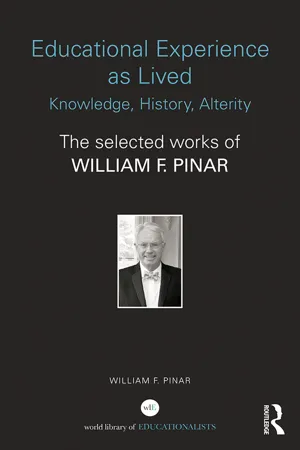
In this volume, Pinar enacts his theory of curriculum, detailing the relations among knowledge, history, and alterity. The introduction is Pinar's intellectual life history, naming the contributions he has made to understanding educational experience. Study is the center of educational experience, as he demonstrates in the opening chapter. The alterity of educational experience is evident in his conceptions of disciplinarity and internationalization, interrelated projects of historicization, dialogical encounter, and recontextualization. By reactivating the past, not by instrumentalizing the present, we can find the future, explicated in his studies of the Eight-Year Study, the Tyler Rationale, and the gendering and racialization of U.S. school reform. The interrelation of race and gender is emphasized in the chapters on Ida B. Wells and Jane Addams. The technologization of education is critiqued through analysis of the achievements of George Grant and Pier Paolo Pasolini. The educational project of subjective and social reconstruction is explored through study of Musil's essayism, a genre that corrects the problems accompanying ethnography and created by identity politics.
eBook - ePub
Educational Experience as Lived: Knowledge, History, Alterity
The Selected Works of William F. Pinar
- 278 pages
- English
- ePUB (mobile friendly)
- Available on iOS & Android
eBook - ePub
Educational Experience as Lived: Knowledge, History, Alterity
The Selected Works of William F. Pinar
About this book
Information
Chapter 1
Study
Commentary
Study— not teaching— is the site of education. In contrast to cramming, study is self-paced and its end unknown; it supports subjective and social reconstruction1 threaded through academic knowledge and everyday life, between “popular and erudite knowledge.”2 In contrast to the anonymity and utility of “information”— currency in a “knowledge economy”— academic knowledge— especially in the humanities and the arts— bears the mark of its composer, his or her time and place. Knowledge can speak to you, as it incorporates the specificity of its origins, even the lived experience of its creator.3 Intrinsically important, as Michael F. D. Young4 appreciates, knowledge is dated— is (as Tyson Lewis5 suggests)— a “remnant.” As a form of witness,6 study encourages historicity and foreshadows the future. Solitary even as it informed by and shared with others— “perhaps in study,” Block7 suggests, “sufferings may be shared”— study does not disavow, despite secularization, its religious and ethical subtexts. These animate and singularize its potential and promise as a “form of life.”8
Bibliography
Block, Alan A. 2007. Pedagogy, Religion, and Practice: Reflections on Ethics and Teaching. New York: Palgrave Macmillan.
Lewis, Tyson E. 2013. On Study. Giorgio Agamben and Educational Potentiality. New York: Routledge.
Muller, Johan. 2000. Reclaiming Knowledge: Social Theory, Curriculum and Education Policy. London: Routledge.
Pinar, William F. 2004, June. The Problem with Curriculum and Pedagogy. Journal of Curriculum and Pedagogy, 1 (1), 21–24.
Pinar, William F. 2012. What Is Curriculum Theory? 2nd edition. New York: Routledge.
Said, Edward. 2004. Humanism and Democratic Criticism. New York: Palgrave Macmillan.
Simon, Roger I. 2005. The Touch of the Past: Remembrance, Learning, and Ethics. New York: Palgrave Macmillan.
Strong-Wilson, Teresa. 2007. Bringing Memory Forward. New York: Peter Lang.
Young, Michael F. D. 2008. Bringing Knowledge Back In: From Social Constructivism to Social Realism in the Sociology of Education. London: Routledge.
Study, like prayer, is a way of being— it is an ethics.
Alan A. Block9
The academic field of education is so very reluctant to abandon social engineering. If only we can find the right technique, the right modification of classroom organization, teach according to “best practices,” if only we have students self-reflect or if only we develop “standards” or conduct “scientific” research, then students will learn what we teach them.
Social engineering— the enormously influential early-twentieth-century American Edward L. Thorndike called it, simply, “human engineering”10— appears to assume that education is like an automobile engine: if only we make the right adjustments— in teaching, in learning, in assessment— it will hum, transport us to our destination, the promised land of high test scores, or, for many of us on the educational Left, a truly democratic society.
America’s historic preoccupations with business and religion have provided cultural support for such a view of mind, a view profoundly anti-intellectual in consequence, as historian Richard Hofstadter11 has famously documented. The business-minded— encapsulated in the concept of entrepreneur— are interested in designing effects on situations that can be profitable. In this sense, social engineering is the complement of capitalism. The religiously-minded mangle the present by disavowing it (the best is yet to come), employing religious rituals (such as prayer) to manipulate present circumstances. Protestantism and capitalism are infamously intertwined,12 perhaps most savagely in the American South.13
Social engineering has structured much of American intellectual life. It has structured, some allege, that American philosophical movement known as pragmatism, thanks in part to William James’ construal of the significance of thought as emphasizing its effects on situations.14 Pragmatism’s progressive formulation of social engineering has been eclipsed, as we are painfully aware, by political conservatism, intent on side-stepping culture and history by focusing on “learning technologies” such as the computer.15 If only we place computers in every classroom, if only school children stare at screens (rather than at teachers, evidently), they will “learn,” will become “competitive” in the “new millennium.” Information is not knowledge, and without ethical and intellectual judgment— which cannot be programmed into a machine— the Age of Information is an Age of Ignorance.
In 1938 the first Department of Curriculum and Teaching was established in the United States (at Teachers College, Columbia University). This historic mistake— the conjunction of curriculum with teaching— institutionalized social engineering at the site of the teacher. In so doing, the field set itself up for the eclipse of institutionally-led curriculum development and the politics of scapegoating, vividly obvious in No Child Left Behind and Race to the Top, wherein teachers are held responsible for student learning. Despite its very different politics, progressive education also inflated the role of the teacher in the process of education, suggesting that role could be socially and economically transformative.
Adjusting the inflated status of pedagogy in curriculum studies will be difficult but necessary labor. To contribute to that project, I focus here on the concept of “study,” relying on the work of Robert McClintock and Alan A. Block. The former provides a history and analysis of its place in humanism; the latter locates this lost tradition in Judaism. I suggest that one form of contemporary curriculum research, resulting in a “new” synoptic text, can also contribute to the resuscitation of this lost tradition. Like teaching or instruction or pedagogy, study, too, should be a subsidiary concept in curriculum studies.16
The Lost World of Study
The word study connotes zealous striving.
Anna Julia Cooper17
Robert McClintock begins his argument for study against instruction with attention to Montaigne who, McClintock tells us, engaged himself in an ongoing project of “self-education.”18 A process, study is also a place (as McClintock makes explicit in his essay’s title); for Montaigne, that place was his study wall to which he appended sayings— (McClintock quotes one from Lucian)— stimulating the process of his self-formation through the creation of a “self-culture,” stimulating self-reflection as he went about his daily life.19 Sayings appended to the wall, McClintock theorizes, stimulated his “self-formation.”20
As if anticipating the Marxist misunderstanding of autobiography as narcissism,21 McClintock points out that study is not only a private project. For Montaigne, he notes, education was a never-ending “heightening” of “consciousness,” an unceasing cultivation of judgment.22 Like Seneca, McClintock observes, Montaigne worried that relying on teachers for one’s education could replace one’s self-engaged labor of discovery with passivity.23 “Authoritative” instruction can discourage thinking, McClintock notes.24 Undermining altogether the authority of the teacher can as well.
Montaigne was hardly alone in preferring study to instruction. McClintock names Erasmus as a second example. “[I] shall not refuse any task,” McClintock quotes him as saying, “if I see that it will be conducive to the promotion of honest study.”25 He justified his editorial labor— recall that Erasmus edited both pagan and Christian classics— as providing readers with important literature for personal study. His writing— McClintock cites The Handbook of the Christian Knight— aimed to support readers’ self-formation and self-possession. Teaching and learning might disseminate knowledge...
Table of contents
- Cover
- Title
- Copyright
- CONTENTS
- Acknowledgments
- Preface
- Introduction
- 1 Study
- 2 Allegory
- 3 Internationalization
- 4 Nationalism
- 5 Technology
- 6 Reform
- 7 Misrepresentation
- 8 Conversation
- 9 Place
- 10 Emergence
- 11 Alterity
- 12 Discipline
- 13 Identity
- 14 Resolve
- 15 Decolonization
- 16 Inwardness
- 17 Individuality
- 18 Cosmopolitanism
- Epilogue
- Sources and Permissions
- Index
Trusted by 375,005 students
Access to over 1.5 million titles for a fair monthly price.
Study more efficiently using our study tools.
Frequently asked questions
Yes, you can cancel anytime from the Subscription tab in your account settings on the Perlego website. Your subscription will stay active until the end of your current billing period. Learn how to cancel your subscription
No, books cannot be downloaded as external files, such as PDFs, for use outside of Perlego. However, you can download books within the Perlego app for offline reading on mobile or tablet. Learn how to download books offline
Perlego offers two plans: Essential and Complete
- Essential is ideal for learners and professionals who enjoy exploring a wide range of subjects. Access the Essential Library with 800,000+ trusted titles and best-sellers across business, personal growth, and the humanities. Includes unlimited reading time and Standard Read Aloud voice.
- Complete: Perfect for advanced learners and researchers needing full, unrestricted access. Unlock 1.5M+ books across hundreds of subjects, including academic and specialized titles. The Complete Plan also includes advanced features like Premium Read Aloud and Research Assistant.
We are an online textbook subscription service, where you can get access to an entire online library for less than the price of a single book per month. With over 1.5 million books across 990+ topics, we’ve got you covered! Learn about our mission
Look out for the read-aloud symbol on your next book to see if you can listen to it. The read-aloud tool reads text aloud for you, highlighting the text as it is being read. You can pause it, speed it up and slow it down. Learn more about Read Aloud
Yes! You can use the Perlego app on both iOS and Android devices to read anytime, anywhere — even offline. Perfect for commutes or when you’re on the go.
Please note we cannot support devices running on iOS 13 and Android 7 or earlier. Learn more about using the app
Please note we cannot support devices running on iOS 13 and Android 7 or earlier. Learn more about using the app
Yes, you can access Educational Experience as Lived: Knowledge, History, Alterity by William F. Pinar in PDF and/or ePUB format, as well as other popular books in Education & Comparative Education. We have over 1.5 million books available in our catalogue for you to explore.