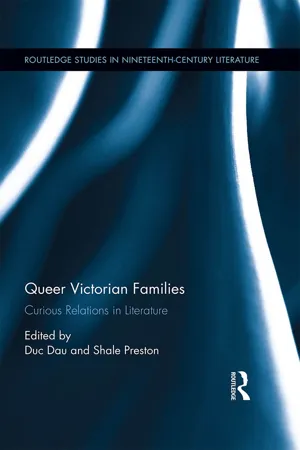
The Victorians elevated the home and heteronormative family life to an almost secular religion. Yet alongside the middle-class domestic ideal were other families, many of which existed in the literature of the time. Queer Victorian Families: Curious Relations in Literature is chiefly concerned with these atypical or "queer" families. This collection serves as a corrective against limited definitions of family and is a timely addition to Victorian studies. Interdisciplinary in nature, the collection opens up new possibilities for uncovering submerged, marginalized, and alternative stories in Victorian literature. Broad in scope, subjects range from Count Fosco and his animal "children" in Wilkie Collins's The Woman in White, to male kinship within and across Alfred Tennyson's In Memoriam and Herman Melville's Moby-Dick, and the nexus between disability and loving relationships in the fiction of Dinah Mulock Craik and Charlotte M. Yonge. Queer Victorian Families is a wide-ranging and theoretically adventurous exposé of the curious relations in the literary family tree.
eBook - ePub
Queer Victorian Families
Curious Relations in Literature
- 220 pages
- English
- ePUB (mobile friendly)
- Available on iOS & Android
eBook - ePub
About this book
Information
Queervolutions
1 The “Queer-Looking Party” Challenge to Family in Alice
“Who cares for you?” said Alice (she had grown to her full size by this time). “You’re nothing but a pack of cards!”
— Lewis Caroll, Alice’s Adventures in Wonderland.1
The Alice books – Lewis Carroll’s 1865 Alice’s Adventures in Wonderland, and Through the Looking-Glass and What Alice Found There, 1871 – have a been a staple of family reading practices since their publication. Generations of mothers and fathers have read Alice aloud to their children; I have myself to all four of my children. This reading history is at odds, however, with the attitude toward the domestic family inscribed in Carroll’s narratives, for the Alice books radically undo Victorian conceptions of family (and whatever fragments of Victorian domestic ideals modern families continue to model).2 While Alice’s Adventures in Wonderland do begin and end with Alice sitting next to her loving and empathetic elder sister, neither “mother” nor “father” are referenced at any point in her travels or her returns. Throughout both books, Alice refers to her family at home primarily as a discipline-minded but collective “they.” “They” may be largely forgotten while Alice explores her fantasy lands, but the idea of family is not. No normative family emerges, however, and every family relation is distorted into a queer configuration. By queer, I refer to what the Victorians would have understood as such, as people or behaviors or art that ran counter to normative social expectations, particularly – for the purposes of this essay – those elements that were at odds with normative roles of family relationships. While Victorians both tolerated and celebrated the queer (that is, the odd, the non-normative) in eccentric figures such as Edward Lear, primarily because such queer behavior reinforced the national pride Britons have historically taken in common-law protections for the liberty of the individual and in strength of individual character (as most famously enunciated in Mill’s On Liberty), the egregious oddity of such figures also reinforced, by contrast, then-normative social structures, particularly that of the Victorian family. In the case of the Alice books, however, the queer reformations of family do not necessarily reinforce the norm; instead, they often trouble that norm’s placid assumptions. Carroll’s effect – leaving aside the question of his aim – is to damage the ideals of the Victorian family even as he ultimately allows Alice to return to her family’s domestic spaces.
In the dream worlds of both Alice books, the replacements for the Victorian upper-middle-class household of parents, children, governess, nurse, and servants, as well as for familial genealogy, resemblance, affection, and customs, come in four patterns. First, the Victorian family is replaced by queer agglomerations of unlike and even mutually hostile characters (such as the triad taking its eternal tea, the Hatter, the March Hare, and the Dormouse, or the “queer-looking party” who participate in the mock caucus race). Second, families turn into mathematically bound sets (such as Tweedledee and Tweedledum of Looking-Glass or the Prima, Secunda, and Tertia who replace the Liddell girls in the prefatory poem to Wonderland). Third, or “contrariwise,” familial associations are replaced by quasi-logical extensions of resemblance, as if identity were subject to logical statements, analogies, and Linnaean taxonomies rather than genealogy. For example, from the Dormouse of a fine family, we learn there were “three little sisters” named “Elsie, Lacie, and Tillie,” but this tale soon devolves into an impoverished improvisation, with every new addition built around treacle. They live at the bottom of a well on nothing but treacle, though it made them ill, very ill, and of course they live at the bottom of the well because it was a treacle well, and they were “well in” (Carroll 76).3 They were learning to draw – what? Treacle. This most unpromising narration, in which the trio of sisters is at best an excuse for palpable nonsense, is stopped only when the March Hare and the Hatter put the Dormouse into the teapot. Fourth, Carroll insistently reconfigures the families we witness in his fantasy lands into bizarrely amoral or nightmarish reconfigurations of adult and child (as seen, for instance, when the Walrus and the Carpenter take the infant oysters first for a seaside frolic and then for a meal). The only happy relation between an adult and a child in both books occurs at the end of Looking-Glass, when Alice meets the ineffectual but amiable White Knight. Since there are many indications Lewis Carroll saw himself as this figure,4 the helplessness of the White Knight must reveal, among other things, that the real Carroll – unmarried, without children of his own, leading the bachelor life of an Oxford don – had no hopes of making himself an effectual replacement for Alice’s family nor of undoing, albeit as wish fulfillment, the Victorian family as a social establishment.
The real Liddell family is mostly kept away from Alice’s thoughts as she undergoes her adventures. Thus all of the displacements of Alice’s “real” family – odd groupings, mathematical sets, obscurely formed family fragments such as the pack of cards, cannibals, and other dark analogues – never really have much “real” family to displace. Even when the Liddell family appears in a sideways mode, the aim seems less to invoke the sweetness of the family’s home life as to disrupt the bonds between adults and children. For instance, the names of the trio who lived on treacle – Elsie, Lacie, and Tillie – play on the pet names of the three Liddell girls. “Lacie,” for instance, is an anagram of “Alice.” But their emergence here in this mode only magnifies the effect of dismantling family. After all, the paltry existence imagined for the three girls (living at the bottom of a well, subsisting only on treacle) is, from a twenty-first-century perspective, not dissimilar to that of Nell and Nagg in Samuel Beckett’s 1957 Endgame, who live in trash cans. And where are the parents, nanny, and governess who should be overseeing this trio, finding them better habitation, varying their diet, and finding them a more satisfactory art tutor?5 In fact, the meagerness of the sisters’ world is underscored by the meagerness of the humor of their tale, especially as the closing joke of “well in” stands as one of Carroll’s worst puns. Alice’s real sisters show up only in this guise, and in the opening dedicatory poem. Admittedly, we do meet a fictional elder sister (perhaps a figure of Lorina, sixteen years old in 1865), who is reading the unidentified book with no pictures that so bores Alice at the start of Wonderland. This sister will be accorded a reverie at the end of the same volume in which she imagines Alice herself as a loving mother of “other little children.” But as this reverie characterizes Alice as “simple and loving” and the Wonderland dream as simply “strange” (127), it is hard to square that with what the reader knows: Alice is more than “simple and loving” and her dream of Wonderland is not fully in accord with either simplicity or love.
Since Alice’s consciousness seems to occlude the individual members of her family, we should not be surprised she generally refers to them as “they.” “They” plainly include the governess and nurse, the figures who oversee discipline most closely; in fact, we learn more (implicitly) about Alice’s governess and nurse than about any actual member of her family. This is because Alice often speaks to herself as if she were her own minder, and almost every other character in the book follows suit. For instance, early on, Alice ventriloquizes these absent authority figures: “You ought to be ashamed of yourself … a great girl like you … to go on crying this way!” (21), and we will hear similar remonstrations from the Cheshire Cat, the Caterpillar, the Duchess, Humpty Dumpty, and the Red Queen, among others (typical is the Red Queen’s admonition, “Look up, speak nicely, and don’t twiddle with your fingers all the time” [161]).
Moreover, the governess and nurse loom large because Alice herself so often thinks about domestic punishment and threats. She doesn’t exactly dread punishment; rather, she looks upon punishment as one of the givens of life, so common as to be possibly “saved up.” As she muses at the start of Looking-Glass, when she considers punishing the black kitten,
You know I’m saving up all your punishments for Wednesday week – Suppose they had saved up all my punishments. … What would they do at the end of a year? I should be sent to prison, I suppose, when the day came. Or – let me see – suppose each punishment was to be going without a dinner: then, when the miserable day came, I should have to go without fifty dinners at once! Well, I shouldn’t mind that much! I’d far rather go without them than eat them. (140)
We can infer the Liddell family, like most Victorian families, was discipline-minded. Alice was frequently punished, and that punishment often took the form of a lost meal. In fact, the weird and hectoring authority figures of both the Wonderland and Looking-Glass worlds are superior to the real authorities of the Liddell home in that they inflict no punishments on Alice other than their bewildering, often disparaging ways of addressing Alice and their abrupt, confrontational behavior.6 The one order to punish Alice, the Queen of Hearts’ last bellow, “Off with her head,” is ignored by everyone in the courtroom, largely because Alice has grown back to her true size. Though the pack of cards fly at her, they cannot damage her any more than can the dead leaves into which they transform. Both Alice books hold to one of the most widespread narrative practices of children’s literature: the ultimate protection of the child protagonist.
The one representative of Alice’s family about whom we learn the most is the one figure putatively under her authority and subject to her punishments: her cat Dinah.7 Dinah, naturally a carnivore, represents a threat to whatever fragments of family the Wonderland or Looking-Glass worlds can muster. For instance, on hearing Alice brag about Dinah’s mousing, the little creatures of the pond of tears leave posthaste: “a Canary called out, in a trembling voice, to its children, ‘Come away, my dears! It’s high time you were all in bed!’”(35–36). One of the recurring jokes of the first chapters of Wonderland is how the Imp of the Perverse keeps prompting Alice to bring up Dinah’s hunting and eating habits, for instance when Alice is trying to remember her French so as to address the Mouse:
“Perhaps it doesn’t understand English,” thought Alice. I daresay it’s a French mouse, come over with William the Conqueror.” … So she began again: “Où est ma chatte?” which was the first sentence in her French lesson-book. The Mouse gave a sudden leap out of the water, and seemed to quiver all over with fright. “Oh, I beg your pardon!” cried Alice hastily, afraid that she had hurt the poor animal’s feelings. “I quite forgot you didn’t like cats.” (26)
The Mouse does seem to understand at least first-year French, but Alice has misunderstood. It has leapt out of the water not because it doesn’t like cats but because it thinks the answer to the question “Où est ma chatte” might be “juste derrière vous.” But even though Alice’s recollections of Dinah keep causing her trouble with the creatures of Wonderland, Dinah comes often to the forefront of Alice’s consciousness. Indeed her one worry about her absence from her real family and home is on Dinah’s behalf: “I hope they’ll remember her saucer of milk at tea-time” (24). And at the very end of Through the Looking-Glass, we learn Alice plans to recite “The Walrus and the Carpenter” to Dinah while the cat has breakfast the next morning: “And you can make believe it’s oysters, dear!” (271). Dinah is a carnivore to the last, and Alice endorses, seemingly, the predatory eating of the child-like oysters that had shocked her as cruel when she first heard Tweedledee and Tweedledum recite the poem.
Carroll’s denaturing of the familial has its reasons. As a logician and fantasist, he finds through fiction the means to remove Alice from the real Liddell family, an act with its own rewards for the Oxford don who apparently longed for intimate emotional, though not sexual, contact with girls. It is beyond the confines of this chapter to discuss the private family life of Carroll or, rather, Charles Dodgson, the devout Christian, Anglican deacon, unmarried Oxford don, photographer, and the eldest son of a family of eleven children.8 The “queer” formations of grouping and identity in Alice, however, do serve the purpose of separating Alice from her essentially nameless family. More importantly, though coded as nonsense, the queer quasi-families of the Alice books also stand as a radical challenge to the Victorian cult of the domestic family itself. The many figures in the Alice books who claim peremptory authority – the Queen of Hearts, the Duchess, the Red Queen, Humpty Dumpty – are also figures who seem to embody the authority of nurse, governess, mother, and father but do so in an unstable way. The authority figures never sustain authority. Since they are mostly talking nonsense, Alice is commonly prompted to correct them, even though these corrections fall on deaf ears or she is chastised for making them, usually to her befuddlement. Moral pronouncements from those in charge, such as the Duchess’s “morals” – e.g., “Take care of the sense, and the sounds will take care of themselves” (92) – are notable for their lack of moral content. Nor do the commands of authority figures seem to carry weight. Even the Queen of Hearts’ execution orders are ignored by her subjects, though her playing-card minions do go through the motions of hauling her intended victims off scene. Moreover, in some cases authority is deposed outright (as we see with Humpty Dumpty most notably). And both books close with Alice literally shaking apart the world she has entered, rendering all other authorities as harmless as falling leaves or kittens. Ultimately, the alternate “families” of the Alice books are remarkably untenable, as physically uncomfortable as the nightmare Duchess who pokes Alice with her grotesque chin, as mentally uncomfortable as the White Queen who is in the habit of thinking “six impossible things before breakfast,” (199) and as emotio...
Table of contents
- Cover Page
- Half Title Page
- Title Page
- Copyright Page
- Contents
- Foreword
- Acknowledgments
- Queer Victorian Families An Introduction
- PART I Queervolutions
- PART II Queer Actually
- PART III Queer Connections
- Contributors
- Index
Trusted by 375,005 students
Access to over 1.5 million titles for a fair monthly price.
Study more efficiently using our study tools.
Frequently asked questions
Yes, you can cancel anytime from the Subscription tab in your account settings on the Perlego website. Your subscription will stay active until the end of your current billing period. Learn how to cancel your subscription
No, books cannot be downloaded as external files, such as PDFs, for use outside of Perlego. However, you can download books within the Perlego app for offline reading on mobile or tablet. Learn how to download books offline
Perlego offers two plans: Essential and Complete
- Essential is ideal for learners and professionals who enjoy exploring a wide range of subjects. Access the Essential Library with 800,000+ trusted titles and best-sellers across business, personal growth, and the humanities. Includes unlimited reading time and Standard Read Aloud voice.
- Complete: Perfect for advanced learners and researchers needing full, unrestricted access. Unlock 1.5M+ books across hundreds of subjects, including academic and specialized titles. The Complete Plan also includes advanced features like Premium Read Aloud and Research Assistant.
We are an online textbook subscription service, where you can get access to an entire online library for less than the price of a single book per month. With over 1.5 million books across 990+ topics, we’ve got you covered! Learn about our mission
Look out for the read-aloud symbol on your next book to see if you can listen to it. The read-aloud tool reads text aloud for you, highlighting the text as it is being read. You can pause it, speed it up and slow it down. Learn more about Read Aloud
Yes! You can use the Perlego app on both iOS and Android devices to read anytime, anywhere — even offline. Perfect for commutes or when you’re on the go.
Please note we cannot support devices running on iOS 13 and Android 7 or earlier. Learn more about using the app
Please note we cannot support devices running on iOS 13 and Android 7 or earlier. Learn more about using the app
Yes, you can access Queer Victorian Families by Duc Dau, Shale Preston, Duc Dau,Shale Preston in PDF and/or ePUB format, as well as other popular books in Literature & LGBT Literary Criticism. We have over 1.5 million books available in our catalogue for you to explore.