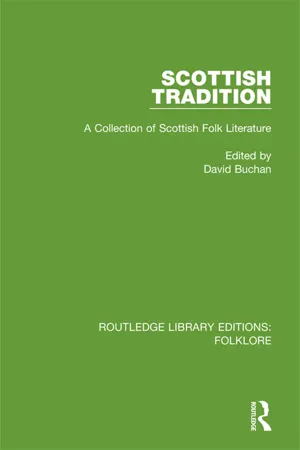
Scottish folk literature is characterised by a wide range of creative expression: story, song, play and proverb. This anthology, first published in 1984, provides an authoritative introduction to Scottish folk literature, and is unique in that it deals with all the genres intrinsic to Scottish tradition. Its selected texts offer an unusual and diverse enjoyment to the reader, including such forms as wonder tales or Märhcen, classical ballads, riddles, jocular tales, lyric and comic and occupational folksongs, rhymes, historical and supernatural legends, and guisers' plays. The texts chosen cover the main regional traditions of Lowland Scotland, from Galloway to the Shetlands, and span a number of centuries, through both pre- and post-industrial periods, from a sailor's worksong of the sixteenth century to modern urban legends just recently recorded. The book is arranged in four sections, on Folk Narrative, Folksong, Folksay, and Folk Drama, each with an introduction and a bibliographical essay setting the material in context and indicating some of its international links. Folk literature itself is brought into firm focus by discussion and generic example, and the anthology as a whole illuminates substantial areas of Scottish social and cultural life.
- 266 pages
- English
- ePUB (mobile friendly)
- Available on iOS & Android
eBook - ePub
About this book
Trusted by 375,005 students
Access to over 1.5 million titles for a fair monthly price.
Study more efficiently using our study tools.
Information
Topic
Scienze socialiSubtopic
Antropologia1
FOLK NARRATIVE
INTRODUCTION
Taletelling once occupied in Scottish life a position whose prominence may be difficult to comprehend in times when many media compete to provide entertainment and stimulation. It influenced both community life and family life:
How stern and ample was the sway
Of themes like these, when darkness fell,
And gray-hair’d sires the tales would tell!
When doors were barr’d, and eldron dame
Plied at her task beside the flame,
That through the smoke and gloom alone
On dim and umber’d faces shone.1
What may strike us with particular force is the extent of the tale-telling and the scope of the tale itself: ‘My father could sit there, he could start at six o’clock in the [evening], he could finish at six in the morning … and he could tell one story to last that time.’2 This is Andrew Stewart and Bella Higgins talking in 1955 about their father, John Stewart, and such a comment, made here about a Scottish travelling family which retained some of the habits of the old culture lost in the wake of education, literacy, and social change, can be parallelled from other traditional cultures.3
Folk narrative has been transmitted in Scotland for many centuries although, not surprisingly for a literature created through the medium of dramatic speech, documentation of its existence in earlier years does not abound, the most substantial evidence being the titles of traditional narratives in the list of tales to be found in the 1549 Complaynte of Scotland.4 All the texts in the following section come from the last 200 years and, as will be readily apparent, they vary in nature, for different kinds of recording techniques produce different kinds of text on the page. In the twentieth century the tape-recorded texts of the School of Scottish Studies provide word-for-word transcriptions of the actual tale told and also convey the flavour of the performance. The pen and paper method obligatory in the past can also furnish accurate transcriptions although the possibility of error is greater. Some of the older texts, like those supplied by Charles Kirkpatrick Sharpe from Nurse Jenny’s repertoire, are recreated from memories of actual performance. Some make no attempt to recreate the spoken text but are in effect digests of the tale that seize on the narrative plotline. And in some texts the narrative essentials are reworked in a style and language deemed more acceptable for print. In the last two cases the procedure normally entails the narrative, if not necessarily the dialogue, being translated from Scots into English. The two versions (nos 3,4) of the same tale-type recorded in the Southwest at the beginning and end of the nineteenth century exemplify the difference between a text close to actual performance and a text containing a digest of the story. Infinitely desirable though it would be to have a selection composed entirely of meticulously transcribed spoken texts from this and earlier centuries, for a diachronic perspective on Scottish folk narrative one simply has to utilize the various kinds of texts that are extant.
How, the question may then arise, can one tell if a printed text actually belongs to folk narrative, if it has in fact been passed along by word of mouth? Frequently the context informs us of its traditional derivation, but often the indication is that the story belongs to the international body of folk narrative registered by the standard indexes. For the folktale the important international index is The Types of the Folktale first compiled by the Finnish scholar Antti Aarne in 1910 and twice revised and enlarged by the American Stith Thompson, most recently in 1961. This arranges the tale-types, summarizes their contents, allocates each a number and short title, and lists where each has been recorded and what has been written about it. The internationality of folk narrative material makes such a work indispensable; in place of lengthy plot summaries and swollen footnotes of parallels, folktale scholars need only refer to the number and short title in Aarne-Thompson. No.1 of this section, for example, ‘The Black Bull of Norroway’, is a version of AT 425 The Search for the Lost Husband. Area and national indexes supplement the international index, and that for Britain, excluding the Celtic material, is Ernest Baughman, Type and Motif Index of the Folktales of England and North America. Unfortunately the coverage of Scottish narrative in this book is less than satisfactory; of the twenty-four AT narratives in the following section which appeared in print before 1966 only two are listed by Baughman. A properly executed type-index of Scottish folktales is a great desideratum. For international legends Reidar Christiansen’s The Migratory Legends provides, on the basis of the Norwegian material, a classification framework in which the numbering carries on from Aarne-Thompson, so that a scholar may refer to such a legend as the following no.45 from Burns’s Letters as ML 3045 Following the Witch.
Folk narrative includes various kinds of tales which serve different purposes, demand different styles, and provide different enjoyments. The basic division distinguishes between folktale and legend, between fiction and ostensible non-fiction. The folktale category comprehends a number of genres, prominent amongst which is the Märchen or wonder tale, which is the kind of story most people are acquainted with in its rewritten and transformed guise of children’s fairytale. The wonder tales involve a young hero or heroine undergoing a series of tests or tasks, often in a quest, that ends in a change of status: the young lad marries and gains land (he weds the princess and wins half the kingdom). These stories, with all their marvellous elements, enact in narrative form processes of psychic maturation for man and woman. The Märchen here (nos 1–7) include some of the earliest printed Scottish texts from the beginning of the nineteenth century, one from the late nineteenth century, and a long one recorded by field-workers of the School of Scottish Studies in 1976. In recent decades the School has recorded from members of the travelling folk many excellent Märchen whose length precludes a more substantial representation. The animal tale (nos 8–13) has not been found in any great numbers in lowland Scottish tradition and the religious tale (the term, like the former, is self-explanatory) even less so (no. 14). Stray pieces of evidence, however, would suggest that the animal tale was at one time quite widespread. The novella (nos 15–16) is the realistic tale: ‘the action occurs in a real world with definite time and place, and though marvels do appear, they are such as apparently call for a hearer’s belief in a way that the Märchen does not’.5 These stories generally concern themselves with cleverness, trickery, and the operations of a keen mind. After the novella in Aarne-Thompson comes a bridging section to the jocular tales devoted to tales of the stupid ogre, represented here by a Galloway version of the Polyphemus story (no. 17).
Among the genres of the jocular tale is the numskull or noodle tale which deals in foolishnesses, often, as here in ‘The Assynt Man’s Mistakes’ (no.18), ascribed to the people of a particular district or village. The ‘most elaborate genre of humorous narrative’ is the Schwank or merry tale which ‘is a relatively long, well-structured, realistic narrative without fantastic or miraculous motifs. Its humour is obvious and easy to comprehend and the action is funny in itself without a punch line.’6 The Schwanke here (nos 19–23) exemplify the description, though perhaps one should point out that while they do not contain the fantastic motifs found in Marchen their humour does often have an element of imaginative fantasy, seen here most particularly in the Angus tale (no.20). Along with the longer Schwanke is a compressed didactic tale from Orkney (no. 19) which occurs also in Scandinavia, France, Belgium, Hungary, Russia and the USA. Compression and reliance on the punchline characterize the joke (nos 24–28), a form which in tradition often derives its humour from the typifying attitude revealed by the climactic line. If succinctness characterizes the joke, exaggeration, together with a deadpan manner of telling, characterize the tall tale (nos 29–32). Although the tall tale may be thought of today as particularly American, once it existed widely and had firm habitation in Scotland. The formula tale usually contains a single idea or situation developed repetitively, and is represented by a relatively rare form, the dialogue story, in a tale from Edinburgh (no.33) noted by Aarne-Thompson as occurring only in Estonia and Romania, and by a cumulative tale from Aberdeenshire (no.34).
The legend is most conveniently defined as a prose narrative not told as direct fiction; or, to modify Stith Thompson’s words, the legend purports to be an account of an unusual happening believed, by some people at some time, to have occurred. One cannot nowadays simply say the legend is a story told as true, for it can also be told within a frame of only partial belief or disbelief (‘Well, that is what the old folks said, anyway …’) though the teller feels some compulsion to repeat it. Broadly, there are six, often overlapping, categories of legend: aetiological (those dealing with the origins of things) (no.35), religious (no.36), supernatural (nos 37–48), historical (nos 49–57), personal (these are often anecdotes) (nos 58–59), and place (nos 60–62). Scotland is particularly rich in the supernatural and historical kinds. The modern legend (nos 63–65) is a story told as true circulating by word of mouth in contemporary society and exhibiting traditional variation. The tales normally deal with lucky or unlucky accidents, horrific or unusual events, and sometimes belong to the lore of a group such as students, but most move widely through society.7 These stories spread internationally in an astonishingly short time. It is the modern legend, the legend, the anecdote, and the joke which constitute the most active and hardy narrative genres of contemporary tradition.
It is possible to categorize the narratives of tradition from different perspectives when particular features of function, form, or content require to be stressed. The fable, for example, is a tale told with a conscious moral purpose: it frequently but not exclusively involves animals as characters (and just as not all fables are animal tales, not all animal tales are fables), and when it deals with human characters it is also called the moral tale. The cante-fable is a form where prose narration and singing intermingle (no.23). The hero tale is a term usually reserved, since so many tales have ‘heroes’, for one story in a cycle of stories that attach to a particularly outstanding and important character. The narrative categories should not of course be viewed as absolute watertight divisions, for considerable intermixing of the genres can occur: one story may be at the same time an animal tale, a fable, and an aetiological tale; no.50, for example, is both an international Schwank and a historical legend told about James V.
One genre whose absence may require a comment is myth. As Katherine Briggs has remarked, ‘In Britain … Christianity has submerged the primitive mythical material so that it can often be discovered only in buried forms and by oblique hints.… The High Myths were swallowed by Christianity.’8 Instead of the High Myths – ‘sacred histories or expressions of symbolic truth’, as she puts it – Britain has Secondary Myths, narratives with aetiological, cosmological, or eschatological elements which are often to be found in tales conventionally classified as aetiological legends, place legends, and Marchen; no. 60 provides an instance.
What follows is a collection of texts of traditional material, and texts by themselves, however interesting, can afford only a partial reflection of tradition and its workings. But they furnish a focus for consideration of context and function, the taleteller and his audience, through which one can gain a deeper understanding of man and his culture.
Notes
1 James Hogg, ‘To Lady Anne Scott’, The Brownie of Bodsbeck, ed. Douglas S. Mack (Edinburgh, 1976), p. 174.
2 Tocher, no.21 (1976), 188.
3 See, for example, Linda Dégh, Folktales and Society (Bloomington, Ind., 1969), pp.82–4.
4 Ed. J.A.H. Murray (London, 1872), pp.63–4.
5 Stith Thompson, The Folktale (New York, 1946), p.8.
6 Linda Dégh, ‘Folk Narrative’, Folklore and Folklife: an Introduction, ed. Richard M. Dorson (Chicago, 1972), p.70.
7 For an extended discussion see David Buchan, ‘The Modern Legend’, in Language, Culture and Tradition, eds A.E. Green and J.D. A. Widdowson (Leeds and Sheffield, 1981), pp. 1–15.
8 ‘Possible Mythological Motifs in English Folktales’, Folklore 83(1972), 265–6.
MÄRCHEN
1 The Black Bull of Norroway
In Norroway, langsyne, there lived a certain lady, and she had three dochters. The auldest o’ them said to her mither: ‘Mither, bake me a bannock, and roast me a collop, for I’m gaun awa’ to spotch my fortune.’ Her mither did sae; and the dochter gaed awa’ to an auld witch washerwife and telled her purpose. The auld wife bade her stay that day, and gang and look out o’ her back-door, and see what she could see. She saw nocht the first day. The second day she did the same, and saw nocht. On the third day she looked again, and saw a coach-and six coming alang the road. She ran in and telled the auld wife what she saw. ‘Aweel,’ quo’ the auld wife, ‘yon’s for you.’ Sae they took her into the coach, and galloped aff.
The second dochter next says to her mither: ‘Mither, bake me a bannock, and roast me a collop, for I’m gaun awa’ to spotch my fortune.’ Her mither did sae; and awa she gaed to the auld wife, as her sister had dune. On the third day she looked out o’ the back-door, and saw a coach-and-four coming alang the road. ‘Aweel,’ quo’ the auld wife, ‘yon’s for you.’ Sae...
Table of contents
- Cover
- Half Title
- Title Page
- Copyright Page
- Original Copyright Page
- Table of Contents
- Folk Literature: Introduction
- 1 Folk Narrative
- 2 Folksong
- 3 Folksay
- 4 Folk Drama
- Abbreviations
- Bibliographies and Notes
- Glossary
- Afterword and Acknowledgments
- Indexes
Frequently asked questions
Yes, you can cancel anytime from the Subscription tab in your account settings on the Perlego website. Your subscription will stay active until the end of your current billing period. Learn how to cancel your subscription
No, books cannot be downloaded as external files, such as PDFs, for use outside of Perlego. However, you can download books within the Perlego app for offline reading on mobile or tablet. Learn how to download books offline
Perlego offers two plans: Essential and Complete
- Essential is ideal for learners and professionals who enjoy exploring a wide range of subjects. Access the Essential Library with 800,000+ trusted titles and best-sellers across business, personal growth, and the humanities. Includes unlimited reading time and Standard Read Aloud voice.
- Complete: Perfect for advanced learners and researchers needing full, unrestricted access. Unlock 1.5M+ books across hundreds of subjects, including academic and specialized titles. The Complete Plan also includes advanced features like Premium Read Aloud and Research Assistant.
We are an online textbook subscription service, where you can get access to an entire online library for less than the price of a single book per month. With over 1.5 million books across 990+ topics, we’ve got you covered! Learn about our mission
Look out for the read-aloud symbol on your next book to see if you can listen to it. The read-aloud tool reads text aloud for you, highlighting the text as it is being read. You can pause it, speed it up and slow it down. Learn more about Read Aloud
Yes! You can use the Perlego app on both iOS and Android devices to read anytime, anywhere — even offline. Perfect for commutes or when you’re on the go.
Please note we cannot support devices running on iOS 13 and Android 7 or earlier. Learn more about using the app
Please note we cannot support devices running on iOS 13 and Android 7 or earlier. Learn more about using the app
Yes, you can access Scottish Tradition Pbdirect by David Buchan in PDF and/or ePUB format, as well as other popular books in Scienze sociali & Antropologia. We have over 1.5 million books available in our catalogue for you to explore.