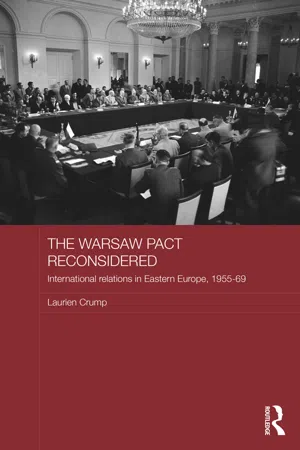
The Warsaw Pact is generally regarded as a mere instrument of Soviet power. In the 1960s the alliance nevertheless evolved into a multilateral alliance, in which the non-Soviet Warsaw Pact members gained considerable scope for manoeuvre. This book examines to what extent the Warsaw Pact inadvertently provided its members with an opportunity to assert their own interests, emancipate themselves from the Soviet grip, and influence Soviet bloc policy. Laurien Crump traces this development through six thematic case studies, which deal with such well known events as the building of the Berlin Wall, the Sino-Soviet Split, the Vietnam War, the nuclear question, and the Prague Spring. By interpreting hitherto neglected archival evidence from archives in Berlin, Bucharest, and Rome, and approaching the Soviet alliance from a radically novel perspective, the book offers unexpected insights into international relations in Eastern Europe, while shedding new light on a pivotal period in the Cold War.
eBook - ePub
The Warsaw Pact Reconsidered
International Relations in Eastern Europe, 1955-1969
- 322 pages
- English
- ePUB (mobile friendly)
- Available on iOS & Android
eBook - ePub
About this book
Information
Part I
Embryonic emancipation, 1955–64
1 The Warsaw Pact in its infancy
‘What do you imagine, that we will make some kind of NATO here?’1
(Soviet Supreme Commander Ivan Konev to Polish politicians in 1957)
The foundation of the Warsaw Pact on 14 May 1955 at first sight seems an anomaly. The absence of a preceding bargaining process defies most theories on the formation of alliances,2 and the foundation of a military alliance seems out of sync with Khrushchev’s zeal for détente and disarmament. The WP was, after all, founded by a Soviet leadership, which preferred ‘peaceful coexistence’ to further confrontation. After the death of the Soviet despot Joseph Stalin in the spring of 1953, his successors had embarked on a much more conciliatory course towards the West. Four days before the Warsaw Pact’s foundation Stalin’s eventual successor, Nikita Khrushchev, had even put forward the Kremlin’s ‘most credible disarmament proposal to date’, and one day after its foundation Khrushchev signed the Austrian State Treaty, which entailed the withdrawal of all foreign troops from Austria, including Soviet ones, and declared Austria neutral.3 In the wake of the WP’s foundation, Khrushchev chose to demilitarise the Cold War still further, and withdrew Soviet troops from, inter alia, Romania and Finland. Moreover, there were already perfectly functioning bilateral treaties between the Soviet Union and its satellites in place, which explains why the WP has often been considered ‘superfluous’.4
It is, therefore, imperative to examine the original objectives of the Warsaw Pact and its functioning in the first years of its existence. Only by closely considering the WP in its infancy is it possible to compare and contrast the way in which the alliance originally functioned with its evolution in the 1960s. The alliance was, however, not founded in a vacuum, and the first five years of its existence witnessed an extremely turbulent period in the history of Eastern Europe. Stalin’s death on 5 March 1953 marked ‘a turning point in the Cold War’, as his successors embarked on an altogether ‘New Course’ in Soviet foreign policy, which had serious ramifications for the Eastern European satellites.5 The Soviet change of direction already led to uprisings in Bulgaria, Czechoslovakia and Eastern Germany in 1953, and the situation spun out of control in Poland and Hungary in the autumn of 1956 after Khrushchev had publicly distanced himself from Stalin during his ‘secret speech’ in February 1956. Although Khrushchev’s programme of ‘de-Stalinisation’ facilitated the rapprochement with Josip Tito’s Yugoslavia, it also estranged the Albanian and Chinese leaderships from the Soviet cause.
In this chapter the first five years of the WP’s existence will accordingly be examined in the context of developments in Eastern Europe from the death of Stalin until Khrushchev’s visit to the US President Dwight D. Eisenhower in the autumn of 1959. This visit sealed Khrushchev’s zeal for peaceful coexistence, and illustrates the U-turn in Soviet foreign policy between 1953 and 1960. This period is also known as the Soviet ‘thaw’, during which Khrushchev relaxed his grip on both Soviet society and Eastern Europe as a whole.6 Both the foundation of the WP and the more centrifugal consequences of Khrushchev’s liberalisations, such as the Hungarian Revolution, should be considered in this context. Since the Kremlin’s new foreign policy outlook affected the relations between the Soviet Union and all its satellites, the developments of each Eastern European country in this period will be discussed. The position of each individual WP country, as well as the character of its party leadership and the interests of the political elites, will be of paramount importance for the rest of the book. Moreover, a treatment of the wider context should serve to introduce two themes that dominated the WP’s dynamics throughout the 1960s: namely, Sino-Soviet relations and the German question.
The New Course
The death of Stalin on 5 March 1953 heralded the end of an era. Already on the evening of Stalin’s death his closest collaborators assumed a ‘collective leadership’, since none of them was powerful enough to succeed Stalin on his own, and all of them wanted to curb the power of their potential rivals.7 Moreover, in this way Stalin’s successors clearly distanced themselves from Stalin’s autocratic rule. Former secret police chief Lavrentii Beria proposed Georgii Malenkov as chairman of the Council of Ministers, in return for which Malenkov appointed Beria as one of his first vice-chairmen. Beria was additionally appointed minister of internal affairs, which meant he was also in charge of state security, and Vyacheslav Molotov, another first vice-chairman, was reinstated as minister of foreign affairs.8 The meeting in which all of this was decided lasted only 40 minutes, which gives the impression that Beria and Malenkov, who formed a close alliance, had decided in advance the course of events after Stalin’s death, and had ‘presented their colleagues with a fait accompli’, as Khrushchev claimed later.9 Khrushchev, meanwhile, became the senior secretary of the Party Central Committee, which meant he set the agenda for the Presidium meetings together with Malenkov. Although Beria, Malenkov and Molotov were generally considered ‘the three most prominent leaders’, it was Khrushchev who would ultimately assume the party leadership.10
Grappling with Stalin’s controversial legacy, his successors strove to convince the West of their peaceful intentions, and even decided to conclude an armistice in the Korean War.11 It was, ironically, the former secret police chief Beria who most vehemently supported introducing a programme of controlled reforms, the so called ‘New Course’, in Eastern Europe, as well as arguing in favour of a unified but neutral Germany. These reforms had become overdue anyhow, since Stalin’s programme of forced agricultural collectivisation and accelerated industrialisation had wreaked havoc upon the economies within Eastern Europe.12
This caused a series of serious protests in the wake of Stalin’s death, which began with a major riot in the Bulgarian town Plovdiv on 4 May 1953 by hundreds of tobacco workers, who protested against an increase in the work norms and who had to be appeased by a former popular deputy prime minister, Anton Iugov.13 Compelled to adopt the Soviet ‘New Course’ in order to prevent further upheavals, the Bulgarian Prime Minister and party leader Vulko Chervenkov relinquished his position as party leader in March 1954 to the ‘young, efficient, but self-effacing apparatchik named Todor Zhivkov’, thus establishing a kind of collective leadership.14 As a believer ‘both in obedience to Moscow and in strict internal control’ the Stalinist Chervenkov attempted to sail a ‘New Course’ mainly in economic terms, whereas Zhivkov soon developed into one of Khrushchev’s most loyal disciples.15
Social unrest also plagued Czechoslovakia, whose president and party leader, Klement Gottwald, had died on 14 March 1953, just a few days after attending Stalin’s funeral. Gottwald almost emulated Chervenkov’s subservience to the Soviet Union, and with the slogan ‘The Soviet Union, Our Model’, he had embarked on ‘an almost suicidal drive to extirpate not only national traditions but also those of the party itself’.16 Like Stalin, Gottwald was replaced by a collective leadership too, in which the veteran trade union leader Antonin Zapotocky assumed the role of president, with the relatively inexperienced Antonin Novotny as the party leader. Novotny resembled his Bulgarian comrade Zhivkov in that their lack of prominence, personal appeal and intelligence had made them seemingly suitable candidates for the position of party leader in a duumvirate: without either powerful friends or enemies they were unlikely to cause Chervenkov and Zapotocky any trouble.17
The fact that industrialisation and collectivisation had exhausted the Czechoslovak economy caused at this stage more problems. On 1 June 1953 thousands of workers in the Czechoslovak town of Pilsen protested against a currency reform that was imposed from above, while turning the economic demands political by demanding the government’s resignation and free elections.18 As in Bulgaria, the party leadership embarked on a ‘New Course’ in primarily economic terms in order to modify the excesses of industrialisation and collectivisation. The Czechoslovak New Course nevertheless ‘simply petered out during 1955 and early 1956’, and the Czechoslovak leadership took its recourse again to a hard line, which culminated in ‘the unveiling of a gigantic statue of Stalin on the bank of the Vltava’ in the course of 1955.19
The East German economy was also in desperate need of a New Course. This was, however, not at all in the interests of the East German party leader, Walter Ulbricht, who had been one of Stalin’s most loyal disciples, and was determined to cling to his power. Ulbricht had spent the whole of World War II as a committed communist in the Soviet Union, before he became the leader in the Sozialistische Einheitspartei Deutschlands (SED) in the summer of 1945, and appointed many ‘Muscovite’ Germans to the highest positions.20 Having pushed Stalin into supporting the creation of the German Democratic Republic (GDR) in 1949 and the ‘building of socialism’,21 Ulbricht was forced by Stalin’s successors to backtrack on his economically disastrous policies in order to stem the increasing number of refugees from East to West Berlin. The new Soviet leadership regarded a moderation of Ulbricht’s policies as the solution to the refugee exodus, and compelled Ulbricht to introduce the ‘New Course’ on 2 June.22 Reluctant to undermine his own power by supporting liberalisation, Ulbricht did not rescind the 10 percent increase in work norms, and thus indirectly facilitated a popular uprising in the GDR on 16–17 June, which had to be quenched by Soviet tanks.23
Although the uprisings at first sight seem to indicate a weakening of Ulbricht’s power, in fact they strengthened his position. It is therefore not farfetched to assume that Ulbricht had a vested interest in these uprisings to safeguard his own power. The greatest casualty of the uprisings, apart from the East German people, was Beria himself, the main architect of the New Course, who was sentenced to death on the charge of inter alia ‘adopt[ing] a course for the conversion of the GDR into a bourgeois government’.24 He was, in fact, not so much a victim of the East German uprisings as of a plot orchestrated by Khrushchev during the post-Stalin succession struggle, but his death penalty served Ulbricht well, since it enabled him to oust the much more liberal opposition, consisting of Wilhelm Zaisser and Rudolf Herrnstadt, on the same charge, and facilitated the consolidation of his own power.
Ulbricht clearly signalled to the Kremlin that his iron grip was essential in preventing any more unrest in the GDR and as such quenched any liberalising tendencies and silenced the more liberal opposition. Going against the Soviet Union’s ‘New Course’ had accordingly paid off for Ulbricht, as it had left the Soviet leaders without any alternative to the consolidation of Ulbricht’s power. Moreover, it had raised the stakes of a stable East Germany in the eyes of the Soviet leadership, which invited an official East German government delegation to Moscow for the first time since the GDR’s foundation in 1949 in order ‘to upgrade relations’ and promise economic aid.25 This episode clearly indicates Ulbricht’s capacity to bend Soviet aims to his own advantage and to sacrifice the greater good for his own power, but Ulbricht’s ability to exercise leverage over the divided Soviet leadership strongly diminis...
Table of contents
- Cover
- Half Title
- Title Page
- Copyright Page
- Dedication
- Table of Contents
- List of illustrations
- Foreword
- Acknowledgements
- List of abbreviations
- Chronology of events
- Note on translations
- Introduction: reconsidering the Warsaw Pact
- Part I: Embryonic emancipation, 1955–64
- Part II: The dynamics of dissent, 1965–68
- Part III: Crisis and consolidation, 1968–69
- Note on the sources
- Bibliography
- Index
Trusted by 375,005 students
Access to over 1.5 million titles for a fair monthly price.
Study more efficiently using our study tools.
Frequently asked questions
Yes, you can cancel anytime from the Subscription tab in your account settings on the Perlego website. Your subscription will stay active until the end of your current billing period. Learn how to cancel your subscription
No, books cannot be downloaded as external files, such as PDFs, for use outside of Perlego. However, you can download books within the Perlego app for offline reading on mobile or tablet. Learn how to download books offline
Perlego offers two plans: Essential and Complete
- Essential is ideal for learners and professionals who enjoy exploring a wide range of subjects. Access the Essential Library with 800,000+ trusted titles and best-sellers across business, personal growth, and the humanities. Includes unlimited reading time and Standard Read Aloud voice.
- Complete: Perfect for advanced learners and researchers needing full, unrestricted access. Unlock 1.5M+ books across hundreds of subjects, including academic and specialized titles. The Complete Plan also includes advanced features like Premium Read Aloud and Research Assistant.
We are an online textbook subscription service, where you can get access to an entire online library for less than the price of a single book per month. With over 1.5 million books across 990+ topics, we’ve got you covered! Learn about our mission
Look out for the read-aloud symbol on your next book to see if you can listen to it. The read-aloud tool reads text aloud for you, highlighting the text as it is being read. You can pause it, speed it up and slow it down. Learn more about Read Aloud
Yes! You can use the Perlego app on both iOS and Android devices to read anytime, anywhere — even offline. Perfect for commutes or when you’re on the go.
Please note we cannot support devices running on iOS 13 and Android 7 or earlier. Learn more about using the app
Please note we cannot support devices running on iOS 13 and Android 7 or earlier. Learn more about using the app
Yes, you can access The Warsaw Pact Reconsidered by Laurien Crump in PDF and/or ePUB format, as well as other popular books in Ciencias sociales & Estudios étnicos. We have over 1.5 million books available in our catalogue for you to explore.