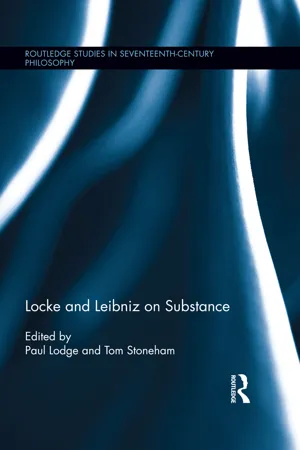
Locke and Leibniz on Substance gathers together papers by an international group of academic experts, examining the metaphysical concept of substance in the writings of these two towering philosophers of the early modern period. Each of these newly-commissioned essays considers important interpretative issues concerning the role that the notion of substance plays in the work of Locke and Leibniz, and its intersection with other key issues, such as personal identity. Contributors also consider the relationship between the two philosophers and contemporaries such as Descartes and Hume.
- 260 pages
- English
- ePUB (mobile friendly)
- Available on iOS & Android
eBook - ePub
Locke and Leibniz on Substance
About this book
Information
1
Locke on Substance and Our Ideas of Substances
Our ideas of substance and substances play a central role in John Locke’s epistemology, and feature prominently in his writings from the very beginning of the 1671 Draft A of his Essay Concerning Human Understanding (ECHU) to the final additions made to the posthumous fifth edition of the Essay in 1706. We cannot be sure how far the latter additions were authorized by Locke himself, but they were in his own words, for they involved the incorporation—within footnotes—of various passages from his lengthy correspondence with Edward Stillingfleet, Bishop of Worcester, who had raised objections to the Essay in the course of his own discourse on the Christian doctrine of the Trinity.1 With so much textual material at our disposal, one might expect that scholars would by now be clear at least on the core of Locke’s philosophy of substance. But nevertheless it remains one of the most contentious aspects of his thought, owing to difficulties that I shall do my best to resolve here. Space limitations preclude detailed discussion of scholarly debates, so I shall focus relatively narrowly on the key issues, and on presenting what I take to be Locke’s own position as clearly as possible, and mainly in his own words.
1. Our Ideas of Substance and Substances
Locke’s overall theory of substance is explained at the beginning of the famous book two, chapter twenty-three of the Essay:
§1. The Mind being… furnished with a great number of the simple Ideas, conveyed in by the Senses, as they are found in exteriour things, or by Reflection on its own Operations, takes notice also, that a certain number of these simple Ideas go constantly together; which being presumed to belong to one thing… are called so united in one subject, by one name; which by inadvertency we are apt afterward to talk of and consider as one simple Idea, which indeed is a complication of many Ideas together; Because, as I have said, not imagining how these simple Ideas can subsist by themselves, we accustom our selves, to suppose some Substratum, wherein they do subsist, and from which they do result, which therefore we call Substance.
§2. So that if any one will examine himself concerning his Notion of pure Substance in general, he will find he has no other Idea of it at all, but only a Supposition of he knows not what support of such Qualities, which are capable of producing simple Ideas in us… The Idea then we have, to which we give the general name Substance, being nothing, but the supposed, but unknown support of those Qualities, we find existing, which we imagine cannot subsist… without something to support them
§3. An obscure and relative Idea of Substance in general being thus made, we come to have the Ideas of particular sorts of Substances, by collecting such Combinations of simple Ideas, as are by Experience and Observation of Men’s Senses taken notice of to exist together, and are therefore supposed to flow from the particular internal Constitution, or unknown Essence of that Substance. Thus we come to have the Ideas of a Man, Horse, Gold, Water, etc.… only we must take notice, that our complex Ideas of Substances, besides all these simple Ideas they are made up of, have always the confused Idea of something to which they belong, and in which they subsist
(ECHU 2.23.1–3)
These are rich passages that demand, and repay, careful study. One notable point is that despite Locke’s efforts to distinguish different notions of ‘substance’, it is not entirely clear how many are in play here. Most prominently, at section two we have the quite general idea of ‘pure substance in general’ which is supposed to provide some sort of ‘substratum’ or ‘unknown support’ to the observable qualities of things.2 Then at section three we have various ideas of ‘particular sorts of Substances’, such as ‘Man, Horse, Gold, Water, etc.’ Finally, we have the ‘confused Idea of something’ which is a component of our idea of any sort of substance. But Locke’s introductory paragraph gives the impression that he takes the last of these to be the same as the first, and his discussion as a whole is bedevilled by the difficulty of distinguishing in English between ‘substances’ in the sense of types of substance (e.g. gold as opposed to water) and ‘substances’ in the sense of substantial individuals (e.g. one gold ring as opposed to another). Correspondingly an ‘idea of substance’ can be the idea of a specific type of substance (e.g. gold, metal), the idea of a specific individual (e.g. my wife’s wedding ring), or the abstract idea of either of these (e.g. the idea of a type in general, or of an individual in general). Add to this that some ‘substance’ terms are mass nouns (e.g. gold, water) whereas others are count nouns (e.g. man, horse, ring), and it is no wonder that Locke’s discussion lends itself to some misunderstanding. Indeed, as we shall see, it seems likely that much of the secondary literature—and perhaps some of his own thinking—has suffered from this sort of unclarity, with Lockean ‘substratum’ understood sometimes in terms of what underlies the qualities of an individual thing, and sometimes in terms of the stuff of which physical things are composed. There are ways of bringing these two interpretations together, but a particular focus on either of them can lead in quite different directions.
A further complication emerges in the immediately following sections (whose references to substratum, support, and subsistence again strongly suggest that Locke sees all his notions of substance as closely connected):
§4. Hence when we talk or think of any particular sort of corporeal Substances, as Horse, Stone, etc. though the Idea, we have of either of them, be but the… Collection of those several simple Ideas of sensible Qualities… yet because we cannot conceive, how they should subsist alone… we suppose them existing in, and supported by some common subject; which Support we denote by the name Substance, though it be certain, we have no clear, or distinct Idea of that thing we suppose a Support.
§5. The same happens concerning the Operations of the Mind… which we concluding not to subsist of themselves, nor apprehending how they can belong to Body, or be produced by it, we are apt to think these the Actions of some other Substance, which we call Spirit; whereby… We have as clear a Notion of the Substance of Spirit, as we have of Body; the one being supposed to be (without knowing what it is) the Substratum to those simple Ideas we have from without; and the other supposed (with a like ignorance of what it is) to be the Substratum to those Operations, which we experiment in our selves within. ’Tis plain then, that the Idea of corporeal Substance in Matter is as remote from our Conceptions, and Apprehensions, as that of Spiritual Substance, or Spirit
§6. Whatever therefore be the secret and abstract Nature of Substance in general, all the Ideas we have of particular distinct sorts of Substances, are nothing but several Combinations of simple Ideas, co-existing in such, though unknown, Cause of their Union, as makes the whole subsist of itself.
(ECHU 2.23.4–6)
Section five introduces a new and important distinction, between corporeal and spiritual substances, but again it is not entirely clear whether Locke intends these as just two very general categories of types of substance, or a more fundamental dichotomy within his overall taxonomy. Perhaps, indeed, this unclarity is deliberate, since it follows from his account that all our ideas of the ‘substrata’ of different types of substance are equally vacuous apart from their relation to the specific ideas of sensation or reflection that they supposedly ‘support’.
2. Dismissing Substance?
The unclarities of Locke’s analysis, his somewhat detached third-personal account of how ‘we talk or think’, and the apparent vacuity of his general notion of substance (in the sense of substratum) might well prompt a suspicion that his commitment here is less than full-blooded, and that he sees himself as diagnosing a dubious aspect of folk-metaphysics rather than developing his own positive theory. Such a suspicion can then be backed up by other passages where he seems to be at least somewhat dismissive of the notion in question, and even abusively ironic about it, most pointedly as follows:
They who first ran into the Notion of Accidents, as a sort of real Beings, that needed something to inhere in, were forced to find out the word Substance, to support them. Had the poor Indian Philosopher (who imagined that the Earth also wanted something to bear it up) but thought of this word Substance, he needed not to have been at the trouble to find an Elephant to support it, and a Tortoise to support his Elephant: The word Substance would have done it effectually… an intelligent American… would scarce take it for a satisfactory Account, if desiring to learn our Architecture, he should be told, That a Pillar was a thing supported by a Basis, and a Basis something that supported a Pillar… were the Latin words Inhærentia and Substantia, put into… plain English… and were called Sticking on, and Under-propping, they would better discover to us the very great clearness there is in the Doctrine of Substance and Accidents, and shew of what use they are in deciding of Questions in Philosophy.
(ECHU 2.13.19–20)
The Indian philosopher’s elephant and tortoise—and the ironic tone—return at ECHU 2.23.2, where Locke goes on to draw the sceptical moral:
where we use Words without having clear and distinct Ideas, we talk like Children; who, being questioned, what such a thing is, which they know not, readily give this satisfactory answer, That it is something; which… signifies no more… but that they know not what; and that the thing they pretend to know, and talk of, is what they have no distinct Idea of at all, and so are perfectly ignorant of it, and in the dark.
(ECHU 2.23.2)
There are also several passages where Locke might easily be construed as denying that we genuinely have any idea of substance: ‘the Idea of Substance… we neither have, nor can have, by Sensation or Reflection’ (ECHU 1.4.18);3 ‘the supposed, or confused Idea of Substance, such as it is’ (ECHU 2.12.6); ‘of Substance, we have no Idea of what it is, but only a confused obscure one of what it does’ (ECHU 2.13.19); ‘we are as far from the Idea of the Substance of Body, as if we knew nothing at all’ (ECHU 2.23.16); ‘a Man has no Idea of Substance in general’ (ECHU 2.31.13).
On the other hand, there are equally prominent passages where Locke insists that the idea of a substratum is ‘always a part’ of our complex ideas of particular substances (ECHU 3.6.21), and indeed is even ‘the first and chief’ component of those ideas (ECHU 2.12.6, cf. also 2.23.6, 37; 4.6.7). Moreover, he seems to endorse the supposition of such a substratum based on our acknowledged inability to imagine or conceive how objects’ qualities could subsist ‘by themselves’ (ECHU 2.23.1, cf. 2.23.5), ‘alone’ (2.23.4), or ‘without something to support them’ (2.23.2). That Locke himself is indeed committed to such a substratum—rather than just reporting a common way of thinking—is confirmed in his correspondence with Stillingfleet, where he counters the accusation that he had ‘almost discarded substance out of the reasonable part of the world’ (The Works of John Locke (LS), p. 5):
as long as there is any simple id...
Table of contents
- Cover
- Title
- Copyright
- Dedication
- Contents
- Abbreviations
- Acknowledgements
- Introduction
- 1 Locke on Substance and Our Ideas of Substances
- 2 The Supposed but Unknown: A Functionalist Account of Locke’s Substratum
- 3 Hume on Substance: A Critique of Locke
- 4 Locke’s Account of Substance in Light of His General Theory of Identity
- 5 Locke on Substance, Consciousness, and Personal Identity
- 6 Are Locke’s Persons Modes or Substances?
- 7 Locke’s Choice between Materialism and Dualism
- 8 Leibniz on Substance in the Discourse on Metaphysics
- 9 Perception and Individuality in the Leibnizian Conception of Substance
- 10 Leibniz on Created Substance and Occasionalism
- 11 Leibniz on Substance and Causation
- 12 Leibniz’s Theory of Substance and His Metaphysics of the Incarnation
- Contributors
- Index
Trusted by 375,005 students
Access to over 1.5 million titles for a fair monthly price.
Study more efficiently using our study tools.
Frequently asked questions
Yes, you can cancel anytime from the Subscription tab in your account settings on the Perlego website. Your subscription will stay active until the end of your current billing period. Learn how to cancel your subscription
No, books cannot be downloaded as external files, such as PDFs, for use outside of Perlego. However, you can download books within the Perlego app for offline reading on mobile or tablet. Learn how to download books offline
Perlego offers two plans: Essential and Complete
- Essential is ideal for learners and professionals who enjoy exploring a wide range of subjects. Access the Essential Library with 800,000+ trusted titles and best-sellers across business, personal growth, and the humanities. Includes unlimited reading time and Standard Read Aloud voice.
- Complete: Perfect for advanced learners and researchers needing full, unrestricted access. Unlock 1.5M+ books across hundreds of subjects, including academic and specialized titles. The Complete Plan also includes advanced features like Premium Read Aloud and Research Assistant.
We are an online textbook subscription service, where you can get access to an entire online library for less than the price of a single book per month. With over 1.5 million books across 990+ topics, we’ve got you covered! Learn about our mission
Look out for the read-aloud symbol on your next book to see if you can listen to it. The read-aloud tool reads text aloud for you, highlighting the text as it is being read. You can pause it, speed it up and slow it down. Learn more about Read Aloud
Yes! You can use the Perlego app on both iOS and Android devices to read anytime, anywhere — even offline. Perfect for commutes or when you’re on the go.
Please note we cannot support devices running on iOS 13 and Android 7 or earlier. Learn more about using the app
Please note we cannot support devices running on iOS 13 and Android 7 or earlier. Learn more about using the app
Yes, you can access Locke and Leibniz on Substance by Paul Lodge,Tom Stoneham in PDF and/or ePUB format, as well as other popular books in Philosophie & Philosophie moderne. We have over 1.5 million books available in our catalogue for you to explore.