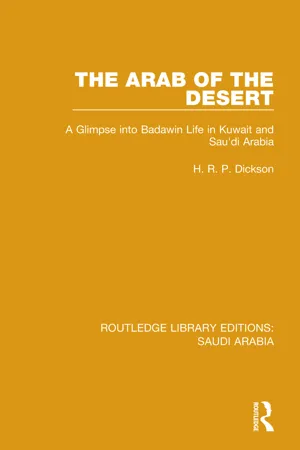
H.R.P. Dickson had the good fortune to spend many years among the Badawin, living and travelling with them as one of them in their own tents. In this book, first published in 1949, the author uses his great experience and knowledge to reveal all aspects of the lives of the nomadic desert Arabs, from social systems to marriage and children, from faith to food, sandstorms, warfare and hunting. The Arab of the Desert is truly a wealth of information, informed by personal insight and anecdotes.
eBook - ePub
The Arab of the Desert (RLE Saudi Arabia)
A Glimpse into Badawin Life in Kuwait and Saudi Arabia
- 728 pages
- English
- ePUB (mobile friendly)
- Available on iOS & Android
eBook - ePub
The Arab of the Desert (RLE Saudi Arabia)
A Glimpse into Badawin Life in Kuwait and Saudi Arabia
About this book
Trusted by 375,005 students
Access to over 1.5 million titles for a fair monthly price.
Study more efficiently using our study tools.
Information
CHAPTER I
My Life in the Desert
Badawin life has been so often and so well described by such giants in Arabian knowledge as Doughty, Musil, Philby, Bertram Thomas and others, that I feel timid in recording my own experiences. I am constrained to do so, however, by the thought that even I may be able to add a little to the knowledge that has been accumulated about a people, who are perhaps more lovable than any other race on earth, for I have had the good fortune, during my seven years' life among the Muntafiq and Khazail Arabs of the Euphrates, my two years' duty in Bahrain and Hasa, and last but not least during my subsequent seven years' sojourn in Kuwait as H.M.'s Political Agent, to have lived, moved about and camped among the nomad Badawin* in their own tents and as one of themselves. During these years, and in particular during my service in Kuwait, I learned to like and respect the Badawin and gained an insight into his life which I shall never regret.† I was blessed with a wonderful partner, who loved the Arab woman, her charming ways, her wonderful courage, simplicity and pride of race even more perhaps than I did her menfolk. This enabled me to acquire through her a knowledge of the thoughts, manners and occupations of these daughters of Arabia and descendants of Hagar, which few others have had a like chance to gain. Two factors in particular have helped me to win the confidence of the Arab and have assisted not a little in furthering my investigations. First, the fact that I was wet-nursed by an 'Anizah woman of the Misrab section of the Ruwala, and so can claim milk-brotherhood with them. Secondly, the fact that I have spoken Arabic from childhood.
The Badawin themselves were quick to realise that I was interested in them and liked them ("Al galb sháhid" as they say: "the heart bears witness") and appreciated the fact that I preferred to live in a black tent as they did, and always kept one ready in the desert, year in and year out, in charge of a respected Badawin family who wandered about with other nomads. These things made my position in the Kuwait Badawin world secure.
When I first came to Kuwait in May 1929, I bought the necessary "black" Badawin tents, and handed them over to one Salim al Muzaiyin, a Mutair (Sana) tribesman of Kuwait, whom with his Shammari wife I met in the Shamiyah camping ground of Kuwait when out riding one afternoon, instructing him to pitch my tents wherever he and his family and herdsmen happened to wander. I thus got early into desert ways and always had a camp ready for me. For seven* winters in succession I have made a practice of taking out my wife, son and daughter,† and living with our Badawin friends as opportunity offered and work at headquarters permitted. I would often take my wife and little girl to camp 40 or 50 miles away, leave them there alone for ten days or a fortnight. My own sojourns were as a rule of shorter duration, but speaking generally, we were able to spend quite a third of the Autumn, Winter and Spring months of each year wandering round with our Arab friends. Our favourite part of Kuwait, because of the abundance of grazing and flowers in spring, was Araifjan, a district some 40 miles south of Kuwait, but our wanderings took us at different times to practically every corner of the state, as well as to the Kuwait Neutral Zone.‡ Our own camp always consisted of three tents. With our Badawin family's three tents this gave us six tents all told, which were invariably pitched in a line.
Sometimes of course our party camped alone, at other times among large numbers of 'Ajman, 'Awazim, Mutair or 'Arabdar Badawin as the mood of our man took him, or migrations from the south occurred.
We never told Salim to go to any particular place or to join up with any particular tribe—we left him to decide where the grazing was best for his own camels and sheep, and for our sheep, camels and horses, which we left entirely in his charge. All we asked of him was that as he moved about and pitched his own camp, he would also pitch our black tents, ready for us to join him if opportunity offered.
There was no need for him to tell us where he intended to move to next or when. We in Kuwait always knew where the various Badawin ('Arabdar as well as foreign Badawin) were encamped. It was part of my job as Political Agent to know this—and any tribesman could at any given moment say where Abu Sa'ud's or Daksan's camp was.*
Our desert life was good; I count 1929 to 1936 as some of the happiest years that my wife and I have ever spent together. In these camps my wife and daughter largely amused themselves with collecting wild flowers for Kew Gardens in London and insects for the South Kensington Natural History Museum. I for my part did political work, got in touch with neighbouring shaikhs from Sa'udi Arabia or Iraq and generally kept myself abreast of the Badawin news about the Arabian world. When not at work, the wife and I hawked the lesser bustard (hubára), shot sand grouse or went for rides on our riding camels. Such rides almost always ended in calls on our neighbours, some 'Ajman shaikh, or some relative of the Shaikh of Kuwait. Periodically, if distances were great, we would take out cars and visit shaikhs of the Mutair, Shammar, 'Ajman and 'Awazim tribes, many of whom migrated almost every year, with their vast herds of camels, into Kuwait territory or into the Neutral Zone to the south of it. Many happy days were thus spent, and we were able to get on to terms of real intimacy with the shaikhs of those great tribes as well as with their charming womenfolk. My descriptions of such things as the daily round of a Badawin family, and how they water their camels, horses, sheep, etc., are therefore based on actual experience. I would watch their doings for days at a time, and supplement my observations by perpetually asking questions. I used to find that a good opportunity for questioning was round our camp fire at night. On these occasions while coffee went the round, men, women and children of the camp would foregather in our tent, retail news of raids, expectations, rain, grazing, sickness amongst camels, sheep and so forth, and answer questions on a hundred subjects. Were strangers to drop in, the women and children would discreetly disappear, but the real valuable and pleasant evenings were those when we were en famille, so to speak, and outsiders were neither present nor expected.
The following made up our family at Abu Sa'ud's camp, as it was called, in the barr (desert):
Salim al Muzaiyin—the head of our Badawin family (Mutairi).
Maziad—a Dhafír tribesman (assistant to Salim), and a fine example of a desert fighting man.
Dhuwaihi—'Azmi* (Muta'awah), a blind old man and leader of the family prayers.
Hamud—a lad of sixteen, Salim's nephew.
Faláh—'Azmi camel herdsman and brother of Dhuwaihi.
Nasir—'Azmi shepherd.
Swailim—'Azmi camel-herd.
Amsha—wife of Salim, our hostess (a Shammariyah).
Maneira—Salim's sister.
Hussa—Salim's daughter (fifteen years old).
Wadha—Dhuwaihi's daughter (fourteen years old).
Dghaima—Maziad's daughter (mother was dead).
Adhaiya—Dhuwaihi's daughter.
Marzúk—negro slave boy (died 1933).
Mabrúk—negro slave boy (aged three in 1934).
Hawaiya—Dhuwaihi's wife (seldom seen).
Dhuwaihi's three infants, Faláh, Kharmit and Bibi.
Of the above the following deserve more detailed mention:
Salim al Muzaiyin.—A fine, thick-set, good type of Badawin—of the Muzaina family, a semi-nomad Mutairi. Head of the clan is his brother Ibrahim al Muzaiyin, at one time intimate companion, friend and standard-bearer of the great Shaikh Mubárak of Kuwait and hero of a dozen tribal battles and a hundred raids. Ibrahim left the service of the present shaikh three years ago, as times were bad in Kuwait, and removed to Riyadh, where he now enjoys a comfortable stipend from Bin Sa'ud. Salim, who is now the head of the house in Kuwait, is widely respected for his honesty, stability and knowledge of country from Kuwait to Riyadh and Hufuf. He visits Bin Sa'ud's capital regularly twice a year, to see his elder brother, and generally is persona grata with the King as with Ibn Subah. A most useful man to have, and a good man in a tight place. He is a relative of Ibrahim ibn Juma'a, Bin Sa'ud's major domo in charge of the entertainment of Badawin guests in Riyadh. Being a Mutairi tribesman, Salim is a particularly useful man to have for work in the desert, where Mutair tribesmen commonly roam.
Maziad.—A Dhafír Badawin of Juwasim origin. Very useful, hardy and honest; a widower till 1934, when he married a Mutairi woman. He bought her for two she-camels and 100 rials, and is still paying off his debt. He is exceptionally valuable when Dhafír tribesmen are met with, as he insures the camp against raids and robbery by his fellow-tribesmen.
Dhuwaihi, the blind Muta'awah or priest, has much influence with his tribe and, like Maziad, insures that the 'Awazim tribe is friendly disposed. He leads the prayers, and marries those desiring matrimony. A rather dear old man.
Swailim.—A fine upstanding 'Azmi warrior, full of camel lore, and as hard as nails, assists Maziad with the camels: a remarkable youth where tracking, finding of lost camels, birds' nests and fagah (truffles) for the camp are concerned.
Amongst the women, pride of place must go to Amsha (or Atsha, to give her her Shammari name), the gentle-eyed, sweet-natured and contralto-voiced Shammari wife of Salim. Always tidy, clean and attractive, and a mine of information in matters of desert folklore, names of herbs, flowers and the manners and customs of her people, the Tumán section of the Sinjára Shammar. She was brought up in Hail or its vicinity, and came to Kuwait as a girl of fifteen in 1921 (sanat al Jahrah). She is a splendid cook and a real companion to her husband. She has had seven children, all of whom died in infancy except Hussa, her daughter. The latter is now fifteen years old and of marriageable age. A strong, thick-set and particularly attractive Badawin lass, Hussa does most of the tent work for her mother, weaves tent strips and qátas (dividing curtains for the tent) in her spare time, and daily goes out to cut firewood with her...
Table of contents
- Cover
- Half Title
- Title
- Copyright
- Original Title
- Original Copyright
- Dedication
- Foreword
- Preface
- Acknowledgements
- Contents
- List of Illustrations
- Part One
- Part Two
- Appendices
- Glossary of Common Badawin Words
- Index
Frequently asked questions
Yes, you can cancel anytime from the Subscription tab in your account settings on the Perlego website. Your subscription will stay active until the end of your current billing period. Learn how to cancel your subscription
No, books cannot be downloaded as external files, such as PDFs, for use outside of Perlego. However, you can download books within the Perlego app for offline reading on mobile or tablet. Learn how to download books offline
Perlego offers two plans: Essential and Complete
- Essential is ideal for learners and professionals who enjoy exploring a wide range of subjects. Access the Essential Library with 800,000+ trusted titles and best-sellers across business, personal growth, and the humanities. Includes unlimited reading time and Standard Read Aloud voice.
- Complete: Perfect for advanced learners and researchers needing full, unrestricted access. Unlock 1.5M+ books across hundreds of subjects, including academic and specialized titles. The Complete Plan also includes advanced features like Premium Read Aloud and Research Assistant.
We are an online textbook subscription service, where you can get access to an entire online library for less than the price of a single book per month. With over 1.5 million books across 990+ topics, we’ve got you covered! Learn about our mission
Look out for the read-aloud symbol on your next book to see if you can listen to it. The read-aloud tool reads text aloud for you, highlighting the text as it is being read. You can pause it, speed it up and slow it down. Learn more about Read Aloud
Yes! You can use the Perlego app on both iOS and Android devices to read anytime, anywhere — even offline. Perfect for commutes or when you’re on the go.
Please note we cannot support devices running on iOS 13 and Android 7 or earlier. Learn more about using the app
Please note we cannot support devices running on iOS 13 and Android 7 or earlier. Learn more about using the app
Yes, you can access The Arab of the Desert (RLE Saudi Arabia) by H.R.P. Dickson in PDF and/or ePUB format, as well as other popular books in Social Sciences & Regional Studies. We have over 1.5 million books available in our catalogue for you to explore.