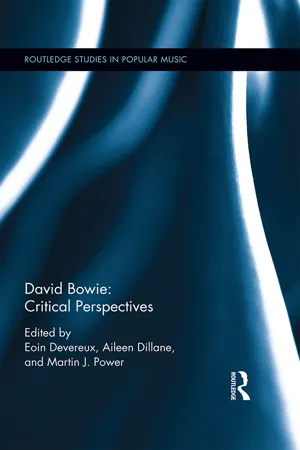
David Bowie: Critical Perspectives examines in detail the many layers of one of the most intriguing and influential icons in popular culture. This interdisciplinary book brings together established and emerging scholars from a wide variety of backgrounds, including musicology, sociology, art history, literary theory, philosophy, politics, film studies and media studies. Bowie's complexity as a singer, songwriter, producer, performer, actor and artist demands that any critical engagement with his overall work must be interdisciplinary and wide-ranging in its scope. The chapters are organised around the key themes of 'textualities', 'psychologies', 'orientalisms', 'art and agency' and 'performing and influencing' in Bowie's work. This comprehensive book contributes a great deal to the study of popular music, performance, gender, religion, popular media and celebrity.
eBook - ePub
David Bowie
Critical Perspectives
- 324 pages
- English
- ePUB (mobile friendly)
- Available on iOS & Android
eBook - ePub
David Bowie
Critical Perspectives
About this book
Information
1 David Bowie is
Bowie’s release of The Next Day in 2013, his first album in ten years, generated a media frenzy. In what was described as the perfect comeback, the album charted in the top 10 in over 20 countries in March. In the same month, the Victoria and Albert Museum (hereafter V&A) opened David Bowie is. This was the first major museum exhibition on Bowie’s long career in music, and the first to draw fully on the collections of The David Bowie Archive. This chapter draws on my experience, as assistant curator, of working intensively with the Archive and in collaboration with a large project team to develop the exhibition between 2011 and 2013. The curators Geoffrey Marsh, Victoria Broackes and I devised the exhibition’s narrative without any knowledge of the impending album release, but with a firm belief in Bowie’s far-reaching influence and cultural importance in the twenty-first century. The exhibition was not conceived as a retrospective and its unorthodox title was written in the present tense to emphasise this. In the event, the emphasis was barely needed. David Bowie is became the fastest selling exhibition in the history of the V&A. Over 230,000 visitors came to see it in London and an international tour brought it to many more.1

Figure 1.1 Queues for David Bowie is, 24 July 2013 © Victoria and Albert Museum, London
At the entrance to the exhibition, visitors were faced by this quotation from Bowie’s notes on the album 1.Outside (1995): “All art is unstable. Its meaning is not necessarily that implied by the author. There is no authoritative voice, there are only multiple readings”. In Bowie’s notes, the scrawled originals of which could be seen on display nearby, this line is prefaced by a fuller explanation:
Taking the present philosophical line we don’t expect our audience to necessarily seek an explanation from ourselves. We assign that role to the listener and to culture. As both of these are in a state of permanent change there will be a constant “drift” in interpretation. All art is unstable. Its meaning is not necessarily that implied by the author. There is no authoritative voice. There are only multiple readings.
(Bowie, 1995)
These words deliberately open up the album to interpretation by Bowie’s listeners. They echo views previously expressed by him in 1980 “a piece of music once it’s left the writer … becomes public property” (Bowie, Interview with Andy Peebles, 1981), and in 1972, “when an artist does his work it’s no longer his … I just see what people make of it” (cited in Copetas, 1974).
Bowie’s expansion of the term ‘art’ to include rock and pop music finds wide acceptance today. The notion that art, in this broad sense, has a meaning that is open to personal interpretation is likewise familiar to contemporary readers and listeners. This principle has gained increasing recognition since the 1970s, the ‘Me’ decade as Tom Wolfe (1976) named it, in which Bowie and other artists of his generation contributed to the widespread championing of individualist philosophies. Moreover, music in the public domain is now easily recognisable as ‘public property’, not only in a metaphorical and intellectual sense but, increasingly, in a practical one as well. As Bowie predicted in 2002, the digital streaming of music on the internet has made much of it as readily available as, “running water or electricity” (Pareles, 2002).
Yet, acute as Bowie’s statements are, they are not the common starting point for appreciation of his work. We know Bowie as a music superstar and global icon; the subject of both critical and popular acclaim. As a performer, Bowie projects awe-inspiring charisma and authority. For these reasons, his personal story remains the hook on which much interest in, and analysis of, his career hangs. Creem magazine ran a straight-talking, comic ‘letter’ to Bowie by Laura Fissinger (1983), which stated, “If they [Bowie fans] didn’t smell a person inside the fashion spectacle and musical melodrama, you would have been declared a dead lizard years ago”. Even a music critic such as Robert Matthew-Walker (1985), who notes it is important “to rely mainly on our own observations and analyses” in interpreting Bowie’s work, begins his study with an in-depth account of ‘The Man’. The majority of critical works on Bowie are biographies or variants on them; often full of subtlety and insight, yet invariably reinstating the kind of intentionality that Bowie himself disclaims in the quotation above. His work and music are interpreted chiefly in the light of his personal experience and choices.
This means that a certain tension is generated when Bowie speaks from his position of cultural authority, in order to wilfully abandon it. If ‘meaning’ is not created by such a charismatic ‘author’, does that leave his audience empowered or unsatisfied? By creating work of extraordinary sophistication and originality, Bowie leaves us in no doubt of his own creative powers. By ensuring that the same work demands and sustains ‘multiple readings’, Bowie confers creative agency on us, his audience. In what follows, I suggest that this creative tension, between power and empowerment, is central to Bowie’s lasting cultural impact and enduring popularity.
DAVID BOWIE IS WHO I AM
Having made his extraordinary archive available to the Museum, Bowie chose to give the V&A curatorial freedom and did not comment directly on the exhibition’s development. The approach he described in 1972, “I just see what people make of it”, applied as much to the exhibition as to his work as a whole. The curatorial and design team faced a dual challenge: to define, convey and celebrate Bowie’s star appeal, while allowing for ‘multiple readings’ of his work. The interplay between power and empowerment described was not only key to understanding Bowie’s creative impact, but key to the success of the exhibition.
The thousands of visitors to the exhibition were drawn by the chance to see objects from Bowie’s personal archive, many on display for the first time. As Tilda Swinton put it, on opening the exhibition, “We’re in the Victoria and Albert Museum preparing to rifle through your drawers. It’s truly an amazing thing” (Swinton, 2013). The David Bowie Archive is an exceptional collection of over 75,000 objects, and the V&A was privileged to be the first museum given full access to it. The collection dates from the 1940s to the present and illuminates the entire span of Bowie’s career. It includes not only finished products such as albums and stage costumes but also the working notes, models, sketches and drafts showing their development. By drawing together almost 300 objects from this collection for the first time, the V&A offered both fans and newcomers to Bowie a uniquely rich and intimate view of his creative practice.
Given the V&A’s exclusive archival access, the curators were aware that many visitors would expect the exhibition to ‘reveal all’ and offer an authoritative summing-up of Bowie’s character and career. Even the most committed fans and Bowie experts would visit the exhibition to feel closer to his work and gain new insights. To a significant extent, the opportunity to display previously unseen working notes, sketches and lyrics satisfied this last expectation. They revealed the astonishing extent of Bowie’s creative control over each detail of his work, from album design to stage performances. Tracing the process of experimentation and thought which led to an iconic album cover or film footage refreshed readings of well-known objects. Some of the most fascinating ‘finds’ in the archive were unrealised projects, such as sketches for a musical film elaborating on and illuminating references in the Diamond Dogs album to the character of street gang leader Hallowe’en Jack and the urban dystopia of ‘Hunger City’. The exhibition demonstrated that Bowie’s commercially available work represented only a fraction of his creative output. It shed light on the multiple creative artists and works that inspired him, from George Grosz and Erich Heckel to the Beano and Viz. As Jarvis Cocker commented, “The main thing that will impress people as they go round the V&A is the sheer volume of stuff that Bowie has done, it made me feel very lazy” (Cocker, 2013). By giving primacy to creative process over finished product, the exhibition offered a new perspective on Bowie’s work.
But in terms of the meaning of that work, there could be no revelations. Spending more than two years immersed in Bowie’s music, story and archived possessions convinced us as curators that Bowie’s cultural influence and importance could not be captured in a single reading. Diversity, polysemy and ambiguity colour Bowie’s creative language. His lyrics invite ‘multiple readings’, as do his album artworks, his astutely crafted public image and complex, theatrical stage performances. The many books and articles written about him form a palimpsest of interpretation, analysis and myth. To each of his fans he represents something intensely personal. One of Bowie’s more famous admirers, Gary Kemp, described his feelings en route to see the exhibition as follows:
Bowie is who I am: I was fired up by Ziggy, my soul was stirred by his Young Americans, and my sense of cool was dictated by his Thin White Duke. He held my hand creatively throughout the Seventies and guided me to my choices in the following decade [in Spandau Ballet]. I’m not responsible for this show, but it is responsible to me, to my youth, to all the things that I became because of this man, and I’m desperate not to have that destroyed.
(Kemp, 2013)
The sense of responsibility was palpable. We were acutely aware that to present Bowie’s multifaceted career from a single angle would distort its real complexity. We wanted visitors to be able to revel in the sense of identification and ownership that Gary Kemp describes, “Bowie is who I am”. Rather than attempting to devise another definitive story, therefore, we aimed to capture the existing multiplicity of readings and allow for others to emerge.
In an exhibition context this meant avoiding the didactic ‘authoritative voice’ often associated with museum displays. That tone would run contrary to Bowie’s own creative language. It would also assert authority over an area of popular culture in which many visitors could claim equal expertise. For this reason, curatorial texts in the exhibition were juxtaposed with excerpts from existing critical texts by David Buckley, Kevin Cann and Nicholas Pegg.2 By positioning the quotation, ‘All art is unstable … there is no authoritative voice. There are only multiple readings’ at the entrance to the exhibition, we offered a curatorial disclaimer couched in Bowie’s own words. Conveying the dynamic power of Bowie’s work and, at the same time, its ability to spark a multiplicity of ideas and readings, became a core principle of the curatorial approach.
This principle informed the choice of exhibition title David Bowie is, devised by music journalist Paul Morley.3 Both a statement and a deliberately unfinished sentence, the title functioned as a teaser and a catalyst. It was a statement of Bowie’s contemporaneity and cultural presence. At the same time, it provoked visitors to engage in defining and re-defining what Bowie ‘is’. It invited personal responses and did not rule out different and potentially conflicting readings. Paul Morley’s own variations on the theme, playful or thought-provoking, were embedded in the exhibition text and design: “David Bowie is moving like a tiger on Vaseline” borrowed Bowie’s lyric from, ‘Hang on to Yourself’. ‘David Bowie is making himself up’ or ‘David Bowie is a face in the crowd’ were deliberately ambiguous.
For Gary Kemp, among others, this approach was successful. Kemp’s review read:
It’s an exhibition that is thrilling and sensorial, with sound and vision working together to immerse or—dare I say—baptise you, in Bowieworld. But it’s not, I realised, about one man, it’s about all of us; all of us who invested so much and learned so much at his tutelage. As I left I thought about what the show’s open-ended title implied: David Bowie is … you.
(Kemp, 2013)
In terms of curatorial practice and exhibition design, David Bowie is aimed to take an existing trend to a new level. When Bowie questions the authority of his own ‘authorial voice’ in his notes on 1.Outside he describes his position as part of “the present philosophical line”. This philosophical tendency was registered across several cultural fields by the 1990s, including museum practice. The ‘new museology’ of the 1970s and 1980s focused critical attention on the social and ideological purpose of the museum, pushing curators to ask ‘why’, as well as ‘how’, objects should be preserved. Exhibitions were newly defined at this time as narratives driven by ideology. These ideas continued to gain urgency in the 1990s, at which time Mieke Bal accurately pinpointed the differentiating factor between the ‘new museology’ and previous curatorial approaches:
it is the serious follow up on the idea that a museum installation is a discourse and an exhibition is an utterance within that discourse … Bringing this discursive perspective to the museum … deprives the museum practice of its innocence, and provides it with the accountability it, as well as its users, are entitled to.
(Bal, 1996: 128)
A questioning approach to curatorial authority entered along with this increased recognition of the curator’s accountability. It was widely felt that exhibition narratives delivering a single curatorial viewpoint risked becoming overly didactic. The interpretative agency of the visitor was given a new level of recognition and respect. The terms of this debate remain pressing today. Andrea Witcomb has argued that in order for museums to be more than ‘mausoleums’ it is vital to acknowledge the limits of curatorial understanding and authority:
exhibition spaces need to be reconceptualised as … interactive in themselves. This requires museums to move away from a didactic, hierarchical model of communication towards an understanding of exhibition narratives as polysemic and open ended.
(Witcomb, 2003: 130)
Pop music exhibitions invite and require a curatorial approach and language that is in sympathy with this tre...
Table of contents
- Cover
- Half Title
- Title Page
- Copyright Page
- Dedication
- Table of Contents
- List of Figures, Cases or Illustrations
- Foreword
- Preface
- Acknowledgments
- 1 David Bowie is
- 2 In this Age of Grand Allusion: Bowie, Nihilism and Meaning
- 3 Culminating Sounds and (En)visions: Ashes to Ashes and the case for Pierrot
- 4 Turn Myself to Face Me: David Bowie in the 1990s and Discovery of Authentic Self
- 5 ‘Crashing Out with Sylvian’: David Bowie, Carl Jung and the Unconscious
- 6 Dear Dr. Freud—David Bowie Hits the Couch: A psychoanalytical approach to some of his personae
- 7 Moss Garden: David Bowie and Japonism in fashionin the 1970s
- 8 The “China Girl” Problem: Reconsidering David Bowie in the 1980s
- 9 Embodying Stardom, Representing Otherness: David Bowie in ‘Merry Christmas Mr. Lawrence’
- 10 Art’s Filthy Lesson
- 11 Authorship, Agency and Visual Analysis: Reading (some) Bowie Album Covers
- 12 Revisiting Bowie’s Berlin
- 13 David Bowie: The Extraordinary Rock Star as Film Star
- 14 The (becoming-wo)Man Who Fell to Earth
- 15 Out of this World: Ziggy Stardust and the Spatial Interplay of Lyrics, Vocals and Performance
- 16 David Bowie Now and Then: Questions of Fandom and Late Style
- 17 How Superficial!—Bowie and the Art of Surfacing in 21st Century Literature
- Contributors
- Index
Trusted by 375,005 students
Access to over 1.5 million titles for a fair monthly price.
Study more efficiently using our study tools.
Frequently asked questions
Yes, you can cancel anytime from the Subscription tab in your account settings on the Perlego website. Your subscription will stay active until the end of your current billing period. Learn how to cancel your subscription
No, books cannot be downloaded as external files, such as PDFs, for use outside of Perlego. However, you can download books within the Perlego app for offline reading on mobile or tablet. Learn how to download books offline
Perlego offers two plans: Essential and Complete
- Essential is ideal for learners and professionals who enjoy exploring a wide range of subjects. Access the Essential Library with 800,000+ trusted titles and best-sellers across business, personal growth, and the humanities. Includes unlimited reading time and Standard Read Aloud voice.
- Complete: Perfect for advanced learners and researchers needing full, unrestricted access. Unlock 1.5M+ books across hundreds of subjects, including academic and specialized titles. The Complete Plan also includes advanced features like Premium Read Aloud and Research Assistant.
We are an online textbook subscription service, where you can get access to an entire online library for less than the price of a single book per month. With over 1.5 million books across 990+ topics, we’ve got you covered! Learn about our mission
Look out for the read-aloud symbol on your next book to see if you can listen to it. The read-aloud tool reads text aloud for you, highlighting the text as it is being read. You can pause it, speed it up and slow it down. Learn more about Read Aloud
Yes! You can use the Perlego app on both iOS and Android devices to read anytime, anywhere — even offline. Perfect for commutes or when you’re on the go.
Please note we cannot support devices running on iOS 13 and Android 7 or earlier. Learn more about using the app
Please note we cannot support devices running on iOS 13 and Android 7 or earlier. Learn more about using the app
Yes, you can access David Bowie by Eoin Devereux, Aileen Dillane, Martin Power, Eoin Devereux,Aileen Dillane,Martin Power in PDF and/or ePUB format, as well as other popular books in Media & Performing Arts & Music. We have over 1.5 million books available in our catalogue for you to explore.