- 224 pages
- English
- ePUB (mobile friendly)
- Available on iOS & Android
eBook - ePub
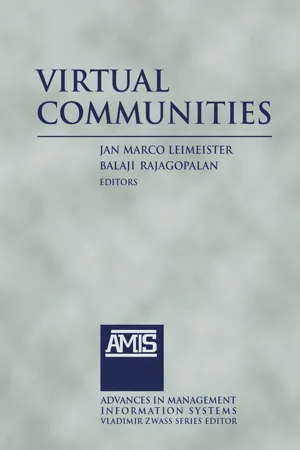
Virtual Communities: 2014
About this book
Written for both scholars and practitioners, this volume focuses on the design, management, use and impacts of Virtual Communities (VCs) from technological, social and economic perspectives. It brings together peer-reviewed research articles that give an in-depth review of the state-of-the-art practices, and also shows opportunities for research and practice in and around VCs.
1
____________________________
VIRTUAL COMMUNITIES
An Introduction
This volume focuses on the design, management, use, and impacts of virtual communities (VCs) from technological, social, and economic perspectives. Written for both scholars and practitioners, it provides a collection of peer-reviewed research articles that give an in-depth review of state-of-the-art practices. It shows opportunities for research and practice in and around VCs.
VIRTUAL COMMUNITIES AND THEIR RELEVANCE
The importance of VCs emerged with the development of the World Wide Web, and the Internet has spurred a phenomenal growth of virtual communities. VCs can range from simple forums based on information exchange to more complex networks supporting new product development. For example, forums based on communities of interest such as investment-related virtual communities bring together individuals interested in exchanging information about stocks while online production communities such as open-source development communities focus on developing a new product. VCs can be found in many different areas and can have very different objectives, ranging from VCs for generating innovations, respectively new products (e.g., Bretschneider et al., 2012; Ebner et al., 2009), VCs for patients (e.g., Leimeister, 2005; Leimeister et al., 2005, 2008), or VCs for the elderly (e.g., Goswami et al., 2010), or any other topic that generates a shared interest of people.
Hartmann et al. (2012) show that the literature provides a wide range of definitions regarding the term “virtual community.” The reason for this is that many research fields such as information systems, psychology, education, and many more investigate virtual communities, their effects, contingencies, and so on from their own disciplinary background. Furthermore, many authors use the term “online community” instead of “virtual community,” and we agree with other researchers (e.g., Hummel and Lechner, 2001; Shen and Khalifa, 2009) that virtual community and online community can be considered as synonyms.
One of the first definitions of VCs understands them as “social aggregations that emerge from the net when enough people carry on those public discussions long enough, with sufficient human feeling, to form webs of personal relationships in cyber-space” (Rheingold, 1993, p. 5). Hagel and Armstrong (1997) also focus on the aspects information technology (IT) support and on building social relationships among the users. Thus, they consider virtual communities as computer-mediated spaces where there is a potential for an integration of content and communication with an emphasis on member-generated content (cf. Hagel and Armstrong, 1997). Additionally, they emphasize the importance of user-generated content within an online community. We use a multidisciplinary approach to define “virtual community.” According to Preece (2000), “an online community consists of:
• People, who interact socially as they strive to satisfy their own needs or perform special roles, such as leading or moderating.
• A shared purpose, such as an interest, need, information exchange, or service that provides a reason for the community.
• Policies, in the form of tacit assumptions, rituals, protocols, rules, and laws that guide social interactions.
• Computer systems, to support and mediate social interaction and facilitate a sense of togetherness” (p. 10).
VCs offer ubiquitous access to information and exchange possibilities for people in similar situations or with similar interests. VCs are groups of people who meet and interact with others, are connected by a specific interest, are brought together by means of a technical platform, and who can establish social relationships or a sense of belonging to this group. For more than twenty years the Internet has been the mainstream medium for information exchange and social interaction. Millions of people have turned to it daily to conduct very diverse information-seeking and communication activities. A great number of users are information consumers, but especially with the rise of Web 2.0 applications, many have assumed an additional role and have become information providers. They contribute content on a wide range of topics in blogs, wikis, podcasts, and videos, and they also develop social relationships with people they have never met in the physical world, or they maintain and cherish many social relationships that they might have lost sight of otherwise. Now users play games online with each other, chat and exchange information in social networks, chat rooms, discussion forums, and meeting rooms, visit social or professional networking sites, and visit dating and other social networking sites to meet people. Sixty-five percent of American Internet users have used social networking sites (Madden and Zickuhr, 2011) and in 2012 have spent more time on social networks (a form of VC) than on any other Web site (Raine, 2013).
Mobile and ubiquitous computing technologies are enabling new forms of user interaction and extending the realm of classic Internet applications as they provide new infrastructures for VCs. Location-based and context-aware services, novel devices, user interfaces, and ubiquitous connectivity allow new services for VCs or even enable new forms of VCs—mobile communities.
The significance of VCs is evident by the impact they have on information generation and transmission, and socialization. For example, today, blogs are quickly becoming a primary source of information in a variety of domains. The dynamic and interactive nature of these forums makes them very attractive to users. An additional value offered by many of these communities is their ability to support socialization and offer an identity to the participants. While most virtual communities share these characteristics, it is also important to recognize that virtual communities are not homogeneous; they differ significantly based on domain, purpose, and benefits. For example, VCs for investments are focused on offering an important forum for individual investors to discuss stock performance. Open-source communities, on the other hand, are virtual communities that offer a platform for participants to collaborate and produce a product of value to the entire community. Within the field of information systems, researchers are interested in studying interaction patterns, transaction processes, management issues, business models, and design aspects of information systems and services for virtual communities. To address important questions in many of these areas, this volume contains a total of nine research articles.
STRUCTURE OF THE BOOK
The book Virtual Communities is structured in four parts. The first part focuses on the fundamentals of VCs. The second part discusses the challenges and limitations of VCs in different areas of application. The third part presents approaches to design of and discusses aspects of the development of VCs. The last and fourth part extends Internet- and PC-based virtual communities to the world of mobile and ubiquitous computing.
Part I. Fundamentals of Virtual Communities
Part I focuses on the fundamentals of virtual communities, ranging from structural elements such as sociability to aspects of user-generated content as well as issues related to theoretical foundations of online interactions. Part I includes two research articles.
The contribution “Creating Trust and Participation in Online Communities with IT Features: The Technology-Trust-Participation Model,” by Alexander Benlian and Thomas Hess argues that
despite the fact that online communities (OCs) still enjoy significant growth, their success is stunted by infringements of user trust by either the community operator (e.g., through the abuse of user information) or other users (e.g., through fake accounts). Since previous research studies have focused their investigations primarily on the trust- and participation-creating effects of just single information technology (IT) features (such as navigational cues or user-profile configurations), the field still lacks an integrative view of how a comprehensive set of IT features affects trust and participation in OCs. This chapter presents an empirical study that aims to address this research gap by conducting an online survey among 364 members of general-interest OCs. Our results show that four clusters of IT features that are investigated in this study—usability, transparency, quality-assured content, and security/privacy—vary in their impact on trust factors and participation. Interestingly, usability was the sole factor that significantly influenced both trust and participation. While transparency had a significant effect only on trust variables, quality-assured content and security/privacy-related IT features were significantly related only to participation. Our findings offer a variety of research implications and practical findings that help in understanding which IT features should be provided in OCs to retain existing users and attract new users by increasing trust and encouraging participation.
The contribution “Sense of Community in Virtual Environments,” by Dana Rotman and Philip Fei Wu, aims to explore the conceptualization of sense of community (SoC) in virtual communities and to discuss the implications of SoC to virtual community researchers and designers. The authors argue that the changing social structure of virtual communities and the different expectations stemming from computer-mediated communications necessitate a different reflection of the SoC elements in the virtual world. Building on McMillan and Chavis’s work, they identify five elements of SoC (common domain of interest, continuous interaction, emotional support, shared history and culture, and virtually constructed identity) and propose a new framework for understanding the evolving nature of SoC in today’s virtual environments.
Part II. Applications of Virtual Communities
Part II discusses the challenges and limitations of virtual communities in different areas of application, ranging from health care to tourism communities to virtual communities for idea development in various domains. Part II includes three research articles.
The contribution “Online Travel Communities: A Self-Determination Theory Approach,” by Felix-Robinson Aschoff and Gerhard Schwabe, provides a literature review of how online communities can support the needs of travelers. To structure this chapter, they use the self-determination theory proposed by Deci and Ryan (2000). This theoretical approach claims three innate psychological needs that are especially relevant to travelers: competence, autonomy, and relatedness. In the first part of the chapter, they illustrate how online communities can support these three travel-related needs. In the second part, the authors discuss community-related business models that are based on these needs. Finally, they discuss how the self-determination theory perspective complements existing approaches to explain motivation and contribution in online travel communities.
The contribution “Factors Influencing Virtual Learning Community Success,” by René Wegener and Jan Marco Leimeister, argues that engaging in a virtual community is often associated with shared knowledge development as well as fostering critical thinking and individual learning. However, many virtual learning communities (VLCs) fail in establishing connectedness among learners and enhancing learning outcomes. Much research has been dedicated to what drives or hinders their success. The authors review a decade of literature in order to identify the most important concepts and theories that have influenced research on VLCs, and to determine the factors most critical for establishing a successful VLC. Applying a structured literature review, they identified, classified, and synthesized fifty-three relevant papers. Results indicate that several factors are critical ...
Table of contents
- Cover Page
- Half Title Page
- Title Page
- Copyright Page
- Series Page
- Contents
- Series Editor’s Introduction
- 1. Virtual Communities An Introduction
- Part I Fundamentals of Virtual Comunities
- Part II Applications of Virtual Communities
- Part III Development of Virtual Communities
- Part IV Extending Virtual Communities Beyond Traditional Boundaries
- Editors And Contributors
- Series Editor
- Index
Trusted by 375,005 students
Access to over 1.5 million titles for a fair monthly price.
Study more efficiently using our study tools.
Frequently asked questions
Yes, you can cancel anytime from the Subscription tab in your account settings on the Perlego website. Your subscription will stay active until the end of your current billing period. Learn how to cancel your subscription
No, books cannot be downloaded as external files, such as PDFs, for use outside of Perlego. However, you can download books within the Perlego app for offline reading on mobile or tablet. Learn how to download books offline
Perlego offers two plans: Essential and Complete
- Essential is ideal for learners and professionals who enjoy exploring a wide range of subjects. Access the Essential Library with 800,000+ trusted titles and best-sellers across business, personal growth, and the humanities. Includes unlimited reading time and Standard Read Aloud voice.
- Complete: Perfect for advanced learners and researchers needing full, unrestricted access. Unlock 1.5M+ books across hundreds of subjects, including academic and specialized titles. The Complete Plan also includes advanced features like Premium Read Aloud and Research Assistant.
We are an online textbook subscription service, where you can get access to an entire online library for less than the price of a single book per month. With over 1.5 million books across 990+ topics, we’ve got you covered! Learn about our mission
Look out for the read-aloud symbol on your next book to see if you can listen to it. The read-aloud tool reads text aloud for you, highlighting the text as it is being read. You can pause it, speed it up and slow it down. Learn more about Read Aloud
Yes! You can use the Perlego app on both iOS and Android devices to read anytime, anywhere — even offline. Perfect for commutes or when you’re on the go.
Please note we cannot support devices running on iOS 13 and Android 7 or earlier. Learn more about using the app
Please note we cannot support devices running on iOS 13 and Android 7 or earlier. Learn more about using the app
Yes, you can access Virtual Communities: 2014 by Jan Marco Leimeister,Rajagopolan Balaji in PDF and/or ePUB format, as well as other popular books in Business & Business General. We have over 1.5 million books available in our catalogue for you to explore.