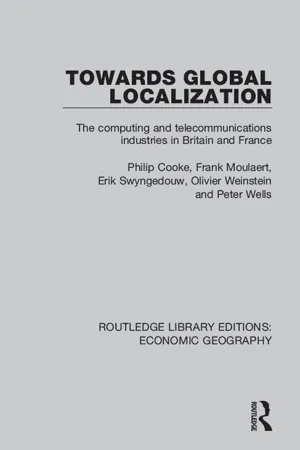
This volume redefines the genre of sector studies. The first part of the book compares the experiences of Britain and France in the very voltaile world of high-tech industries during the 1980s. The macroeconomic regulation approach is carried over a microeconomic level in the empirical chapters through an analysis of studies of firms, each chapter written by authors well-placed to give a pan-European perspective.
- 235 pages
- English
- ePUB (mobile friendly)
- Available on iOS & Android
eBook - ePub
Towards Global Localization
CHAPTER ONE
Computing and communications in the UK and France: innovation, regulation and spatial dynamics – an introduction
The aims of the book
This book is a study of changes taking place in two key advanced-technology industries: computing and communications (C&C). The study is broadened by its focus on the transformation of the industries in two major European economies: Britain and France. It could be said that the two master technologies of C&C have been tending to converge in the past decade, but the policy environments of Britain and France have diverged radically during the same period. In France there has been a continuation of dirigisme in the fields reported here, industrially and territorially. In Britain, the 1980s saw a radical experiment in withdrawal or diminution of government support for both industries (but particularly – through privatization – of the telecommunications sector) and regions.
Thus, a major theme of this book is to what extent the dynamics of economic development and industrial reorganization are dictated by pure market forces, as against the force of government policies seeking to intervene in and shape the competitive market. The development of C&C in these two countries offers a valuable laboratory in pursuit of this aim, precisely because of the differences in the posture of state policy amid universal technological trends.
A second major aim of the book is to explore the relevance of a broad macroeconomic perspective, the “regulationist approach” (Lipietz 1987, Boyer 1988). This school of thought purports to explain the intimate relationships between particular forms of industrial organization and institutional framework that persist over time, and why they change. It is a macro-perspective that subsumes some theoretical propositions, among which those addressing questions of production flexibility, technological innovation, inter-firm institutional structures, globalization and deregulation of markets by governments are a few of the more prominent. Rather unusually, this book examines the validity of the regulationist approach by looking at both macro- and microeconomic phenomena, attempting in the most testing way to establish the empirical credentials of the perspective. Thus, the extent to which firm behaviour in either of our target sectors can be understood in terms of “regulation school” propositions is taken as at least a provisional judgement of the theoretical validity of the approach.
The third main aim of the book is to see, again with the aid of the regulationist perspective, whether a good explanation can be provided for the spatial shifts – both global and local – described in the main empirical sections of this study. It is fair to say that one of the general attractions of the regulationist approach lies in its sensitivity to spatial matters. Accordingly, the perspective has been taken up with some gusto in the spatial analytic disciplines: economic geography, regional science, urban and regional studies (see, for example, Scott & Storper 1986, Leborgne & Lipietz 1988, Moulaert et al. 1988,). Since one of the more interesting features of contemporary economic change is an apparent revaluation of the importance of geographical location and linkage, the book seeks to explain this by teasing out the interactions between organizational and technological innovation by firms, and institutional adjustments in the environmental context in which firms operate. Moreover, since policy-makers from the local to the supranational level express an acute interest in the development of these key advanced technologies, seeking to gain advantage for their territories in the competitive struggle, we hope to shed light on the processes of change, to enable appropriate policy conclusions to be drawn.
There are five key issues which form the broad structure of what is discussed in the book. First, it is necessary to draw attention to certain apparently pervasive technological changes which have in turn led to innovations in both the products and the processes of their production. Secondly, it is vital that the institutional structures that permeate the more directly economic pursuits of firms are presented along with key changes within these pursuits. Next, attention is drawn to two important geographical scales by which it is relevant to consider the effects of these technical and institutional changes. Hence, the third issue concerns the macro-spatial level and the question of “globalization”, while the fourth relates to the micro-spatial, or regional and local, shifts occasioned by the developments occurring in C&C industries. Finally, analysis of the sectoral dynamics of three crucial activities must be foreshadowed, these being the manufacture of computing and communications equipment, and the delivery of specialist value-added services to which they give rise. In what follows, each of these five core areas of the theoretical and empirical research will be outlined, and key elements of each will be highlighted.
Innovation, technical change and the firm
New products and new methods of producing them have always been crucial competitive weapons to firms. However, in the past two decades there has been a huge leap in the rate of product and process innovation, particularly in the computing and communications industries. An exponential growth of new products in telecommunications is demonstrated in Ungerer & Costello (1988), and the profile for computing is comparable, while that in communications services is sharper still and over a much shorter period (Mansell 1989).
A striking feature of innovation in these industries is the noticeable shift in the processes underpinning it. Hitherto, the predominant source of innovation has been the large hierarchical corporation with a divisional structure, one of the key departments of which is research & development (R&D). Whatever organizational changes may have been instituted within large C&C corporations in recent years – and there have been many, as they have sought to cope with the twin uncertainties of heightened competition and more rapid rates of technological change – the R&D department has survived more or less unscathed. However, its capacity for “stand-alone” innovation may have diminished. One reason for this is that innovation has become a far more interactive process than it was as a giant corporation such as IBM grew to prominence. Recent studies show a pervasive increase in the amount of corporate innovative activity occurring through interaction between the innovator and user (Hakansson 1989). This growth of “user-power” is, in itself, something of an innovation and one that has been occasioned by the greater choice a user now has in a more competitive market, and the deepening of markets as more and more users see the potential competitive advantage of investing in C&C. Hakansson (1989) shows that this interaction between client and producer is the most widespread form of inter-firm co-operation in the innovation sphere, accounting for 75% of such co-operative relationships. Moreover, they are the longest-lived form of co-operation, averaging ten years durability. Among the reasons for increased user-producer collaboration in innovation are: the specificity of user needs demanding “bespoke” applications; the prospect of market enhancement through customer “lock-in”, and through learning how to develop new applications for sale elsewhere; and the continuous learning that may be afforded from the user’s growing ability to demand “aftercare” from the producer, once installation has been completed.
A different kind of innovative learning by interaction comes from heightened collaborative efforts between producers (Lundvall 1988). Specifically, the interaction here is likely to be between a larger customer firm and a smaller supplier firm in a similar or related component or service-supply industry. In parallel with user-power is what can be termed “supplier-power” (Cooke & Morgan 1990): this is a situation where, for reasons of increased competition, a firm is forced to reduce, say, materials costs by subcontracting production to one or more independent suppliers. Where suppliers have “strategic competences” (Teece 1986), they may be in a position to demand not the short-term multi-supplier contract, that most customers require to maintain control over the relationship, but long-term single-supplier status. To the extent that the latter position is approached, if not achieved, the relationship between customer and supplier will necessarily have changed from a competitive market relationship to one of increasing trust and confidentiality (Granovetter 1985). Such relationships can result in innovation through learning by interacting. Firms jointly develop and produce, and added value stems from the exchange of the know-how each partner possesses.
The third form of innovative learning by interacting is the inter-firm agreement between equals or near-equals, as distinct from the previous two categories. Though this is one of the most widely discussed innovation processes in the relevant literature, it is much less important than user-producer interaction and not necessarily more important than customer-supplier interaction. Nevertheless, it has attracted attention because it seems to be a new form of relationship between potentially competitive rivals (Chesnais 1988, Mytelka 1990). Strategic alliances, as such collaborations are often referred to, are a prime focus of the micro-analysis presented in this book. They are important, especially so in C&C, as forms of pre-competitive as well as competitive innovation and related activity, but also because they often presage acquisition or merger strategies which are of importance to industry dynamics and competitive position. Ultimately, as is argued in Chapter 2 of this book, innovation is a key element of “knowledge-intensive production”, and, once the interfirm interaction chains are developed, this progresses into a form of competition in which economies of permanent innovation begin to predominate.
Technological change of this permanent, in-built or embedded kind is what characterizes the innovation strategy of the leading Japanese firms, but it is not confined to them. Some leading Western corporations have, through either emulation or collaboration, learned from their interactions with the key competitor firms. The most important value-increment accrued from the quest for permanent innovation is what Weinstein in Chapter 2, following Klein (1986), refers to as “dynamic flexibility”. Flexibility is an over-used term in discussions of the distinguishing characteristics of contemporary industrial organization, in contrast to those of previous production regimes. The fact that it crops up so often in both academic and normal discourse signifies its pervasive presence if not its academic rigour. However, Weinstein’s analysis goes some way to redressing the latter weakness.
Weinstein contrasts “static flexibility”, seen as the simple capacity of a firm to adjust its current product-mix and production technology to adapt to changing demand, with “dynamic flexibility”, which is a far more transformative concept and practice. A dynamically flexible firm is not only capable of meeting short-term market fluctuations but is able to change its framework of operations to absorb and optimize the value embedded in innovative technologies. Organizational change and technological change are intertwined under conditions of dynamic flexibility. In particular, the existence of a high degree of responsiveness on the part of the organizational and technological departments is a defining characteristic of dynamically flexible production. In exploring this relationship in C&C industries the book, and in particular Chapter 2, assists considerably in our understanding of more macroeconomic processes of adjustment, such as those addressed in the regulation school of economic thought.
Regulatory institutions and the networking propensity
The regulation school macro-perspective is used in this book as a “critical heuristic”: a model that orientates the research process (and will be tested against the empirical reality of the computing and communications industries). Theoretical attention is usefully drawn to both matters of economic organization and appropriate institutional frameworks. This is done by the conceptual devices of the “regime of accumulation” and the “mode of regulation”. As may be seen in Chapter 3, there is widespread interest in the extent to which a transition is occurring in both the broad accumulation regime and regulatory mode by which the economic development process in the advanced economies is organized.
The regulationist perspective postulates that over lengthy periods of time the accumulation regime and the mode of regulation come into a reasonably synchronized relationship. The ways in which businesses are organized, their forms of work organization, the technology used, their management practices and their posture towards markets – display, despite variations at the micro-level, certain recognizable broad characteristics. Moreover, the institutional framework, which envelops and pervades key aspects of business activity, itself takes a recognizable general form across national economies. The kinds of state intervention in support of economic activity (monetary, budgetary and fiscal arrangements); the degree and kind of deployment of policy instruments designed to support businesses; the rôle of informal regulatory institutions such as business associations, industrial relations practices and local chambers of commerce; and even the expectations of workers and consumers – all come to share some common and complementary features. There will also be elements of dissonance present in these relationships; the system is by no means closed.
A key claim of the work informed by this broad perspective is that, since the 1970s, one set of relationships between the accumulation regime and the regulatory mode has been discernibly yielding ground to a new set of such relationships. It is proposed that the era from approximately the 1920s to the 1970s in the USA, and the 1940s to the 1970s in Europe, can be characterized as Fordist. That is, the predominant model – not everywhere implemented, but perceived as a highly modern, impressively productive system to be aspired to – was one that originated in the eponymous American automobile firm. Among the key, and perhaps idealized, features of that micro-regime of accumulation were: flow-line assembly, detailed division of labour through task-specification for workers, mass-production of relatively standardized products, a bureaucratic divisional management hierarchy, and a market disposition based on the idea of stand-alone competition.
Crucially, what links the micro-regime of accumulation to the micro-regulatory mode under Fordism is wage bargaining. To move towards synchronization of mass production with mass consumption, a relatively large increase in wage levels is necessitated. This is ultimately secured through recognition of trade unions for bargaining purposes, but the first step is taken at the micro-level by the firm – historically the Ford Motor Company in this case – raising wages substantially and setting a target which later becomes a standard for other firms to meet. In time, this linkage between mass production and mass consumption in the economy at large becomes generalized. Keynesian demand-management regulates the amount of credit in the economy, institutions of collective bargaining become established, and the welfare state develops. Economic relationships become subject to forms of regulatory institution.
Now, taking this historically situated case of the working-out of the relationships postulated in the regulationist model, to what extent does it work for the key industries explored in this study? Clearly, the answers to that question cannot be prejudged, and will, it is to be hoped, emerge in the chapters that follow. Nevertheless, some pointers can be suggested at this introductory stage, given the published research on, particularly, the histories of the telecommunications and computer equipment industries (the C&C services industry is too young to have a history).
As Hills (1984) shows, the early history of telecommunications in many countries resulted in a small number of large companies already involved in some aspect of electrical or telegraphic production and/or experimentation coming to dominate the market reasonably early. Such was the domination of the Bell Telephone Company that its international activities (taken over by ITT) had to be divested early as a consequence of anti-trust legislation in the USA. In Britain and France a very small group of preferred suppliers came to dominate (initially semi-protected in Britain by the state through the Bulk Supply Agreement). In France, Ericsson and CGTT-ITT performed a similar rôle. In both cases an almost classic Keynesian mixed-economy relationship existed between customer and supplier. That is, the public sector owned the service and undertook R&D, then essentially gave its R&D and experimentation results to the suppliers to work up first as prototypes, then final products. The state was thus bearing the high costs of research while the private sector was reaping profits from a quasi-cartellized set of supply arrangements. This does not sound Fordist in the sense that the early development of the automobile industry in the USA does. In some senses it appears almost as a form of hyper-Fordism, where regulation penetrates and almost substitutes for (UK and France) or creates (USA) the market.
Production of telecommunications equipment includes the classically Fordist assembly of telephone handsets, often carried out in branch plants in regionally assisted, former heavy-industry areas to where late-Fordist industry often migrated (see, for example, Massey & Meegan 1978). However it also includes non-Fordist production such as cabling, with the case of switchgear being a more customized craft and assembly production process. One feature common in the telecommunications equipment industry is the high level of trade union representation found there in Britain and France. So, in general outline, the telecommunications equipment industry has some unique features, notably a history of close government involvement in its organization and, as a key customer, its markets, with others that could be said to resemble aspects of Fordist production technology. However, by virtue of the technology involved, not all of the industry could be compared to, for example, the automobile industry.
Computing, perhaps, can be so compared in that much of the production of computers involves assembly of electronic components a...
Table of contents
- Cover
- Half Title
- Title Page
- Copyright Page
- Original Copyright Page
- Dedication
- Table of Contents
- Preface
- 1 Computing and communications in the UK and France: innovation, regulation and spatial dynamics – an introduction
- 2 High technology and flexibility
- 3 Accumulation and organization in computing and communications industries: a regulationist approach
- 4 Globalization and its management in computing and communications
- 5 The regional patterns of computing and communications industries in the UK and France
- 6 The computer hardware industry in the 1980s: technological change, competition and structural change
- 7 The telecommunications equipment industry: the great transformation
- 8 Services: the bridge between computing and communications
- 9 Global localization in computing and communications: conclusions
- References
- Index
Trusted by 375,005 students
Access to over 1.5 million titles for a fair monthly price.
Study more efficiently using our study tools.
Frequently asked questions
Yes, you can cancel anytime from the Subscription tab in your account settings on the Perlego website. Your subscription will stay active until the end of your current billing period. Learn how to cancel your subscription
No, books cannot be downloaded as external files, such as PDFs, for use outside of Perlego. However, you can download books within the Perlego app for offline reading on mobile or tablet. Learn how to download books offline
Perlego offers two plans: Essential and Complete
- Essential is ideal for learners and professionals who enjoy exploring a wide range of subjects. Access the Essential Library with 800,000+ trusted titles and best-sellers across business, personal growth, and the humanities. Includes unlimited reading time and Standard Read Aloud voice.
- Complete: Perfect for advanced learners and researchers needing full, unrestricted access. Unlock 1.5M+ books across hundreds of subjects, including academic and specialized titles. The Complete Plan also includes advanced features like Premium Read Aloud and Research Assistant.
We are an online textbook subscription service, where you can get access to an entire online library for less than the price of a single book per month. With over 1.5 million books across 990+ topics, we’ve got you covered! Learn about our mission
Look out for the read-aloud symbol on your next book to see if you can listen to it. The read-aloud tool reads text aloud for you, highlighting the text as it is being read. You can pause it, speed it up and slow it down. Learn more about Read Aloud
Yes! You can use the Perlego app on both iOS and Android devices to read anytime, anywhere — even offline. Perfect for commutes or when you’re on the go.
Please note we cannot support devices running on iOS 13 and Android 7 or earlier. Learn more about using the app
Please note we cannot support devices running on iOS 13 and Android 7 or earlier. Learn more about using the app
Yes, you can access Towards Global Localization by Philip Cooke in PDF and/or ePUB format, as well as other popular books in Physical Sciences & Geography. We have over 1.5 million books available in our catalogue for you to explore.