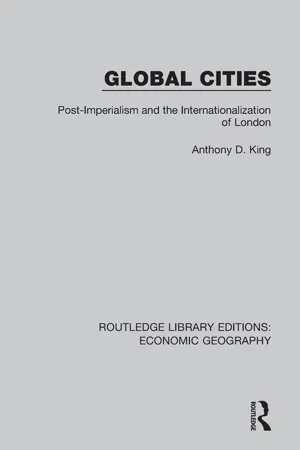
Since the late 1970s the role of key world cities such as Los Angeles, New York and London as centres of global control and co-ordination has come under increasing scrutiny. This book provides an overview and critique of work on the global context of metropolitan growth, world city formation and the theory it has generated. Suggesting 'post-imperialism' as the most appropriate framework for analysis, the author demonstrates the extent to which urban and regional development, both in Britain and elsewhere, were linked to a colonial mode of production, and highlights the effects of its disappearance. Against this background, the author charts the transformation of London from imperial capital in the nineteenth and early twentieth centuries to world city in the capitalist world economy of today.
- 206 pages
- English
- ePUB (mobile friendly)
- Available on iOS & Android
eBook - ePub
Global Cities
Part One
CITIES AND THE WORLD-ECONOMY
Chapter One
INTRODUCTION
Cities and the world-economy1
GLOBAL PARADIGMS IN URBAN RESEARCH
The 1980s have seen a major paradigm shift in urban studies. The study of urbanization and the city has, like other phenomena, been directly linked to developments in the world-economy, the term ‘global’ becoming as common in book titles (on the global shift, global restructuring, global factory) as in the financial sections of newspapers. Theories of and studies on world or global cities (Cohen, 1981; Friedmann and Wolff, 1982; Friedmann, 1986), described by Feagin (1985) as ‘the, cotter pins holding the capitalist world-economy together’ include work on Los Angeles, New York, Tokyo/Osaka/Ngoya, London, and Säo Paulo. The global context of metropolitan growth provides the framework for studies of, among others, Houston, Detroit, Buffalo, and, at a more popular level, Miami, Coral Gables, Paris, and Honolulu (Allman, 1983; Cooke, 1986b; Dickens, 1986; Feagin, 1985; Glickman, 1987; Grunwald and Flamm, 1985; Hall, 1984; Heenan, 1977; Henderson and Castells, 1987; Hill and Feagin, 1987; King, 1984ab; Kowarick and Campanario, 1986; Perry, 1987; Rimmer, 1986; Ross and Trachte, 1983; Sassen-Koob, 1984; 1985; 1986; 1987; Smith and Feagin, 1987; Soja, Morales, and Wolff, 1983; Soja et al. 1985; Soja, 1986; Thrift, 1986b; 1987a; Trachte and Ross, 1985; Weaver and Richards, 1985).
In Urbanization in the World-Economy (Timberlake, 1985), the fifteen co-authors examine the book’s theme in relation to different regions in the world. And from a more historical viewpoint, drawing on Wallerstein’s (1987) world-system perspective, the effects of the historical incorporation of cities into the world-economy are discussed in relation to Latin America (Browning and Roberts, 1980; Meyer, 1986; Pang, 1983; Portes and Walton, 1981; Salinas, 1983; Slater, 1986), with a growing number of studies on Europe, Asia, and Africa (Armstrong and McGee, 1985; Chaichian, 1988; Chase-Dunn, 1985; Drakakis-Smith, 1986; 1987; Ewars, Goddard, and Matzerath, 1986; Henderson and Castells, 1987; McGee, 1986).
Other studies discuss the urban effects of the globalization of producer services (Daniels, 1986; Thrift, 1986ab); yet others (King, 1984a; Robertson and Lechner, 1985) the globalization of culture (from religion to aesthetics), the concept described by Robertson as ‘the processes by which the world becomes a single place’. This refers both to the recognition of ‘a very high degree of interdependence between spheres and locales of social activity across the entire globe’ and, perhaps more importantly, ‘the growth of consciousness pertaining to the globe as such’ (Robertson, 1985: 348; see also Robertson, 1987; 1988; 1989).
Whilst these global perspectives on cities were already foreshadowed in the early 1970s (e.g. by Castells, 1977; Harvey, 1973; Wallerstein, 1974; Walton, 1976), this major shift in paradigms in the mid-1980s poses at least two questions. First, what changes are seen to have taken place in the objective, external world that account for this reorientation in urban research? Second, given that these objective changes have been taking place for at least three decades and, in the longer term, over three centuries or more, why has this theoretical and conceptual understanding of urban development gained currency only from the 1980s and not before? Why has the term ‘global’ assumed a new urgency? For example, in regard to the worldwide nature of economic activity, The Economist was advising its readers thirty years ago that ‘today, more than ever before, exporters must plan globally, especially in view of the growing importance of the world’s new markets’ (5 October 1957); likewise, according to the Oxford English Dictionary (1984), the term ‘globalization’ had entered the vocabulary at the latest by 1962.
We shall deal with the second question first.
URBAN POLITICAL ECONOMY: AN HISTORICAL AND SPATIAL CRITIQUE
The ‘new urban studies’ (or urban political-economy approaches) revolutionized the understanding of and research on urbanization and urban development in the 1970s and 1980s. Drawing on the early work of Harvey and Castells, Walton clearly sets out some of the characteristics of this approach:
1. Urbanism and urbanization could not simply be taken for granted but required definition and explanation; they must assume the status of ‘theoretical objects’ in the sense that they arise (or do not) and take different forms under various modes of social and economic organization and political control.
2. The approach of the new urban studies is concerned with the interplay between relations of production, consumption, exchange, and the structure of power manifest in the state.
3. Actual or concrete urban processes, for example, ecological patterns, community organization, economic activities, class and ethnic politics (and one could add physical and spatial urban form, including architecture and urban design: author) must be understood in terms of their structural bases or how they are conditioned by the larger economic, political and socio-cultural milieu.
4. The approach is essentially connected with social change and sees this as growing out of conflicts among classes and status groups. Changes in the economy are socially and politically generated as well as mediated.
5. The perspective of the new urban studies is tied to the concerns of normative theory (of how things ought to be), concerned with both drawing out the ideological and distributional implications of alternative positions but also being critically aware of its own premisses.
(Walton, 1984: 78)
Yet with some notable exceptions (including Castells, Harvey, Roberts, Slater, Walton, and others) much of the new urban political economy (including urban social theory) has, as was argued in King (1989b), also been characterized by temporal, spatial, and conceptual restrictions; temporal, in the restricted historical dimension within which urban development is frequently analysed; spatial, in that despite recognition of (or in some cases, lip service paid to) the international context, national boundaries have too frequently been used to define the limits of a given urban system; and conceptual, in that relatively little attention has so far been given to the built environment, either as additional data for understanding social change and urban development, or, indeed, as a significant factor in influencing these phenomena. Whilst these comments may apply to the understanding of cities and urbanization in many countries, the following arguments draw particularly on urban studies in and of the UK.
The increased attention given to the global context of urban growth in the 1980s serves to emphasize its earlier neglect, a neglect not only of the historical but also of the geo-political context in which European and North American cities developed. One cause of this neglect has been the restricted focus of many studies in urban political economy on the problems of cities in the ‘developed’ economies of Europe and North America, as has recently been acknowledged (Harloe, 1987) and the (unstated) assumption that these could somehow be conceptualized separately from the rest of the world. The fact is that from the mid-1970s, the observable phenomena of a global system of production made their presence felt in two ways. The first was in the growing consciousness that with the expansion of multinational production (generally, though erroneously seen to have developed from the 1950s (see Dunning, 1983), jobs were being lost to countries where labour was cheaper (Blackaby, 1979; Singh, 1977; Portes and Walton, 1981). The second, and more visible factor was the high profile acquired by international labour migration (‘immigrants’, ‘guest workers’ (Castle and Kosack, 1978; Frobel, Heinrichs, and Kreye, 1980)), and the urban riots of 1980–1.
Among those concerned with urban development in the UK, these were some of the factors behind the increasing interest in ‘the world outside’, an interest that appears to have gathered momentum at this time: Massey (1986b), for example, dates this perspective from the Community Development Projects of 1977. Prior to this date, and even later, few studies on urbanization and urban development in Britain, whether in urban history, geography, sociology, or the ‘new’ urban political economy, paid much attention to this perspective as the journals and textbooks produced at this time will confirm (e.g. Cannadine and Reeder, 1982; Dyos and Wolff, 1973; Pahl, 1970; Fahl et al., 1983; Peach et al., 1978; Robson, 1973; Saunders, 1981). The work of Roberts (1978ab) is the major exception. Robson, for example, though recognizing the effects of international trade on urban growth in England and Wales, none the less undertakes his analysis on the assumption that these two countries form ‘a closed system’ (Robson, 1973: 46). ‘Urbanization in developing countries’ was treated as a distinct and separate phenomenon from ‘British urbanization’ or, in cases, seen as a process that bore historical comparison to British experience, a view that has persisted into the 1980s (e.g. Johnson and Pooley, 1982). Whichever the viewpoint, the two were not seen as part of the same process. Thus, comments such as ‘the periphery nations of Latin America, Asia, and Africa now become an accessible and seemingly inexhaustible reservoir of cheap labour’ (Hill, 1984: 131, emphasis added) overlook the fact that millions of workers in those countries had, through indentured labour, the encomienda system, or simply as part of a colonial-plantation economy, formed part of the international division of labour for centuries. As in Wolfs study (1982), these are ‘the forgotten people of Europe’. Smith and Feagin’s recent suggestion (1987: 5) that urban development can best be understood ‘by analysing cities in terms of their transnational linkages, especially their connections with the world capitalistic economy’ is not only an agenda for the present (and future) but points up the inadequacy of our understanding of urban development in the past (and much urban policy analysis in the UK has been flawed for failing to recognize this (see King, 1986a; Thrift, 1985).
In short, one answer to the earlier question as to why there has been a sudden interest in globally oriented urban research in the 1980s is clear: only when the economic base of cities in ‘advanced economies’ at the core was affected, have many urbanists in those countries looked beyond national boundaries to the larger economic system that supported them. Yet the inhabitants of that ‘external world’ have long been aware that their own urban situation has been affected by core societies, except that this was seen as part of a larger process that went by another name — colonialism. Another answer is more prosaic: the academic realization that earlier explanations of urban growth and decline were too parochial and therefore, inadequate: the analysis required a deeper (historical) and broader (geographical) framework (see Harloe, 1987), which also went beyond traditional disciplinary boundaries.
Thus, whilst it is true that ‘something fundamental happened’ in the 1970s (Thrift, 1986b: 14) with major changes taking place in the organization of the world-economy (these are discussed in Chapter 2) equally significant has been a change in the perception and understanding of urban phenomena. Friedmann (1986: 69) attributes this to the ‘special achievement’ of Castells (1977) and Harvey (1973) in linking ‘city forming processes to the larger historical movement of industrial capitalism’. Yet it is only since 1980, according to Friedmann, that ‘the study of cities has been directly linked to the world economy’.
Whilst Friedmann’s (1986) statement may be correct in terms of its precise wording (his use of the word ‘directly’) it is also misleading: fundamental to the development of the world-economy and the world system in general was the emergence of modern industrial colonialism, the cities that it created and through which it operated. Hence, the study of cities as ‘directly linked to colonialism’ is the necessary prerequisite for understanding the development of cities as ‘directly linked to the world economy’. As indicated elsewhere (King, 1989b), most of the work cited by Friedmann in making his point is concerned with the impact of world economic processes on urban economies in the core states, especially in the USA. Earlier studies of colonial cities demonstrated the impact of industrial capitalism and world economic forces on city-forming processes (if not in the particular form or detail Friedmann (1986) implies) well before the date he suggests (e.g. McGee, 1967; Rayfield, 1974; see also King, 1989b).
However, equally important in the emergence of globally oriented urban research has been the selective adoption of the world-system paradigm (Wallerstein, 1974; 1979; 1984) and the erosion of disciplinary boundaries in urban research, particularly (and at the risk of caricature), between a more globally oriented ‘development studies’, previously focused on the periphery, and other academic disciplines previously focused on advanced industrial societies at the core (the division also relating to the work experience of practitioners in these fields); second, between social and spatial theorists (Gregory and Urry, 1985; Society and Space, 1983-). A third gap that has yet to be bridged is between social and spatial theorists and theorists of architecture and the built environment.
Other scholars, however (for example, Chase-Dunn, 1985: 273) do not see the recent changes noted by Cohen (1981) and Friedmann and Wolff (1982) as fundamentally new. Rather, trends that have been growing for the last 500 ye...
Table of contents
- Cover
- Half Title
- Title Page
- Copyright Page
- Original Title Page
- Original Copyright Page
- Table of Contents
- Dedication
- List of Tables
- Preface
- Acknowledgements
- Part One Cities and the World-Economy
- Part Two Imperial City: World City: Colonial City
- Appendices
- Notes
- Select Bibliography
- Name Index
Trusted by 375,005 students
Access to over 1.5 million titles for a fair monthly price.
Study more efficiently using our study tools.
Frequently asked questions
Yes, you can cancel anytime from the Subscription tab in your account settings on the Perlego website. Your subscription will stay active until the end of your current billing period. Learn how to cancel your subscription
No, books cannot be downloaded as external files, such as PDFs, for use outside of Perlego. However, you can download books within the Perlego app for offline reading on mobile or tablet. Learn how to download books offline
Perlego offers two plans: Essential and Complete
- Essential is ideal for learners and professionals who enjoy exploring a wide range of subjects. Access the Essential Library with 800,000+ trusted titles and best-sellers across business, personal growth, and the humanities. Includes unlimited reading time and Standard Read Aloud voice.
- Complete: Perfect for advanced learners and researchers needing full, unrestricted access. Unlock 1.5M+ books across hundreds of subjects, including academic and specialized titles. The Complete Plan also includes advanced features like Premium Read Aloud and Research Assistant.
We are an online textbook subscription service, where you can get access to an entire online library for less than the price of a single book per month. With over 1.5 million books across 990+ topics, we’ve got you covered! Learn about our mission
Look out for the read-aloud symbol on your next book to see if you can listen to it. The read-aloud tool reads text aloud for you, highlighting the text as it is being read. You can pause it, speed it up and slow it down. Learn more about Read Aloud
Yes! You can use the Perlego app on both iOS and Android devices to read anytime, anywhere — even offline. Perfect for commutes or when you’re on the go.
Please note we cannot support devices running on iOS 13 and Android 7 or earlier. Learn more about using the app
Please note we cannot support devices running on iOS 13 and Android 7 or earlier. Learn more about using the app
Yes, you can access Global Cities by Anthony King,Anthony D King in PDF and/or ePUB format, as well as other popular books in Physical Sciences & Geography. We have over 1.5 million books available in our catalogue for you to explore.