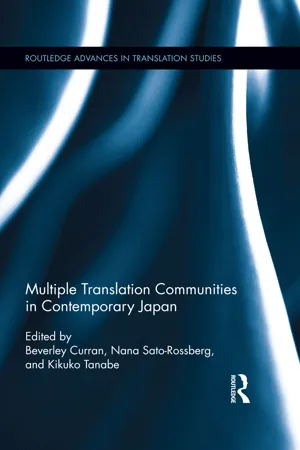
Multiple Translation Communities in Contemporary Japan offers a collection of essays that (1) deepens the understanding of the cultural and linguistic diversity of communities in contemporary Japan and how translation operates in this shifting context and circulates globally by looking at some of the ways it is theorized and approached as a significant social, cultural, or political practice, and harnessed by its multiple agents; (2) draws attention to the multi-platform translations of cultural productions such as manga, which are both particular to and popular in Japan but also culturally influential and widely circulated transnationally; (3) poses questions about the range of roles translation has in the construction, performance, and control of gender roles in Japan, and (4) enriches Translation Studies by offering essays that problematize critical notions related to translation. In short, the essays in this book highlight the diversity and ubiquity of translation in Japan as well as the range of methods being used to understand how it is being theorized, positioned, and practiced.
eBook - ePub
Multiple Translation Communities in Contemporary Japan
- 224 pages
- English
- ePUB (mobile friendly)
- Available on iOS & Android
eBook - ePub
Multiple Translation Communities in Contemporary Japan
About this book
1
Death Note
Multilingual Manga and Multidimensional Translation1
Introduction
In his 1959 essay “On Linguistic Aspects of Translation,” Roman Jakobson famously categorized translation as intralingual, interlingual, or intersemiotic, although translation has always bucked against the constraints of the three discrete classifications and their definitions. Paraphrase, as defined by Jakobson, is still an aspect of intralingual translation, but there is also the translation that takes place among different Englishes or the Japanese spoken in Osaka or Tohoku and, of course, among the language’s multiple writing systems. Interlingual translation, which Jakobson considered “translation proper” and now views as “translation in a narrow sense” (Spivak 2012, 243), may be complicated by codeswitching and the strategic use of linguistic detritus in cultural productions of all kinds. Intersemiotic translation no longer positions the printed word as the departure text, and multiple translations in different media are ubiquitous. The recognition of technology’s profound impact on the way we imagine, shape, produce and receive stories, or understand and interact with the world, displaces language as the sole focus of the translation process. Given the hybrid energies that constitute translation, theory and practice now require an awareness of how translation operates in intralingual, interlingual and intersemiotic terms—all at once. One of the most illuminating ways to approach translation in this way is through graphic narratives, which, as Hillary Chute has suggested, set “visual language in motion with and against the verbal” (2010, 3) as well as the unspoken, and create ‘frictional’ representations of space, time and movement through their panels and gutters. The performance of the complexities of translation, as well as how social anxiety is articulated through its restatement and circulation, are further foregrounded in works that are bi- or multilingual, such as the manga Death Note and its media translations. This chapter looks at examples of intralingual, interlingual and intersemiotic translations in and of Death Note to draw attention to some of the issues linked to the translation of multi-lingual texts found in more than one medium. In the process, the overlapping of cultural and technological locations unsettles any notion of Japan ‘proper’ in recognition that there are multiple versions of Japan that can be accessed and imagined from a number of different linguistic, cultural and technological locations.
Refinding in Translation
“Lost in translation” is a popular expression that registers a resistance to the change that is inevitable in all kinds of translation, as it is in our lives. In lieu of this notion of “loss,” the idea of “refinding” is perhaps a better description of what happens in translation, particularly when it is approached as a process that takes place in and among languages and media.
In “Three Contributions to the Theory of Sex,” Sigmund Freud observed, “[T]he finding of an object is in fact a refinding of it” (2005, 108). Freud was talking about how the relationship between infant and mother is played out in sexual terms with the object of desire, but ‘refinding’ is also an apt description of the queer task of translation and, in particular, the twinned narratives and languages that intertwine and connect in the Japanese manga Death Note, a collaborative work by writer Ohba Tsugumi and artist Obata Takeshi. The titular ‘death note’ is the found object located at the heart of the story. The notebook dropped to earth by the death god Shinigami Ryuk is written in English because where it lands is random and English is “the most popular language in the world.” In this encounter between the overlapping worlds of the shinigami and the human, the manga’s performance of multidimensional translation is a response to a question raised by Javier Sanjinés C. in the different context of Andean culture in contact with Spanish invaders: “How should we narrate a present into which some supernatural event has abruptly intruded?” (2013, 115).
The twelve-volume manga (and its 2006 supplement, “How to Use” [Vol. 13]) uses both Japanese and English in its narrative and visual representation of the ‘death note,’ and there are cinematic influences in the manga as well—Obata’s visual depiction of Ryuk is inspired by the hero of Tim Burton’s Edward Scissorhands (Ohba and Obata 2006, 13:185). A culturally hybrid image of the Japanese shinigami is not unique to Death Note; it has been noted that the image of the Japanese death god in the Meiji era has been shaped by Grimm fairy tales and Italian opera into a construction of wakonyosai, or Japanese spirit, Western technology (“Shosetsuya” 2005). Wakonyosai, which updated the term wakonkansai (Japanese spirit, Chinese technology) introduced by Sugawara Michiyoni (845–903) for use in modernity, encapsulates both the idea of “the dual architecture” of Japan’s modern identity as indigenous culture and imported technology and “the double bind of the Orient that has also become the West” (Sato 2007). A twenty-first–century cultural production like Death Note, however, is located in a different Japan, which has become globally synonymous with high technology in a networked era in which cultural differences “are produced by the acts of consumption in which one participates” (Sato 2007) and where media use is integral to understanding cultural change.
Death Note has been retold in published translations and fanlations; an anime series on TV (directed by Araki Tetsuro, it ran in Japan from October 2006–June 2007); two live-action films, both directed by Kaneko Shūsuke, starring Fujiwara Tatsuya; a novel based on the series by Nishio Ishin; and video games. Each of these cultural productions, in different ways, is highly conscious of the complex interaction of word, image and different forms of media and the ways knowledge is constructed, accessed and circulated. We keep refinding the story, and although the narrative seems familiar even when encountering this particular work for the first time, there is a ‘network of desire’ among what Linda Hutcheon (2006) has called ‘knowing audiences’ who recognize the work is being retold and welcome versions “to oscillate in [their] memories” (120) with the version currently being experienced.
Retelling and repetition are an integral part of the pleasure and appeal of adaptation, where “the real comfort lies in the simple act of almost but not quite repeating, in the revisiting of a theme with variations” (Hutch-eon 2006, 114). However, there are certain narratives that circulate over time and space as “unfinished cultural business” (116); there is an obsessive return to or “incessant shuttle” (Spivak 2012, 241) between these stories and their embedded dreams or ethical questions to read them again and again. Such stories change through their refinding in a particular historical moment. Death Note is one of these stories, which iterates the longstanding ethical question of who has the right to kill while exploring the tensions between the secular and the supernatural. The circulation of these issues in popular culture identifies them as broad social concerns that remain unresolved.
Death Note: Its Multiple Locations
Yagami Light is a bright but very bored Japanese high school student, and the manga is about what happens to him when he finds the notebook dropped by Ryuk, a very bored shinigami, or death god. Light first uses the notebook out of curiosity, but when he realizes that writing someone’s name in the book causes that person to die, he decides to use the notebook to get rid of “all the people the world would be better off without.” His tactile engagement with the Death Note has a visual consequence: he can see the shinigami Ryuk. Nobody knows he is in possession of a Death Note, but the project turns him into a media celebrity, known as Kira (Killer). The public and the police are divided on how to deal with the mysterious killer, but a brilliant albeit eccentric detective known as L, who is intent on stopping the killing, seeks to identify him. Over the twelve volumes of the manga, the story becomes more and more complicated, and the rules of the Death Note keep expanding and constraining, but it consistently presents Japan as a location where the Japanese and English languages interact and where a mix of people are coming and going. As L announces when he calls on the help of the Japanese police to find out who is killing criminals, “Whether this is being carried out by a group or by an individual, it’s probable that they’re Japanese. And if not Japanese, that they are in Japan” (1: 69).
The manga Death Note can be critically located in several intersecting cultural contexts. It has been identified as an exemplary work of what self-described otaku critic Uno Tsunehiro has called the zero nendai sōzōryoku, or the imaginative power characteristic of the first decade of the twenty-first century. Unlike the socially withdrawn characters of 1990s manga narratives, Uno sees Yagami Light as someone who has never been alienated from society: he is a top student and a credit to his parents; his mother is interested in his academic success—the first time we meet her, she is waiting for test results—and his father is a high-ranking member of the police. His reaction to breaking social rules distinguishes Light as a zero-nendai hero: instead of being shocked by social transgression, he takes it for granted and is quick to assume as his personal project the reconstruction of society with the use of the shinigami’s Death Note (Uno 2008, 23). Uno sees Takami Kōshin’s novel Battle Royale (1990), later appearing as a manga and a film, providing a proto-narrative of Death Note: high school students have to pit themselves against each other in a game of survival. In the live-action film adaptation of Death Note, this narrative link is made explicit through the casting of Fujiwara Tatsuya, the star of the film Battle Royale, as Light.
In fact, the Death Note is composed of rules concerning its use, and the manipulation and use of those rules constitute a game for Light to prevent discovery of his actions and his identity. From an initial sense of precise, detailed rules that do not change, the rules of the Death Note seem to be under constant revision. The first image of the Death Note in Book 1 shows five rules written in English, with each glossed by a Japanese translation:
The human whose name is written in this note shall die.
This note will not take effect unless the writer has the person’s face in their mind when writing his/her name. Therefore, people sharing the name will not be affected.
If the cause of death is written within 40 seconds of writing the person’s name, it will happen.
If the cause of death is not specified, the person will simply die of a heart attack.
After writing the cause of death, details of the death should be written in the next 6 minutes and 40 seconds. (52)
This emphasis on following precise instructions and also having a heart attack as a default cause of death are other aspects of the narrative that follow the idea of a game.
Jolyon Barka Thomas (2012) also locates the manga in a specific historical context, connecting it to the growth of the trope of an evil cult in the years following the 1995 sarin attacks on the Tokyo subway, coordinated by the Aum Shinrikyo religious sect, which resulted in a dozen deaths and left many more physically injured and emotionally affected by an act of domestic terrorism. Thomas argues that Death Note reworks this trope, present in such manga as Yamamoto Naoki’s Believers and Urasawa Naoki’s Honkaku kagaku bōken manga nijusseiki shōnen (Genuine Science Adventure Manga: 20th Century Boys), to suggest that the ideas of a seemingly marginal cult could be found in the mainstream: “Death Note portrayed ‘cult’ behavior obliquely, treating the ‘Killer cult’ as a symptom of Light’s grandiose scheme rather than as an etiology of social malaise” (Thomas 2012, 146). Nevertheless, the boredom that afflicts both Light and Shinigami Ryuk can be read as a kind of ennui growing out of living in a meaningless world. Light pleases his parents and his teachers as a stellar student, but he finds no satisfaction in this status. Similarly, Ryuk’s motivation to drop the notebook stems from his boredom in the shinigami world. As he explains:

(27)
It might be a weird thing for a shinigami to say, but… I just didn’t feel like I was really alive. In actual fact, shinigami these days don’t have a lot to do. All they do is nap, or gamble. If they see you scribbling human names in your Death Note, they say, “What’re you working so hard for?” and laugh at you.
(27)
According to Carl Cassegård’s work on social movements, trauma and alternative spaces, the mid 1990s were a time when Japanese social critics were representing youth as both doomed and responsible for digging their own graves due to their erratic ideological volatility. Sites of disaster, such as the 1995 Great Hanshin Earthquake, had been chances for those who felt hopeless or withdrawn from society to make a contribution: as a volunteer in the disaster-hit area, Ueyama Kazuki explained that “the invisible ‘everyday’ had collapsed, which had oppressed and plagued me until that day. To me, it felt as if I was breathing for the first time in my life out of my own power and with my own lungs” (qtd. Cassegård 2014, 39–40). Light, a student with brilliant prospects, initially appears to be the antithesis of the s...
Table of contents
- Cover
- Title
- Copyright
- Contents
- Introduction
- 1 Death Note: Multilingual Manga and Multidimensional Translation
- 2 Literature and Theatre into Film: Shindō Kaneto’s Kuroneko
- 3 Translating Kamui Gaiden: Intergeneric Translation from Manga to Live-Action Film
- 4 The Revolution Cannot Be Translated: Transfiguring Discourses of Women’s Liberation in 1970s–1980s Japan
- 5 Catharine MacKinnon in Japanese: Toward a Radical Feminist Theory of Translation
- 6 Translating Queer in Japan: Affective Identification and Translation in the ‘Gay Boom’ of the 1990s
- 7 The Perils of Paisley and Weird Manwomen: Queer Crossings into Primetime J-TV via Telops
- 8 Translating Gendered Voices: From Tanizaki Junichirō’s Naomi to Yoshimoto Banana’s Kitchen
- 9 Hirai Teiichi, the Japanese Translator of Dracula and Literary Shape-shifter
- 10 Yun Dong-ju’s poetry in Japanese Translation
- Contributors
- Index
Trusted by 375,005 students
Access to over 1.5 million titles for a fair monthly price.
Study more efficiently using our study tools.
Information
Publisher
RoutledgeEdition
1Year
2015Print ISBN
9781138306110
9781138831704
Subtopic
LinguisticseBook ISBN
9781317567042
Frequently asked questions
Yes, you can cancel anytime from the Subscription tab in your account settings on the Perlego website. Your subscription will stay active until the end of your current billing period. Learn how to cancel your subscription
No, books cannot be downloaded as external files, such as PDFs, for use outside of Perlego. However, you can download books within the Perlego app for offline reading on mobile or tablet. Learn how to download books offline
Perlego offers two plans: Essential and Complete
- Essential is ideal for learners and professionals who enjoy exploring a wide range of subjects. Access the Essential Library with 800,000+ trusted titles and best-sellers across business, personal growth, and the humanities. Includes unlimited reading time and Standard Read Aloud voice.
- Complete: Perfect for advanced learners and researchers needing full, unrestricted access. Unlock 1.5M+ books across hundreds of subjects, including academic and specialized titles. The Complete Plan also includes advanced features like Premium Read Aloud and Research Assistant.
We are an online textbook subscription service, where you can get access to an entire online library for less than the price of a single book per month. With over 1.5 million books across 990+ topics, we’ve got you covered! Learn about our mission
Look out for the read-aloud symbol on your next book to see if you can listen to it. The read-aloud tool reads text aloud for you, highlighting the text as it is being read. You can pause it, speed it up and slow it down. Learn more about Read Aloud
Yes! You can use the Perlego app on both iOS and Android devices to read anytime, anywhere — even offline. Perfect for commutes or when you’re on the go.
Please note we cannot support devices running on iOS 13 and Android 7 or earlier. Learn more about using the app
Please note we cannot support devices running on iOS 13 and Android 7 or earlier. Learn more about using the app
Yes, you can access Multiple Translation Communities in Contemporary Japan by Beverley Curran,Nana Sato-Rossberg,Kikuko Tanabe in PDF and/or ePUB format, as well as other popular books in Languages & Linguistics & Linguistics. We have over 1.5 million books available in our catalogue for you to explore.