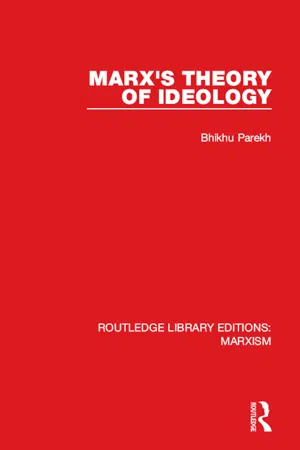
Although Marx's concept of ideology has been a subject of considerable discussion, much of the debate has proved to be rather disappointing. There has been no systematic attempt to examine why Marx needed the concept of ideology, why it was an important concept for him and how it related to his views on truth and objectivity. This book, first published in 1982, considers these and other neglected questions. It explains why Marx continued to use the term ideology throughout his life to mean both idealism and apologia and traces the complex ways in which, according to Marx, such talented writers as Hegel became apologists. In conclusion the book outlines the lessons Marx learnt from his investigations into the nature and mechanism of ideology and discusses his theories of objectivity and truth.
- 260 pages
- English
- ePUB (mobile friendly)
- Available on iOS & Android
eBook - ePub
Marx's Theory of Ideology
About this book
Trusted by 375,005 students
Access to over 1.5 million titles for a fair monthly price.
Study more efficiently using our study tools.
Information
Subtopic
Politics©1982 Bhikhu Parekh
Croom Helm Ltd, 2-10 St John’s Road, London SW11
British Library Cataloguing in Publication Data
Parekh, Bhikhu
Marx’s theory of ideology.
1. Ideology
I. Title
145 B823.3
ISBN 0-7099-0045-7
DOI: 10.4324/9781315713816
Printed and bound in Great Britain by
Biddles Ltd, Guildford and King’s Lynn
Biddles Ltd, Guildford and King’s Lynn
CONTENTS
- Introduction
- 1 Ideology: Idealism and Apologia
- 2 The Concept of Apologia
- 3 Base and Vulgar Writers
- 4 Hegel
- 5 Classical Political Economy
- 6 The Forms of Ideological and Critical Thought
- 7 The Proletarian Point of View
- 8 Marx’s Theory of Truth
- 9 Some Reflections
- Notes
- Bibliography
- Index
To Pramila
Introduction
Marx’s theory of ideology charts a hitherto unexplored epistemological terrain. In the course of his study of such thinkers as Hegel, the young Hegelians and the classical economists, and the past and present societies, Marx discovered a distinct form of reasoning about man and society. It was ahistorical and universalistic in form, systematically biased in its orientation, justificatory in its implications, and involved distinct logical fallacies. Marx was struck by the fact that this pervasive and mistaken form of reasoning had never before been noticed and exposed. Following the contemporary usage he called it ideology, and characteristically invested the term with a new range of meanings. He analysed its logical structure, identified its characteristic fallacies and proposed an alternative form of reasoning about man and society. For him ideology was not an abusive slogan to be used to discredit the opponents, nor a general term describing any organised body of beliefs, but a theoretical concept, an epistemological category designed to conceptualise a specific form of thought.
Like all intellectual explorers Marx had great difficulty articulating his discovery in unambiguous terms. He formulated it in different idioms and gave conflicting accounts of it in different writings. He made exaggerated claims for it, and overlooked many a difficult problem raised by it. Above all he confused the phenomenon he had discovered with the others that looked like it, but were, in fact, very different. 1 As we shall see, throughout his life Marx used the term ideology to mean both idealism and apologia. He evidently thought that the two were logically connected, that idealism led to apologia and the latter required idealism as its necessary epistemological basis, but never clarified the nature of the connection. Similarly he thought that ideology and what has since come to be called the social determination of knowledge were closely connected, but remained unclear about the connection.
Since Marx did not offer an unambiguous statement of his theory of ideology, it has been interpreted in many different ways, some extremely dubious and implausible. For example, some commentators have maintained that for him, ideology refers to such things as illusory ideas, false ideas determined by class interests, class-conditioned thought, unfounded ideas manufactured at the prompting of an unconscious wish or interest, and a body of justificatory beliefs. Apart from the fact that there is little textual evidence to support these crude views, which generally rely on some careless remarks in the German Ideology, they reduce a highly complex theory to a slogan, and destroy its historical integrity. Since most criticisms of Marx’s theory of ideology are based on such interpretations, they miss the target and are grossly unfair to him. Again, several commentators have argued that Marx was a relativist, rejected the concept of objective truth in favour of class truth, and inconsistently claimed to have offered an objective knowledge about the human history in general and capitalism in particular. Although the criticism is one of the commonest, there is little textual evidence to support it. What is more, Marx cannot be a relativist. Relativism is a form of absolutism. It singles out a specific factor and turns it into an absolute. Since Marx’s theory of ideology was primarily designed to undermine all forms of absolutism, it can have nothing to do with relativism either.
My purpose in the book is to articulate the logical structure and epistemological basis of Marx’s theory of ideology. Since Marx’s theory of ideology is somewhat ambiguous and confused, an exposition of it is necessarily an interpretation, and any interpretation is necessarily a form of collaboration. In order to highlight its logical structure, I have felt it necessary to develop arguments he left inchoate, draw distinctions he only hinted at, and articulate his targets and presuppositions more fully than he did. This may sound arrogant, but it is not. Marx developed many fascinating ideas which he did not have the energy, will or time sufficiently to distinguish and defend. If his Capital were to be excluded, he has left behind little more than clusters of brilliant insights. Like Rousseau and Nietzsche, he never systematically worked them out, and tended to express them in striking epigrams and arresting casual remarks requiring sustained reflection in order to squeeze out their full philosophical significance. This may partly explain why the brief first part of the German Ideology and a couple of pages of Theses on Feuerbach have inspired a greater body of literature than the three bulky tomes of Capital put together. Like all creative writers Marx requires sympathy and help; sympathy in order to enter into his world of thought in its own terms, and help to enable him fully to articulate, refine and bring out the full theoretical power of his insights. Without either, a commentator is in danger of getting distracted by his ambiguities, confusions, inadequate arguments and exaggerated claims, and unfairly dismissing his whole system of thought as a ‘philosophical farrago’. 2 A systematic critique and transcendence of Marx’s thought is long overdue, but it cannot be undertaken without a full appreciation of both his greatness and limitations.
The structure of the book is dictated by the structure of its subject matter. The first chapter outlines and explains the two basic senses in which Marx uses the term ideology. Of the two the second, namely an apologetic body of thought, is of central interest to us, and the continuing concern of the rest of the book. Accordingly the second chapter examines the concept of apologia, elucidates its basic characteristics and assumptions, and specifies what Marx does and does not mean by ideology. The next three chapters outline Marx’s analyses of the different ways in which the theorists of society became the apologists of the established social order; in the sixth, I collect together some of the important conclusions of Marx’s analyses. In the next chapter I explore how, in Marx’s view, he could avoid becoming an apologist, and assess the widespread view that he was able to do so by analysing the capitalist society from the proletarian point of view. In the eighth chapter I discuss some of the important ways in which he modified the traditional theories of truth, and outline the basic features of his own. In the final chapter I briefly and somewhat tentatively sketch some of the fundamental insights and limitations of Marx’s theory of ideology.
To avoid misunderstanding I might make three points. First, I am primarily interested in exploring the ways in which, in Marx’s view, the social theorists become ideologists, and only incidentally in his account of the way an ideology gains dominance in society. That the ordinary men should entertain ideological beliefs is explained with relative ease. The difficult and puzzling question is why, in Marx’s view, the ideas of such highly sophisticated thinkers as Hegel and the classical economists retained an ideological dimension. Second, I am not concerned to attack or defend, but simply to understand Marx’s theory of ideology. The theory has created considerable upheaval, especially in the disciplines relating to man and society. It is therefore worth exploring what it meant to its creator, and how he himself proposed to deal with its disturbing implications. Accordingly I have concentrated on laying bare its logical structure and basic assumptions as sympathetically as possible, and avoided commenting on them. Third, since I am only interested in Marx, I have generally avoided Engels’s writings except when necessary to illuminate the obscure points in his friend’s thought. This is not because I share the view that he misunderstood or vulgarised Marx, but solely because I am interested in what Marx himself thought and wrote.
In the composition of the book, I have incurred many debts. The first draft of it, with a slightly different focus, was prepared some years ago. I am most grateful to Professor David McLellan and Dr R.N. Berki for commenting on it and making most valuable suggestions. I have greatly benefited from my years of discussions with them. I am grateful also to Sir Isaiah Berlin, Professor Joseph O’Malley, Dr John Gray and the late and much missed John Rees for discussing with me several parts of it and offering most helpful comments. Finally, I am grateful to Mr David Croom for bearing with the slow progress of the book with considerable understanding and patience.
Bhikhu Parekh
Table of contents
- Cover
- Routledge Page
- Halftitle Page
- Copyright Page
- Title Page
- Copyright Page 1
- Contents
- Dedication
- Introduction
- 1 Ideology: Idealism and Apologia
- 2 The Concept of Apologia
- 3 Base and Vulgar Writers
- 4 Hegel
- 5 Classical Political Economy
- 6 The Forms of Ideological and Critical Thought
- 7 The Proletarian Point of View
- 8 Marx’s Theory of Truth
- 9 Some Reflections
- Notes
- Bibliography
- Index
Frequently asked questions
Yes, you can cancel anytime from the Subscription tab in your account settings on the Perlego website. Your subscription will stay active until the end of your current billing period. Learn how to cancel your subscription
No, books cannot be downloaded as external files, such as PDFs, for use outside of Perlego. However, you can download books within the Perlego app for offline reading on mobile or tablet. Learn how to download books offline
Perlego offers two plans: Essential and Complete
- Essential is ideal for learners and professionals who enjoy exploring a wide range of subjects. Access the Essential Library with 800,000+ trusted titles and best-sellers across business, personal growth, and the humanities. Includes unlimited reading time and Standard Read Aloud voice.
- Complete: Perfect for advanced learners and researchers needing full, unrestricted access. Unlock 1.5M+ books across hundreds of subjects, including academic and specialized titles. The Complete Plan also includes advanced features like Premium Read Aloud and Research Assistant.
We are an online textbook subscription service, where you can get access to an entire online library for less than the price of a single book per month. With over 1.5 million books across 990+ topics, we’ve got you covered! Learn about our mission
Look out for the read-aloud symbol on your next book to see if you can listen to it. The read-aloud tool reads text aloud for you, highlighting the text as it is being read. You can pause it, speed it up and slow it down. Learn more about Read Aloud
Yes! You can use the Perlego app on both iOS and Android devices to read anytime, anywhere — even offline. Perfect for commutes or when you’re on the go.
Please note we cannot support devices running on iOS 13 and Android 7 or earlier. Learn more about using the app
Please note we cannot support devices running on iOS 13 and Android 7 or earlier. Learn more about using the app
Yes, you can access Marx's Theory of Ideology by Bhikhu Parekh in PDF and/or ePUB format, as well as other popular books in Politics & International Relations & Politics. We have over 1.5 million books available in our catalogue for you to explore.