This book examines violence in international affairs. Originally published in 1975, the two types of violence which the book focusses on are nuclear deterrence and international terrorism. The broader perspective in which the ISODARCO discussions took place was the recognition of the need for a new kind of world order and the international contributors reflect a wide variety of ideological perspectives.
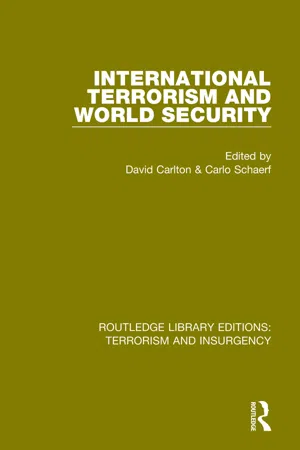
- 338 pages
- English
- ePUB (mobile friendly)
- Available on iOS & Android
eBook - ePub
International Terrorism and World Security
About this book
Information
PART I
INTERNATIONAL TERRORISM
1.INTERNATIONAL TERRORISM: A NEW MODE OF CONFLICT
Introduction1
Terrorism appears to have increased markedly in the past few years. Political and criminal extremists in various parts of the world have attacked passengers in airline terminals and railway stations; planted bombs in government buildings, the offices of multinational corporations, pubs, and theatres; hijacked airliners and ships, even ferryboats in Singapore; held hundreds of passengers hostage; seized embassies; and kidnapped government officials, diplomats, and business executives. We read of new incidents almost daily. Terrorists may strike citizens of another country while they are living overseas, in transit from one country to another, or at home in their own country. Terrorism has become a new element in international relations.
Defining Terrorism
When we talk about terrorism, what exactly are we talking about? The word has no precise or widely accepted definition. One noted lawyer has defined terrorism as acts which in themselves may be classic forms of crime – murder, arson, the use of explosives – but which differ from classic criminal acts in that they are executed ‘with the deliberate intention of causing panic, disorder, and terror within an organised society, in order to destroy social discipline, paralyse the forces of reaction of a society, and increase the misery and suffering of the community’.2 Two scholars in the United States have provided a somewhat broader definition of terrorism:
‘murder, assassination, sabotage and subversion, the destruction of public records, the spreading of rumor, the closing of churches, the sequestration of property, the breakdown of criminal law enforcement, the prostitution of the courts, the narcosis of the press – all these, as they contribute to a common end, constitute terror’.3
Without attempting to define terrorism in a way that will satisfy all lawyers and scholars, we may for the moment satisfy ourselves with the following description: the threat of violence, individual acts of violence, or a campaign of violence designed primarily to instil fear – to terrorise – may be called terrorism. Terrorism is violence for effect, not only, and sometimes not at all, for the effect on the actual victims of the terrorists: In fact, the victim may be totally unrelated to the terrorist’s cause. Terrorism is violence aimed at the people watching. Fear is the intended effect, not the by-product of terrorism. That, at least, distinguishes terrorist tactics from mugging and other common forms of violent crime that may terrify but are not terrorism.
Those we call terrorists may include revolutionaries and other political extremists, criminals professing political aims, and a few authentic lunatics. Terrorists may operate alone or may be members of a large and well-organised group. Terrorists may even be government agents. Their cause may have extreme goals, such as the destruction of all government – in itself not a new idea – or their cause may be one that is comparatively reasonable and understandable – self-rule for a particular ethnic group. Or their motive may be purely personal – money or revenge. The ambition of terrorists may be limited and local – the overthrow of a particular regime – or they may be global – a simultaneous worldwide revolution.
Promiscuous Use of the Term ‘Terrorism’
The problem of defining terrorism is compounded by the fact that terrorism has recently become a fad word which is used promiscuously and is often applied to a variety of acts of violence which are not strictly terrorism by definition. It is generally a pejorative. Some governments are prone to label as terrorism all violent acts committed by their political opponents, while anti-government extremists frequently claim to be the victims of government terror. What is called terrorism thus seems to depend on point of view. Use of the term implies a moral judgement, and if one party can successfully attach the label ‘terrorist’ to its opponent, then it has indirectly persuaded others to adopt its moral viewpoint. Terrorism is what the bad guys do.
The term ‘terrorism’ is also an attention-getting word and therefore tends to be used, especially in the news media, to heighten the drama surrounding any act of violence. What we have, in sum, is the sloppy use of a word that is rather imprecisely defined to begin with. Terrorism may properly refer to a specific set of actions the primary intent of which is to produce fear and alarm for a variety of purposes, which we shall discuss. But terrorism in general usage frequently is also applied to similar acts of violence – all ransom kidnappings, all hijackings, thrill killings, which are not intended by their perpetrators to be primarily terror producing. Once a group carries out a terrorist act, it acquires the label ‘terrorist’, a label that tends to stick, and from that point on, everything this group does, whether intended to produce terror or not, is also henceforth called terrorism. If it robs a bank or steals arms from an arsenal, not necessarily acts of terrorism but common urban guerrilla tactics, these too are described as terrorism. Eventually all similar acts by other gangs or groups also come to be called terrorism. At some point in this expanding use of the term, terrorism can mean just what those who use the term (not the terrorists) want it to mean – almost any violent act by any opponent.
The Theory of Terrorism
Terrorism is often described as mindless violence, senseless violence, or irrational violence. If we put aside the actions of a few authentic lunatics, terrorism is seldom mindless or irrational. There is a theory of terrorism, and it often works. To understand the theory, it must first be understood that terrorism is a means to an end, not an end in itself. In other words, terrorism has objectives, although those who carry out acts of terrorism may be so dedicated to violent action that even they sometimes seem to miss this point.
Unless we try to think like terrorists, we are also liable to miss the point, for the objectives of terrorism are often obscured by the fact that specific terrorist attacks may appear to be random, directed against targets whose death or destruction does not appear directly to benefit the terrorist’s cause. It is hard for us to understand how the killing of Olympic athletes in Munich or the hijacking of a Lufthansa airliner in Rome will ease the plight of Palestinians in the Middle East, or how blowing up an office in Manhattan will help topple a dictator in Latin America. But the objectives of terrorism are not those of conventional combat. Terrorists do not try to take and hold ground or physically destroy their opponents’ forces. Terrorists usually lack that kind of power, or having it, are constrained from applying it. We must be able to see beyond the apparent meaninglessness, sometimes even the tragic absurdity, of a single terrorist act to determine the objectives and the logic of terrorism.
While terrorists may kill, by our standards sometimes wantonly, and while they may threaten a lot of people, the objective of terrorism is not mass murder. Terrorists want a lot of people watching and a lot of people listening, and not a lot of people dead. A credible threat, a demonstration of the capacity to strike, may be from the terrorists’ point of view often preferable to actually carrying out the threatened deed, which may explain why, apart from the technical difficulties involved, terrorists have not done some of the terribly damaging and terrifying things they could do, such as poisoning a city’s water supply spreading chemical or biological agents, or other things that could produce mass casualties.
The Purposes of Terror
Terrorists attempt to inspire and manipulate fear to achieve a variety of purposes. Terrorism may be aimed simultaneously at several objectives: specific tactical objectives, made explicit by the terrorists, and broader strategic objectives, which may be implicit in the choice of tactics or targets. First, individual acts of terrorism may be aimed at wringing specific concessions, such as the payment of ransom, the release of prisoners, or the publication of a terrorist message, under threat of death or destruction. Terrorists may seek to improve their bargaining power by creating a dramatic hostage situation and thereby coerce a government into fulfilling certain demands.
Secondly, terrorism may also be aimed at gaining publicity. Through terrorism, the terrorists hope to attract attention to their cause and project themselves as a force that merits recognition and that must be reckoned with. The publicity gained by frightening acts of violence and the atmosphere of fear and alarm created cause people to exaggerate the importance and strength of the terrorists and their movement. Since most terrorist groups are actually small and weak, the violence they carry out must be all the more dramatic and deliberately shocking.
Terrorist attacks are often carefully choreographed to attract the attention of the electronic media and the international press. Taking and holding hostages increases the drama. If certain demands are not satisfied, the hostages may be killed. The hostages as individuals often mean nothing to the terrorists. Terrorism is aimed at the people watching, not at the actual victims. Terrorism is theatre.
To illustrate this point, let us take a recent example from the United States with which most people are familiar – the Symbionese Liberation Army (SLA). There seem to be two SLAs. One of them appeared on television or in the newspapers almost daily. Everyone has seen the seven-headed cobra symbol; thousands have listened to SLA tapes. An enormous number of police and FBI agents were mobilised to try to find it; it excited and entertained, if not terrified, the people of California. Then there is the other SLA – the real SLA. It once had a dozen or so members, now perhaps three. It has to its credit one murder, one kidnapping, a food distribution financed by and extorted from the family of a hostage, one bank robbery, and a few stolen cars – hardly a crime wave. The difference between the two SLAs is the difference between the actual amount of violence and the greatly amplified effects of that violence.
There are other examples in which terrorism has been used to magnify the importance of the cause and the stature of the group. Insurgents fought in Angola, Mozambique, and Portuguese Guinea for fourteen years using the standard tactics of rural guerrilla warfare. The world hardly noticed their struggle, while an approximately equal number of Palestinian commandos employing terrorist tactics have in a few years become a primary concern to the world.
Publicity may sometimes even exceed fear as the leading effect of a terrorist incident. The bombing of a bank or consulate at midnight, for example, may be a totally symbolic act that threatens no lives and produces little real damage. In a way, it is a violent form of graffiti, a declaration of existence, solidarity, or opposition; but since it is also a demonstration that the perpetrators are willing to resort to violence, and a warning of future violence, it does produce fear, though perhaps not terror, and, therefore, can be called terrorism.
Thirdly, terrorism may be aimed at causing widespread disorder, at demoralising society, and at breaking down the social order. This objective is typical of revolutionary, nihilistic, or anarchistic terrorists. Impatient at the reluctance of the ‘people’ – on whose behalf the revolution is to be carried out – to join them, terrorists may reject society’s normal rules and relationships as intolerable complacency. If the benefits of political obedience are destroyed; if the complacency of un-involvement is not allowed; if the government’s ability to protect its citizens (which is after all the origin and most basic reason for the existence of government) is demonstrated to be ineffectual; if the government can be made to strike back brutally but blindly; and if there is no place to hide in the ensuing battle, then, it is presumed, the ‘people’ will join the opponents of that government and a revolution will be carried out. Such a strategy often backfires. With no immunity from random terrorist violence, even sympathisers may turn against the terrorist violence, and the terrorists, and support the government’s moves to destroy them.
Fourthly, terrorism may be aimed at deliberately provoking repressions, reprisals, and counter-terrorism, which may ultimately lead to the collapse of an unpopular government. In the past, such terrorism has frequently been directed against government security and law enforcement personnel, but there are also examples of deliberately outrageous acts, the kidnapping of a foreign diplomat for example, or random violence against civilians designed to embarass a government and compel it to react with a heavy hand. The government may thus be induced by the terrorists into a course leading to self-destruction.
Fifthly, terrorism may also be used to enforce obedience and cooperation. This is the usual purpose of state or official terrorism, or what is frequently called ‘institutional violence’, but terrorists themselves may also employ institutional violence against their own members to ensure their loyalty. The outcome desired by the terrorists in this case is a prescribed pattern of behaviour: obedience to the state or to the cause, and full cooperation in identifying and rooting out infiltrators or enemies. The success of such terrorism again depends on the creation of an atmosphere of fear, reinforced by the seeming omnipresence of the internal security apparatus. As in other forms of terrorism, terrorism which is aimed at enforcing obedience contains elements of deliberate drama: defectors are abducted or mysteriously assassinated; dissidents are arrested at midnight; people disappear; and stories (often real) spread of dungeons, concentration camps, and torture. And as in other forms of terrorism, the objective is the effect all this has on the target audience. However, enforcement terrorism seldom chooses victims at random and does not seek widespread publicity, especially at the international level.
Sixthly, terrorism is frequently meant to punish. Terrorists often declare that the victim of their attack, whether person or object, is somehow guilty, or is the symbol of something the terrorists consider guilty. A person may be judged guilty because he has committed some crime himself – actively opposed, disobeyed, or informed upon the terrorists – or because he has tacitly cooperated with a guilty party. ‘Cooperated’ is often interpreted rather broadly to mean that the individual worked for, tacitly supported, accepted a visa from, or travelled on the national carrier of an enemy government. Victims of terrorists also have been chosen because their success in business of their life-style represented a system despised by the terrorists. Objects or buildings have been destroyed because they were symbols of a despised government, institution, or system.
There is, in terrorism, a stronger connotation of guilt and pun...
Table of contents
- Cover
- Half Title
- Title Page
- Copyright Page
- Original Title Page
- Original Copyright Page
- Table of Contents
- Preface
- Summary of Proceedings: Our Violent Future
- Part One: International Terrorism
- Part Two: The Arms Race
- Part Three: European and Middle East Security
- Part Four: Peace Teaching and the Study of Conflict
- Contributors
- List of Course Participants
Trusted by 375,005 students
Access to over 1.5 million titles for a fair monthly price.
Study more efficiently using our study tools.
Frequently asked questions
Yes, you can cancel anytime from the Subscription tab in your account settings on the Perlego website. Your subscription will stay active until the end of your current billing period. Learn how to cancel your subscription
No, books cannot be downloaded as external files, such as PDFs, for use outside of Perlego. However, you can download books within the Perlego app for offline reading on mobile or tablet. Learn how to download books offline
Perlego offers two plans: Essential and Complete
- Essential is ideal for learners and professionals who enjoy exploring a wide range of subjects. Access the Essential Library with 800,000+ trusted titles and best-sellers across business, personal growth, and the humanities. Includes unlimited reading time and Standard Read Aloud voice.
- Complete: Perfect for advanced learners and researchers needing full, unrestricted access. Unlock 1.5M+ books across hundreds of subjects, including academic and specialized titles. The Complete Plan also includes advanced features like Premium Read Aloud and Research Assistant.
We are an online textbook subscription service, where you can get access to an entire online library for less than the price of a single book per month. With over 1.5 million books across 990+ topics, we’ve got you covered! Learn about our mission
Look out for the read-aloud symbol on your next book to see if you can listen to it. The read-aloud tool reads text aloud for you, highlighting the text as it is being read. You can pause it, speed it up and slow it down. Learn more about Read Aloud
Yes! You can use the Perlego app on both iOS and Android devices to read anytime, anywhere — even offline. Perfect for commutes or when you’re on the go.
Please note we cannot support devices running on iOS 13 and Android 7 or earlier. Learn more about using the app
Please note we cannot support devices running on iOS 13 and Android 7 or earlier. Learn more about using the app
Yes, you can access International Terrorism and World Security by David Carlton,Carlo Schaerf in PDF and/or ePUB format, as well as other popular books in Politics & International Relations & Military & Maritime History. We have over 1.5 million books available in our catalogue for you to explore.