While there is no shortage of studies addressing the state's regulation of the sexual, research into the ways in which the sexual governs the state and its attributes is still in its infancy. The Sexual Constitution of Political Authority argues that there are good reasons to suppose that our understandings of state power quiver with erotic undercurrents. The book maintains, more specifically, that the relationship between ideas of political authority and male same-sex desire is especially fraught. Through a series of case studies where a statesman's same-sex desire was put on trial (either literally or metaphorically) as a problem for the good exercise of public powers, the book shows the resilience and adaptability of cultural beliefs in the incompatibility between public office and male same-sex desire. Some of the case studies analysed are familiar ground for both political/constitutional history and the history of sexuality. The Sexual Constitution of Political Authority argues, however, that only by systematically reading questions of institutional politics and questions of sexuality through each other will we have access to the most interesting insights that a study of these trials can generate. Whether they involve obscure public officials or iconic rulers such as Hadrian and James I, these compelling fragments of queer history reveal that the disavowal of male same-sex desire has been, and partly remains, central to mainstream understandings of political authority.
eBook - ePub
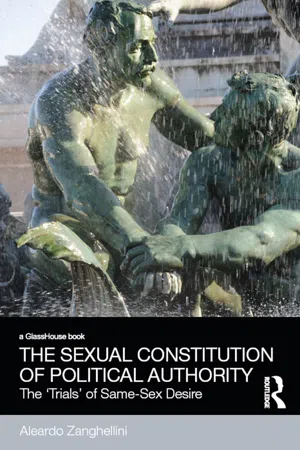
The Sexual Constitution of Political Authority
The 'Trials' of Same-Sex Desire
- 206 pages
- English
- ePUB (mobile friendly)
- Available on iOS & Android
eBook - ePub
About this book
Chapter 1
Antiquity: Eros, lust and self-possessed government
Introduction
After a ten-year campaign that had taken him from the kingdom of Macedon through Asia Minor, Egypt, Mesopotamia, Persia and across the Indus River into the westernmost part of India, in 325 BCE Alexander the Great unwillingly halted his eastward push – forced to turn back by his own exhausted and all but mutinous army (Plutarch, 1919: 309, 401). He split the troops into three parties, each following a different route back to Babylon. Alexander reserved for his own party the hazardous route through the parched expanse of the Gedrosian desert, in present-day Balochistan. During the desert march, countless of his followers fell to famine, exhaustion and disease. When the survivors reached the safety of a royal palace, Alexander held festivities and celebratory contests (Plutarch, 1919: 411, 413). Plutarch tells us that, on this occasion, the Persian eunuch Bagoas, who had attached himself to Alexander’s retinue following Alexander’s defeat of the Persian king Darius and who had become one of Alexander’s familiars and a favourite, won the singing and dancing contest. After processing through a thronged theatre, Bagoas took his seat next to Alexander, who at the instigation of a roaring Macedonian crowd publicly kissed him.1
Alexander’s affections, however, were not undivided. In Pella, he had grown up in close association with a Macedonian youth of noble birth, Hephaistion, who was his closest friend (Plutarch, 1919: 361; Diodorus, 1963: 223) and was to become one of his generals. Although it is almost certain that the two were lovers sharing physical intimacy (Renault, 1973: 408), none of the sources on Alexander’s life explicitly refers to them as such. In contrast, Curtius (1984: 127) expressly states that Bagoas had sexual relations with Alexander. The sources’ reticence about Alexander and Hephaistion’s relationship demands examination. I will suggest that this reticence can be explained in light of the distinctive ways in which a statesman’s same-sex desire was constructed as a problem for good government in antiquity.
An analogy can be drawn between Homer’s treatment of the relationship between Achilles and Patroclus and the way historical sources deal with Alexander and Hephaistion’s bond. Homer never expressly declares the erotic nature of the relationship between Achilles and Patroclus, but the ancients were clear about it (Cantarella, 1992: 10).2Aeschines (1919: 133), for example, states that the Athenians believed that ‘the friendship between Patroclus and Achilles … had its source in passion’ and argues that Homer ‘hides their love and avoids giving a name to their friendship, thinking that the exceeding greatness of their affection is manifest to such of his hearers as are educated men’ (142). Many contemporary commentators agree about the erotic nature of Achilles and Patroclus’ intense attachment (Cantarella, 1992: 9–10; Davidson, 2008: 256–260; Percy, 2006: 18–19). Ultimately, it is hard to imagine that anything other than the love of a lover could drive Achilles, following Patroclus’ death, to the distraction that makes him, in a spree of vengeance and spite, drag the corpse of Patroclus’ assassin, the Trojan hero Hector, behind his war cart three times around Patroclus’ tomb, leaving it lying facedown in the dirt (Homer, 1998: 589).
It would have pleased Alexander, who was a devotee of Homer (Plutarch, 1919: 301; Pearson, 1960: 10), to have the historians’ reticence about the erotic character of his relationship with Hephaistion compared with Homer’s discreet treatment of the love between Patroclus and Achilles. According to Arrian (1884: 396), the Macedonian king had had ‘an ambition to rival’ Achilles ‘from his boyhood’. This lends credibility to the report that – like Achilles stretching over Patroclus’ corpse and yearning for unity in death with him (Cantarella, 1992: 9–10) – Alexander ‘threw himself on [Hephaistion’s] dead body and lay there for the greater part of that day, bewailing him and refusing to depart from him until he was forcibly carried away’ (Arrian, 1884: 396). Befittingly ‘for the man who was the dearest to him in this world’ (Arrian, 1884: 396), Alexander arranged Hephaistion’s funeral so that, according to Diodorus, ‘[it] not only surpassed all those previously celebrated on earth but also left no possibility for anything greater in later ages’ (Diodorus, 1963: 445).
But the evidence of Alexander’s love for Hephaistion is not limited to the time after his death. Consider the report that, while marrying Stateira, the eldest daughter of the defeated Persian king Darius, Alexander had Hephaistion marry one of her sisters so their children could be first cousins (Arrian, 1884: 375). Another eloquent incident is when Alexander presented himself, accompanied by Hephaistion, to Sisigambis, Darius’ mother. When she prostrated herself before Hephaistion, mistaking him for the Macedonian king, Alexander told her she had made no mistake, for Hephaistion too was Alexander (Arrian, 1884: 106; Diodorus, 1963: 223).3 Hephaistion fully reciprocated Alexander’s sentiments. Diodorus (1963: 457) records that when Alexander’s mother Olympia, out of jealousy, threatened Hephaistion in a missive, Hephaistion replied: ‘Stop quarrelling with us and do not be angry or menacing…. You know that Alexander means more to us than anything.’
In the face of all this evidence, why do the sources fall short of explicitly characterising Alexander’s friendship with Hephaistion using the vocabulary of erotic love – especially when they show no similar reticence with respect to Alexander’s relationship with Bagoas? What does this tell us about the ways in which Greek thought sexualised political authority? To be able to address these questions, we first need to take a close look at how same-sex sexuality was constructed in the ancient world. The points made in the next section will inform my analysis of the sexualisation of political authority in ancient Greece and Rome in the rest of the chapter.
Same-sex desire in the Graeco-Roman world
There is a substantial body of scholarship on same-sex desire in the ancient world. There are important differences, but also important similarities, between Greek and Roman attitudes. Scholars disagree to some extent on questions of detail, but all except those most invested in heteronormative projects (Finnis, 1994; Thornton, 1998) agree that same-sex desire in and of itself was socially acceptable in both Rome and Greece.
In Athens, the paradigmatic case of homoeroticism involved a ‘lover’ (erastes) and a ‘beloved’ (eromenos) (Robson, 2013: 38–57). The erastes was an adult male citizen and the eromenos a boy who would one day grow up to enjoy the privileges of citizenship in the city-state. While not all erastes/eromenos relationships need have been grounded in a desire for sexual intimacy, the very fact that the Greeks did not consistently differentiate between love and desire (Davidson, 2008: 35) indicates that normally the two were believed to go hand in hand. This potentially sexual relationship, however, was governed by a complex ethics (Foucault, 1998: 191). The erastes was required to court the eromenos who, in turn, was supposed to resist the suit until the erastes proved that his love was genuine and his intentions honourable. At that point it was acceptable for the eromenos to give in to physical intimacy – although Foucault (1998: 209) points out that the sources fail to elaborate on what particular sexual practices the eromenos could honourably consent to, probably because it was a matter of common knowledge. Some scholars (Cohen, 1991: 193–198) have suggested the eromenos was supposed never to give in, but Cantarella (1992: 18–20) argues that it is highly implausible for the Greeks to have been the only society to have developed a courtship practice with no rewards for the courtier.4Foucault (1998: 210–211, 222) suggests that where the injunction never to give in to sexual intimacy makes its appearance, it refers to sexual practices that would put the eromenos in a position of subordination, or feminised him. He adds, however, that the injunction is probably best understood as warning the boy against letting himself be passively manipulated in the relationship as whole. According to Davidson (2008: 78–88), it was age that was determinative: the legal age of consent was set at 18, and because the term ‘boy’ (pais) applied to everyone up to 19, pederastic (man-boy) relationships could legitimately involve sexual activity only during the very late stages of the eromenos’s boyhood. In addition to protecting the eromenos from being stigmatised as effeminate (Winkler, 1991: 186), the etiquette of pederastic bonds was bound up with the pedagogical function of these relationships, which were seen as a means by which eromenoi could be inducted into adult citizenship. This involved learning how to benefit the city in different ways, including through political participation (Percy, 2006: 15).
The erastes who scrupulously followed the etiquette of courtship in his pursuit of boys was idealised, at least in elite circles, as a paragon of moderation and self-restraint. Thus, not only was the pederastic relationship, in its idealised form, believed to enable the eromenos to flourish into a responsible citizen, but it also provided the erastes with fertile ground to cultivate and rehearse his personal virtues.5 Conversely, the extent to which same-sex relationships deviated from the logic of the pederastic paradigm determined the extent of their social reprehensibility. An eromenos who gave in easily or was eager for sexual intimacy showed an inability to properly conduct himself, evidenced by a disregard of the requirement to put the erastes’s love to the test (Cantarella, 1992: 19). An eromenos who sought material advantages – particularly money – out of physical intimacy with adult males, turned a socially valuable relationship into a mercenary affair and his moral integrity was compromised (Ferrari, 2002: 15).
The conventional view among historians of Greek sexuality is that once an eromenos reached adulthood, it was normally expected that he would break off the amorous relationship, and particularly sexual activity, with the erastes (Cantarella, 1992: 31–32).6 For Foucault it was at this point – when the eromenos reached adulthood – that the relationship might turn into philia. Philia was different from the erotic pederastic relationship that the couple had outgrown because it was a reciprocal bond between equal soulmates (Robson, 2013: 63). It is unclear to what extent the practice of same-sex relationships matched the theoretical expectation that former eromenoi and erastai now bonded in philia break off sexual relationships (Robson, 2013: 63). Once the boy reached adulthood at around 20, however, his sexual appeal – which had just peaked one or two years earlier (Davidson, 2008: 89) – was supposed to have declined. Furthermore, if it is true that sex was hierarchically organised around active and passive roles, it would have been inconsistent with the partners’ equal status in the context of adult philia if a former eromenos persisted in the passive role after coming of age (Boswell, 1991: 79).7 Finally, the former eromenos’s newly acquired adult age-set seemed to have required a new set of responsibilities – namely the courtship of boys in an erastes capacity, as well as, eventually, marriage (Cantarella, 1992: 31–32). Thus, the failure to give up sexual passivity after reaching adulthood could be seen as a failure to fully accept the rights and responsibilities of citizenship.
Davidson (2008) provides a somewhat different account. He argues that philia replaced the erastes/eromenos relationship not when the eromenos reached adulthood, but...
Table of contents
- Cover
- Half Title
- Series Page
- Title Page
- Copyright Page
- Dedication Page
- Contents
- Acknowledgments
- Introduction
- 1 Antiquity: Eros, lust and self-possessed government
- 2 The Middle Ages: Edward II’s favourites – One throne, two kings
- 3 The Early Modern Age: King James, effeminacy and spineless policy
- 4 The Victorian Age: The rhetorical conflation of homosexuality and poor government in the Cleveland Street and Dublin Castle scandals
- 5 Late Modernity: Homosexuality, disloyalty and falling below the standards of public life
- Conclusions
- Index
Frequently asked questions
Yes, you can cancel anytime from the Subscription tab in your account settings on the Perlego website. Your subscription will stay active until the end of your current billing period. Learn how to cancel your subscription
No, books cannot be downloaded as external files, such as PDFs, for use outside of Perlego. However, you can download books within the Perlego app for offline reading on mobile or tablet. Learn how to download books offline
Perlego offers two plans: Essential and Complete
- Essential is ideal for learners and professionals who enjoy exploring a wide range of subjects. Access the Essential Library with 800,000+ trusted titles and best-sellers across business, personal growth, and the humanities. Includes unlimited reading time and Standard Read Aloud voice.
- Complete: Perfect for advanced learners and researchers needing full, unrestricted access. Unlock 1.5M+ books across hundreds of subjects, including academic and specialized titles. The Complete Plan also includes advanced features like Premium Read Aloud and Research Assistant.
We are an online textbook subscription service, where you can get access to an entire online library for less than the price of a single book per month. With over 1.5 million books across 990+ topics, we’ve got you covered! Learn about our mission
Look out for the read-aloud symbol on your next book to see if you can listen to it. The read-aloud tool reads text aloud for you, highlighting the text as it is being read. You can pause it, speed it up and slow it down. Learn more about Read Aloud
Yes! You can use the Perlego app on both iOS and Android devices to read anytime, anywhere — even offline. Perfect for commutes or when you’re on the go.
Please note we cannot support devices running on iOS 13 and Android 7 or earlier. Learn more about using the app
Please note we cannot support devices running on iOS 13 and Android 7 or earlier. Learn more about using the app
Yes, you can access The Sexual Constitution of Political Authority by Aleardo Zanghellini in PDF and/or ePUB format, as well as other popular books in Law & Law Theory & Practice. We have over 1.5 million books available in our catalogue for you to explore.