This book brings together a carefully selected range of contemporary disciplinary approaches to new areas of Gothic inquiry. Moving beyond the representational and historically based aspects of literature and film that have dominated Gothic studies, this volume both acknowledges the contemporary diversification of Gothic scholarship and maps its changing and mutating incarnations. Drawing strength from their fascinating diversity, and points of correlation, the varied perspectives and subject areas cohere around a number of core themes — of re-evaluation, discovery, and convergence — to reveal emerging trends and new directions in Gothic scholarship. Visiting fascinating areas including the Gothic and digital realities, uncanny food experiences, representations of death and the public media, Gothic creatures and their popular legacies, new approaches to contemporary Gothic literature, and re-evaluations of the Gothic mode through regional narratives, essays reveal many patterns and intersecting approaches, forcefully testifying to the multifaceted, although lucidly coherent, nature of Gothic studies in the 21st Century. The multiple disciplines represented — from digital inquiry to food studies, from fine art to dramaturgy — engage with the Gothic in order to offer new definitions and methodological approaches to Gothic scholarship. The interdisciplinary, transnational focus of this volume provides exciting new insights into, and expanded and revitalised definitions of, the Gothic and its related fields.
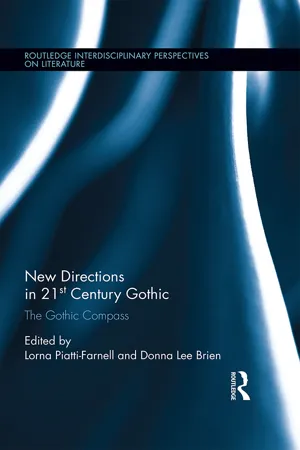
eBook - ePub
New Directions in 21st-Century Gothic
The Gothic Compass
- 238 pages
- English
- ePUB (mobile friendly)
- Available on iOS & Android
eBook - ePub
New Directions in 21st-Century Gothic
The Gothic Compass
About this book
Information
1 Gothic Affect
An Alternative Approach to Critical Models of the Contemporary Gothic
In the autumn of 2013, the British Film Institute launched its first ever gothic-themed season, which, its tagline promised, would take audiences to the “dark heart of film”. Intended as a “celebration of gothic film and TV,” BFI Gothic consisted of a series of screenings that included works as diverse as the German expressionist Nosferatu / Nosferatu, eine Symphonie des Grauens (F. W. Murnau, 1922) and the political Hispano-Mexican allegory Pan’s Labyrinth / El laberinto del fauno (Guillermo del Toro, 2006).1 It also featured talks by gothic scholars on topics as varied as the mad science of Eyes without a Face / Les Yeux sans visage (Georges Franju, 1959) or the vampire romance of the Twilight series (2008–2012), as well as interviews with renowned horror filmmakers such as George A. Romero and Dario Argento.2 An important part of the project was the publication of an accompanying compendium which announced the gothic to be a “trans-medial, genre-defying, migrating and polluting phenomenon” (Myrone 2013, 78). Apart from signalling an important investment in gothic as a distinctive sub/genre in film and television with an intellectual cachet and commercial viability, BFI Gothic seemed to also suggest a significant collapse of gothic and horror or, more appropriately, the acceptance that both have become intextricable.
Although it is difficult to quantify the success of the BFI Gothic season, all three screenings in the British Museum sold out and the season was covered by newspapers such as The Guardian, magazines such as Sight and Sound, and news websites such as BBC.co.uk. A second thematised season in 2014/2015, this time on science fiction, signals that the venture was profitable enough to guarantee a successor. The public and media interest in this gothic season points toward the social and scholarly opening up of the gothic in the late 20th and early 21st centuries. This mode is now ubiquitous in popular culture, from Twilight to the Living Dead Dolls or Monster High (2010–present), consistently present in media such as video games that had only tenuously been connected to it in the past and has, more importantly, experienced a sustained critical recuperation in academic circles since the 1990s and the foundation of the International Gothic Association and the Gothic Studies journal. The existence of contemporary and even postmillennial forms of the gothic are also no longer contested ground. On the contrary, given that the gothic is part of undergraduate and postgraduate degree provision in a number of universities (especially in Britain) and that 2013 saw the birth of the specialised Aeternum: A Journal of Contemporary Gothic Studies, it is safe to say that contemporary gothic is going through a phase of consolidation and institutionalisation.3 However, what this contemporary gothic is, how we recognise and define it, continues to be a subject of debate. Whilst some approaches focus on certain shared concerns, for example, an obsession with “interior entropy—spiritual and emotional breakdown” or “[t]he prospect of apocalypse,” and common themes, such as “horror, madness, monstrosity, death, disease, terror, evil, and weird sexuality” (McGrath and Morrow 1993, xii, xiv), a working definition has proven elusive. Paradoxically, we have reached a point where, as David Punter queried in 2009, the laxity and permeability of the term has led us to start asking, instead, whether there might be anything that “is not gothic” (Punter 2009).
In this chapter, I trace some of the most important developments in theorisations of the contemporary gothic and the representational and traumatic premises that have dominated it. Ultimately, my contention is that the purpose of the gothic—to scare, disturb, or disgust—has often been neglected and that this is detrimental to areas such as horror film or horror fiction, which commonly rely on corporeality or non-cognitive (somatic) or instinctive human reactions. Considering the gothic’s affective dimensions in isolation would not, in itself, provide a full picture of this artistic mode—such a picture is quite likely an impossibility, given the various and sometimes opposed methodologies used as key identifiers of gothic indexity. Instead, an affective approach suggests that the gothic is concerned with readerly effect and immersion and, thus, is more physically and physiologically invested than other models of contemporary gothic.
CONTEMPORARY GOTHIC: AESTHETIC-THEMATIC AND CATHARTIC-TRAUMATIC APPROACHES
Approximations to the notion of contemporary gothic were made initially by mapping out a “modern gothic”. This term served to establish the existence of such a genre or mode in the 20th century and thus to challenge the historicist view that it should be connected exclusively to what has been referred to as “first wave” gothic, roughly covering the period between the publication of Horace Walpole’s The Castle of Otranto (1764) and Charles Robert Maturin’s Melmoth the Wanderer (1820). The apparently oxymoronic partnering of “modern,” which evokes present times and a sense of progression, with “gothic,” generally connected to the return of the past and medieval Europe, paved the way for reconfigurations of the gothic beyond strict thematic boundaries or the reliance on a number of stock characters and tropes. David Punter was the first scholar to bring the gothic into the realm of the 20th century in his The Literature of Terror, which, in its 1980 edition, included a chapter that discussed writers such as Mervyn Peake, Isak Dinesen, Joyce Carol Oates, William Burroughs, Thomas Pynchon, and Angela Carter.4 The revised 1996 edition included new chapters on even more contemporary texts, such as Thomas Harris’ Red Dragon (1981), Iain Banks’ The Wasp Factory (1984), and Bret Easton Ellis’ American Psycho (1991). Punter noted that the term “gothic” had become increasingly more prevalent in the 20th century and gradually “acquired a new and extensive range of further meanings,” even if it was still possible to specify that it had retained its non-realistic or “broadly expressionist” component. In fact, Punter’s main conclusion is that “contemporary gothic” texts share a “relentless exposure of the paucity and deception of traditional criteria of realism” (1980, 373) and, thus, expose the “failure of accounts of the world and the mind predicated on the supremacy of objectivity” (400–1). Punter’s transhistorical survey would resonate with future studies of the gothic centred on specific time periods not traditionally associated with the gothic, such as modernism (see Riquelme 2008).
Victor Sage and Allan Lloyd Smith’s Modern Gothic: A Reader (1996) would later focus on the works of postmodern writers such as Angela Carter, Toni Morrison, Ramsey Campbell, Stephen King, and Ruth Prawer Jhabvala. In this collection, the editors explicitly attempted “to interpret the unmistakeable presence, through structural and verbal allusion, or wholesale rewriting, of the Gothic in some of the fictions of the postwar period” (Sage and Lloyd Smith 1996, 1). Crucial to this charting of the gothic, therefore, was the positioning of the “modern” as “postmodern,” and, therefore, as encompassing more than the first quarter of the 20th century. In fact, as Sage and Lloyd Smith argued, the gothic is particularly well suited to negotiate contemporary anxieties via postmodern stylistic twists and effects. An inevitable corollary of this stretching of the gothic to cover a larger part of the 20th century is the natural redefinition of the term. The gothic, thus, became less a marginal literary genre exposing the dark side of Romantic literature and more a “resistant strain” or “anonymous language” (Sage and Lloyd Smith 1996, 1) connected to a “‘camp’ recycling of the past” (4) that could be applied to different forms of media such as films and video games. The critical approximation of the gothic and the postmodern was further emphasised by Lloyd Smith in a chapter that identified a number of parallels powerfully and subversively connecting the two. Textual indeterminacy, self-reflexivity and the use of pastiche, the accentuation of paranoia, or the unspeakable and unrepresentable as motifs are only a few of the most relevant of the connections he identified (see Lloyd Smith 1996, 6–19, for examples).5
Ambiguity regarding the development of the gothic mode in the 20th and 21st centuries has also arisen, at least partly, from its dispersion across different media, a further reflection of its transhistorical, self-referential, and formulaic nature. A few publications have started to map out the gothic in the early years of the 21st century—see Cherry, Howell, and Ruddell (2010); Olson (2010); Nelson (2012). Since the methodology and tools used for analysing, for example, television series and novels are similar, although by no means the same, to those applied in the study of literature, this has also meant that research into specific areas, such as television, has spread rapidly (see Wheatley 2006; Jowett and Abbott 2013). As the gothic has fragmented and permeated popular culture, gothic criticism has needed to subdivide in order to contain and explore the many products and permutations ascribed to the mode. Selection and discriminatory processes could be seen as both inevitable and necessary, for, as the gothic becomes as inclusive a term as “postmodern” or “contemporary” and its components hard to taxonomise, the task of producing a study that could cover all manifestations of the contemporary gothic becomes unfeasible.
Faced with this situation, criticism of the contemporary gothic tends to follow two major approaches. The first of these prioritises certain aesthetic or thematic aspects and, in a materialist historicist vein, explores their potential for social commentary. This can take different guises and is inflected by the field in which the text is intended to make an intervention, some of the major areas being gender, sexuality, race, subcultural identities, and power structures. The work of Catherine Spooner, whose contributions in the area have been very influential, is perhaps the best example of this approach. Important to her formulation of the gothic as multimodal and transmedial is the ubiquity of a number of themes that are as pertinent to contemporary culture (late 20th and early 21st century in this context) as they were to post-Enlightenment Britain. These include:
the legacies of the past and its burdens on the present; the radically provisional or divided nature of the self; the construction of peoples or individuals as monstrous or “other”; the preoccupation with bodies that are modified, grotesque or diseased.
(Spooner 2006, 8)
Even though Spooner gestures to the fact that the gothic may be fast becoming “a set of discourses” (2007, 2), “imagery and narrative strategies” (2) are still prioritised in locating instances of the gothic in contemporary and postmillennial popular culture.
Related to this aesthetic-thematic approach is another that relies on theoretical frameworks. Although the principle is the same, the gothicity of the texts under investigation is determined by specific formulations as laid out by important contributions from philosophy and critical or literary theory that have been aligned with the gothic or that resonate with its preoccupations. These are then applied to the texts. For example, Derridean notions of “haunting” and “hauntology” have been used to structure parts of work on contemporary literature (Watkiss 2012) and gothic music (van Elferen 2012), and Paulina Palmer (2012) has focused on Sigmund Freud’s notion of the “uncanny” (“un/heimlich”) in her investigation of gay, lesbian, and transgender narratives.
Parallel to this aesthetic-thematic approach, a number of studies on the cathartic purpose of the gothic have emerged. These focus on the cultural need for the gothic and understand specific texts as negotiations or projections of social and political anxieties often repressed by subjects or by the nation in which they live (see Blake 2008). Unsurprisingly, these have often drawn on Trauma Studies or psychoanalytic theory, particularly Freud’s notion of the return of the repressed. Because the gothic helps us negotiate and deal with traumas that might otherwise lay buried or unresolved, critics such as Alexandra Warwick or Steven Bruhm have suggested that we crave and/or need this gothic experience. In their words, engaging willingly in the fictional process of trauma can “make us whole” (Warwick 2007, 11), for the gothic dramatizes the essential loss in the 20th century of “a coherent psyche” and “a social order to which we can pledge allegiance in good faith” (Bruhm 2002, 273). Although not always intended as a challenge to the aesthetic-thematic model, the cathartic-traumatic approach does question the use-value of “work[ing] towards identifying [a text] as Gothic, or identifying Gothic elements in an act of critical disclosure” (Warwick 2007, 7). In fact, as the work of Fred Botting has proposed, the goal might be to show how contemporary gothic has been emptied out of meaning in its favouring of surface over substance. In his view, the gothic becomes a form that exposes the bleak side of late capitalism, the black hole of consumer culture, and “the darkness of the postmodern condition” (2002, 281). Although the aesthetic-thematic and the traumatic-cathartic approaches are not necessarily exclusive and may even be used in conjunction, they use different aspects of the gothic as their starting points, namely its appearance (in the case of the former) and its function (in that of the latter).
In the new millennium, the gothic is no longer, as many have noted, “shackled to the conventional props of the genre” (McGrath and Morrow 1993, xiv), even if some enduring themes and images are still generally indicative of such a sensibility in some Western cultures. There is a sense that the gothic has indeed manifested profusely and consistently throughout the late 20th and early 21st centuries, although exactly how these phenomena may be unequivocally recognised beyond obvious intertextual references, direct borrowing, or plot continuation of texts that are part of the gothic canon is difficult to ascertain. As a result, isolated gothic tropes or characters—for example, the appearance of a ghost or a vampire in a larger narrative that makes no other concessions to the genre—may no longer be enough to grant a text the appellative “gothic”. The slipperiness of the term has led to confusion regarding what the gothic is and what it does. I am, here, not necessarily referring to the purpose identified by the “traumatic-cathartic” model but to a larger questioning of how the gothic works on its readers/viewers. Is it unclear, for example, whether a gothic text is meant to convey a type of feeling, set up a type of mood, or merely shock its consumers. It is, of course, possible that successful ...
Table of contents
- Cover
- Half Title
- Title Page
- Copyright Page
- Table of Contents
- Acknowledgements
- Introduction: The Gothic Compass
- 1 Gothic Affect: An Alternative Approach to Critical Models of the Contemporary Gothic
- 2 The Gothic Landscape of Tale of Tales Games: Unresolved Quests for Meaning
- 3 Adapting Gothic Literature for Animation
- 4 Rock Hard: Gargoyles in Contemporary Gothic Romance
- 5 Monster Mash-Ups: Features of the Horror Musical
- 6 Gothic 2.0: Remixing Revenants in the Transmedia Age
- 7 Cyberfangs: Online Communities and the Gothic Hypercharacter
- 8 Hypertext and the Creation of Choice: Making Monsters in the Age of Digital Textual (Re)Production
- 9 Writing ‘Lesbian, Gay-Type Lovers’: Buffy, Postmodern Gothic and Interruptions to the Lesbian Cliché
- 10 Unsettled and Destabilising Life Writing: The Gothic Memoir
- 11 Impersonating Spirits: The Paranormal Entertainer and the Dramaturgy of the Gothic Séance
- 12 “’Til Death Do Us Part”: A Reflection on Gothic-Inspired Trends in Contemporary Wedding Cake Decoration
- 13 Resurrection: A Gothic Revival in Irish Fine Art Practice
- Select Bibliography
- Contributors
- Index
Trusted by 375,005 students
Access to over 1.5 million titles for a fair monthly price.
Study more efficiently using our study tools.
Frequently asked questions
Yes, you can cancel anytime from the Subscription tab in your account settings on the Perlego website. Your subscription will stay active until the end of your current billing period. Learn how to cancel your subscription
No, books cannot be downloaded as external files, such as PDFs, for use outside of Perlego. However, you can download books within the Perlego app for offline reading on mobile or tablet. Learn how to download books offline
Perlego offers two plans: Essential and Complete
- Essential is ideal for learners and professionals who enjoy exploring a wide range of subjects. Access the Essential Library with 800,000+ trusted titles and best-sellers across business, personal growth, and the humanities. Includes unlimited reading time and Standard Read Aloud voice.
- Complete: Perfect for advanced learners and researchers needing full, unrestricted access. Unlock 1.5M+ books across hundreds of subjects, including academic and specialized titles. The Complete Plan also includes advanced features like Premium Read Aloud and Research Assistant.
We are an online textbook subscription service, where you can get access to an entire online library for less than the price of a single book per month. With over 1.5 million books across 990+ topics, we’ve got you covered! Learn about our mission
Look out for the read-aloud symbol on your next book to see if you can listen to it. The read-aloud tool reads text aloud for you, highlighting the text as it is being read. You can pause it, speed it up and slow it down. Learn more about Read Aloud
Yes! You can use the Perlego app on both iOS and Android devices to read anytime, anywhere — even offline. Perfect for commutes or when you’re on the go.
Please note we cannot support devices running on iOS 13 and Android 7 or earlier. Learn more about using the app
Please note we cannot support devices running on iOS 13 and Android 7 or earlier. Learn more about using the app
Yes, you can access New Directions in 21st-Century Gothic by Lorna Piatti-Farnell, Donna Lee Brien, Lorna Piatti-Farnell,Donna Lee Brien in PDF and/or ePUB format, as well as other popular books in Literature & Gothic, Romance, & Horror Literary Criticism. We have over 1.5 million books available in our catalogue for you to explore.