A unique and comprehensive study on social science research, this book highlights the status, issues, roadblocks and challenges of the field in India and certain select nations of the world. It conducts key cross-comparisons with existing literature in the area, and discusses aid policies and decisions, funding dynamics and quality of research as well as assessment systems in social science research.
eBook - ePub
Social Science Research in India and the World
- 218 pages
- English
- ePUB (mobile friendly)
- Available on iOS & Android
eBook - ePub
Social Science Research in India and the World
About this book
Information
1
Indian and International Social Science Research
Trends, Issues and Initiatives in Performance Orientation
Social Science Research (SSR) embodies the study of various societal systems, their constituents, patterns, behaviour, power structures and welfare aspects such as status of health, education, employment and others. One need not exemplify the inherent importance of this field and more so the role of the field for knowledge and inputs in various policies and decisions for the benefit of the society. Yet, there is a prevailing concern across countries of the world on the status it enjoys vis-à-vis the field of science, funding issues, concerns of necessary infrastructure and consideration in policy making. In this context, this chapter consolidates the trends in SSR across select countries of the world and documents the salient features of the trends existing thereof. The issues specific to this field in India are elaborated and a performance measurement framework is suggested for the SSR system in India.
Trends in SSR in Select Geographies
The World Social Science Report 2010 on the theme ‘Knowledge Divides’, presented a unique collection of information on the institutional and organizational aspects of social sciences, and on the various divides that characterize their production and use. The report highlights the enormous but skewed growth in social science production on society and on policy making, the continued fragmentation of social science knowledge and the globalization of social sciences despite the persistence of geographical and knowledge gaps in the social sciences map.
An important point brought out in the report on internationalization of SSR is the influence on the field’s mobilization in connection with global issues, both the type of research done, which will become more interdisciplinary, and the choice of research themes in different parts of the world. This phenomenon, while giving the potential for creating new knowledge domains, also poses newer challenges in research in social sciences. While it is appreciated that any field of research shall witness growth constantly, it is equally important to study the enablers in the system to promote such knowledge.
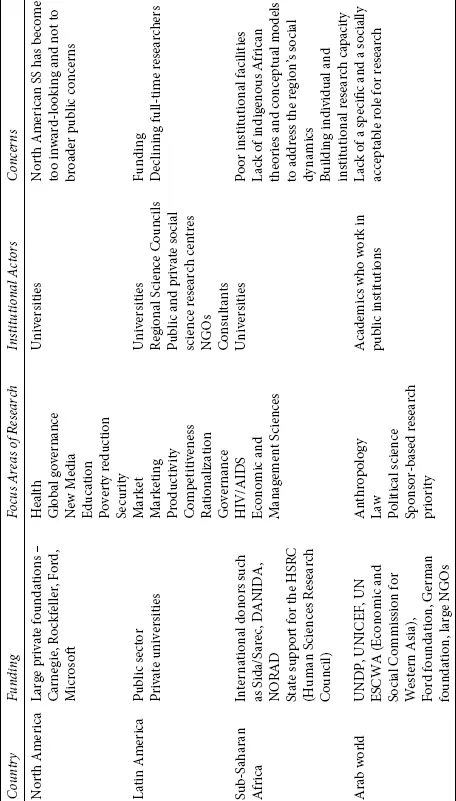
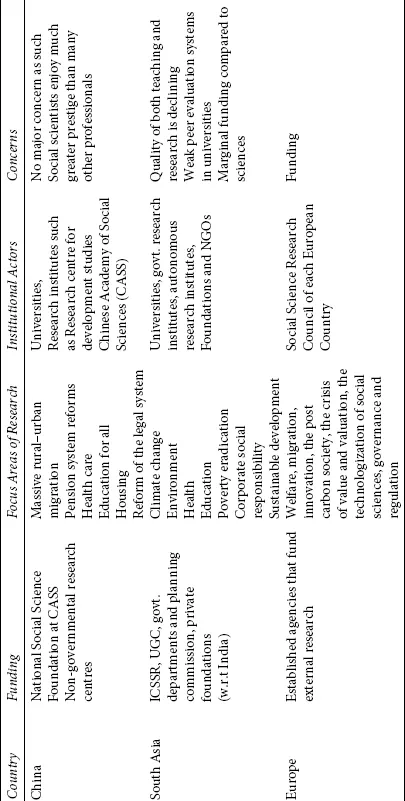
In this context, the geographies of North America, Latin America, Sub-Saharan Africa, Arab world, China, South Asia and Europe are studied in terms of funding, focus areas of research, institutional actors and major concerns of the country pertaining to SSR. The trends of SSR in these places are captured in a matrix in Table 1.1.
a. The major observations that emerge from the comparison of SSR trends in the geographies are as follows: Funding for SSR mainly comes from the government, universities, public/private sectors and foundations. The United States (US), Arab and European countries have relatively better access to funding from large foundations. Rest of the countries depend on the government/public predominantly. Funding, however, seems to be a universal concern and an issue in SSR.
b. Universities/SSR Councils are predominant institutional actors.
c. While funding SSR is a main concern, the quality of research, assessment systems and the prestige that SSR scholars carry are other issues highlighted by most of the countries studied. China however seems to be an exception to this phenomenon.
d. The basic topics of research in most of the places are health, education and employment, environment and climate change. An increasing orientation towards management studies, governance, technology, corporate social responsibility and sustainable development is found.
e. There seems to be a prevailing concern across these places on weak evaluation system of the field.
TABLE 1.1 TRENDS IN SSR IN SELECT GEOGRAPHIES
Source: Compiled by authors from the World Social Science Report 2010.
Gupta et al. (2009) document that, in social sciences, India ranks 13th among the top 26 productive countries with 1 per cent global publication share. Overall, the top 26 productive countries in social sciences have shown wide disparity in their global publication share, between 0.35 and 29.17 per cent of the cumulative world publication output during 1996–2007. The US tops the list with 29.17 per cent global publication share, followed by the United Kingdom (UK) with 9.84 per cent share. The countries that ranked at 3rd to 14th positions have shown disparity in their global publication share but on a narrow band, between 1 and 4.07 per cent (Table 1.2).
TABLE 1.2 GLOBAL PUBLICATION OUTPUT OF SOCIAL SCIENCE RESEARCH, 1996–2007
Publication Output, 1996–2007 | ||
Country | Rank | Global Publication |
USA | 1 | 29.17 |
UK | 2 | 9.84 |
Canada | 3 | 4.07 |
Germany | 4 | 3.58 |
Australia | 5 | 2.87 |
The Netherlands | 6 | 2.18 |
China | 7 | 2.16 |
France | 8 | 2.13 |
Japan | 9 | 1.62 |
Italy | 10 | 1.44 |
Spain | 11 | 1.36 |
Sweden | 12 | 1.03 |
India | 13 | 1.00 |
Israel | 14 | 1.00 |
Taiwan | 15 | 0.80 |
Switzerland | 16 | 0.80 |
Belgium | 17 | 0.77 |
Finland | 18 | 0.60 |
South Korea | 19 | 0.58 |
Demark | 20 | 0.49 |
Brazil | 21 | 0.48 |
Mexico | 22 | 0.47 |
Russia | 23 | 0.46 |
Turkey | 24 | 0.44 |
Austria | 25 | 0.42 |
Poland | 26 | 0.35 |
Source: Compiled from Gupta et al. (2009).
The World Social Science Report 2010 also enables the comparison of research output among the Latin American Countries (LAC), India and China. The Social Science Citation Index (SSCI), which brings together the world’s most-cited social science journals and covers 50 disciplines, reported a fourfold increase from 852 research papers in 1995 to 3,269 in 2007 including articles, conference papers, reviews, letters and notes from the LAC region.
Between 1995 and 2007 the increase in publications for Brazil ranged from 274 to 690, for Mexico from 248 to 581 and for Argentina from 92 to 239. When we compare these three countries with India and China and with LAC as a whole, China showed the most marked growth over the period, moving from being fourth of the five individual countries in 1995 to a predominant first position in 2007. India showed the smallest increase and drops from the first position of the individual countries in 1995 to third, behind China and Brazil, at the end of the period (World Social Science Report 2010).
In developing countries, social science research is considered to be primarily of local relevance and to impact only its immediate surroundings, making publication in national books and journals the main communication outlets. Nonetheless, a growing presence in the highly visible mainstream journals published predominantly in English indicates an increasing awareness that much of this research also has implications for the global scientific community.
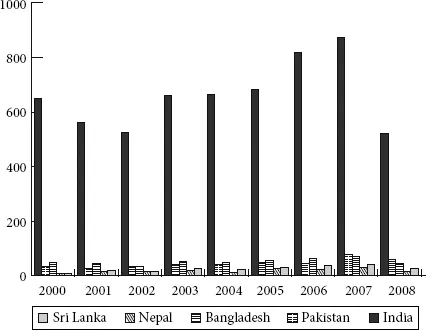
FIGURE 1.1 SOCIAL SCIENCE RESEARCH OUTPUT IN SOUTH ASIA
Source: Compiled by the authors from Arunachalam 2008.
The status of SSR in India is found to be better compared to other South Asian countries. If one takes a look at the data on the number of papers published from the five South Asian countries and indexed in SSCI and compare them with data on the number of papers from these countries indexed in Science Citation Index (SCI), it is observed that in all the five countries social science research is clearly seen to be a poor cousin of research in science and technology (Arunachalam 2008).
Except for India, none of the other countries studied have published more than 500 papers in nearly eight years in all of social sciences as seen from SSCI.

Social Science Research in India
The Indian Council of Social Science Research (ICSSR) is the nodal agency for SSR in India and was established by the Government of India on 19 July 1969 as an autonomous society registered under the Registration of Societies Act, 1860. This has been envisaged to be a premier body for promoting social science research in India, funded by the government, with the research agenda decided primarily by the social scientists themselves.
Disciplines in SSR in India
The following major categories of disciplines and interdisciplinary areas exist in India:
• Economics
• Political Science
• Psychology
• Sociology
• Women’s Studies
• Others (including, inter alia, Defence Studies, Geography, Music, Home Science Linguistics, Management, Education and Public Administration)
Issues in SSR in India
There are a number of pertinent issues with reference to the prevailing situation in India’s SSR activities beginning from attracting good research candidates to bringing out high-quality research publications. SSR in India has an institutional history for more than 40 years now. There are a number of Indian universities, the ICSSR established under the Ministry of HRD, Non-governmental Organizations (NGOs) and other research institutions working in various domains of social science research. However, there are unique challenges before all these entities. As Mukherjee (2011) observes
There are 3 sets of issues which are important for SSR to prosper under effective cooperation: quality of the persons who are choosing the academic profession; the organization of departments in universities and research institutes; the quality of administrators who help run these institutions.
All the three issues identified pose a challenge to SSR in India.
Attracting Good Research Talent
Availability of good candidates for appointment in universities and institutes at the faculty level and scholars with an inclination to research still remains a challenge. This is a concern in India where a steady inflow of good researchers is not available with the nature of remuneration in the academic profession being an additional attribute to this situation.
Sunder (2010) observes that while there are many high-quality PhD programmes in India preparing good scholars, a large number of the degrees are also granted to work of much lower creative, scientific or scholarly merit. The proliferation of low-quality programmes hurts the reputation of Indian scholars, research and PhD programmes, and is itself a barrier to attracting new talent into research careers. On the whole, Sunder observes that the quality of talent entering the faculty and PhD programmes is not high and in most disciplines talented students from the top half of the undergraduate or master’s class tend not to choose to pursue doctoral education or scholarly careers.
Another point to make is that the SSR findings are hardly considered in policy making which would be the ultimate use value coming out of research. As the ICSSR Report (2007: 20) observes
while the scale and range of social science research in the country have been expanding, the nature, scope and quality of research output, as well as its contribution to a bette...
Table of contents
- Cover
- Half Title
- Title Page
- Copyright Page
- Table of Contents
- List of tables
- List of figures
- Preface
- Introduction
- 1. Indian and International Social Science Research: Trends, Issues and Initiatives in Performance Orientation
- 2. Social Science in Switzerland: State of the Art and Perspectives
- 3. The Social Science Research in Thailand: Development, Constraints and Challenges
- 4. Social Science Research in Vietnam: Strategies, Issues and Prospects
- 5. Statistics and Public Administration
- 6. Social Science Research in India: Some Methodological Issues
- 7. Population and Development Challenges in Bangladesh
- 8. Connect Social Science Research to Public Policy: A Case of Thailand’s Local Initiatives 2003
- Notes on contributors
- About the editors
Trusted by 375,005 students
Access to over 1.5 million titles for a fair monthly price.
Study more efficiently using our study tools.
Frequently asked questions
Yes, you can cancel anytime from the Subscription tab in your account settings on the Perlego website. Your subscription will stay active until the end of your current billing period. Learn how to cancel your subscription
No, books cannot be downloaded as external files, such as PDFs, for use outside of Perlego. However, you can download books within the Perlego app for offline reading on mobile or tablet. Learn how to download books offline
Perlego offers two plans: Essential and Complete
- Essential is ideal for learners and professionals who enjoy exploring a wide range of subjects. Access the Essential Library with 800,000+ trusted titles and best-sellers across business, personal growth, and the humanities. Includes unlimited reading time and Standard Read Aloud voice.
- Complete: Perfect for advanced learners and researchers needing full, unrestricted access. Unlock 1.5M+ books across hundreds of subjects, including academic and specialized titles. The Complete Plan also includes advanced features like Premium Read Aloud and Research Assistant.
We are an online textbook subscription service, where you can get access to an entire online library for less than the price of a single book per month. With over 1.5 million books across 990+ topics, we’ve got you covered! Learn about our mission
Look out for the read-aloud symbol on your next book to see if you can listen to it. The read-aloud tool reads text aloud for you, highlighting the text as it is being read. You can pause it, speed it up and slow it down. Learn more about Read Aloud
Yes! You can use the Perlego app on both iOS and Android devices to read anytime, anywhere — even offline. Perfect for commutes or when you’re on the go.
Please note we cannot support devices running on iOS 13 and Android 7 or earlier. Learn more about using the app
Please note we cannot support devices running on iOS 13 and Android 7 or earlier. Learn more about using the app
Yes, you can access Social Science Research in India and the World by R. K. Mishra,Jayasree Raveendran,K. N. Jehangir in PDF and/or ePUB format, as well as other popular books in Social Sciences & Politics. We have over 1.5 million books available in our catalogue for you to explore.