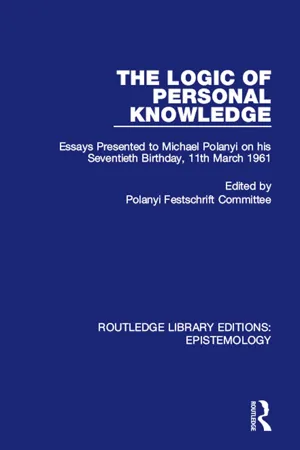
Originally published in 1961. Michael Polanyi was a polymath who influenced economics and the sciences as well as philosophy. His wide-ranging research in physical science is as well-known as his work on freedom and knowledge and his arguments against positivism and reductionism. This collection of essays written for him touches on all aspects of his influence but rotates around his published lectures Personal Knowledge: Towards a Post-Critical Philosophy. The contributors address four areas – The Scientist as Knower, Historical Perspectives, The Knowledge of Society and the Knowledge of Living Things.
eBook - ePub
The Logic of Personal Knowledge
Essays Presented to M. Polanyi on his Seventieth Birthday, 11th March, 1961
- 256 pages
- English
- ePUB (mobile friendly)
- Available on iOS & Android
eBook - ePub
The Logic of Personal Knowledge
Essays Presented to M. Polanyi on his Seventieth Birthday, 11th March, 1961
About this book
Trusted by 375,005 students
Access to over 1.5 million titles for a fair monthly price.
Study more efficiently using our study tools.
Information
Topic
PhilosophySubtopic
Philosophy History & TheoryPART ONE
The Scientist as Knower
Scientists … spend their lives in trying to guess right. They are sustained and guided therein by their heuristic passion. We call their work creative because it changes the world as we see it, by deepening our understanding of it. The change is irrevocable. A problem that I have once solved can no longer puzzle me; I cannot guess what I already know. Having made a discovery, I shall never see the world again as before. My eyes have become different; I have made myself into a person seeing and thinking differently. I have crossed a gap, the heuristic gap which lies between problem and discovery.
P.K., p. 143
2
An Index to Michael Polanyi’s Contributions to Science
MY father’s scientific interests have taken him into a substantially larger number of independent fields of research than is customary. This makes it difficult to follow his trail. A scientific bloodhound can follow him through a particular field. But today the well-adjusted hound is a specialist; if the quarry is an eclectic the scent is rapidly lost. It is hoped that the following summary, which lists his main contributions under four headings, will serve as a partial index to the scientific bibliography given later. Since the names of collaborators are to be found in the bibliography, to which cross references are given, these names have not always been repeated in the summary. I hope that this discourtesy will be forgiven.
Adsorption
1. A theory of adsorption (ref. 12, 1916).
This theory was critically received for the first thirty-five years after its publication, but has recently come into favour.
2. The application, made jointly with F. London (ref. 115, 1930), of the theory of dispersion forces to the additivity rules of the adsorption potential. These additivity rules had previously been postulated empirically by M.P.
3. Experimental observations made in the light of the theory (1., above) on the state of adsorbed vapours and crystalline solutes (refs. 92, 94, 1928).
4. Observation of very high heats of adsorption at low pressures (ref. 93, 1928). (Paralleled by H. S. Taylor and by others.)
Plasticity and Strength of Materials
1. Discovery of general hardening of single crystals (ref. 41, 1922).
2. Elucidation, following on experiments by Andrade, of the mechanism of gliding in metal crystals, particularly zinc (ref. 46, 1922).
3. Elucidation of the mechanism for tin crystals (ref. 52, 1923).
4. Discovery of hardening of single crystals against (a) gliding (ref. 48, 1922; 50, 1923; 62, 1924). (b) brittle rupture (ref. 60, 1924).
5. Discovery of ‘recovery’ in crystals (Refs. as in 4 (a)).
6. Discovery of the reversibility of the tendency towards recrystallization (ref. 105, 1928; 121, 1931).
7. Discovery of ‘fibre-structure’ in cold worked metal wires (refs. 35, 38, 40, 1921).
8. Determination of the structure for various classes of metals (refs. 35, 38, 1921).
9. Discovery of ‘recrystallization-structure’ (refs. 38, 1921).
10. First observation of the plasticity of crystals at low temperatures, down to liquid helium temperatures (ref. 113, 1930).
11. ‘Dislocation’ as an explanation of crystal plasticity (ref. 156, 1934). (Paralleled by G. I. Taylor.)
X-ray Analysis
1. Discovery (with Herzog) of ‘fibre structure’ in cellulose (ref. 27, 1920). (Paralleled by Scherrer.)
2. Elucidation of the ‘fibre diagram’ and determination of the elementary cell of cellulose; elimination of all but two types of chemical structures for cellulose (ref. 32, 1921).
3. Establishment (after preliminary experiments by Schiebold) of the ‘rotating crystal method’ for X-ray analysis of crystals. Discovery, in particular, of the ‘layer line relationships’ (ref. 45, 1922).
4. Determination by this method (3, above) of the structure of white tin (ref. 52, 1923).
5. Determination, with Brill, of the cell of silk protein (K. H. Meyer, ‘Natural and Synthetic High Polymers’ p. 446).
Reaction Mechanism
1. First theoretical explanation of an activation energy (H2 + Br2 reaction). (refs. 18, 19, 20, 21, 1920). (Paralleled by Herzfeld and Christiansen.)
2. (a) Theory of surface dissociation and consequent reduction of activation energy on solid catalysts (ref 34, 1921).
(b) The same conception expanded in terms of quantum mechanics (refs. 108, 1929; 124, 1932).
3. Rate of activation of a gas-reaction by collisions, calculated for the first time by the ‘many degrees of freedom formula’ now commonly applied to this problem (ref. 23, 1920).
4. Jointly with E. Wigner, the first formulation for a chemical molecule of the inverse relationship between stability and breadth of quantum state, which is now the basis of pre-dissociation theory. The same paper contains the postulate of Uncertainty for angular momentum (ref. 70, 1925).
5. Jointly with E. Wigner, the theory of the absolute rate of monomolecular reactions (ref. 97, 1928).
6. Jointly with H. Eyring, the calculation of activation energies and reaction mechanism by the energy surface method (ref. 118, 1931).
7. Atomic Reactions of Na Vapour.
(a) Invention of the highly dilute flame method (with Beutler and Bogdandy). Observations by this method include (i) measurement of the rates of a number of reactions occurring at every collision; (ii) discovery of a luminescence with a high yield and first elucidation of the precise atomic process of a chemiluminescence. (Sodium + chlorine luminescence had been discovered by Haber at a yield of perhaps 10−6 quanta per reacting molecule.)
(b) Invention of the ‘diffusion flame’ method (with v. Hartel). Observations by this method include rates of reaction of sodium with numerous organic halides.
(c) Invention of the ‘life period’ method (with L. Frommer) extended the range of measurable reactions. (References to this work are reviewed in ref. 131, 1932.)
8. The mechanism of negative substitution including the accompanying optical inversion (ref. 127, 1932). First kinetic analysis of racemization by atomic exchange (jointly with E. Bergmann) (ref. 136, 1933).
9. Racemization through electrolytic dissociation (optical instability of carbonium ion) first postulated and measured (ref. 142, 1933).
10. Jointly with Horiuti, the first observation of catalytic exchange reaction (water and deuterium on platinum) (ref. 145, 1933).
11. Jointly with Horiuti, the observation of catalysed exchange of deuterium with benzene; theory of the Half Hydrogenated State to explain exchange, hydrogenation and catalytic migration of double bonds (ref. 153, 1934).
12. First use of heavy oxygen for establishment of reaction mechanism (hydrolysis), with Szabo (ref. 150, 1934).
13. Method for calculating the activation energy of an ionic substitution reaction and of the reaction of sodium with organic halides; first derivation of parallelism between reaction heat and reaction rate of a ‘homologous’ series of reactions (ref. 168, 1935). Later elaborated with M. G. Evans.
14. With Horiuti, the theory of activation energy for prototropic reactions including cathodic discharge (ref. 176, 1935).
15. The above was later elaborated with M. G. Evans into a theory of Bronsted’s logarithmic linear relationship between equilibrium and rate constants (ref. 179, 1936).
16. With M. G. Evans, the discovery of a linear relationship between heat of solution and entropy of solution (ref. 179, 1936).
17. Jointly with M. G. Evans (ref. 169, 1935).
(a) A generalized form of Wigner’s ‘Transition State Method’ for calculating reaction rates.
(b) The thermodynamics of the Transition State in varying media.
(c) The postulate of intermediate position (between initial and final states) of transition state in regard to density and entropy.
(d) The theory of the effect of hydrostatic pressure on reaction rate.
In this list (a) was paralleled independently in a paper published earlier by Eyring; (b) was paralleled independently in a paper published later by Eyring and Wynne Jones.
18. Systematic measurements, conducted jointly with E. T. Butler, of the rates of pyrolysis of organic iodides have revealed a close parallelism of these with the corresponding rates of the sodium reaction. From this evidence (and other data) considerable variations of bond energy of saturated hydrocarbons were derived. These variations were theoretically explained and related to other properties. Part of this work was done jointly with E. C. Baughan, other parts jointly with E. C. Baughan and M. G. Evans (refs. 198, 199, 1940; 200, 1941; 205, 1943).
19. Investigation (with A. G. Evans and H. A. Skinner) of the mechanism of Friedel-Craft catalysed isobutene polymerization; the notion of ‘co-catalysis’ (refs 208, 210, 1946; 211, 212, 214, 215, 1947).
3
Polanyi’s Contribution to the Physics of Metals
METALLURGY is of particular importance today, above all because of the great significance for many branches of physics and technology of problems involving raw materials. Thanks to the co-operation of many outstanding workers it has entered in the last few decades upon a very rapid course of development, which is by no means finished. In the following pages I shall try to assess the work and significance of a man who was active in this field for only a few years and with limited experimental facilities, but who has left such clear traces that he must be numbered among the great pioneers of this science.
The road by which Polanyi came to metallurgical research is by no m...
Table of contents
- Cover Page
- Half Title page
- Title Page
- Copyright Page
- Original Title Page
- Original Copyright Page
- Contents
- Acknowledgements
- Prelude
- 1 The Hungary of Michael Polanyi
- Part One The Scientist as Knower
- Part Two Historical Perspectives
- Part Three The Knowledge of Society
- Part Four The Knowledge of Living Things
- Bibliography
Frequently asked questions
Yes, you can cancel anytime from the Subscription tab in your account settings on the Perlego website. Your subscription will stay active until the end of your current billing period. Learn how to cancel your subscription
No, books cannot be downloaded as external files, such as PDFs, for use outside of Perlego. However, you can download books within the Perlego app for offline reading on mobile or tablet. Learn how to download books offline
Perlego offers two plans: Essential and Complete
- Essential is ideal for learners and professionals who enjoy exploring a wide range of subjects. Access the Essential Library with 800,000+ trusted titles and best-sellers across business, personal growth, and the humanities. Includes unlimited reading time and Standard Read Aloud voice.
- Complete: Perfect for advanced learners and researchers needing full, unrestricted access. Unlock 1.5M+ books across hundreds of subjects, including academic and specialized titles. The Complete Plan also includes advanced features like Premium Read Aloud and Research Assistant.
We are an online textbook subscription service, where you can get access to an entire online library for less than the price of a single book per month. With over 1.5 million books across 990+ topics, we’ve got you covered! Learn about our mission
Look out for the read-aloud symbol on your next book to see if you can listen to it. The read-aloud tool reads text aloud for you, highlighting the text as it is being read. You can pause it, speed it up and slow it down. Learn more about Read Aloud
Yes! You can use the Perlego app on both iOS and Android devices to read anytime, anywhere — even offline. Perfect for commutes or when you’re on the go.
Please note we cannot support devices running on iOS 13 and Android 7 or earlier. Learn more about using the app
Please note we cannot support devices running on iOS 13 and Android 7 or earlier. Learn more about using the app
Yes, you can access The Logic of Personal Knowledge by Polanyi Festschrift Committee in PDF and/or ePUB format, as well as other popular books in Philosophy & Philosophy History & Theory. We have over 1.5 million books available in our catalogue for you to explore.