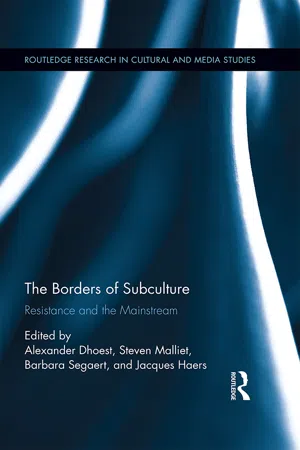
This book aims to revisit the notion of subculture for the 21st century, reinterpreting it and extending its scope. On the one hand, the notion of resistance is redefined and applied to contemporary practices of cultural production and entrepreneurship. On the other hand, contributors reconsider the connection of subcultures to everyday culture, exploring more mainstream forms of cultural production and consumption across a wider range of social groups. As a consequence, this book extends the scope to look beyond the white, male, adolescent, urban cultures identified with earlier subcultural studies. Contributors also examine fusions and crossovers between Western and non-Western cultural practices.
eBook - ePub
The Borders of Subculture
Resistance and the Mainstream
- 218 pages
- English
- ePUB (mobile friendly)
- Available on iOS & Android
eBook - ePub
The Borders of Subculture
Resistance and the Mainstream
About this book
Information
1 Contextualizing the Spectacular
DOI: 10.4324/9781315722733-2
The notion of subculture has come in for all sorts of criticism in recent decades yet is proving to be extraordinarily resilient. This chapter offers a reflection on some aspects of the development of subcultural studies in the light of ongoing criticisms and some alternative approaches. I focus, in particular, on suggestions that subcultural studies have been too exclusive in their emphasis on the spectacular. I suggest that such criticism ought to be taken on board but not only through greater focus on so-called “ordinary” young people. We might also pay more attention, I suggest, to the less spectacular aspects of subcultural participation itself, as well as to the broader lives of participants in subcultures. Such a focus can offer all manner of fruitful avenues for analysis, including the interplay between distinctive and the more everyday subcultural practices and the relationship between subcultural participation and work, family life or friendship patterns—both at any moment in time and throughout the life course. Such an orientation also offers possibilities for reconnecting subcultural studies with questions about broader socio-economic status and prospects.
Criticisms: Subculture to Post-Subculture?
Some of the most well-known criticisms of subcultural theory relate to the specifics of the approach taken by the Centre for Contemporary Cultural Studies (CCCS) in their examination of post-war subcultures—from teds, to mods, to skinheads and bikers—in the 1960s and 1970s (see Cohen, 1972; Hall & Jefferson, 1976). The work of the center was pioneering and also more sophisticated and diverse than it is sometimes given credit for (Blackman, 2005; Griffin, 2011) but, for many, the core of the best-known writings on subculture suffered from a number of flaws. Criticisms center on the interpretation of subcultural styles as a form of Gramscian cultural resistance whereby young working class people responded to the contradictions and subjugation they faced by adopting subversive, spectacular styles that semiotically “resolved” these structural problems and enacted a cultural struggle against hegemonic power. For many critics, such an interpretation seemed to impose on young people’s practices a particular form of neo-Marxist interpretation and placed insufficient emphasis on the empirical experiences and understandings of young subculturalists themselves (Clarke, 1981). It is also suggested the CCCS offered little to no empirical account of the emergence of subcultures, that their analysis was overly centered on social class as a deterministic explanation (Bennett, 1999) and that it rendered the experience of young girls invisible (McRobbie & Garber, 1976).
In addition, it is argued that the CCCS over-estimated the clarity and fixity of subcultural boundaries and gave insufficient consideration to the many young people who were partially or fleetingly involved, or associated with more than one subculture (Bennett, 1999; Muggleton, 2000). This connects to a broader criticism of the notion of subculture itself. The concept, it is suggested, has always presented an overly clear-cut, fixed, and collectivized understanding of the relationship between young people’s style and identity. Together with a rejection of the CCCS’ class-centered explanation, it is this criticism that underpins the development of what some have termed “post-subcultural theory,” characterized by an emphasis on fluidity, individualized identities and loose-knit collectivities, rather than fixed, bounded and class-based subcultures in the relationship between young people, popular music and style (Bennett, 1999, 2011; Bennett & Khan-Harris, 2003; Muggleton & Weinzeirl, 2004). The extent to which such fluidity and individualism in youth cultures represents a recent development born from the expansion and diversification of media and consumer culture, as opposed to a feature that was always present, remains an unresolved point of contention.
Beyond Spectacular Youth?
Post-subcultural theory also sometimes included calls to place greater emphasis on the cultural practice of “ordinary” young people rather than only the most noticeable or spectacular (Laughey, 2006). In this respect it highlighted one of the most important criticisms of subcultural theories—that the latter have always placed too much emphasis on the activities of the spectacular, deviant or unusual minority, leaving the cultural identities, practices, and strategies of the majority of young people largely invisible. For Gary Clarke (1981), one of the CCCS’s biggest problems was that it interpreted subcultures as a solution to working class problems but excluded typical working class youth from an analysis that took spectacular style as its starting point:
The fundamental problem with Cohenite subcultural analysis is that it takes the card-carrying members of spectacular subcultures as its starting point and then teleologically works backwards to uncover the class situation and detect the specific set of contradictions which produced the corresponding styles. … If we reverse the methodological procedure … we have to examine the whole range of options, modes of negotiation, or “magical resolution”… that are open to, and used by, working-class youth. (pp. 82–83)
Yet, for all the criticism of subcultural theory, some are unconvinced that post-subcultural theory and research have managed to develop a more inclusive approach to the study of youth cultures. Though it may emphasize the fluidity, complexity, and, sometimes, individualism of youth identities, post-subcultural theory is singled out by Shildrick and MacDonald (2006) for its excessive fascination with spectacular minority styles, musics and associated practices:
[T]he post-subcultural equation of youth culture with the stylistic exploits of minority music/ dance “scenes” and “neo-tribes”—at the expense of the cultural lives and leisure activities of the “ordinary” majority,—is in danger of producing a distorted and incomplete portrayal of contemporary youth culture. (p. 128)
The criticism is perhaps a little broad-brush and, as Paul Sweetman (2014) points out, it actually amounts to a denunciation of the whole of subcultural studies rather than post-subcultural theory specifically. Nevertheless, it probably remains the case that in-depth studies (whether “post-subcultural” or not) of youth, leisure and style that focus broadly across the range of young people, rather than on those whose tastes and practices are the most intensive or noticeable, can be overshadowed by studies of spectacular music or style groups. For Shildrick and MacDonald, this partly reflects an increasing tendency for young academics who have been members of distinctive youth music scenes to carry out “insider” studies of such groups for their doctoral studies, something that may also carry the risk of bias towards particular middle class forms of youth culture.
Nevertheless, there is a very substantial and increasing body of work focused upon youth cultures in a broader sense. Classic examples include McRobbie’s seminal examination of the cultures of ordinary teenage girls (1991), Jenkins’ study of “lads, citizens and ordinary kids” in Northern Ireland (1983) and Willis’ examination of the everyday creativity of “common culture” (1990). There is an increasingly wide range of more recent work too, to the extent that it is hard to single out examples. To mention just a few, we might note Laughey’s inclusive study of music tastes and identities based on inclusive, school-based research (2006), Lincoln’s ongoing work on youth and private space (2012), current research by Cantillon (2014) into mainstream clubbing and a wide-ranging body of work on youth and media (boyd, 2013; Osgerby, 2004).
That it would be desirable to further develop and expand this broader focus on “ordinary” youth cultures is obvious. Yet this need not signal the end of the road for subcultural studies as such. There remains considerable value in studying those young people who do adopt apparently unusual, spectacular, deviant or defiant forms of cultural identity. It goes without saying that such young people often constitute a minority but this is partly what makes it important to understand them, whether in terms of the motivations and consequences of becoming involved, the ways they are labeled or understood by the rest of society, the nature and consequences of their practices, the ways their participation is lived and felt, their relationship to networks of communication and commerce, the ways they challenge (or reinforce) dominant forms of ideology or the complex relations within and between groups.
Moreover, while post-subcultural theories may have usefully identified the fluidity, complexity, dynamism and individualism apparent in many young people’s musical and stylistic identities, this should not prevent us from identifying and examining the operation and significance of distinctive, committed, and defiant communities where they exist (Blackman, 2005). Debates over terminology, meanwhile, will always have their place but can become overly distracting. For all the limitations and controversies surrounding it, I am among those who have continued to regard subculture as an appropriate and well-recognized term to describe substantive, distinctive and committed youth leisure or style groupings. No concept is perfect and my interest here is in proceeding beyond arguments about terminology towards further discussions about how such groupings work and with what significance.
Spectacular Aspects of Subculture
Yet asserting the continued value of studying subcultures does not entirely resolve the aforementioned criticism about a tendency in subcultural and post-subcultural theory to focus too much attention on the spectacular, the deviant or the noticeable. For, in my understanding, this criticism is not limited to the question of what kinds of young people or youth grouping are studied, but also pertains to how those who do come under the microscope are examined and the kinds of understandings that are consequently generated concerning such groups and the individuals that make them up. Put simply, it may be argued that subcultural studies as a whole has had a tendency to focus its attention too exclusively on the most spectacular elements of subcultural life.
For example, while the CCCS may be criticized by some for focusing so much attention on subcultures at all, it is also noteworthy that, in coming to their conclusions about such groups, they relied largely on semiotic interpretations of fixed, idealized versions of spectacular style. The workings and importance of subcultures and the various identities, narratives and contexts involved often became reduced to the most externally visible or obvious textual features. As I have noted elsewhere, recent analyses of Goth culture seem also to have been reliant primarily on the analysis of spectacular style and cultural texts (Siegel, 2005; Van Elferen, 2011, 2012). An understanding of the specifics of subcultural music, film and style constitutes a valuable contribution to the understanding of youth cultures and, in this respect, such scholarship has much to offer. Yet, if taken as representative of subcultures in a broader sense, analyses centered primarily on spectacular sounds, texts or style may prompt us to read too much into these spectacular specifics and, in the process, to develop explanations that do not place those aspects that are the most distinctive, deviant or subversive in the context of a more rounded understanding of subcultural life (Hodkinson, 2012).
Similar issues may emerge for another useful approach to the study of subcultures being developed, one that focuses on understanding the affective and bodily significance of what we might term signature subcultural experiences, from the intensity of listening to particular forms of music to activities such as dancing, drug-taking, skating, or surfing, to having one’s body pierce...
Table of contents
- Cover Page
- Half-Title Page
- Series
- Title Page
- Copyright Page
- Table of Contents
- Introduction
- 1 Contextualizing the Spectacular
- Part I Exploring New Ground
- Part II Revisiting Old Ground
- Contributors
- Index
Trusted by 375,005 students
Access to over 1.5 million titles for a fair monthly price.
Study more efficiently using our study tools.
Frequently asked questions
Yes, you can cancel anytime from the Subscription tab in your account settings on the Perlego website. Your subscription will stay active until the end of your current billing period. Learn how to cancel your subscription
No, books cannot be downloaded as external files, such as PDFs, for use outside of Perlego. However, you can download books within the Perlego app for offline reading on mobile or tablet. Learn how to download books offline
Perlego offers two plans: Essential and Complete
- Essential is ideal for learners and professionals who enjoy exploring a wide range of subjects. Access the Essential Library with 800,000+ trusted titles and best-sellers across business, personal growth, and the humanities. Includes unlimited reading time and Standard Read Aloud voice.
- Complete: Perfect for advanced learners and researchers needing full, unrestricted access. Unlock 1.5M+ books across hundreds of subjects, including academic and specialized titles. The Complete Plan also includes advanced features like Premium Read Aloud and Research Assistant.
We are an online textbook subscription service, where you can get access to an entire online library for less than the price of a single book per month. With over 1.5 million books across 990+ topics, we’ve got you covered! Learn about our mission
Look out for the read-aloud symbol on your next book to see if you can listen to it. The read-aloud tool reads text aloud for you, highlighting the text as it is being read. You can pause it, speed it up and slow it down. Learn more about Read Aloud
Yes! You can use the Perlego app on both iOS and Android devices to read anytime, anywhere — even offline. Perfect for commutes or when you’re on the go.
Please note we cannot support devices running on iOS 13 and Android 7 or earlier. Learn more about using the app
Please note we cannot support devices running on iOS 13 and Android 7 or earlier. Learn more about using the app
Yes, you can access The Borders of Subculture by Alexander Dhoest,Steven Malliet,Jacques Haers,Barbara Segaert in PDF and/or ePUB format, as well as other popular books in Social Sciences & Ethnomusicology. We have over 1.5 million books available in our catalogue for you to explore.