In May 1956, in his eighty-second year, Jung first discussed with Gerhard Adler the question of the publication of his letters. Over many years, Jung had often used the medium of letters to communicate his ideas to others and to clarify the interpretation of his work, quite apart from answering people who approached him with genuine problems of their own and simply corresponding with friends and colleagues. Many of his letters thus contain new creative ideas and provide a running commentary on his work.
From some 1,600 letters written by Jung between the years 1906-1961, the editors have selected over 1,000. Volume 1, published in 1973, contains those letters written between 1906 and 1950.
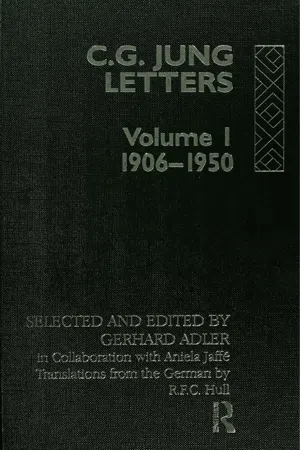
eBook - ePub
Letters of C. G. Jung
Volume I, 1906-1950
- 634 pages
- English
- ePUB (mobile friendly)
- Available on iOS & Android
eBook - ePub
Letters of C. G. Jung
Volume I, 1906-1950
About this book
Trusted by 375,005 students
Access to over 1.5 million titles for a fair monthly price.
Study more efficiently using our study tools.
Information
Letters 1906 - 1950
To Sigmund Freud
Burgholzli-Zurich, 5 October 1906
Dear Professor Freud,
Please accept my sincerest thanks for the present1 you kindly sent me. This collection of your various short papers should be most welcome to anyone who wishes to familiarize himself quickly and thor oughly with your mode of thought. It is to be hoped that your scientific following will continue to increase in the future in spite of the attacks which Aschaffenburg,2 amid the plaudits of the pundits, has made on your theory—one might almost say on you personally. The distressing thing about these attacks, in my opinion, is that Aschaffenburg fastens on externals, whereas the merits of your theory are to be found in the psychological realm of which modern psychiatrists and psychologists have somewhat too scanty a grasp. Recently I conducted a lively correspondence3 with Aschaffenburg about your theory and espoused this standpoint, with which you, Professor, may not be entirely in agreement. What I can appreciate, and what has helped us here in our psychopathological work, are your psychological views, while I am still pretty far from understanding the therapy and the genesis of hysteria because our material on hysteria is rather meagre. That is to say your therapy seems to me to depend not merely on the affects released by abreaction but also on certain personal rapports, and it seems to me that though the genesis of hysteria is predominantly, it is not exclusively, sexual. I take the same view of your sexual theory. Harping exclusively on these delicate theoretical questions, Aschaffenburg forgets the essential thing, your psychology, from which psychiatry will one day be sure to reap in exhaustible rewards. I hope to send you soon a little book4 of mine, in which I approach Dementia praecox and its psychology from vour standpoint. In it I have also published the case5 that first drew Bleuler's6 attention to the existence of your principles, though at that time still with vigorous resistance on his part. But as you know, Bleuler is now completely converted.
Respectfully and gratefully yours, C. G. JUNG
To Karl Abraham
Burgholzli-Zurich, 3 January 1908
Dear Colleague,
First of all, my best wishes for the New Year! Then please forgive me for not having reacted until now to your earlier news. I am still
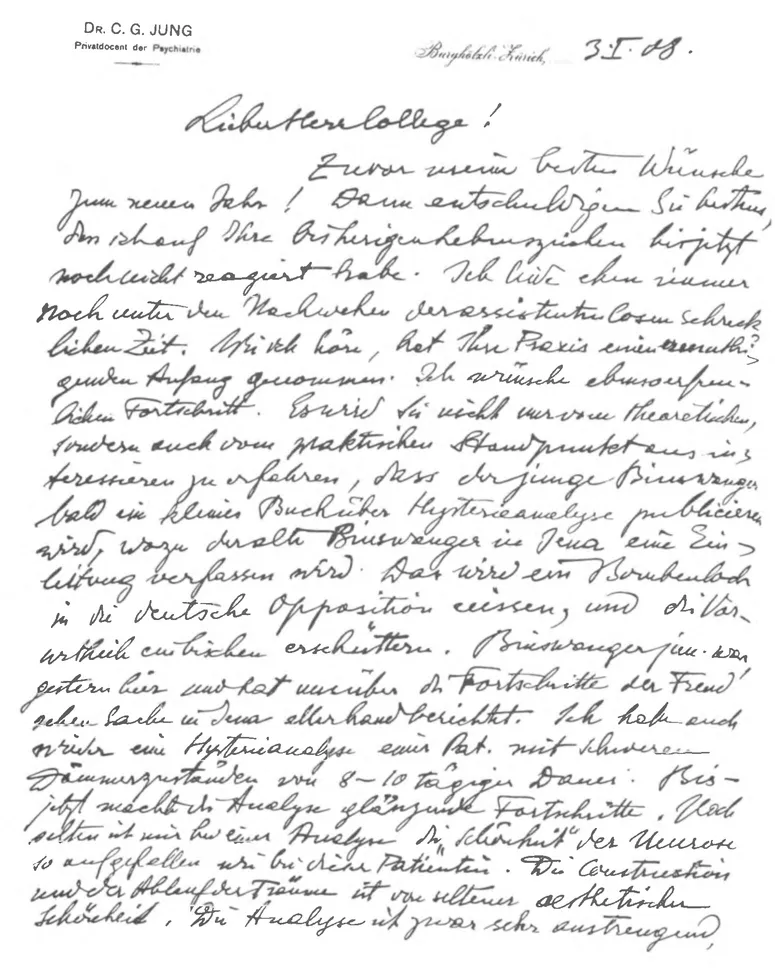
Abraham, 3 Jan. 08
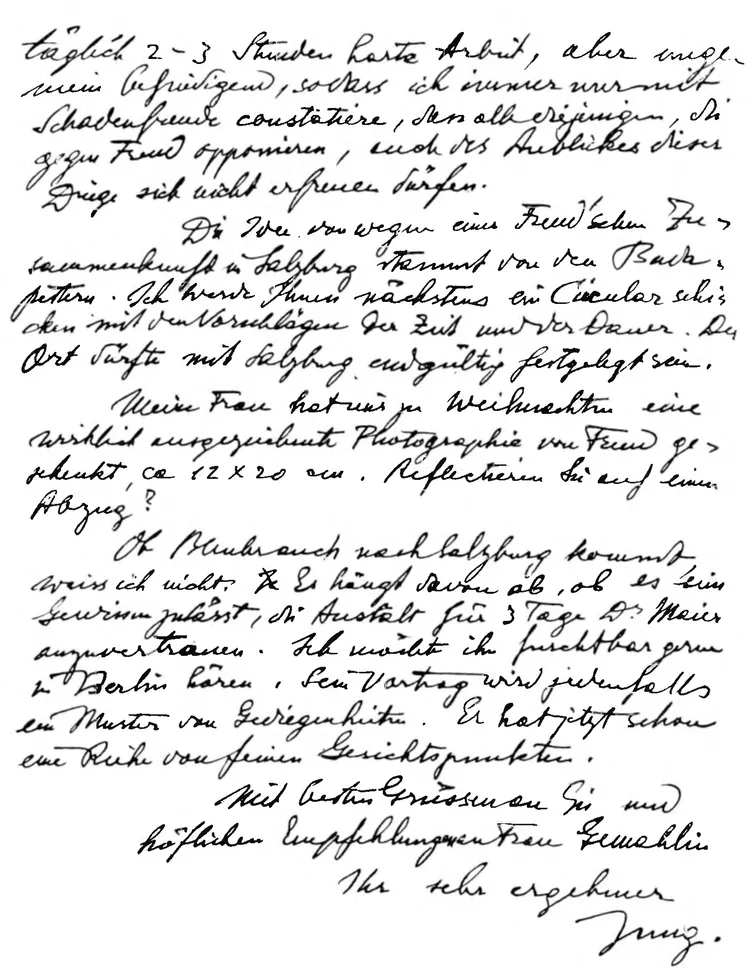
Abraham, 3 Jan. 08 (verso)
suffering from the after pains of the frightful time without assistants. I hear your practice has made an encouraging start, and I hope its progress will be equally gratifying. You will be interested to know not only from the theoretical but from the practical side as well that the young Binswanger1 will soon be publishing a little book on the analysis of hysteria,2 with an introduction b, the old Binswanger3 in Jena. It will come as a bombshell to the German opposition and shake their prejudices a little. Binswanger junior was here yesterday and told us all sorts of things about the progress of Freud's cause in Jena. Again I am doing an analysis of hysteria—a woman patient with severe twilight states lasting 8-10 days. So far the analysis is going ahead splendidly. Seldom in my analytical work have I been so struck by the "beauty" of neurosis as with this patient. The construction and course of the dreams are of a rare aesthetic beauty. The analysis is very exacting, 2-3 hours of hard work every day, but extraordinarily satisfying, so I can only take malicious glee [Schadenfreude] in asserting that all those who oppose Freud should not enjoy the spectacle of these things either.
The idea of a Freudian meeting in Salzburg4 originates with the Budapestians. Shortly I will send you a circular with suggestions as to the date and duration. The place should definitely be Salzburg.
For Christmas my wife gave me a really superb photograph of Freud, ca. 12 x 20 cm. Are you thinking of buying a copy?
I don't know whether Bleuler will come to Salzburg.5 It depends on whether his conscience allows him to entrust the Clinic for 3 days to Dr. Maier.6 I terribly much want to hear him in Berlin. In any event his lecture will be a model of thoroughness. Just now he has a lot of subtle ideas.
With best greetings to yourself and please remember me to your wife,
Yours sincerely, JUNG
To Karl Abraham
Burgholzli-Zurich, 30 January 1908
Dear Colleague,
I am pleased to see from your letter that you are not only coming to Salzburg but will also give us the pleasure of lecturing.1 I would ask you to keep it short, limiting it to about 20 minutes, as we must make room for a lecture by Freud. I shall announce in the programme that the speaking time is restricted to 20 minutes. So far we are sure of four lectures, one of them by Dr. Jones,2 London: "Rationalism in Everyday Life."
The Freud discussion in Berlin makes dismal reading—they have even filched the method from Breuer-Freud.3 It is nothing but a ridiculous farce and a piece of impudent knavery besides for Bezzola4 to assert that he has a new method. Freud has done all that already, only with less masquerading and other suggestive humbug, but more intelligence. It is depressing that Juliusburger,5 who is obviously an honest man, didn't spot the trick. Can't you instil a little insight into him? Liepmann's6 attitude is—well, what can one call it? Maybe you have a good Berlin expression for this, for there must be other people of that ilk there. Freud was naturally moved by this discussion—he did get mentioned and a crumb even fell to him from the Lord's table. A man of Freud's modest achievements can wax fat on that.
You know, of course, that Rezzola called Freud a "psychological swine." In order to spare the moral susceptibilities of this gentleman I have not sent him an invitation to Salzburg. On the other hand Juliusburger, who evidently still doesn't quite know how matters stand, perhaps would be interested in our meeting. Unfortunately I don't know how far he has been immunized against further under standing by Bezzola's injections of antifreudin. Perhaps you would sound him out sometime if you are better acquainted with him. I'd rather not send him a direct invitation.
The photograph can be obtained on request from our Zurich photographer for fr. 10. It is an enlargement of my excellent little snapshot and is wonderfully handsome. The best picture of Freud I have ever seen.
If you can round up in Berlin a few more participants for the meeting, that would be very nice provided that they are people with proFreudian interests. Please would you stress in each case the private nature of the project.
With best wishes for the continued successful development of your practice and remembrances to your wife,
Ever sincerely yours, JUNG
To Sandor Ferenczi
Burgholzli-Zurich, 6 January 1909
Dear Colleague,
Following your wish I will write at once to Dr. Brodmann1 to ask whether he will take your paper,2 although I would have liked to see you represented in our 1909 Jahrbuch.3 I hope you won't fail to collaborate with us. Freud has already written to me about your work with many expressions of praise, so that I must here give vent to an ignoble feeling of envy, as Freud has not always taken Olympian delight in certain of my works. Still, someone is always destined to come afterwards who does it better. As you see, I am sublimating our rivalry into the philosophy of the fate of all things earthly. So if you don't get accepted by Brodmann, you will find a resting-place with us in the Jahrbuch. Moreover, perhaps Bresler'4 would not be unwilling, or the Allgemeine Zeitschrift für Psychiatrie.
Do you know Strohmaver's paper?5 It is an arrow that hits the mark. Cordial greetings,
Yours, JUNG
To Sigmund Freud
Burghölzli-Zurich, 2 April 1909
Dear Professor Freud,
Worry and patients and all the other chores of daily life have beset me again and quite got me down for the first 2 days. Now I am slowly coming to the surface and beginning to bask in the memory of the days in Vienna.1 I hope you will have received my offprints in good time for Wednesday evening.2
12. IV.
After a 10-day interruption I have at last succeeded in continuing my letter. From this interlude it appears that the above complaint was premature, because, as usual, worse was to follow. Today I have put the last bad day behind me. All during the Easter holidays, when other people were out walking, I was able to snatch only one day's breath of air. On 15.IV I shall wrench myself free without fail and start my bicycle tour. Since Vienna all scientific work has been out of the question. But in my practice I have accomplished much. At the moment a madly interesting case is stretching me on the rack. Some of the symptoms come suspiciously close to the organic borderline (brain tumour?), yet they all hover over a dimly divined psychogenic depth, so that in analysing them all one's misgivings are forgotten. First-rate spiritualistic phenomena occur in this case, though so far only once in my presence. Altogether it makes a very peculiar impression. The patient is a man slaying Sara, Ragucl's daughter.3
The case I told you about—evil eye, paranoiac impression—was cleared up as follows. She was abandoned by her last lover, who is altogether pathological (Dem. praec.?);4 abandoned also by an earlier lover—this one even spent a year in an asylum. Now the infantile pattern: hardly knew her father and mother, loving instead her brother, 8 years older than she and at 22 a catatonic. Thus the psychological stereotype holds good. You said the patient was merely imitating Dem. praec.; now the model has been found.
When I left Vienna I was afflicted with some sentiments d'incompletude on account of the last evening I spent with you. It seemed to me that my spookery5 struck you as altogether too stupid and perhaps unpleasant because of the Fl...
Table of contents
- Cover
- Title
- Copyright
- Contents
- List of Illustrations
- Introduction
- Chronology
- LETTERS: 1906-1950
- Addenda
- The Collected Works of C. G. Jung
- Index of Persons
Frequently asked questions
Yes, you can cancel anytime from the Subscription tab in your account settings on the Perlego website. Your subscription will stay active until the end of your current billing period. Learn how to cancel your subscription
No, books cannot be downloaded as external files, such as PDFs, for use outside of Perlego. However, you can download books within the Perlego app for offline reading on mobile or tablet. Learn how to download books offline
We are an online textbook subscription service, where you can get access to an entire online library for less than the price of a single book per month. With over 1.5 million books across 990+ topics, we’ve got you covered! Learn about our mission
Look out for the read-aloud symbol on your next book to see if you can listen to it. The read-aloud tool reads text aloud for you, highlighting the text as it is being read. You can pause it, speed it up and slow it down. Learn more about Read Aloud
Yes! You can use the Perlego app on both iOS and Android devices to read anytime, anywhere — even offline. Perfect for commutes or when you’re on the go.
Please note we cannot support devices running on iOS 13 and Android 7 or earlier. Learn more about using the app
Please note we cannot support devices running on iOS 13 and Android 7 or earlier. Learn more about using the app
Yes, you can access Letters of C. G. Jung by C. G. Jung, Gerhard Adler,Aniela Jaffé, Gerhard Adler, Aniela Jaffé in PDF and/or ePUB format, as well as other popular books in Psychology & Mental Health in Psychology. We have over 1.5 million books available in our catalogue for you to explore.