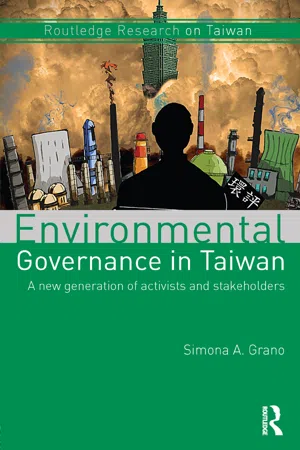
Three decades of rapid industrialization until the lifting of martial law in 1987, with little or no concern for the environment, have made Taiwan's environmental degradation a serious problem. In the past twenty years, Taiwan has seen a surge of environmental organizations, which to a certain degree have enjoyed a remarkable success in fighting polluting industries or affecting policies on behalf of the environment.
This book aims to analyse environmental governance mechanisms and actors in Taiwan through a multi-disciplinary research approach. Based on extensive and original research, it includes four different case studies, which have all taken place since 2011. It focuses on four major elements of governance - specifically norms, actors, processes, and outcomes - to examine Taiwan's national and local environmental governance in the post-2008 period. The book shows how the painful lessons Taiwan has learned throughout its transition should be of interest to other developing countries, illustrating how these positive transformations have managed to bring about a more ecologically friendly mode of economic development.
Demonstrating that the battle to further ecological sustainability is also a battle to further democratisation, this book will be of interest to students and scholars of Taiwan Studies, Developmental Studies and Environmental Studies.
Trusted by 375,005 students
Access to over 1.5 million titles for a fair monthly price.
1 Introduction to environmental politics in Taiwan
DOI: 10.4324/9781315736587-1
Post-2008 resurgence of civil activism
Since the lifting of martial law in 1987 Taiwan has slowly transformed itself into a democratic country and its civil society has boomed; nevertheless, according to various scholars and Taiwan watchers, since 2008 there has been a partial return to semi-authoritarian methods on the part of the state (Ho, 2010 a: 17)1 even more so, according to others (e.g., Cole, 2014), after President Ma’s second term started in 2012. However, rather than being pressured into silence, this unfavorable condition has prompted social movements to protect their rights with renewed vigor (Ho, 2014 a: 11–12) getting them “re-started” (Hsiao and Ku, 2010). This renaissance period has its symbolical birth in the Wild-Strawberry movement2 (野草莓運動 ye caomei yundong), which took place in November 2008 and has, since then, undergone two peaks coinciding with two “external” strategic events: one took place in 2011, which is coincidentally also the year of several “grassroots revolutions” that threatened to overturn numerous non-democratic regimes around the world,3 and one in 2014.
For Taiwanese 2011 was a particularly emotional year under many aspects. Not only was this a year of celebration and national pride for the centennial anniversary of the foundation of the Republic of China,4 but this was also the year of the shattering earthquake of magnitude 9.1 that hit Japan, which brought devastation and death onto the country and its people. Taiwan, geographically close to Japan and an earthquake-prone country itself (out of four nuclear plants, three are built in the immediate vicinity of seismic faults), developed a lively discussion on the nuclear energy issue, which gave environmentalists new vigor to fight for the complete acquittal of nuclear power (Shan, 2011 a, 2011 b). On April 30, 2011, several thousand people gathered in the streets of Taipei and Kaohsiung to protest against nuclear energy lobbies, in the aftermath of the devastating effects of the Fukushima nuclear catastrophe (福島核災 fudao hezai) in Japan (11 March, 2011). A special issue of contention centers on Taiwan’s controversial nuclear power plant number 4 (henceforth NPP-4), which has currently been frozen until a referendum will settle its fate and is set in an area known for its – still active – underwater volcanoes, at a distance of about 40 km from the capital, Taipei.5
Moreover, 2011 was also the year in which the deal regulating the deposit of nuclear wastes on Orchid Island expired. Needless to say, even though the rent contract expired on December 31, no action was taken by Taipower6 to remove the storage deposit, igniting further protests, due to the heightened awareness brought about by the Fukushima incident.
Apart from the nuclear energy controversy, 2011 was also a year of extreme drought – the worst in Taiwan since 2003 (The China Post, 2011 a, 2011 b) – causing the immediate implementation of a strict water-rationing scheme that brought on severe consequences for Taiwan’s high tech industries and chemical plants alike.7
In 2011 Taiwan also experienced its biggest-ever food scare beginning in mid-May, as government inspectors testing sport and soft drinks detected dangerous levels of industrial plasticizers, which have since then been found in a great variety of other products, some of which were exported to other Asian and Southeast Asian countries, making this an international crisis with huge economic losses for Taiwan, whose products were withdrawn from supermarket shelves in mainland China, Hong Kong and the Philippines (The Economist, 2011).8
Figure1.1 A dry river in Taitung, May 30, 2011 (source: Simona Grano).
Most importantly though, 2011 was a highly significant year for Taiwan’s citizens, politicians and green activists, being the year preceding the presidential elections held in January 2012 (Fell, 2011; Schubert, 2012). This means that every move, every decision and every public display of outrage (or consent) towards both the environment and potentially ecologically damaging projects (from nuclear power plants to petrochemical complexes and sporting facilities) were mostly driven by ideological and political motivations and were exploited and manipulated, with the not-so-hidden agenda of attracting votes, by all the major parties present on the political scene.
It is thus sufficiently safe to conclude that 2011 represents a watershed year in Taiwanese politics, during which the status of environmental issues was elevated and brought to the fore of the political agenda. In fact, while until a few years ago environmental concerns featured prominently in local elections with issues such as national identity and cross-strait relations dominating national level politics (Fell, 2013), a reversed trend has been established since 2011, which is clearly visible from the increased attention paid to nuclear energy issues after Fukushima, as well as from the growing number of TV shows (e.g., “Our Island,” 我們的島 women de dao) and popular TV series (“Heroes of the Country,” 國民英雄 guomin yinxiong) featuring environmental pollution, developmental projects and developers’ corruption among their leitmotivs. This does not mean that environmental problems were the most relevant topic discussed in the pre-election campaign period (China’s growing influence over Taiwan was a far more relevant topic); however, it does indicate that such concerns have become more significant than they ever were in the past. Furthermore, in a period in which social unrest was brewing already, Taiwanese activists united their efforts under the common banner of requesting more transparency and accountability on part of the government, thus increasing the status and visibility credited to ecological concerns. Political parties, aware of the increasing importance of the powerful pro-green rhetoric, exploit such issues to attract votes, often without a real commitment. This signals a change from the past, when political campaigns were almost exclusively focused on unification with the PRC and economic development (Fell, 2013). However, as we shall see with the analysis of the four case studies, environmental activists have also learned how to make use of this powerful rhetoric and of the specific, strategic time in which events take place, in order to achieve their goals.
The Fukushima disaster, in all of its drama, has contributed to revive long-dormant anti-nuclear feelings, causing a major change at the political level, with a traditionally pro-business party such as the Kuomintang – KMT – (中國國民黨 zhongguo guomindang) reaching the decision to halt construction of the nearly completed NPP-4. Whether this could indicate a shift in the KMT’s perception of what concerns Taiwanese citizens or whether such issues have become so powerful that no political party can ignore them, lest they risk the loss of future electoral battles, remains to be seen. What is certain though, is that the stronger emphasis on green issues during the pre-election campaign period indicates a novel trend, favorable to environmental protection, which has been established since this watershed year and has been growing ever since. 2011 was definitely a remarkable year not only for the anti-nuclear movement, but also for the environmental movement at large with the successful and formidable opposition against the Kuokuang naphtha cracker, a case study, which will be expounded in Chapter 4 of this book.
Finally one last observation in regards to the future of environmental protection in Taiwan; currently “nature conservation” is a prominent concern of officials, common citizens and activists, as can be observed in the numerous leaflets heartily portraying the island’s natural beauty and wild parks, as well as in the heightened awareness towards “ecological problems” such as water conservancy and recycling activities. While for a long time such issues represented nothing more than careless topics for superficial, over-dinner conversations, recently Taiwan has experienced an upgrade of efforts and commitment towards the protection of its fragile ecosystem. To quote Ho Ming-sho paraphrasing Ulrich Beck’s essay on the “world risk society” (Beck, 1986) “Perhaps, the worldwide sympathy for Japanese people and resurgence of anti-nuclear movement following the wake of the Fukushima disaster in March 2011 constitutes an instance of cosmopolitan consciousness in the era of world risk society” (Ho, 2012: 3).
Building on Ho Ming-sho’s own categorization of social movements in Taiwan from the 1980s until today (Ho, 2010 a: 16), social movements underwent a phase of resurgence (2008–2010) after a decade of “institutionalization” coinciding with Chen Shui-bian’s administration, in which no remarkable protests erupted. I contend that this resurgence phase has not yet exhausted its force but that, actually, it has been growing stronger since the year 2011.
In fact, Taiwan’s political environment between 2010 and 2012 was extremely volatile with the country undergoing two mayoral and one presidential election.
The second Ma Ying-jeou (馬英九) administration finds itself in the uneasy situation of having to balance waning popular support with the implementation of unpopular trade agreements (Chow, 2011: 185–186); protests are directed at a plethora of issues of social discontent: from those who claim that the Economic Cooperation Framework Agreement,9 enacted in 2010, is more favorable to China than Taiwan and serves to advance China’s unification agenda, to the numerous anti-nuclear rallies, which have become a frequent feature of Taiwanese street life, to accusations against President Ma of having exploited the Wang Jin-pyng (王金平) affair to further his personal interests in trying to oust a fellow KMT member and political rival. However things may be, these past few years have been characterized by a vigorous civic activism with several large-scale protests and demonstrations in 2013 alone (Wang, 2013 a). Protests were not only environmental of course, ranging from indignation over the unclear circumstances surrounding the death of a young army corporal who was being punished for misconduct (Hung, 2014: 54–77), to the long-going anti-media monopoly dispute (反媒體壟斷 fan meiti longduan) in 2012–2013 (Harrison, 2012; Rawnsley, 2014 b). Younger generations, who are the major force behind the social unrest, have been taking to the streets to defend issues such as human rights, social justice and environmental protection, while openly battling governmental corruption and abuse. The Sunflower Student Movement (太陽花學運 taiyanghua xueyun),10 which occupied the legislative floor for several weeks to protest against the Cross-Strait Service Trade Agreement (CSSTA) in March 2014, is the most prominent example of such unrest and epitomizes the culmination of the several protests that have taken place since 2008 (Cole, 2014). All of this represents an unprecedented re-awakening of civil society, in the history of democratic Taiwan, which has, at the same time, contributed to re-launch several other issues, such as environmental concerns and anti-nuclear sentiments or public awareness in regards to the government’s willingness to promote economic agreements with China, that are considered by some as tools to advance Beijing’s reunification goals (Yuen, 2014: 74). Amidst the growing uneasiness and discontent towards Ma Ying-jeou’s administration, barely two weeks after the Sunflower occupation of the Legislative Yuan, former head of the DPP, Lin Yi-hsiung (林義雄), launched a long-planned hunger strike in favor of the abolition of NPP-4, which brought several thousand people to the streets, who set up blockades on public arteries and organized a series of anti-nuclear rallies. Against the backdrop of rising social unrest, this book tries to sketch the most salient points of the environmental policymaking arena in contemporary Taiwan, positing particular attention at the newer cohorts of environmental activists that have emerged in the past few years, and are often characterized by a more radical positioning (by no means violent) while at the same time displaying a far more professional approach and a deeper understanding of the available mechanisms to fight developers and polluting facilities. These can range from a skilled employment of the legal system to a deeper effectiveness in spreading their ideas through online platforms and forums. Paraphrasing Michael Cole (2014), smaller rallies organized by this new generation of activists, though not as flashy as larger protests usually portrayed by the media in their reportages, have been much more successful at generating responses on the part of the government and consequently pose a greater concern for the authorities who have tried to deter them or discredit them. One of the elements of success of these newer groups is their ability to unite under a common banner, which transcends older divisions that often alienated one group from the other in the past, such as ethnic, generational and political divisions, giving shape to a truly unified opposition movement. This movement has shown its full strength by urging the general public to remember that the KMT’s governance over the past year has been characterized by infringements on human rights, forced evacuations, demolition of homes and the forceful seizure of land, among others. Whether these allegations are founded and represent the real motivations for the widespread discontent or whether the public is unhappy about the country’s situation of economic stagnation, the DPP, as well as a few independent candidates (e.g., Taipei City’s mayor-elect Ko Wen-je 柯文哲) have benefited from the disappointment and anger towards the KMT, which suffered a massive setback in the November 29, 2014 municipal elections,11 when the public revoked its mandate in several key strongholds and gave it to the DPP instead. These elections were a victory for smaller parties like the Green Party, who managed for the first time since its establishment in 1996 to win two seats out of nine candidates it had presented and for the newly established Tree Party – a GP splinter organization founded in 2014 by former GP secretary-general Pan Han-sheng (潘翰聲), which triumphed in the mayoral election for Nantou County’s Chichi Township (集集), marking a successful start for the party. Such gains seem to indicate a growing awareness and support for parties that prioritize environmental awareness and grassroots social activism.
Reasons for writing a book on environmental governance in Taiwan
Scholars who analyse political power can be divided into two groups, each with a different perspective. One group emphasizes social conflict; the other, social cooperation. Depending on the emphasis, what the two see as the nature of political power is quite different.
(Fei Xiaotong, 1992: 108)
The contemporary world faces a wide selection of difficult social and environmental problems that often transcend established social and territorial boundaries. Therefore, modern states try to reorganize involved institutions in the hope of finding ideal solutions for effective governance. This has led to the emergence of a host of new actors, of new forms of state-society relations, of hybrid public institutions and networks of multi-sector partnerships, while questions of accountability and legitimacy remain unresolved. These developments necessitate a fresh look at the question of governance.
The idea of writing a book on the topic of environmental governance in Taiwan began after my reading of Taiwan’s Environmental Struggle:...
Table of contents
Cover Page
Half-Title Page
Title Page
Copyright Page
Table of Contents
List of figures
Preface
Acknowledgments
Note on Romanization
List of abbreviations
1 Introduction to environmental politics in Taiwan
2 Contextualizing Taiwan’s environmental history: from “developmentalism” to ecological awareness?
3 Nuclear energy and the fourth nuclear power plant controversy
4 Taiwan’s petrochemical industry and the Kuokuang Petrochemical Naphtha Cracker
5 The Taipei Dome BOT Project
6 The Tamsui North Shore Road Project
7 Towards a more balanced and inclusive environmental governance approach
References
Index
Frequently asked questions
Yes, you can cancel anytime from the Subscription tab in your account settings on the Perlego website. Your subscription will stay active until the end of your current billing period. Learn how to cancel your subscription
No, books cannot be downloaded as external files, such as PDFs, for use outside of Perlego. However, you can download books within the Perlego app for offline reading on mobile or tablet. Learn how to download books offline
Perlego offers two plans: Essential and Complete
Essential is ideal for learners and professionals who enjoy exploring a wide range of subjects. Access the Essential Library with 800,000+ trusted titles and best-sellers across business, personal growth, and the humanities. Includes unlimited reading time and Standard Read Aloud voice.
Complete: Perfect for advanced learners and researchers needing full, unrestricted access. Unlock 1.5M+ books across hundreds of subjects, including academic and specialized titles. The Complete Plan also includes advanced features like Premium Read Aloud and Research Assistant.
Both plans are available with monthly, semester, or annual billing cycles.
We are an online textbook subscription service, where you can get access to an entire online library for less than the price of a single book per month. With over 1.5 million books across 990+ topics, we’ve got you covered! Learn about our mission
Look out for the read-aloud symbol on your next book to see if you can listen to it. The read-aloud tool reads text aloud for you, highlighting the text as it is being read. You can pause it, speed it up and slow it down. Learn more about Read Aloud
Yes! You can use the Perlego app on both iOS and Android devices to read anytime, anywhere — even offline. Perfect for commutes or when you’re on the go. Please note we cannot support devices running on iOS 13 and Android 7 or earlier. Learn more about using the app
Yes, you can access Environmental Governance in Taiwan by Simona A. Grano in PDF and/or ePUB format, as well as other popular books in Politics & International Relations & American Government. We have over 1.5 million books available in our catalogue for you to explore.