Elections are a fundamental element of democracy, since elected governments reflect voter preferences. At the same time, it is inevitable that policies pursued by any government closely resemble the preferences of some citizens, while alienating others who hold different views. Previous works have examined how institutional settings facilitate or hinder policy proximity between citizens and governments. Building on their findings, the book explores a series of "so what" questions: how and to what extent does the distance between individual and government positions affect citizens' propensity to vote, protest, believe in democracy, and even feel satisfied with their lives?
Using cross-national public opinion data, this book is an original scholarly research which develops theoretically grounded hypotheses to test the effect of citizen-government proximity on three dependent variables. After introducing the data (both public opinion surveys and country-level statistics) and the methodology to be used in subsequent chapters, one chapter each is devoted to how proximity or the absence thereof affects political participation, satisfaction with democracy, and happiness. Differences in political attitudes and behavior between electoral winners and losers, and ideological moderates and radicals, are also discussed in depth.
According to Robert Dahl, a leading democratic theorist, ‘a key characteristic of democracy is the continued responsiveness of the government to the preferences of the people’ (Dahl 1971:1). Responsiveness is one of the key indicators of the quality of democracy (Diamond and Morlino 2005), and refers to a series of links which are needed to ensure the relationship between citizens and their government. More specifically, the term ‘responsiveness’ denotes the government’s responsibility towards the citizens to abide by its promises and the preferences expressed by the governed (see Powell 2005). In this view, public accountability and public policy, as well as representation, constitute the basic elements of institutions of democratic governance (Soroka and Wlezien 2010).
Few would disagree with the proposition that representative democracy is meaningful only insofar as political leaders act in accordance with the wants, needs and demands of citizens when they make policy (Luttbeg 1974). This does not assume that all politicians selflessly dedicate themselves to enhancing the welfare of society; it is entirely plausible that they harbour ambitions for personal power, wealth or status. But regardless of the motive, governments often end up offering policies that citizens demand in part because they don’t want to be voted out of office in the next election (Ferejohn 1986). Free elections are thus an indispensable component of representation. We can imagine an authoritarian regime under which the autocrat acts benevolently toward his or her subjects and takes their preferences into account when dictating new laws, resulting in policy proximity. Yet in the absence of free elections, there is no mechanism to hold the ruler accountable to the ruled, to restrain the governing authority from ignoring the popular will.
Policy proximity is not a new idea. As long as half a century ago, a classical study examined the degree to which the opinions of citizens and legislators overlap with regard to social welfare policy (Miller and Stokes 1963). The focus soon shifted from individual legislators to political parties (Barnes 1977), since it is parties (especially those in government) that often determine the contents of policies. This assumes that within a given party, members are bound by both agreement over what policy proposals they should put forward and the understanding that deviating from the party line could lead to certain censures. While there are necessarily variations across countries, these assumptions of shared goals and discipline hold for most parties in democratic countries most of the time. Given this condition, political scientists have discussed a ‘responsible party government model’, in which voters choose between parties that offer alternative sets of policies (Dalton 1985; Thomassen 1994, 1999). We adopt this premise and treat parties as single units in our analysis.
When discussing what ordinary citizens want, it is worth making a distinction between policy proximity and simply being on the winning side in an election. In reality, these two characteristics often overlap: insofar as people consider policies when deciding how to mark their ballots (Downs 1957), we should observe closer proximity for someone who votes for a party that enters the government (what we label a ‘winner’) than others who vote for parties which end up in opposition (labelled ‘losers’). However, we know that not all ballots are cast on the basis of policy preferences alone. This has been well established by the literature over the years, underlying the importance of factors such as ‘party identification’ (Budge et al. 1976; Campbell et al. 1960) and ‘personalisation of politics’ (Kaase 1994; Mughan 2000).
Moreover, electors not only assess candidates’ and parties’ positions in the policy space, but also judge their qualities by the standard of commonly shared values (Curini and Martelli 2010; Curini 2015). Stokes (1963) proposed a distinction between ‘position issues’ involving ‘advocacy of government actions from a set of alternatives over which a distribution of voter preferences is defined’, and ‘valence issues’, defined as ‘those that merely involve the linking of the parties with some condition that is positively or negatively valued by the electorate’, such as honesty, competence, etc. Also, some electoral systems provide incentives for strategic voting (Cox 1990), meaning that voters abandon their most preferred candidate or party in order to keep their least favourite alternative from winning. A voter would be a ‘winner’ if the party he or she votes for gains office, but we cannot take it for granted that this voter’s preferences closely correspond to the new government.
Furthermore, the category of losers can encompass widely divergent groups. Imagine, for example, a social democratic party forming the new government after an election, and both the communist and far-right nationalist parties finding themselves on the opposition benches. Supporters of both latter parties would be designated ‘losers’, but the extent to which they would fight against the new government’s proposals may not be the same, due to differences in policy proximity. Finally, voters understand that elections are not a one-off event. If past experience has taught them that, despite losing in one election, there remains a realistic chance of winning next time, then their temporary loser status may not affect their faith in democracy, while policy distance can have an impact nonetheless.
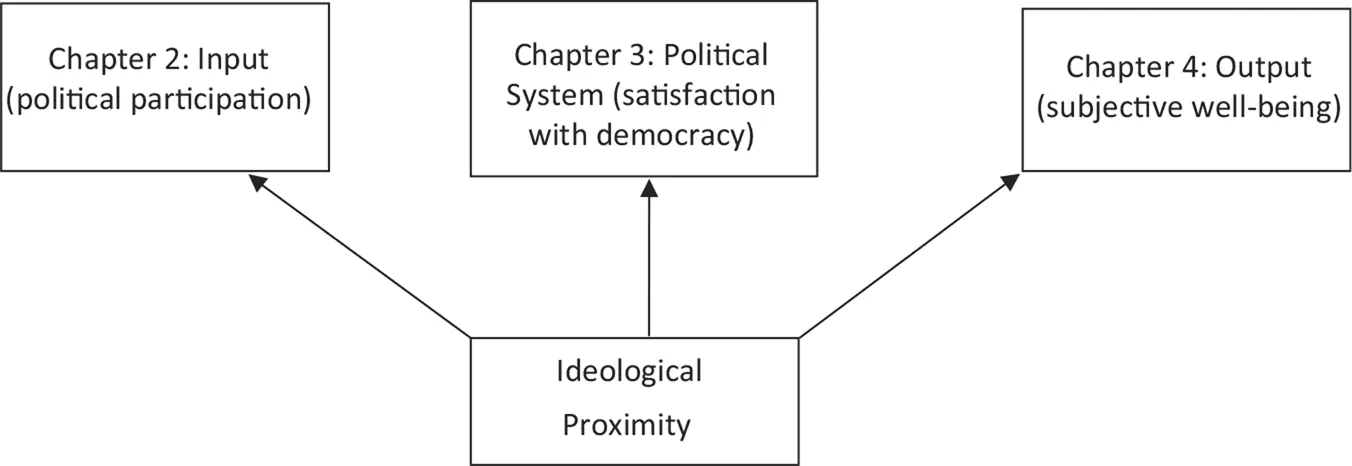
Figure 1.1 graphically presents the synopsis of this book. The main independent variable in the following chapters, namely how closely a government reflects its citizens’ policy preferences, is probably not a topic that often comes up in our minds. Nevertheless, we will argue that this factor can have an impact not only when we face a choice among parties and candidates during election time, and not only when we turn our attention to political debates, but also when we try to engage in activities to make our voices heard and, perhaps more unexpectedly, when we assess how satisfied we are with daily life. In other words, the importance of policy proximity extends beyond abstract concepts of democratic representation to affect political attitudes, behaviour and personal happiness.
Figure1.1 Plan of the book
The discussion so far on citizen–government policy proximity, and factors that may affect it, is based on rather abstract ideas. In order to examine this concept empirically, we need a concrete means of measuring just how close or distant citizens are from their government. That is our main task in this chapter.
1. Measuring policy positions: the left-right scale
Two pieces of information are required to ascertain the policy distance between citizens and their government: 1) the preferences of individual citizens, and 2) the position of their government. This seems so obvious as to appear almost redundant, but neither aspect is easy to measure. For example, if the government passed a new law stipulating a 5 per cent tax rise, would an advocate of a 10 per cent tax hike be considered as distant from the government as someone who wants to maintain the status quo? Since either of these preferences would change the tax rate by the same magnitude, we can say that both individuals are equally far away from the government’s position. Yet it is also possible to argue that since the tax hike proponent agrees with the policy direction of the new law in principle (i.e. higher taxes), that individual is closer to the government than the individual who is averse to any change (see Macdonald et al. 1991; Rabinowitz and Macdonald 1989). Furthermore, some people who think that a 5 per cent tax increase is appropriate may disagree with the government about how the resulting revenue should be used. How to measure their policy distance?
We can imagine similar scenarios for policies on a host of other issues, all of which would demonstrate the difficulty of capturing the precise policy distance between each individual and his or her government. And such difficulty would be multiplied when we try to analyse a cross-national sample, since an issue that attracts a great deal of attention and debate in one country may be entirely irrelevant in another. This highlights the need for a common measurement that can be applied to different issue dimensions and utilized across widely disparate national contexts.
One solution – which has been widely used by political scientists over the years – is the left-right scale. Instead of being randomly distributed, views on different issues are often clustered together in systematic, predictable patterns (Hinich and Munger 1992). For instance, in many advanced industrialized countries, socially conservative attitudes are linked with disapproval of an extensive government role in the economy. While we acknowledge that not all issues may fit on the same scale, scholars have described the left-right schema as ‘an amorphous vessel’ that takes on meanings according to political and economic conditions in a given society (Huber and Inglehart 1995). Using the left-right spectrum has the advantages of simplicity and, of particular importance in a cross-national study, flexibility, that is being adaptable to the context of different countries at each point in time.
Usage of the labels ‘left’ and ‘right’ to describe political orientations can be traced back to the French Revolution, when the terms referred literally to where deputies sat in Parliament (Laponce 1981). With the emergence of party competition and a widening franchise in the late nineteenth and early twentieth centuries, these semantics came to encapsulate the main political conflict of that era: capital versus labour. ‘Left’ denoted advocacy of income redistribution to ensure greater social equality, workers’ rights, regulation of business practices, and welfare for disadvantaged segments of society. In contrast, a ‘rightist’ stance favoured individual freedom, market competition, and limits on government intervention in the economy (Budge and Robertson 1987; Lipset 1960). In some countries such as Great Britain, this divide corresponded with a class cleavage, while in other cases such as United States, the left-right schema also incorporated a religious element.
As society evolves, new issues inevitably come to the attention of ordinary citizens and policy makers. Would this gradually make the left-right schema obsolete? Take the example of post-materialism, which emerged as citizens in advanced industrialized countries who grew up in peaceful, prosperous times came to prioritize quality-of-life goals (such as environmental protection and freedom of ...
Table of contents
Cover Page
Half-Title Page
Copyright Page
Table of Contents
List of figures
List of tables
List of boxes
Acknowledgements
Introduction
1 Ideological proximity: concept and measurement
2 Ideological proximity and political participation
Ideological proximity and support for democracy
Ideological proximity and individual happiness
Conclusion
References
Index
Trusted by 375,005 students
Access to over 1.5 million titles for a fair monthly price.
Study more efficiently using our study tools.
Frequently asked questions
Yes, you can cancel anytime from the Subscription tab in your account settings on the Perlego website. Your subscription will stay active until the end of your current billing period. Learn how to cancel your subscription
No, books cannot be downloaded as external files, such as PDFs, for use outside of Perlego. However, you can download books within the Perlego app for offline reading on mobile or tablet. Learn how to download books offline
Perlego offers two plans: Essential and Complete
Essential is ideal for learners and professionals who enjoy exploring a wide range of subjects. Access the Essential Library with 800,000+ trusted titles and best-sellers across business, personal growth, and the humanities. Includes unlimited reading time and Standard Read Aloud voice.
Complete: Perfect for advanced learners and researchers needing full, unrestricted access. Unlock 1.5M+ books across hundreds of subjects, including academic and specialized titles. The Complete Plan also includes advanced features like Premium Read Aloud and Research Assistant.
Both plans are available with monthly, semester, or annual billing cycles.
We are an online textbook subscription service, where you can get access to an entire online library for less than the price of a single book per month. With over 1.5 million books across 990+ topics, we’ve got you covered! Learn about our mission
Look out for the read-aloud symbol on your next book to see if you can listen to it. The read-aloud tool reads text aloud for you, highlighting the text as it is being read. You can pause it, speed it up and slow it down. Learn more about Read Aloud
Yes! You can use the Perlego app on both iOS and Android devices to read anytime, anywhere — even offline. Perfect for commutes or when you’re on the go. Please note we cannot support devices running on iOS 13 and Android 7 or earlier. Learn more about using the app
Yes, you can access Why Policy Representation Matters by Luigi Curini,Willy Jou,Vincenzo Memoli in PDF and/or ePUB format, as well as other popular books in Politica e relazioni internazionali & Business generale. We have over 1.5 million books available in our catalogue for you to explore.