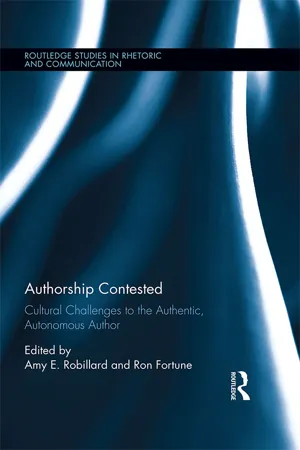
This volume explores a dimension of authorship not given its due in the critical discourse to this point—authorship contested. Much of the existing critical literature begins with a text and the proposition that the text has an author. The debates move from here to questions about who the author is, whether or not the author's identity is even relevant, and what relationship she or he does and does not have to the text. The authors contributing to this collection, however, ask about circumstances surrounding efforts to prevent authors from even being allowed to have these questions asked of them, from even being identified as authors. They ask about the political, cultural, economic and social circumstances that motivate a prospective audience to resist an author's efforts to have a text published, read, and discussed. Particularly noteworthy is the range of everyday rhetorical situations in which contesting authorship occurs—from the production of a corporate document to the publication of fan fiction. Each chapter also focuses on particular instances in which authorship has been contested, demonstrating how theories about various forms of contested authorship play out in a range of events, from the complex issues surrounding peer review to authorship in the age of intelligent machines.
eBook - ePub
Authorship Contested
Cultural Challenges to the Authentic, Autonomous Author
- 214 pages
- English
- ePUB (mobile friendly)
- Available on iOS & Android
eBook - ePub
Authorship Contested
Cultural Challenges to the Authentic, Autonomous Author
About this book
Information
Contrived Authorship
1 A Gay Girl in Damascus
Multi-vocal Construction and Refutation of Authorial Ethos
On June 7, 2011, the audience of the blog A Gay Girl in Damascus launched a sincere and urgent campaign through petitions, news articles, and Twitter to rescue the blog’s author, Amina Abdallah Arraf al Omaril, a self-described lesbian Syrian-American activist, from Syrian security forces. As a result, The Washington Post, NPR, and Palestinian news site Electronic Intifada investigated Amina. They soon came to the startling conclusion that no one had actually seen Amina in person (including her Canadian girlfriend). By June 9, it was revealed that Amina, A Gay Girl in Damascus, was the pseudonym of Tom MacMaster, a straight American man who created the persona in order to shed light on the Syrian situation, present his arguments, and practice his creative writing ability (“Apology to Readers,” June 13, 2011). The author’s audience was confronted with the dilemma of whether to view this situation as egregious fraud or as the work of a creative author.
Audiences of literary and online hoaxes such as James Frey’s A Million Little Pieces and Tom MacMaster’s A Gay Girl in Damascus often react with anger upon discovering that they have been duped (for example, Oprah Winfrey’s public rebuking of Frey on her syndicated network talk show, January 26, 2006). These examples of problematic authorship, which are not marked by plagiarism or financial fraud, raise a fundamental question about the nature of contested authorship and authorship in general. In an example of contested authorship, how is ethos constructed, and how are rhetorical messages distributed? Despite scholarly moves to decenter the author as the single authority over a text, the impulse in these situations is to return sole responsibility back to the speaker, denounce the speaker’s choices, and censor the speaker’s message.1 As the events surrounding A Gay Girl in Damascus reveal, MacMaster was successful in creating his false persona because he did not create his ethos alone. Early on in the process, MacMaster relied on other people to help validate Amina’s existence and message. Later, in response to MacMaster’s admission, audiences of the blog and the blog’s message either moved to denounce MacMaster or scrambled to protect the rhetorical message even as the ethos of the speaker was shattered. Thus, the unmasking of MacMaster as the author of the Gay Girl in Damascus blog offers an example of contested authorship in the digital age, where the breakdown of ethos unmasks cultural assumptions regarding individual authorship and the often ignored interventions of others in producing and disseminating rhetorical messages.
In our typical model of a rhetorical event, a single speaker builds his rhetorical ethos and addresses his rhetorical message to a specific audience, since the practice of speaking begins with “a speaker and a subject on which he speaks and someone addressed, and the objective of the speech relates to the last (I mean the hearer)” (Aristotle On Rhetoric I: 3:1). The well-constructed speech reflects “the character [ethos] of the speaker, and some in disposing the listener in some way, and some in the speech [logos]” (Aristotle On Rhetoric I: 2: 3). Thus ethos is defined as the character of the speaker or as Barbara Warnick explains in her article “Online Ethos”: “to be viewed as credible, the author must be perceived as a person of good will who has the audience’s best interest at heart and also as an expert in some sense—one who is qualified to speak on the topic at hand” (258). This definition places the burden of ethos on the speaker, who must demonstrate good character, operate through goodwill, and have an expertise in the topic.
However, the hoax A Gay Girl in Damascus, as an example, demonstrates that the ethos of the speaker is not lodged only in the speaker’s choices or character. In “Collaboration and Conceptions of Authorship,” M. Thomas Inge writes, “there has seldom been a time when someone did not stand between author and audience in the role of a mediator, revisor, or collaborator” (624). These mediators problematize our understanding of ethos in particular since their influence shifts the construction and power of ethos. Here, I examine the relationships between MacMaster and other participants who appropriated and transmitted his message online in order to illuminate how rhetorical ethos comes to be constructed not by one individual, but rather through the direct interventions of multiple people. These participants, who I call the rhetorical chorus, are separate from other members of the audience because they specifically use their technical and rhetorical skills to distribute the message and promote or build the speaker’s ethos by altering the shape of digital spaces. Principally, in this example, these individuals are other bloggers, but many are also journalists and social activists. This chapter uses the terminology of musical texture and chorus, which allows me to identify and analyze the movements of different members of the ensemble who participated in distributing Amina’s message and building her ethos, as well as the later contributors who denounced MacMaster. This group acts as mediators, co-actors with the original speaker, by operating between the original speaker and the audience. However, despite their actions as co-participants in the distribution of rhetoric, the chorus neither participates in the act of invention nor functions as coauthoring collaborators. Instead the ensemble appropriates and disseminates the message of the original speaker with its own authority and agendas. They stand apart from the audience because they have the technical skills to alter and arrange the space of the textual artifact or digital space and the rhetorical techne, rhetorical artistry, to contribute their own rhetoric.
ACT I: A GAY GIRL IN DAMASCUS
In February 2011, a blogger Amina Abdallah Arraf al Omaril, claiming to be a lesbian Syrian-American activist, began a blog entitled A Gay Girl in Damascus: An Out Syrian Lesbian’s Thoughts on Life, the Universe and So On. This blog caught the attention of many because of her combination of on-the-spot descriptions of the Syrian uprisings, her Sapphic poetry, and her thoughts as “an out Syrian lesbian.” Amina further reinforced her feminine identity by designing her blog with pink lettering and pastel floral backgrounds.2 Amina built on the audience’s preconceived expectations regarding the use of a blog to present autobiographical narratives and the use of external sources and relationships with others to give witness to Amina’s existence and her authority as a speaker.
Amina created her false persona by first enacting the traditional role of the individual speaker and establishing her ethos based on personal experiences. She described herself as “a dual-national and I grew up between Damascus, Syria and the American South, neither of which was exactly the easiest place to be struggling with what I considered inappropriate desires” (“Halfway out of the Dark” February 19, 2011). Throughout her blog, she delivered autobiographical anecdotes, which were effective in first building an audience and later distributing ideologies. The blog served as an ideal place for the construction of a speaker’s identity because it functioned as a site of self-disclosure and self-expression, which served to enhance “self-awareness” and confirm “already-held beliefs” (Miller and Shepherd). Amina articulated her messages by organizing them according to culturally sanctioned forms of self-disclosure and personal narrative to convey her ethos and build ties to her audience. As an example, Amina shared a story of finding an active lesbian community while going out in Syria: “I went into a hair salon one day and, not long after I arrived, I picked up on something between the women working there; I spoke around in circles and so did they … and finally learned that the women there were all gay” (“‘Halfway out of the Dark’” February 19, 2011). With similar stories, such self-disclosure in her blog functioned as a “rhetorical convention” designed to “gain readers in the blog community” (Rak 172). Statements of disclosure in the blog created credibility because of their apparent authenticity. In addition, these personal anecdotes created the possibility of shared experiences as women, as lesbians, as Muslims. Therefore, the audience could accept Amina as a credible speaker because they were familiar with the authority and authenticity of blogging as a medium to convey personal experiences in order to express ideologies.
Through the authority of personal experience living in Syria, Amina promoted several major arguments, which were taken up by others who would become her rhetorical chorus. First, she posited a positive and optimistic view of the lesbian situation in a Middle Eastern community, such as Amina’s pleasant encounter with the women in the hair salon (“Halfway out of the Dark,” February 19, 2011). Second, her stories about her family depicted familial relationships within a Muslim family as less patriarchal and homophobic than Western media depicts, and she claimed that she was able to easily balance lesbianism and her Muslim faith (“My Hijab, My Choice,” April 10, 2011). For example, in the blog post, “Waiting and Worse,” Amina described drinking alcohol with her Muslim father, where he claims, “‘Silly girl,’ he grins, ‘we, your mother and me, were fairly certain you were gay’” (May 3, 2011). Third, Amina often set up scenarios and descriptions of her own sexuality in Syria as evidence that Western media only has a superficial understanding of the Middle East and its policies towards the gay community. For example, she made this argument explicit in her blog entry, “PinkWashing Assad?” She argued that Western culture, especially the media, was pinkwashing the Middle East, using false constructs of how gender and sexuality are treated in the Middle East as justification for invading or compelling Middle Eastern countries to adopt Western ideals (May 28, 2011). As the persona developed, Amina positioned herself as a lead voice by using rhetorical techniques familiar to an audience in order to build credibility and organize the message according to culturally sanctioned conventions that often evoke an emotional response from the audience.
However, Amina’s role as the individual speaker was further predicated not only on those traditional rhetorical strategies, but also on how other people responded to her—not just her audience, but a specific group of people who took up Amina’s message and distributed it elsewhere for their own purposes. Besides being the speaker of the initial message, Amina cannily made use of digital spaces and connections with other people outside of her blog in order to develop relationships with other speakers and activists who held ideologies similar to her own. Amina had an online presence through the use of a Facebook account and a LinkedIn account, and she developed and maintained contact with activists in Syria and the Middle East through e-mail. This web presence helped to clarify and build Amina’s ethos, because these sites provided audience members other aspects of Amina’s character to reveal her constructed “authenticity.” For example, Amina’s Facebook page was for Amina Arraf and claimed her birthday was October 12, 1975. On the Facebook page, Amina described herself as “just your typical Syrian/American Lesbian dilettante, dreaming of being the most successful Muslim female author of SF/Fantasy/AltHistory in the English Language” (“Amina Arraf”). Amina also had made an earlier attempt to develop her ethos online through another blog, which was started in September, 2007, and indicated an interest in writing fiction and her autobiography.3 In other words, Amina was MacMaster’s online persona for as many as six years prior to the revelation of the hoax, and her “life” online can be heavily documented in other locations besides her blog. This online life meant that Amina had relationships with others who could vouch for and reinforce the authenticity of both Amina’s message and her existence as a speaker.
In early February, as Amina began posting to her blog, she initiated relationships with early members of her rhetorical chorus, members of the news blog Lez Get Real, who would later help to promote her ideas and defend her ethos. Lez Get Real “is a blog with ‘A Gay Girl’s View on the World’” developed by Paula Brooks4 that continues to function as a site for a lesbian community to report the news. The reporters demonstrated their belief in her ethos as a speaker by deferring to Amina’s expertise and knowledge about issues in Syria and the Middle East. For example, the February 7, 2011 post “Syria Protests Story Apology,” Linda Carbondell quotes Amina’s response to an earlier news posting: “I just stumbled on your blog and, as a Syrian lesbian now living in Damascus, I had to read it … and comment. A fair number of the facts are actually wrong; the economy here’s actually doing pretty good (compared to most of the world and certainly compared to Egypt) which, probably more than anything, has undermined any protest movement here.” Later, Brooks asked Amina to write news articles (as was announced on June 1, 2011, in the “Happy Pride Month” posting by Bridgette P. La Victoire). In writing for Lez Get Real, Amina had the opportunity to extend her socio-political arguments regarding the Middle East and LGBT rights to a different community and enlist their help in advancing her arguments. The community of Lez Get Real perceived Amina to be an expert on Syria because of her experiences living there, and they believed she was working with them in good faith. Because of their trust in her authenticity, they were willing to extend to her the authority of a speaker on their site. This relationship built up Amina’s ethos by lending her credibility as a speaker on Syrian affairs through their privileging of her voice on their site. They could testify to Amina’s identity because of their continued interactions with her. Through her presence in multiple locations online, Amina was able to act as a site for the intersections of several communities. These relationships and networked connections allowed Amina to be positioned as lead voice, because they opened her arguments to the appropriate production and distribution of her ideas by a rhetorical chorus.
ACT II: GOING VIRAL
On April 26, 2011, Amina’s blog posting inspired an emotional response from its audience, and the message of the post was taken up immediately by new members of the rhetorical chorus, other bloggers and news organizations. The blog post entitled “My Father, the Hero” describes a nighttime visit to Amina’s house by guards from the Syrian military police who arrived to arrest her for blogging against the Syrian government and for being open about her sexuality. In response, Amina’s father lashed out at the men and cowed them, using harsh words, into leaving the house without Amina. She writes,
“So you come here to take Amina. Let me tell you something though. She is not the one you should fear; you should be heaping praises on her and on people like her. They are the ones saying alawi, sunni, arabi, kurdi, duruzi, christian, everyone is the same and will be equal in the new Syria; they are the ones who, if the revolution comes, will be saving Your mother and your sisters. They are the ones fighting the wahhabi most seriously. You idiots are, though, serving them by saying ‘every sunni is salafi, every protester is salafi, every one of them is an enemy’ because when you do that you make it so.
“Your Bashar and your Maher, they will not live forever, they will not rule forever, and you both know that. So, if you want good things for yourselves in the future, you will leave and you will not take Amina with you. You will go back and you will tell the rest of yours that the people like her are the best friends the Alawi could ever have and you will not come for her again.
“And right now, you two will both apologize for waking her and putting her through all this. Do you understand me?”
And time froze when he stopped speaking. Now, they would either smack him down and beat him, rape me, and take us both away … or. … the first one nodded, then the second one. “Go back to sleep,” he said. “We are sorry for troubling you.” And they left! As soon as the gate shut … I heard clapping; everyone in the house was awake now and had been watching from balconies and doorways and windows all around the courtyard … and everyone was cheering. … MY DAD had just defeated them! Not with weapons but with words … and they had left. … I hugged him and kissed him; I literally owe him my life now. And everyone came down and hugged and kissed, every member of the family, and the servants and everyone … we had won … this time …
She ends the story by stating that her father will remain in Syria to fight for democracy and so while the rest of the family has left for the safety of Beirut, she will remain to be with her father. Because Amina’s story exemplifies the courageousness of both her own actions and those of her father, the posting went viral immediately. At least three different communities took up the message of the blog and distributed it into other locations: the LGBT community, academics and activists interested in Middle Eastern politics (specifically Syria), and a couple of different Western media outlets.
The people who distributed Amina’s message online followed a homophonic relationship with Amina positioned in the role of lead voice. According to musical terminology, the homophonic relationship “balances the melodic conduct of the individual parts with the harmonies that result from their interactions, but one part—often but not always the highest—usually dominates the entire texture” (Hyer). The chorus may be picking up on specific inflections determined to be the main thrust of the rhetor’s speech. Homophonic relationships act as support for the original message by repeating the message, which amplifies different aspects of Amina’s message. This support, in our blog example, takes the form of directly mediating the message to other locations to increase readership, emphasizing particular messages from the text, and further magnifying the speaker’s ethos.
On April 29, 2011, Heather Clisby updated HerBlog’s Spotlight Blogger with an article “A Gay Girl in Damascus: My Brave Father” in which she writes of Amina’s blog: “this riveting post will bring the recent events in Syria in glaring reality” and “the bravery of Amina and her amazing father is admirable and her writing, unforgettable.” Another blog, WhenSallymetSally, added a post describing Amina as a “rising internet star” on May 10, 2011. The posting goes on to state “Amina candidly and humorously describes her experiences as a lesbian in Syria, a country that bans homosexua...
Table of contents
- Cover Page
- Half Title page
- Series Page
- Title Page
- Copyright Page
- Contents
- Foreword
- Acknowledgements
- Introduction
- Contrived Authorship
- 1 A Gay Girl in Damascus Multi-vocal Construction and Refutation of Authorial Ethos
- 2 Writing in the Dead Zone Authorship in the Age of Intelligent Machines
- 3 Writers Who Forge Forgery as a Response to Contested Authorship
- Distributed Authorship
- 4 Authorial Ethos as Location How Technical Manuals Embody Authorial Ethos without Authors
- 5 The Kairos of Authorship in Activist Rhetoric
- 6 In the Author's Hands Contesting Authorship and Ownership in Fan Fiction
- Excluded Authorship
- 7 Writing after Stonewall The Lost Forms of Gay Authorship
- 8 The Sound of Silence Defense of Marriage, Don't Ask, Don't Tell, and Post-Authorship Theory
- 9 The Emotional Contests of Peer Review
- Nascent Authorship
- 10 “I Feel Like This Is Fake” Spontaneous Mediocrity and Studied Genius
- 11 Student Authorship in the Age of Permissions Fostering a Gift Economy in First-Year Writing Programs
- 12 Authorizing Plagiarism
- List of Contributors
- Index
Trusted by 375,005 students
Access to over 1.5 million titles for a fair monthly price.
Study more efficiently using our study tools.
Frequently asked questions
Yes, you can cancel anytime from the Subscription tab in your account settings on the Perlego website. Your subscription will stay active until the end of your current billing period. Learn how to cancel your subscription
No, books cannot be downloaded as external files, such as PDFs, for use outside of Perlego. However, you can download books within the Perlego app for offline reading on mobile or tablet. Learn how to download books offline
Perlego offers two plans: Essential and Complete
- Essential is ideal for learners and professionals who enjoy exploring a wide range of subjects. Access the Essential Library with 800,000+ trusted titles and best-sellers across business, personal growth, and the humanities. Includes unlimited reading time and Standard Read Aloud voice.
- Complete: Perfect for advanced learners and researchers needing full, unrestricted access. Unlock 1.5M+ books across hundreds of subjects, including academic and specialized titles. The Complete Plan also includes advanced features like Premium Read Aloud and Research Assistant.
We are an online textbook subscription service, where you can get access to an entire online library for less than the price of a single book per month. With over 1.5 million books across 990+ topics, we’ve got you covered! Learn about our mission
Look out for the read-aloud symbol on your next book to see if you can listen to it. The read-aloud tool reads text aloud for you, highlighting the text as it is being read. You can pause it, speed it up and slow it down. Learn more about Read Aloud
Yes! You can use the Perlego app on both iOS and Android devices to read anytime, anywhere — even offline. Perfect for commutes or when you’re on the go.
Please note we cannot support devices running on iOS 13 and Android 7 or earlier. Learn more about using the app
Please note we cannot support devices running on iOS 13 and Android 7 or earlier. Learn more about using the app
Yes, you can access Authorship Contested by Amy E. Robillard,Ron Fortune in PDF and/or ePUB format, as well as other popular books in Sprachen & Linguistik & Urheberschaft. We have over 1.5 million books available in our catalogue for you to explore.