First published in 1984, this book was designed to benefit the foreign learner who wishes to grasp the essential basis of English stress so that he or she can go on to predict stress patterns in new words. It is aimed at teachers of English as a foreign language and helps them to communicate English stress effectively to their students. The book bridges the gap between books that are mainly anecdotal or abstract, practical or theoretical, or made up of lists or principles.
- 240 pages
- English
- ePUB (mobile friendly)
- Available on iOS & Android
eBook - ePub
English Word-Stress
About this book
Trusted by 375,005 students
Access to over 1.5 million titles for a fair monthly price.
Study more efficiently using our study tools.
Information
Section 1
Introduction
1.1 What Is Stress?
Stress means essentially that one phonological element is singled out within another, longer, phonological element. Sentence-stress involves the picking out of one word or phrase within a sentence; this word or phrase is usually given special emphasis of some kind in pronunciation. Which word the speaker picks out will depend on the situation in which he finds himself, and about which he wants to inform the hearer. Thus the string of words John hasn’t arrived can be uttered in three ways:
(1) John hasn’t arrived.
(2) John hasn’t arrived.
(3) John hasn’t arrived.
The first of these might be spoken in a context where it is known that John has set out to get here, but is not yet here; the second might be uttered as a correction to someone else’s assertion that John has arrived; the third might be said if John was expected to be among the people who have arrived, but is not in fact among them.
Word-stress, on the other hand, essentially picks out one syllable within a word; in English, the syllable singled out in a given word is nearly always the same one, irrespective of the context: the word arrived, for example, is always arRIVED, never ARrived.1 Sometimes the syllable is picked out from a stretch which is longer than a single word: in the postman hasn’t arrived, the word the normally has no stress of its own at all, and it would make sense to say that the syllable post is picked out of the longer stretch the postman rather than out of just the single word postman. We shall refer to such longer stretches as stress-groups, although other terms are in current use.2 Word-stress also differs from sentence-stress in that the stressed syllable of a word is not always given special prominence in pronunciation; if the word is not an important one in the sentence, it is quite likely that none of its syllables will be emphasised. For example, let us imagine that Edward’s golf style is the topic of conversation, and that Edward has just been specifically mentioned; if someone utters sentence 4, the word Edward is likely to show few signs of emphasis, and in that case neither of its syllables will be more prominent than the other from the point of view of its physical properties.
(4) But I’ve never actually seen Edward playing golf.
The place where we can be most sure3 that prominence will show is on the syllable which bears word-stress within the word which bears sentence-stress; in the examples we have had so far, the syllables concerned are (1) -rived, (2) has-, (3) John and (4) seen. The term nuclear syllable is used to denote this syllable, and the stress on the nuclear syllable is often referred to as nuclear stress.
The signs of prominence (i.e. the physical properties which signal stressed syllables, and nuclear syllables in particular) vary somewhat from language to language. Certainly, various head or hand movements are likely to accompany prominence, and this takes place in just about all languages. However, the common assumption that a stressed syllable is simply said more loudly than other syllables in the word or sentence is not completely substantiated by research. A number of experimental studies4 have indicated that when English-speaking listeners have to determine which syllables in an utterance actually bear stress they may pay at least as much attention to pitch changes or to increased duration as they do to differences of loudness.
For example, sentence 4 above, in the stated situation, might be uttered with the pitch-pattern and time characteristics represented in Figure 1.1. The nuclear syllable seen is not necessarily much (if at all) louder than the rest, but it carries a very noticeable pitch movement, and is longer than any two-syllable stretch in the utterance (until the very last syllables, which tend to be prolonged in any utterance). (Note that the two syllables of Edward differ from each other very little in pitch and duration in this context.) This noticeable inequality in the duration of syllables is the basis of English speech-rhythm, and that of a number of other languages, including German, Swedish, Persian and Mandarin Chinese.
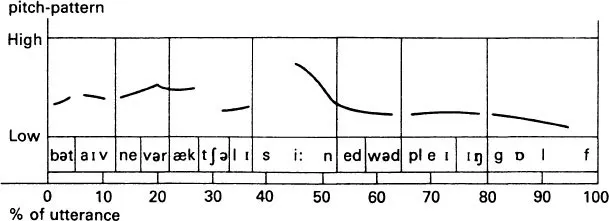
Figure 1.1 The lower half of the diagram shows the relative duration of the syllables of an utterance of sentence 4, while the upper part of the diagram indicates typical pitch movements associated with such an utterance.
This is in strong contrast to the rhythmic principle in languages like French, Hindi, Finnish, Cantonese and Vietnamese, in which syllables occur at approximately equal intervals of time; the rhythm of these languages is often called syllable-timed, for this reason. Speakers of such languages often experience particular difficulty in mastering the rhythm of the languages listed in the previous paragraph.5 Moreover, the imposition of syl...
Table of contents
- Cover
- Half Title
- Title Page
- Copyright Page
- Original Copyright Page
- Dedication
- Table of Contents
- Preface
- 1 Introduction
- 2 Preliminaries
- 3 Stress in Simple Roots
- 4 Suffixes and Stress
- 5 Stress in Compounds
- 6 Prefixes and Stress
- 7 Vowel Quality Changes
- Solutions to Exercises
- Index
Frequently asked questions
Yes, you can cancel anytime from the Subscription tab in your account settings on the Perlego website. Your subscription will stay active until the end of your current billing period. Learn how to cancel your subscription
No, books cannot be downloaded as external files, such as PDFs, for use outside of Perlego. However, you can download books within the Perlego app for offline reading on mobile or tablet. Learn how to download books offline
Perlego offers two plans: Essential and Complete
- Essential is ideal for learners and professionals who enjoy exploring a wide range of subjects. Access the Essential Library with 800,000+ trusted titles and best-sellers across business, personal growth, and the humanities. Includes unlimited reading time and Standard Read Aloud voice.
- Complete: Perfect for advanced learners and researchers needing full, unrestricted access. Unlock 1.5M+ books across hundreds of subjects, including academic and specialized titles. The Complete Plan also includes advanced features like Premium Read Aloud and Research Assistant.
We are an online textbook subscription service, where you can get access to an entire online library for less than the price of a single book per month. With over 1.5 million books across 990+ topics, we’ve got you covered! Learn about our mission
Look out for the read-aloud symbol on your next book to see if you can listen to it. The read-aloud tool reads text aloud for you, highlighting the text as it is being read. You can pause it, speed it up and slow it down. Learn more about Read Aloud
Yes! You can use the Perlego app on both iOS and Android devices to read anytime, anywhere — even offline. Perfect for commutes or when you’re on the go.
Please note we cannot support devices running on iOS 13 and Android 7 or earlier. Learn more about using the app
Please note we cannot support devices running on iOS 13 and Android 7 or earlier. Learn more about using the app
Yes, you can access English Word-Stress by Erik Fudge in PDF and/or ePUB format, as well as other popular books in Languages & Linguistics & Linguistics. We have over 1.5 million books available in our catalogue for you to explore.