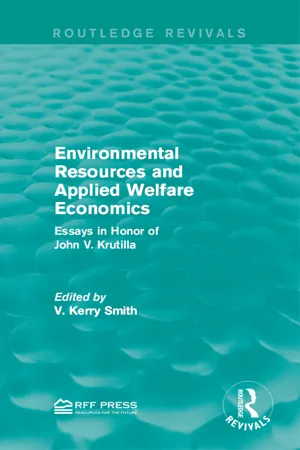
This book, first published in 1988, provides an overview of the diverse work that was being done in applied and theoretical environmental and resource economics. Some essays reflect upon the background of the work of John Krutilla, one of the founders of Resources for the Future and a leading scholar of environmental economics, and the development of the field to date. Other essays examine and convey findings on particular resource problems and theoretical issues and resource policies and the practice of applied welfare economics. This title will be of interest to students of economics and environmental studies.
eBook - ePub
Environmental Resources and Applied Welfare Economics
Essays in Honor of John V. Krutilla
- 294 pages
- English
- ePUB (mobile friendly)
- Available on iOS & Android
eBook - ePub
Environmental Resources and Applied Welfare Economics
Essays in Honor of John V. Krutilla

PART 1
BACKGROUND

THE INFLUENCE OF RESOURCE AND ENVIRONMENTAL PROBLEMS ON APPLIED WELFARE ECONOMICS
An Introductory Essay

This volume was prepared to honor John V. Krutilla, who has helped shape resource and environmental economics in a way and to a degree matched by few economists within their respective fields. His ideas and research accomplishments have been powerful forces in the development of the theory and the practice of economic analysis applied to resource and environmental problems. John’s research career coincides closely with that of Resources for the Future (RFF), which was founded thirty-six years ago, in 1952. Indeed, of his thirty-six years as a resource economist, he has spent thirty-three as a member of the RFF research staff.
One objective of this introduction is to describe a part of John’s influence, specifically, as it is evidenced in relation to the papers in this volume. As a consequence, this is probably a more technical essay than one might expect to find launching a festschrift. The explanation is simple. This is what John would probably prefer if he were given a choice. He would want us to consider his ideas, what they have meant for resource and environmental economics, and what they continue to mean for the research frontiers that lie ahead.
Nonetheless, if this essay communicated only those aspects of his work it would fall short of describing his impact in an important respect. For he also affected the way a large group of economists—including many of the contributors to this volume—select and complete their research.
Three important aspects of that influence on economists who were associated with him on various research projects or who otherwise followed his work should be mentioned: (1) his method of identifying and addressing a research problem; (2) his insistence on the importance of defining future research needs as part of the work of a project; and (3) that attractive quality about his ideas and research which engaged and motivated others in the field.
With regard to the first of these areas, it is significant that, while many economists look primarily to the profession and to professional journals for their ideas and stimulation, John has always gone directly to the set of resource policy problems for his. Simply stated, his strategy is this: identify a problem that matters; develop the theory, methods, and information necessary to address it; and be sure that the analysis and conclusions can be understood by those who might use them to improve resource allocation decisions.
The list of examples of this strategy from his own work is long. For the moment, the mention of three particularly important examples will suffice. The first is Multiple Purpose River Development: Studies in Applied Economic Analysis, which he wrote with Otto Eckstein (Krutilla and Eckstein, 1958). The purpose of the study, which was motivated by the Eisenhower administration’s policy advocating a larger private-sector role in river basin development, was to consider the economic rationale for river basin development and the appropriate mix of private- and public-sector activities in that development. In carrying out that purpose, the work established the theoretical rationale for applied welfare economics and illustrated, in practical terms, how it might be used.
A second example is his work with Robert H. Haveman, Unemployment, Idle Capacity, and the Evaluation of Public Expenditures: National and Regional Analyses (Haveman and Krutilla, 1968). That study likewise set out to solve a particular problem and in the process laid the conceptual and practical foundation for another part of the structure of applied welfare economics as it is known today. The problem addressed in the study is this: the conditions for efficient resource allocation decisions assume that all resources are fully employed, and thus the real resource costs of one allocation can be readily gauged by the available alternative uses for those resources. The idea is fine for the classroom, but how can it work in cases where national or regional underemployment of resources may be more than reflections of short-term adjustments to a new full-employment economy? To solve this problem, the Haveman–Krutilla methodology introduced the concept of shadow prices for taking account of idle resources of manpower and industrial capacity, and it provided a practical means for estimating them. The shadow prices are based on the extent of employment and prospect for storage (thereby acknowledging the need to consider dynamic opportunity costs).
John is probably best known today for identifying the problems in making allocation decisions that involve unique natural environments and wildlife resources. The third example of his research strategy in operation is his pathbreaking article “Conservation Reconsidered” (Krutilla, 1967; reprinted in the appendix in this volume), in which he sought to identify a class of resources requiring a new set of analytical methods because of their special features. The features that he identified are these: in this class the allocation choices are irreversible; one of the uses of such a resource is unique (or at least has few substitutes); there is little or no prospect that its supply will increase over time as a result of expected technological change; individuals do not have to be active consumers to derive satisfaction from the presence of such resources; and frequently there are substantial uncertainties either in the factors affecting consumers’ demands in the future or in the availability of supplies. The applications of this work were discussed somewhat later in his capstone volume, The Economics of Natural Environments: Studies in the Valuation of Commodity and Amenity Resources (Krutilla and Fisher, 1985, rev. ed.), published in 1975. Yet in his original article he structured a generic set of problems and identified some of the methodological advances that would be needed to deal with them.
The litany of examples could continue, but those given illustrate the first aspect of John’s influence on his profession: through the example of his own work he taught a large number of resource economists about the process of planning and doing their research.
A second aspect of his influence reinforces the first: John has maintained that in answering a particular policy question, part of the researcher’s task in preparing a detailed academic response to the original mandate is to define an agenda for the research that must logically follow. When the assumptions matter, he would counsel, find out why and then incorporate the revised conceptual and methodological formulations into the practical guidance necessary for future analyses of similar problems. The case studies in the books just cited illustrate this strategy, of which many papers in this volume are also the products.
A third way in which John’s influence has made itself felt is through the infectious quality of his ideas and through his selection of an agenda of research problems that likewise captured the interest of a large number of young resource economists in the 1960s and 1970s and continue to do so today. Thus, his reach has extended well beyond his own considerable research accomplishments.
There seemed to be no better guide for preparing this introductory essay than John’s own work. Thus, the title and organizing principles underlying this paper, as well as the rest of this volume, can be traced to his presidential address to the Association of Environmental and Resource Economists in 1980 (Krutilla, 1981). In it John provided a carefully woven blend of historical and methodological insights into the evolution of applied welfare economics. His essay offers the reader an insider’s view of the intellectual environment at the time benefit–cost methods emerged as a tool for public policy analysis.
Leading theorists had concluded by the early 1950s that welfare economics had no practical relevance. In his Ph.D. thesis, Welfare Economics and the Theory of the State (the first edition having been published in 1952), Baumol (1967), for example, summed up the views of the time:
So long as we recognize the existence of particular types of interdependence in the results of the activities of our economic units, our analysis is likely to break down completely…. The fact that categories like “external economies” and “external diseconomies” remain largely empty economic boxes prevents any further application of welfare theory as it now stands. (Baumol, 1967, p. 205)
Juxtaposed with this view and continued theoretical laments about the lack of relevance of welfare economics was the “robust progress” that was being made in developing the practical means for dealing with externalities and judging the efficiency effects of specific, small-scale water resource projects. These efforts were clearly not what Baumol expected, according to the minor concession he offered in closing his rather gloomy judgment on the relevance of welfare economics: he noted, in effect, that it probably would not hurt if “practical economists” talked to policymakers.1 Of course, as the preceding quotation implies, he did not hold out much hope that substantive advances in applying welfare economics would result from such consultations.
Writing over a decade later, Baumol dramatically changed his appraisal. In a lengthy introductory essay to the second edition of his thesis (Baumol, 1967), he clearly acknowledged that benefit–cost analysts of the 1950s and 1960s were able to demonstrate
how specific governmental projects can be evaluated in a manner which accords at least roughly with the prescriptions of welfare analysis…. [T]hese writers have also breathed life into many of our welfare constructs even though they have been Jorced to treat some of them rather roughly at times [emphasis added]. (Baumol, 1967, p. 23)
In the discussion that follows, I argue that practitioners of applied welfare economics over the past three decades have not simply used the “well-oiled” theoretical machinery of welfare economics, as Baumol seems to imply. They have advanced it!2 Moreover, the issues raised in evaluations of resource and environmental problems have themselves been at the leading edge of this process.3 Certainly John Krutilla’s work has been a central element in this development throughout the three decades since the publication of his first major work, Multiple Purpose River Development, in 1958.
Like applied welfare economics, part I of this introduction develops its case using both the theoretical and the applied literatures in considering the following issues that have been influenced in important ways by Krutilla’s work: (1) efficient allocation decisions and policy design when externalities are present, (2) the valuation of nonmarketed resources, (3) the selection of a discount rate for public investment decisions, and (4) public management of environmental resources. While these four issues are not entirely independent of one another, they are described separately in this paper for the purpose of identifying some of their primary lines of research. These particular issues were selected because they are especially relevant to the other essays in this volume. Rather than summarizing the individual papers, part I of this introduction discusses the relationship of each to these issues or to the broader inferences one might draw from Krutilla’s research.
Part II highlights areas in which future advances in the theory of applied welfare economics seem likely, based on the shape of today’s resource and environmental problems.
PART I APPLIED WELFARE ECONOMICS: THEORY AND PRACTICE
Applied welfare economics provides the principles for making investment and management decisions that result in efficient resource allocations; these principles apply in cases where the inputs to or outputs from production activities require some form of intervention or supervision by the public sector.4 Therefore, applied welfare economics includes what is conventionally referred to as benefit–cost analysis, as well as the analyses associated with defining the operating and access conditions for production processes or resources under public control or oversight.
A simple definition of efficiency is helpful in explaining the two types of decisions (investment and management) and in organizing the discussion to follow. It suggests that resources should be allocated to their highest-valued uses. For Western, free-market economies, the values used for making such judgments are assumed to be those of private consumers. Thus, while acknowledging that the distribution of income (and wealth) is important to a tangible realization of consumer sovereignty in the form of the monetary values placed on goods and services, the analysis generally proceeds by accepting a particular distribution of income (usually the status quo) and gauging the efficiency implications of a specified array of actions.
An examination of the distributional implications of the actions is often supplementary information, developed independently of any judgments about efficiency. Much of the literature in the 1960s viewed the focus on efficiency as being a serious limitation in the application of benefit–cost analysis in the United States. Maass (1966), for example, contended that the true objective of most public spending was redistribution of income, not improving the efficiency in the existing resource allocation. The statement by Maass and related work in this area require additional comment.
In the 1950s and 1960s most benefit–cost analyses were evaluations of public spending projects. Consequently, discussions of the implications of accepting the Kaldor–Hicks criterion for potential compensation of losers (where public actions impose both gains and losses) were routinely arguments over equity goals and about whether it was appropriate to specify in advance a “trade-off ratio” or set of weights for efficiency and equity goals.5 Implicitly, the gains and losses were viewed as being associated with specific income groups. With the perspective that only an “insider” can offer, Allen V. Kneese, in the next paper in this volume, provides additional insight into the evolution of research on the most important component of the public investment projects of those early years—the water projects.
Today, the focus of the distributional analysis differs depending on the type of public action being evaluated; regulations imposed on private-sector activities are now analyzed at least as frequently as are public spending projects. For the latter, the incidence of distributional effects by region, by sector, or by some other aggregative criterion is often reasonably clear from the definition of the particular project, so the focus is on the groups in the region that will gain. By contrast, in the case of regulatory actions, the legislation defining the programs often deliberately impedes a priori appraisal of regional effects (see Zeckhauser [1981]), so the focus of distributional analyses is the region or sector of impact. Neither approach should be interpreted as an effort to gauge the shortcomings of the Kaldor–Hicks standard relative to some theoretical ideal. Instead, they identify impacts that have political significance for the respective types of decision.
Investment decisions and management decisions use quite different methods of implementing a practical version of the efficiency criteria (i.e., one based on the Kaldor–Hicks concepts). As a result, the two types of decision have different connections to welfare theory as well as different ways of advancing it. As a rule, benefit–cost analysis involves an evaluation of whether the departure from the existing resource allocation implied by a specific (usually small) project6 would yield a greater increment to aggregate benefits than to aggregate costs. It signals opportunities for improvement. (Otherwise, if the existing resource allocation were efficient, there would not be positive net benefits.7) Thus, the connection of an investment decision to a theoretical description of the conditions for...
Table of contents
- Cover
- Half Title
- Title Page
- Copyright Page
- Original Copyright Page
- Table of Contents
- Foreword
- Preface and Acknowledgments
- PART I Background
- PART 2 Resource Problems and Theoretical Issues in Applied Welfare Economics
- PART 3 Resource Policies and the Practice of Applied Welfare Economics
- Appendix: “Conservation Reconsidered,” by John V. Krutilla
- The Works of John V. Krutilla: A Bibliographic Profile
- Index
Trusted by 375,005 students
Access to over 1.5 million titles for a fair monthly price.
Study more efficiently using our study tools.
Frequently asked questions
Yes, you can cancel anytime from the Subscription tab in your account settings on the Perlego website. Your subscription will stay active until the end of your current billing period. Learn how to cancel your subscription
No, books cannot be downloaded as external files, such as PDFs, for use outside of Perlego. However, you can download books within the Perlego app for offline reading on mobile or tablet. Learn how to download books offline
Perlego offers two plans: Essential and Complete
- Essential is ideal for learners and professionals who enjoy exploring a wide range of subjects. Access the Essential Library with 800,000+ trusted titles and best-sellers across business, personal growth, and the humanities. Includes unlimited reading time and Standard Read Aloud voice.
- Complete: Perfect for advanced learners and researchers needing full, unrestricted access. Unlock 1.5M+ books across hundreds of subjects, including academic and specialized titles. The Complete Plan also includes advanced features like Premium Read Aloud and Research Assistant.
We are an online textbook subscription service, where you can get access to an entire online library for less than the price of a single book per month. With over 1.5 million books across 990+ topics, we’ve got you covered! Learn about our mission
Look out for the read-aloud symbol on your next book to see if you can listen to it. The read-aloud tool reads text aloud for you, highlighting the text as it is being read. You can pause it, speed it up and slow it down. Learn more about Read Aloud
Yes! You can use the Perlego app on both iOS and Android devices to read anytime, anywhere — even offline. Perfect for commutes or when you’re on the go.
Please note we cannot support devices running on iOS 13 and Android 7 or earlier. Learn more about using the app
Please note we cannot support devices running on iOS 13 and Android 7 or earlier. Learn more about using the app
Yes, you can access Environmental Resources and Applied Welfare Economics by V. Kerry Smith in PDF and/or ePUB format, as well as other popular books in Economics & Environmental Economics. We have over 1.5 million books available in our catalogue for you to explore.