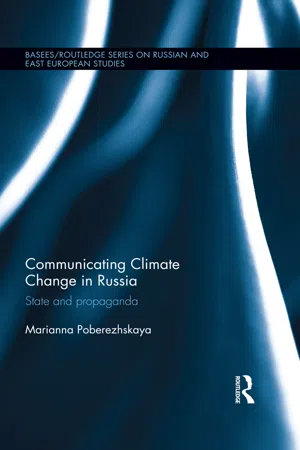
The attitude of Russia towards climate change is extremely important for the success of climate change control policies worldwide, as Russia, with its cold climate and vast resources of carbon fuels, is one of the world's biggest polluters. Moreover, Russia frequently comes across as not being very interested in containing environmental pollution. This book explores how issues to do with climate change are handled by the Russian media. It discusses how the state and economic elites have influenced Russia's environmental communication, with the state's control of the media strengthening since Putin came to power, and with control being exercised in some cases by ignoring or silencing the key issues. However, the book also shows how, recently, elites and the state in Russia have begun to realise that it is in the state's best interest to pursue more climate-oriented policies. The book concludes by examining how the communication of climate change issues in Russia could be improved and by assessing the extent to which a recent change in state climate policy could mean that media coverage of climate change in Russia will keep increasing.
- 168 pages
- English
- ePUB (mobile friendly)
- Available on iOS & Android
eBook - ePub
About this book
Information
BASEES/Routledge Series on Russian and East European Studies
Series editor: Richard Sakwa
Department of Politics and International Relations, University of Kent
Editorial Committee:
Roy Allison, St Antony’s College, Oxford
Birgit Beumers, Department of Theatre, Film and Television Studies, University of Aberystwyth
Richard Connolly, Centre for Russian and East European Studies, University of Birmingham
Terry Cox, Department of Central and East European Studies, University of Glasgow
Peter Duncan, School of Slavonic and East European Studies, University College London
Zoe Knox, School of History, University of Leicester
Rosalind Marsh, Department of European Studies and Modern Languages, University of Bath
David Moon, Department of History, University of York
Hilary Pilkington, Department of Sociology, University of Manchester
Graham Timmins, Department of Politics, University of Birmingham
Stephen White, Department of Politics, University of Glasgow
Founding Editorial Committee Member:
George Blazyca, Centre for Contemporary European Studies, University of Paisley
This series is published on behalf of BASEES (the British Association for Slavonic and East European Studies). The series comprises original, high-quality, research-level work by both new and established scholars on all aspects of Russian, Soviet, post-Soviet and East European Studies in humanities and social science subjects.
- Ukraine’s Foreign and Security Policy, 1991–2000 Roman Wolczuk
- Political Parties in the Russian Regions Derek S. Hutcheson
- Local Communities and Post-Communist Transformation Edited by Simon Smith
- Repression and Resistance in Communist Europe J.C. Sharman
- Political Elites and the New Russia Anton Steen
- Dostoevsky and the Idea of Russianness Sarah Hudspith
- Performing Russia – Folk Revival and Russian Identity Laura J. Olson
- Russian Transformations Edited by Leo McCann
- Soviet Music and Society under Lenin and Stalin The baton and sickleEdited by Neil Edmunds
- State Building in Ukraine The Ukrainian parliament, 1990–2003Sarah Whitmore
- Defending Human Rights in Russia Sergei Kovalyov, dissident and Human Rights Commissioner, 1969–2003Emma Gilligan
- Small-Town Russia Postcommunist livelihoods and identities: a portrait of the Intelligentsia in Achit, Bednodemyanovsk and Zubtsov, 1999–2000Anne White
- Russian Society and the Orthodox Church Religion in Russia after CommunismZoe Knox
- Russian Literary Culture in the Camera Age The word as imageStephen Hutchings
- Between Stalin and Hitler Class war and race war on the Dvina, 1940–46Geoffrey Swain
- Literature in Post-Communist Russia and Eastern Europe The Russian, Czech and Slovak fiction of the changes, 1988–98Rajendra A. Chitnis
- The Legacy of Soviet Dissent Dissidents, democratisation and radical nationalism in RussiaRobert Horvath
- Russian and Soviet Film Adaptations of Literature, 1900–2001 Screening the wordEdited by Stephen Hutchings and Anat Vernitski
- Russia as a Great Power Dimensions of security under PutinEdited by Jakob Hedenskog, Vilhelm Konnander, Bertil Nygren, Ingmar Oldberg and Christer Pursiainen
- Katyn and the Soviet Massacre of 1940 Truth, justice and memoryGeorge Sanford
- Conscience, Dissent and Reform in Soviet Russia Philip Boobbyer
- The Limits of Russian Democratisation Emergency powers and states of emergencyAlexander N. Domrin
- The Dilemmas of Destalinisation A social and cultural history of reform in the Khrushchev eraEdited by Polly Jones
- News Media and Power in Russia Olessia Koltsova
- Post-Soviet Civil Society Democratization in Russia and the Baltic StatesAnders Uhlin
- The Collapse of Communist Power in Poland Jacqueline Hayden
- Television, Democracy and Elections in Russia Sarah Oates
- Russian Constitutionalism Historical and contemporary developmentAndrey N. Medushevsky
- Late Stalinist Russia Society between reconstruction and reinventionEdited by Juliane Fürst
- The Transformation of Urban Space in Post-Soviet Russia Konstantin Axenov, Isolde Brade and Evgenij Bondarchuk
- Western Intellectuals and the Soviet Union, 1920–40 From Red Square to the Left BankLudmila Stern
- The Germans of the Soviet Union Irina Mukhina
- Re-constructing the Post-Soviet Industrial Region The Donbas in transitionEdited by Adam Swain
- Chechnya – Russia’s “War on Terror” ...
Table of contents
- Cover Page
- Half Title Page
- Frontmatter 1
- Title Page
- Copyright Page
- Dedication
- Table of Contents
- Illustrations
- Abbreviations
- Note on transliteration
- Acknowledgements
- Introduction
- 1 Mass media and climate change: its role, challenges and trends
- 2 The political economy of Russian mass media: state and market
- 3 Russian climate change policy: towards ‘climate pragmatism’
- 4 Russian newspapers and climate change
- 5 Mediating climate change in Russia: passing through the barriers
- 6 Conclusion
- Appendix
- Index
Trusted by 375,005 students
Access to over 1.5 million titles for a fair monthly price.
Study more efficiently using our study tools.
Frequently asked questions
Yes, you can cancel anytime from the Subscription tab in your account settings on the Perlego website. Your subscription will stay active until the end of your current billing period. Learn how to cancel your subscription
No, books cannot be downloaded as external files, such as PDFs, for use outside of Perlego. However, you can download books within the Perlego app for offline reading on mobile or tablet. Learn how to download books offline
Perlego offers two plans: Essential and Complete
- Essential is ideal for learners and professionals who enjoy exploring a wide range of subjects. Access the Essential Library with 800,000+ trusted titles and best-sellers across business, personal growth, and the humanities. Includes unlimited reading time and Standard Read Aloud voice.
- Complete: Perfect for advanced learners and researchers needing full, unrestricted access. Unlock 1.5M+ books across hundreds of subjects, including academic and specialized titles. The Complete Plan also includes advanced features like Premium Read Aloud and Research Assistant.
We are an online textbook subscription service, where you can get access to an entire online library for less than the price of a single book per month. With over 1.5 million books across 990+ topics, we’ve got you covered! Learn about our mission
Look out for the read-aloud symbol on your next book to see if you can listen to it. The read-aloud tool reads text aloud for you, highlighting the text as it is being read. You can pause it, speed it up and slow it down. Learn more about Read Aloud
Yes! You can use the Perlego app on both iOS and Android devices to read anytime, anywhere — even offline. Perfect for commutes or when you’re on the go.
Please note we cannot support devices running on iOS 13 and Android 7 or earlier. Learn more about using the app
Please note we cannot support devices running on iOS 13 and Android 7 or earlier. Learn more about using the app
Yes, you can access Communicating Climate Change in Russia by Marianna Poberezhskaya in PDF and/or ePUB format, as well as other popular books in Social Sciences & Ethnic Studies. We have over 1.5 million books available in our catalogue for you to explore.